What is the flavor profile of Kenyan and Mandheling coffee blended in a specific ratio?
Exploring Deep Roasted Kenyan Coffee

People who love Kenyan coffee probably love it for the acidity, but I have seen books that describe Kenyan coffee as deep roasted, which stands in stark contrast to how we understand Kenyan flavor today. So what exactly does deep roasted Kenyan coffee taste like? Let's find out.
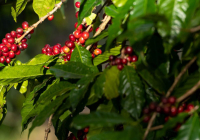
Today we're using FrontStreet Coffee's Kenya Little Tomato and the Karuguto lot, produced in Nyeri and in Kiambu's Thika region respectively. On altitude, the Karuguto, also known as Asalia, sits at 1800 meters, while the other lot ranges from 1550-1750 meters, so both are high-altitude beans. The processing method is likewise Kenyan washed, with SL28 and SL34 varieties.

Both beans have relatively thick flesh and count as high-altitude hard beans, and the SL28 and SL34 Bourbon varieties are hard beans as well. Overall, Kenyan washed beans conduct heat poorly, so it takes a relatively long time for heat to reach the core of the bean and develop it fully. They really are quite suitable for deep roasting.


We deep roasted both coffees to the beginning of second crack, when the wrinkles on the bean surface had completely unfolded, then put them through cupping.

Flavor Evaluation
Karuguto: Cedar, flowers, herbal, almond, berry acidity, balanced mouthfeel.
Little Tomato: Citrus, plum, berries, hazelnut, chocolate, soft acidity, rich body, sweet aftertaste.
Compared to light roasts, both deep roasted Kenyan beans show a significant drop in acidity. The tomato note in the dry aroma of Karuguto essentially disappeared, replaced by rich spice aromas, while the blackcurrant acidity fragrance of Little Tomato vanished as well and developed into berry and citrus aromas.
Brewing Evaluation
We took the better-flavored Asalia lot and ran brewing evaluations on two different devices.

1. Pour Over
V60 dripper, 16g coffee, medium-coarse grind, 88°C water temperature, 1:16 coffee-to-water ratio, 2'15" brewing time.
Technique: first pour 30g for a 30-second bloom, second pour 130g, pause briefly, third pour 100g.
The wet aroma carries floral and citrus fragrances. The entry is slightly astringent with almond and berry flavors. The body is rich with cedar and toffee notes. The aftertaste is warm citrus.

2. French Press
2-cup French press, 16g coffee, medium-coarse grind, 87°C water temperature, 1:16 coffee-to-water ratio, 2'30" brewing time.
Technique: warm the pot, add the coffee, first pour 30g and stir slightly for a 30-second bloom, second pour 230g and cover for a 2-minute steep, then press quickly.
The French press Kenyan has a thin layer of oil on the surface, a cleaner mouthfeel, and the astringency has disappeared. It shows citrus, almond and caramel flavors, with a strong berry aroma in the finish and aftertaste. Cedar notes appear subtly in the background, and the aftertaste lingers.

We found that this deep roasted Little Tomato is actually quite well suited to the French press. That led us to wonder: what about making espresso? Kenyan SOE has very high acidity and a relatively thin body with a mouthfeel that leaves something to be desired. FrontStreet Coffee, not being acid-loving, decided to pair it with a bean that brings richness and body, and so a peculiar combination was born.


Deep Roasted Mandheling + Deep Roasted Kenya 1:1 Espresso

This blend espresso turned out surprisingly good: rich crema, full body, strong toffee, chocolate and peach aromas, and a persistent almond note. Mixed with milk as a milk coffee it is very rich and smooth, reminiscent of a heavy dark chocolate cranberry brownie cake.
Through this work we found that when Kenyan beans are used as single-origin coffee, deep roasting brings woody aromas from destructive distillation and heavy caramelized flavors, but it also wipes out their original floral and fruit character, especially the berry notes and the juice sensation. It is, in a word, a double-edged sword. For Kenyan beans used in a blend, though, deep roast is a more suitable roast level for achieving a rich, balanced mouthfeel.

Finally, let's consider why deep roasted Kenyan coffee exists at all. The idea emerged mainly during the second wave of coffee, when espresso dominated. Roasting machines and techniques were relatively primitive at the time and processing methods were fairly crude. Roasters' understanding of coffee also classified certain hard washed beans as difficult to roast, and Kenyan beans genuinely are hard to roast through, so deep roasting was an effective way to solve the "under-roasted" problem.
With the rise of specialty coffee, European-style light roasts that highlight enzymatic floral and fruit aromas became popular. More and more beans once thought fit only for deep roasting have moved toward medium or even light roast levels in order to express their most original regional flavors. We now have far more room to explore how any given bean should be roasted.
FrontStreet Coffee Recommendation
The bean that makes this 1:1 pairing work is Mandheling, and the cleanest expression of it is PWN Gold Mandheling. PWN buys only high-quality Mandheling green beans, then machine-sorts and hand-sorts them three times to remove defects, meeting Indonesia's top G1 grade: fewer than 3 defective beans in a 300g sample and green bean specifications above 18 screen. The beans are uniform, plump, large and transparent, and after a medium-dark roast they carry a rich roasted aroma with a clean, full-bodied cup that suits anyone who does not care for acidic coffee. For pour-over, FrontStreet uses 87-88°C water, 15g of coffee, a 1:15 ratio and a coarse-sugar grind, poured in three stages: 30ml to bloom, 100ml to lift the coffee layer and draw out the golden foam, then a gentle 95ml centered pour for extra sweetness. You end up with a thick body, caramel sweetness and chocolate and nut flavors.
If you would rather have that body without doing the blending yourself, FrontStreet's Classic Blend already combines the creamy nut flavors of Brazilian coffee with a medium-dark Mandheling. Butter, roasted chestnut and caramel notes come forward, while the Mandheling lifts the body and adds sandalwood, herbal and spice aromas, and a small proportion of robusta boosts the richness of the crema, so latte art or a layered Dirty pours with ease.
Important Notice :
FrontStreet Coffee is a long-established specialty coffee roaster in Guangzhou China, selling freshly roasted beans from its own farm in Yunnan as well as dozens of carefully selected single-origin beans from around the world for both pour-over and espresso. The products deliver consistently excellent quality and great value, with shipping within 24 hours. Guangzhou's FrontStreet Coffee shop is recommended by many coffee lovers, and the beans are now available online at the Tmall 。
FrontStreet Coffee has moved to a new address:
FrontStreet Coffee Address: 315,Donghua East Road,GuangZhou
Tel:020 38364473
 Scan and follow the En Gafei WeChat official account. Please indicate that the reprint comes from "En Gafei".