Costa Rica's Most Renowned Tarrazu Dota Region: Home to Micro-batch Geisha Varietals
Gesha or Geisha: What's the Difference?
They are the same coffee. The name simply comes from the Japanese word "geisha."
Which Variety Does Gesha Belong To?
Hacienda La Esmeralda in Panama normally sorts its Gesha into three grade tiers: Red Label, Green Label, and Blue Label. Some Red Label lots are the estate's own competition lots, while others are lots the estate sells directly, including natural and washed coffees that appear at auction.
Quality control at La Esmeralda starts with the way pickers are trained and paid. The estate offers pickers higher fees and insists that only fully ripe, vivid red cherries are harvested.
During preparation, every lot is inspected for rotten or underripe beans. A great deal of time goes into the fine details and into studying how to build a pleasing mouthfeel, and that is what sets La Esmeralda apart from coffee producers around the world.
Our newest Gesha is the Esmeralda Special from Hacienda La Esmeralda, often called competition Gesha or the competition lot (Special-Geisha). It represents the estate's premium selected lots, all grown above 1,550 meters (some above 1,900 meters), with cupping scores above 90 points.
La Esmeralda is a deeply experimental estate. By comparing 400 coffee varieties and running sample processing and cupping every year, they identify the varieties that cup best (this is how Gesha was found). These innovative experimental lots cannot be found even at auction.
Esmeralda Red Label Has Three Defining Traits:
1. Strong traceability: every lot can be traced back to its picking date, specific plot, and the age of the trees in that plot.
2. Altitude: all lots sit above 1,600 meters, and some exceed 1,900 meters.
3. Cupping score: a lot must reach 90 points or higher (SCAA standard) to be called Red Label.
In 1931, a group of botanists mounted an expedition through southern Ethiopia and came across the Gesha variety near Gesha village. The trees were notably tall and their seeds larger than those of typical Ethiopian beans. The seeds were carried to Kenya and raised in nurseries. After five years, fruit was taken from the healthiest specimens and brought to Uganda and Tanzania. In 1953, the Costa Rican research institute CATIE obtained some of those seeds from Tanzania for study.
The person who first brought Gesha from Costa Rica to Panama was Pachi Serracin, then owner of Don Pachi Estate, in 1963. Gesha was unpopular in Panama at first because of its low yield and poor returns, and it was often blended with other varieties for sale. Many estates had a few Gesha trees, some even using them as windbreaks in the coffee fields. It was not until after 2000 that the Petersons of La Esmeralda recognized Gesha's captivating flavor, so unusual that they wondered whether consumers would accept it.
In the 2003 Best of Panama, La Esmeralda took first place with its Gesha, and the powerful, complex flavors astonished every judge. Over the following decade, Gesha was unstoppable in green bean competitions, and growers across Central and South America eagerly followed suit, planting Gesha in Costa Rica, Bolivia, Colombia, and beyond. Although their flavors still trailed Panama's, Gesha had become the golden bean that nobody wanted to miss.
Some also hoped to trace Gesha back to its origins, organizing several expeditions deep into the primary forests of southwestern Ethiopia, but in the end it was generally agreed that Panama remained the world's best Gesha-producing region. Different processing methods also gave Gesha different flavors, moving from the earliest washed processing to later natural and honey processing, each becoming more detailed and complex.
So how does Gesha Village differ from typical Ethiopian estates? What do OMA and SURMA in lot numbers refer to? What do numbers like 51, 72, and 59 mean? And how do Gesha 1931 and Gori Gesha differ?
Estate Background
Adam Overton and Samuel Rachel began planting Ethiopian Gesha across nearly 500 hectares at Gesha Village in 2011, with a single goal: to produce the world's best coffee. Starting in 2008, after three years of searching, they finally found a suitable environment for coffee in a tropical rainforest at 1,900-2,100 meters, with a fitting climate, fertile forest soil, and historic woodland.
Gesha Village Coffee Estate covers a total area of 471 hectares. By 2015 the estate had planted 300 hectares of coffee, adding another 50 hectares in 2016. The Gesha selection came from the native coffee forest Gori Gesha, 20 kilometers from the estate, which is also the source of the Panama Gesha variety. Guided and supported by Willem Boot, the "Godfather of Gesha," Gesha Village's coffee has achieved outstanding results in world competitions.
Exceptional Traceability and Tight Quality Control
Unlike most Ethiopian coffees, which must be exported through ECX (Ethiopia Commodity Exchange) or cooperatives, Gesha Village Coffee Estate, at nearly 500 hectares, can operate as a single estate with independent processing and export. As a result, it offers traceability that other Ethiopian green beans cannot match.
Every lot of green beans can be traced to specific plots, varieties, tree ages, picking dates, and the length of natural or washed processing, effectively guaranteeing transparency and quality control at every stage.
How Do Gori Gesha and Gesha 1931 Differ?
Gori Gesha and Gesha 1931 are both names of planted varieties.
Gesha Village grows three varieties: Gori Gesha, Gesha 1931, and Illubabor Forest. The first two are both Gesha varieties, while Illubabor Forest is a disease-resistant variety supplied by the Ethiopian research institute.
Gori Gesha is the Gesha variety from the wild coffee forest Gori Gesha near the estate. It embraces the genetic diversity of Gesha and takes its name from that forest.
Gesha 1931 was selected from among many Gesha varieties in the Gori Gesha forest as the one closest to Panama Gesha. The selection was based on plant morphology, bean appearance, and cupping results. It was named Gesha 1931 because 1931 was also the year the Gesha variety was discovered in Ethiopia.
What Do OMA and SURMA Stand For?
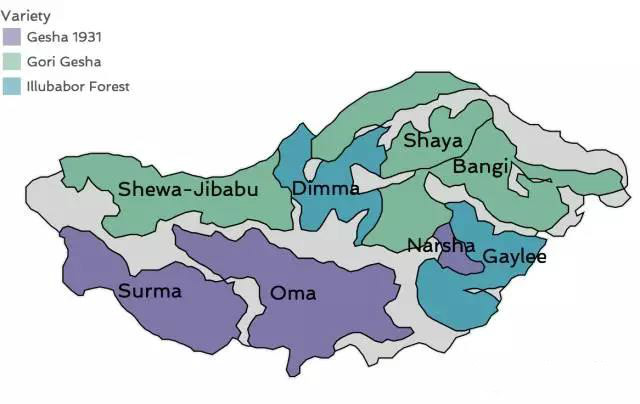
The estate divides its nearly 500 hectares into plots according to variety and microclimate (as shown in the image below):
The variety distribution is therefore as follows:
Planted with Gori Gesha: Shewa-Jibabu; Shaya, Bangi
Planted with Gesha 1931: Surma; Oma; Narsha
Planted with Illubabor Forest: Dimma; Gaylee
What Do the Numbers in Lot Names Mean?
Now let's look specifically at Gesha Village's traceability.
Gesha Village 2016-2017 partial lot picking date data (image: Gesha Village competition materials)
Take the natural lot from the OMA plot used by Japanese champion Takayuki Ishiya for competition as an example (see the image above). This plot grows the Gesha 1931 variety, and it is divided internally into five natural lots: 51, 72, 77, 86, and 90. The closer the areas, the more similar their maturity and picking periods. In addition, OMA#27 is a washed lot from this plot (space is limited, so it does not appear in the image above). Takayuki Ishiya's competition bean is the OMA#51 competition lot, and Grand Cru Coffee ordered one lot from the same batch as OMA#72.
After repeated cupping and screening, Grand Cru Coffee selected three distinct natural lots and bought them separately. The first batch, Surma#85 and Shewa-Jibabu#59, has sold out; the second replenishment batch of the same Shewa-Jibabu#59 and the same Oma#72 is now in stock.
Specific Cupping Flavors:
1. Shewa-Jibabu#59 same batch (Gori Gesha)
This lot has prominent sweetness, with clear strawberry, honey peach, and papaya flavors and delicate floral aromas, plus a cream-like, thick mouthfeel;
2. Oma#72 same batch (Gesha 1931)
This lot has candied fruit flavors, strong floral aromas, and high complexity;
Both Gesha lots above use natural processing. First, floating impurities are removed, then the cherries are covered with film and plastic sheeting on African-style raised beds for natural drying, with a total drying time of 18-30 days.
FrontStreet Coffee · Ethiopia Gesha Village Natural Gesha
(Gesha Village Coffee Estate Gesha Natural)
Variety: Gesha (Gori Gesha)
Processing Method: Natural
Season: 2017 New Season
Flavor Description: Strawberry, honey peach, papaya, floral notes, cream-like, thick

FrontStreet Coffee · Panama La Esmeralda 2017 Season Red Label Geisha Competition Washed Processing
Panama Geisha Hacienda La Esmeralda
Country: Panama
Grade: Red Label
Region: Boquete
Roast Level: Light Roast
Processing Method: Washed
Variety: Gesha
Estate: La Esmeralda
Flavor: Lychee, peach, sweet potato
FrontStreet Coffee · Costa Rica Diosa Geisha
The Dota region, within Costa Rica's most famous Tarrazu area, is known specifically for producing micro-lot Geisha varieties. As early as 1865, Dota already enjoyed a reputation for fine Costa Rican coffee. Because the capital's highway ran through the Tarrazu district to reach the Dota valley, Costa Rica's coffee authority habitually labels production areas as Dota Tarrazu. The region is classic highland terrain, with soil, temperature, and humidity that make it an excellent choice for coffee growing.
Diosa Estate was established in the 1960s. It farms organically, using native trees and fruit trees as shade for the coffee. The fertilizer is a blend of coffee cherry pulp and molasses, added to mineral-rich soil from nearby mountains and fermented with microorganisms to create an organic fertilizer that strengthens the plants' disease resistance. They also habitually use California earthworms to build up the soil, supplying it directly as the main nutrient source for the coffee trees during fertilization while interplanting several coffee varieties. They uniformly source and select fully ripe red-purple cherries and broadly control the soaking fermentation, developing a very distinctive constant-temperature processing method. The fermentation degree, neither too much nor too little, strikes an excellent balance between clarity and complexity, making the flavor more stable and drawing out Geisha's special flavors strand by strand, truly intoxicating.
Dota E1 Diosa Geisha
Origin: Costa Rica
Region: Tarrazu
Variety: Geisha
Altitude: 1800 meters
Soil: Volcanic soil
Grade: SHB
Processing Method: Washed
Harvest: Hand-picked
Flavor:
[Dry Aroma] Tea fragrance, orange, plum fruit, cranberry, floral notes, vanilla, almond
[Wet Aroma] Floral notes, chocolate, vanilla, bright malic acid, cranberry
Flavor Characteristics: Lemon and citrus series aroma, gentle grapefruit fruit acidity and fruity sugar sweetness, medium body, clean and smooth mouthfeel
FrontStreet Coffee Recommendation
If this article has you curious about the flavors that made Gesha famous, the most direct way to explore them is through Panama. FrontStreet Coffee's Panama Boquete Gesha is an estate-grade entry point to the variety: grown at 1,600 meters on fertile volcanic ash soil, it shows the jasmine, green tea, honey, and orange notes that define the classic Panama profile. For the full experience, FrontStreet Coffee's Esmeralda Red Label Gesha is drawn from a single plot above 1,700 meters and cups with the refined citrus-honey richness that La Esmeralda is known for, while the Esmeralda Green Label Gesha blends several plots into the estate's signature high-altitude character at a friendlier price.
Because this article also visits Costa Rica's Dota region, FrontStreet Coffee's Strawberry Candy Gesha blend is a natural companion. It pairs Panama Gesha with a Costa Rican honey-processed coffee, so the cup carries both the delicate rose-and-orange side of Gesha and the grape, blueberry, and strawberry-fudge sweetness of the honey process. It is easy to pour over and equally at home as espresso or cold brew.
Important Notice :
FrontStreet Coffee is a long-established specialty coffee roaster in Guangzhou China, selling freshly roasted beans from its own farm in Yunnan as well as dozens of carefully selected single-origin beans from around the world for both pour-over and espresso. The products deliver consistently excellent quality and great value, with shipping within 24 hours. Guangzhou's FrontStreet Coffee shop is recommended by many coffee lovers, and the beans are now available online at the Tmall 。
FrontStreet Coffee has moved to a new address:
FrontStreet Coffee Address: 315,Donghua East Road,GuangZhou
Tel:020 38364473
 Scan and follow the En Gafei WeChat official account. Please indicate that the reprint comes from "En Gafei".