What's the Difference Between Geisha and Gesha? Understanding La Esmeralda's Red, Green Labels and Geisha Village's Red, Green Labels

Introduction to Geisha Village Coffee
Ask any coffee lover to picture a Gesha, and what comes to mind first is almost certainly the Gesha from Panama's Hacienda La Esmeralda, whose lots have defined the variety's signature flavor. But today FrontStreet Coffee wants to talk about a different Gesha -- Geisha Village coffee from Ethiopia, the birthplace of the variety itself.
Geisha Village sits in Ethiopia's Benshanguel-Gumuz region, in coffee's original homeland. Its founders are Adam Overton and his wife Rachel Samuel, who, guided by Willem Boot, owner of the Mule Estate, tracked down wild Gesha in the Gori Gesha forest. Seeds carefully collected from that forest were then planted in Geisha Village.

Geisha Village's Coffee Grading System
Like Panama's Gesha estates, Geisha Village runs a strict grading system. Hacienda La Esmeralda divides its Gesha mainly into Red Label, Green Label, and Blue Label -- but Geisha Village goes a step further. As FrontStreet Coffee understands it, its Gesha is generally divided into Auction Lots, Gold Label RARITIES, Red Label GROWERS RESERVE, Green Label SINGLE-TERROIR, and the Chaka (CHAKA) batch, with further distinctions by variety.
Within the past month or two, FrontStreet Coffee has acquired both the natural-processed Green Label from Hacienda La Esmeralda and the Green Label from Geisha Village. Which tastes better? We were just as curious as everyone else about how this year's two coffees differ, so we set out to compare them through both cupping and pour-over brewing.

Cupping Geisha Village Green Label
First up: the Green Label from the Benji plot of Geisha Village. The variety here is Gori Gesha, the Gesha line planted in Geisha Village, and the coffee is natural processed.

FrontStreet Coffee's standard cupping procedure: grind the natural Green Label beans -- we use 11.3 grams per cup, with water at approximately 94°C. Even while grinding, the dry fragrance of the grounds is noticeable, and this Green Label Gori Gesha showed distinct berry notes in its dry aroma. Pour in the hot water and start a four-minute timer; at this stage the wet aroma reads like ripe fruit. At exactly four minutes, break the crust by stirring the cupping spoon in the same direction three times, gently pushing the floating grounds aside. The wet aroma grows even stronger after the break. Skim off the remaining grounds with the spoon, and the tasting can begin.

Although Geisha Village's Green Label is not held to the cupping-score requirements applied to its Red Label and Gold Label, it comes from a single plot and a single variety at Geisha Village Estate, and every batch number carries full traceability -- farm plot name, variety, and processing date. Quality is therefore well assured. As for the exact flavors, we'll save those for the side-by-side at the end.

Cupping Hacienda La Esmeralda Green Label
Next, the Green Label from Hacienda La Esmeralda, cupped with the same procedure. Both its dry and wet aromas carry intense florals, with the wet aroma even more pronounced. From here, we moved on to brewing both Green Labels with a three-stage pour-over -- but first, a word about roast levels.
The Geisha Village Green Label FrontStreet Coffee carries is entirely natural processed: floaters and debris are removed first, then the cherries are spread in thin layers on plastic-covered African raised beds to dry. During drying they are screened again to pick out insect-damaged and underripe green beans, with total drying time of 18-30 days. Because natural processing brings obvious sweetness, gentle acidity, and complex fruit, FrontStreet Coffee roasts the Geisha Village Gesha to a medium-light level to highlight the florals and fruity sweetness that the natural process delivers.
For Panama's Green Label Gesha, FrontStreet Coffee generally roasts lighter to showcase Hacienda La Esmeralda's signature Gesha character. Brewing is handled just as carefully: 90°C water, 15 grams of coffee per serving, a 1:15 ratio, and a segmented pour -- 30 g of water for the bloom, then a small, circular stream up to 125 g; when the water level drops to expose the coffee bed, pour on to 225 g, stop, and lift off the dripper.

Tasting Comparison and Conclusion
Now for the tasting. FrontStreet Coffee found Hacienda La Esmeralda's Green Label remarkably clear, with a smooth mouthfeel and a moderate aftertaste; the natural processing lends it intense jasmine florals, and as it cools it develops something like a honeyed texture. Geisha Village's Green Label carries more acidity -- something like Kenyan berry acidity -- with a full, rich body, honeyed sweetness in the finish, and a whisper of fermented, winey aroma.

The verdict: Panamanian Gesha matches most people's mental image of what Gesha should be, while Geisha Village's coffee is equally excellent but leans toward stone-fruit flavors and higher sweetness, with Panama emphasizing delicate florals and tea-like qualities. And since Ethiopia's Geisha Village sits at a higher altitude than Panama's Gesha farms, its conditions are even more favorable for flavor accumulation.
FrontStreet Coffee Recommendation
There is a reason Gesha prices keep climbing: the variety's unmistakable floral aromatics and superb sweet-sour balance won over the coffee world even as its low yields, weak disease resistance, and demanding cultivation kept supply thin. Knowing the landscape helps you find a Gesha that tastes wonderful without costing a fortune. On the Panama side, Hacienda La Esmeralda -- the estate that made the variety famous, after its Gesha stunned judges at the Best of Panama competition with an average cupping score of 94.6, a competition record -- splits its line into two tiers. The Red Label (officially "Esmeralda Special") grows at 1,600-1,800 meters, must score above 90 points in cupping, and each numbered batch comes entirely from one small plot (FrontStreet Coffee's Red Label, for example, comes from the Harimiyu plot). The Green Label ("Private Collection") blends batches from multiple plots to express the estate's signature high-altitude Gesha profile, at a friendlier price -- excellent value. For a first taste of "the Gesha flavor" itself, FrontStreet Coffee recommends the entry-level FrontStreet Boquete Gesha: classic Panamanian orange blossom and honeyed sweetness, oolong-tea-like character, delicate fruit acidity, and clear layering, all at an accessible price.
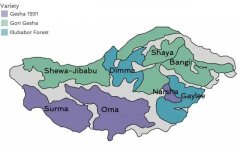
On the Ethiopian side, Geisha Village Estate -- founded by a couple 12 miles from the Gesha forest on 475 hectares, planted with the variety that most closely matches the wild original -- grades its coffee even more finely. The estate grows three Gesha varieties (Gori Gesha, Gesha 1931, and Illubabor Forest) and ranks them as Gold Label RARITIES, Red Label GROWERS RESERVE, Green Label SINGLE-TERROIR, and the Chaka batch. The Gold Label, a Gesha 1931 refined-natural lot making up 10% of the estate's output, is its top coffee outside the auctions and a frequent choice for international competition baristas; the Red Label, a Gori Gesha lot accounting for 15% of production, scores 88 or higher on the SCA 100-point scale as a single-terroir release with full batch traceability. For an easier Ethiopian entry point, the FrontStreet Genlana Gesha -- from a 2014 processing station run by Israel Degefa at the border of Kochere and Genji Abaya, surrounded by 700 hectares of mostly uncultivated, shade-dotted, fertile land -- is roasted medium-light to show bright citrus acidity, elegant ginger-flower aroma, full ripe-fruit sweetness, and Gesha's signature refined finish, after 14-20 days of raised-bed sun drying.
However you buy, brewing matters: Gesha is a dense, light-to-medium roast floral coffee that tends to sink and clog the dripper, so FrontStreet Coffee recommends a grind passing 78% through a #20 sieve (about fine granulated sugar), 91°C water, 15 g of coffee in a small Hario V60 at a 1:16 ratio, poured in three stages -- 30 g bloom for 30 seconds, up to 125 g, then up to 225 g once the bed drains halfway, for a total extraction of roughly 2:10-2:20. If you want to experiment beyond pour-over, the medium-roast Genlana Gesha also makes a superb SOE (20 g dose, 1:2 brew ratio, 25 seconds, 40 g out), and the Gesha-style blend FrontStreet Strawberry Candy -- Costa Rica honey process plus Panama Gesha -- even works as cold brew: 30 g ground to fine sugar (EK43s at 9, Comandante C40 at 24), steeped in 360 g of room-temperature water at 1:12 for 8 hours in the fridge, filtered, then matured another 3 hours, yielding grape juice, rose, sweet orange, and fruit-wine flavors.
Important Notice :
FrontStreet Coffee is a long-established specialty coffee roaster in Guangzhou China, selling freshly roasted beans from its own farm in Yunnan as well as dozens of carefully selected single-origin beans from around the world for both pour-over and espresso. The products deliver consistently excellent quality and great value, with shipping within 24 hours. Guangzhou's FrontStreet Coffee shop is recommended by many coffee lovers, and the beans are now available online at the Tmall 。
FrontStreet Coffee has moved to a new address:
FrontStreet Coffee Address: 315,Donghua East Road,GuangZhou
Tel:020 38364473
 Scan and follow the En Gafei WeChat official account. Please indicate that the reprint comes from "En Gafei".