A Comprehensive Guide to Global Coffee Bean Grading Systems and Coffee Origin Green Bean Classification Standards
Coffee Bean Grading Standards: A Complete Guide

For more premium coffee knowledge, follow FrontStreet Coffee.
When you buy coffee beans, terms like Yirgacheffe G2 and Kenya AA probably sound familiar. Designations such as G2 and AA indicate the grade of the green beans. Every producing country grades green beans differently. Today, FrontStreet Coffee walks through the green bean grading standards of several representative producing countries.

Coffee Grading and Classification
Coffee bean grades are usually set by defect rate, bean size, altitude, green bean density, processing standards, and similar factors. No single set of standards, and no simple altitude cutoff, can be applied across a country's growing regions, because history, trade interests, climate, and terrain all come into play. Nor can one country's grade be compared directly with another's.
1. Ethiopia (Graded by Defect Bean Percentage)
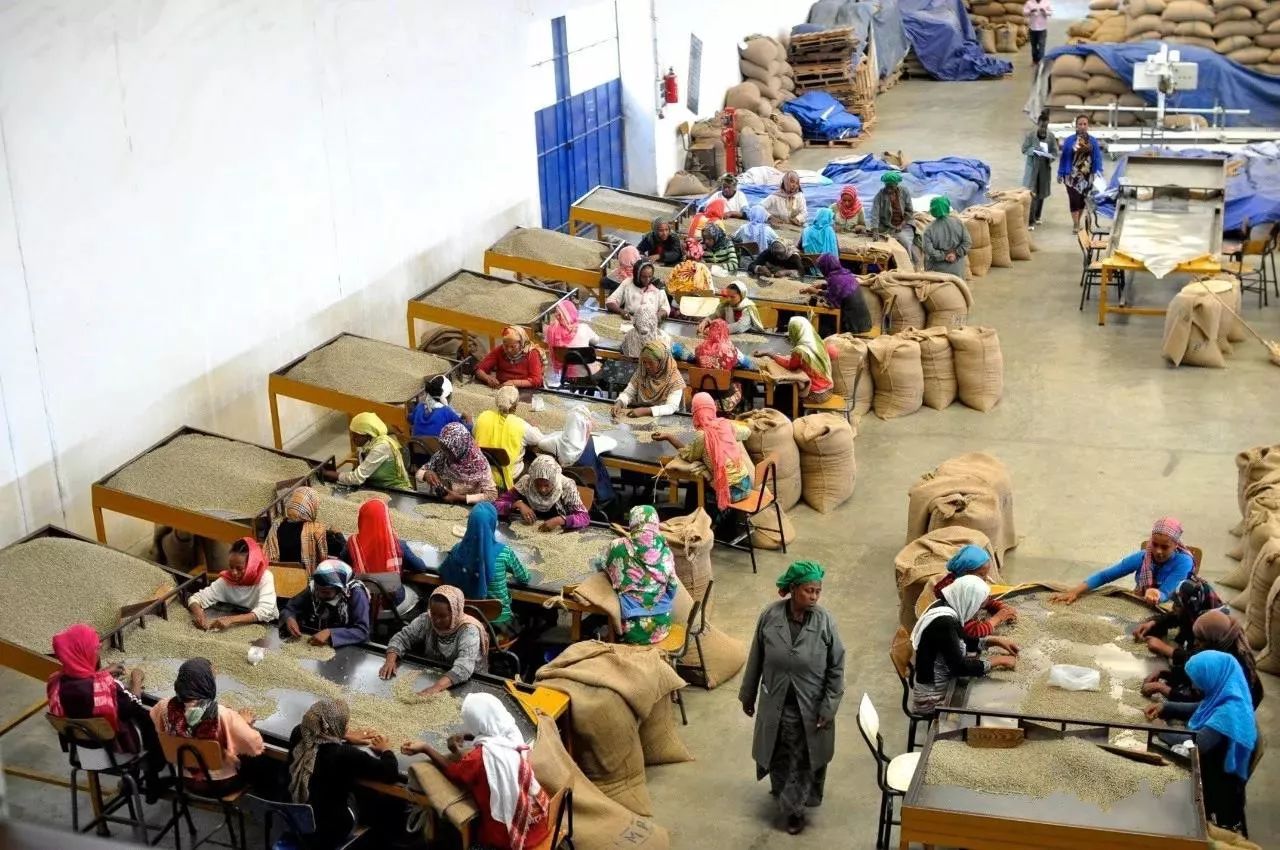
Before the Ethiopia Commodity Exchange (ECX) was created, Ethiopia's coffee export grades were set by the CLU (Cupping and Liquoring Unit) under the Ministry of Agriculture, based mainly on the number of defective beans in a 300g sample. The standards are shown in the table below.
Grade: Number of defective beans (per 300g)
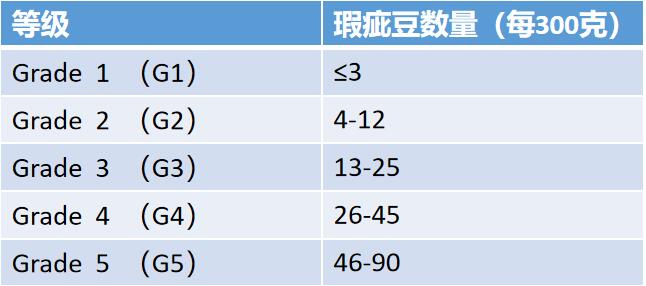
Generally, washed coffees are graded G1-G2. Because natural processing was technically limited at the time, natural beans had more defects and were typically graded G3-G5. As natural processing technology improved, natural beans can now reach G1-G2 as well. After the ECX was established in 2008, beans have been graded by combining physical characteristics with cupping quality.

The ECX sorts all coffee into three types according to processing method (non-washed and washed):
a. Specialty: few defects, high cupping quality
b. Commercial: does not reach specialty grade but ranks above the domestic (Local/Domestic) consumption grade
c. Local/Domestic: coffee with many defective (unripe) beans, out of season, or poorly stored, resulting in relatively poor flavor
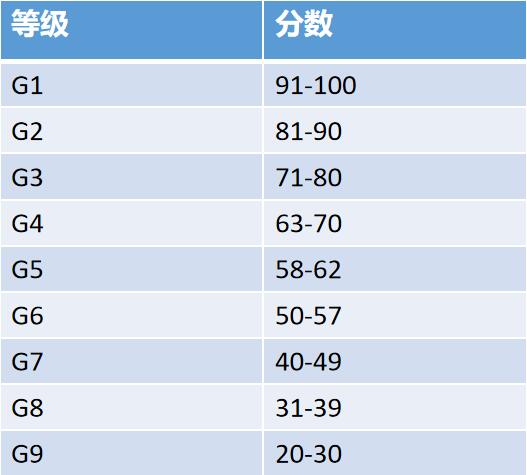
Of these, Specialty and Commercial are meant for the international export market. The ECX divides beans into nine grades based on the combined score of physical characteristics and cupping quality, where physical characteristics account for 40% and cupping quality for 60%.
Physical Characteristics (40%):
Washed processing: defect count (20%), appearance size (10%), color (5%), odor (5%)
Non-washed processing: defect count (30%), odor (10%)
2. Cupping Quality (60%)
Grade Score Washed Non-washed
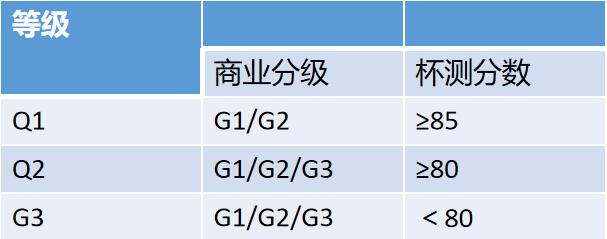
G1-G3 beans are then re-cupped to SCAA standards for a more detailed flavor assessment. G1 and G2 beans scoring no less than 85 points are classed Q1; G1, G2, and G3 beans scoring 80 to 85 points are classed Q2; and all G1, G2, and G3 beans scoring below 80 points are classed G3. Q1 and Q2 are the specialty coffee grades for export. G4-G9 keep their original grades and are exported as commercial grades together with G3.

3. Kenya (Graded by Bean Size)
Kenya grades its coffee beans mainly by bean size, typically into eight grades.

E (Elephant Beans): here "E" stands for "Elephant," though it does not refer to the Maragogype variety. It is a defect from abnormal development in which two seeds intertwine and look like a single bean. Normally a coffee fruit holds two seeds facing each other, creating one flat side; these are called flat beans or female beans. Grade E beans form when two seeds fuse as they grow, producing oversized beans. They run about 18 screen size (1 screen = 1/64 inch) or larger and are rare.

AA: about 17-18 screen size (roughly 6.7-7.1mm), the grade you hear about most often from Kenya. In specialty coffee it is often called AA TOP and promoted by many shops, but AA does not automatically mean the best. It speaks only to bean size, not flavor.

FrontStreet Coffee's Kenya Small Tomato grade is AA.
AB: most coffee beans fall into this grade. It is called AB mainly because grade A beans are 6.80mm and grade B beans are 6.20mm. The two sizes are mixed together for sale, hence AB. The size runs about 15-16 screen (roughly 6.0-6.4mm).
C: bean size about 14-15 screen (roughly 5.6-6.0mm), smaller than grade B.
PB: short for Peaberry, also called small round beans or male beans. Compared with regular flat beans they are rare, making up about 10% of all coffee beans. They occur when only one seed develops inside the fruit, producing small, round beans. Some drinkers love the PB flavor, so PB beans are sorted and sold on their own.
TT: lightweight beans screened out of AA and AB with air sorters. They are usually light, fail to meet hardness standards, and include broken and defective beans.
T: lightweight beans screened out of grade C, mixed with damaged beans and even fragments of broken beans.
MH/ML: these beans are not exported. They are typically overripe beans that have fallen to the ground with poor quality, accounting for about 7% of all coffee beans, and are sold only in Kenya's domestic market.
Many other countries also grade by green bean size, including Tanzania, Rwanda, Colombia, and Jamaica.
4. Colombia
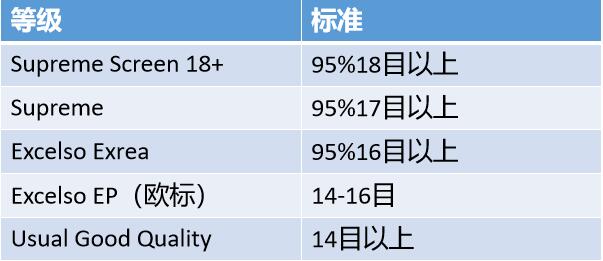
Grade Size Standard

Jamaica
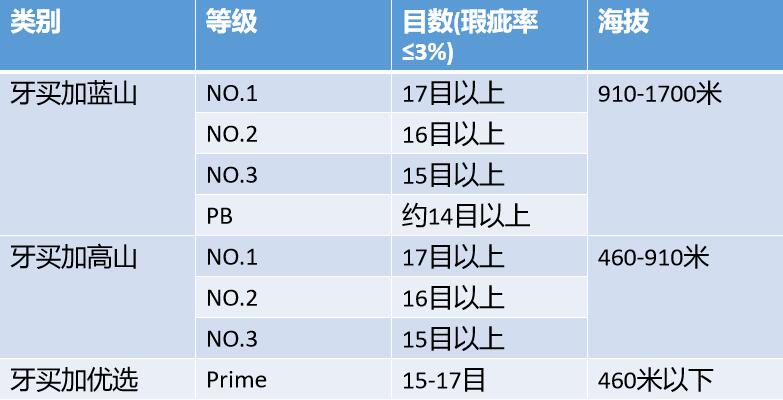
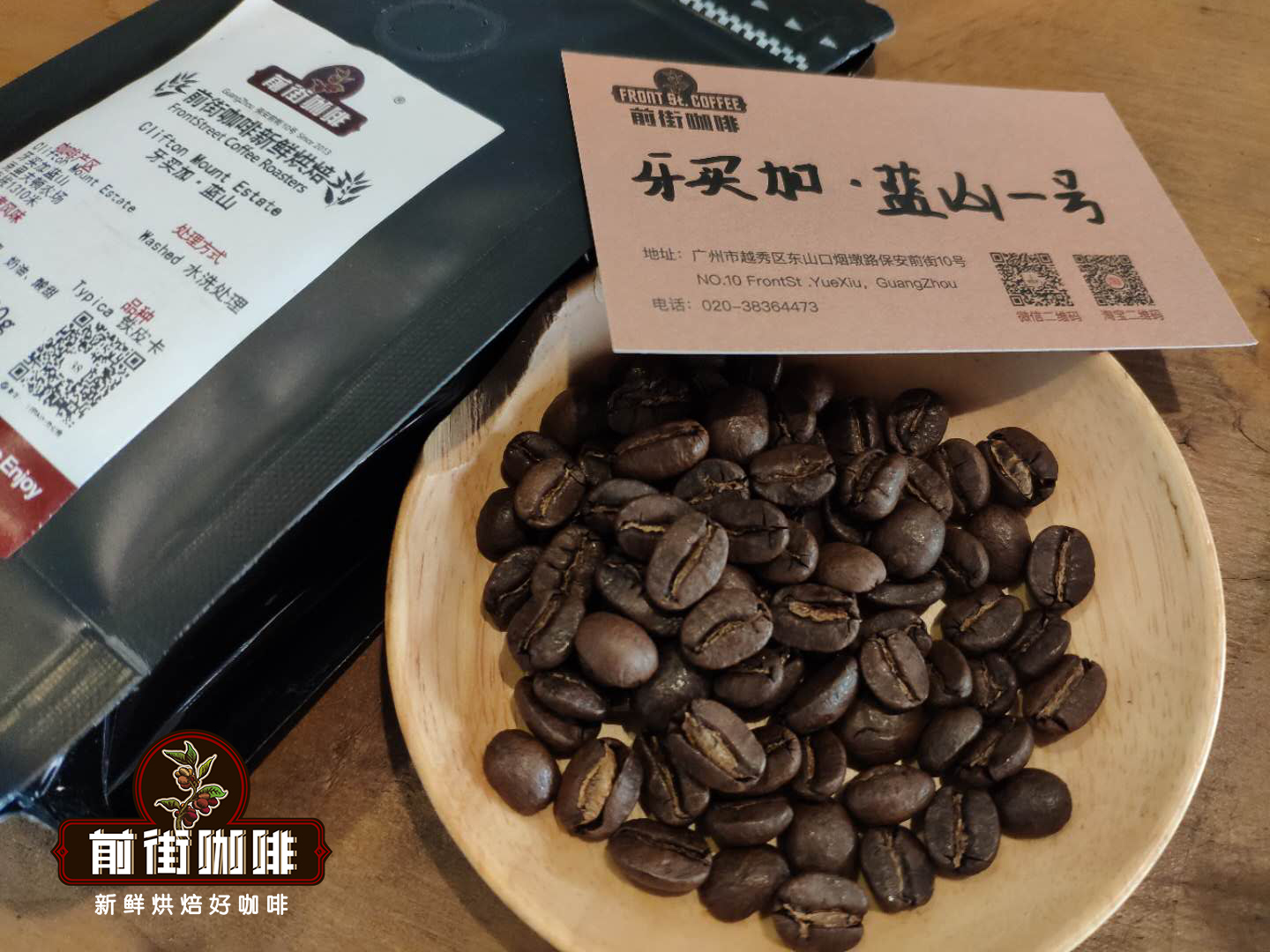
FrontStreet Coffee's Jamaica Blue Mountain belongs to NO.1 grade, commonly known as Blue Mountain No.1.
5. Costa Rica, Panama, Guatemala (Graded by Bean Hardness)
At the same latitude and location, higher altitude means a greater temperature difference between day and night, a longer growing period, harder beans, more nutrients taken up by the bean, and more pronounced flavor compounds.
Grade Altitude
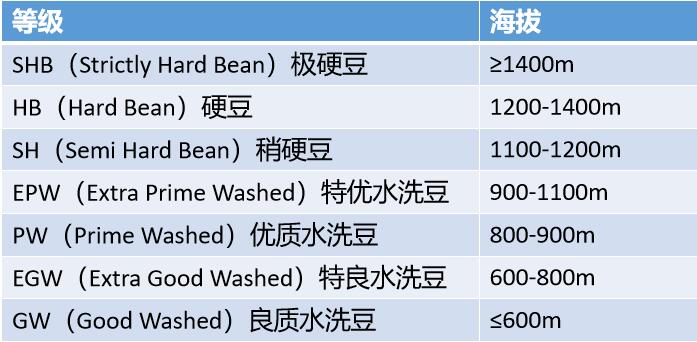

FrontStreet Coffee's Panama Hacienda La Esmeralda Green Label Geisha belongs to the SHB grade, Strictly Hard Bean.
6. El Salvador, Honduras (Graded by Altitude)
Grade Altitude (El Salvador) Altitude (Honduras)
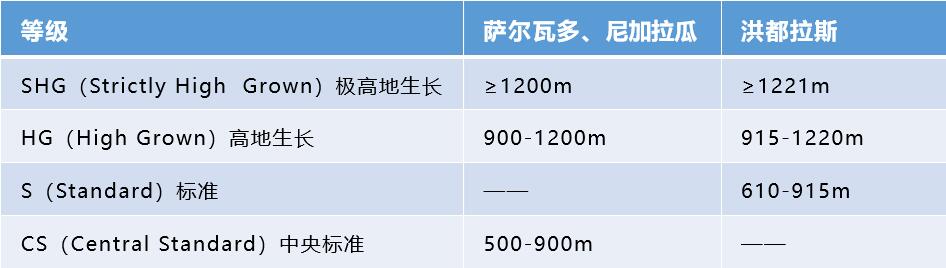

FrontStreet Coffee's Honduras Sherry grade is SHG.
7. Brazil (Graded by Bean Size, Defect Rate, and Cupping Score)
Brazil holds that only completely defect-free beans can qualify as NY.1, but completely defect-free beans do not exist. So the best green beans in Brazil are NY.2.
Grading by coffee bean size (NY grading method)
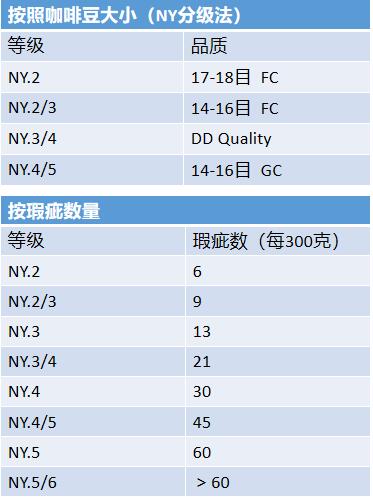
Divided by cupping level:
Fine Cup (FC), Fine, Good Cup (GC), Fair Cup, Poor Cup, Bad Cup. For example: Brazil Cerrado NY-2 SC-17/18 FC means the Brazil Cerrado region, NY grading method 2, bean size 17-18 screen, and flavor quality Fine Cup (excellent flavor).

FrontStreet Coffee Recommendation
If you are working your way into origins, FrontStreet Coffee suggests starting with Ethiopia, and the most classic entry point is FrontStreet Coffee's washed Yirgacheffe. It is known for white jasmine florals, bright citrus and lemon acidity, and a tea-like body, and its friendly price makes it the first specialty bean for many drinkers. Yirgacheffe is a small town in southern Ethiopia within the Sidamo zone, at about 1,700-2,100 meters, with coffee trees planted above 1,800 meters, one of the highest coffee regions in the world. Its highly recognizable white florals and lemon-citrus acidity have made the name a byword for Ethiopian specialty coffee; in 2010, its fame grew so large that the Ethiopia Commodity Exchange separated it from the Sidamo region.
Within Yirgacheffe, FrontStreet Coffee's Gedingding Cooperative is a standout. It sits in the Worka area at the southeastern edge of Yirgacheffe and was once part of the Worka cooperative under the Yirgacheffe union YCFCU. As buyers chased traceability, it became known as a single-origin micro-region, and it follows the most traditional washed processing, with no bitterness and a clean, bright citrus-lemon acidity plus jasmine fragrance. For a natural option, FrontStreet Coffee's sun-dried Red Cherry beans use only fully ripe, sound cherries, dried on raised beds for three to five weeks with turning every 2-3 hours early on to avoid uneven heat and over-fermentation, giving classic Yirgacheffe character together with tropical fruit, citrus-like acidity, a berry-juice mouthfeel, honey sweetness, and creamy smoothness.
For brewing, FrontStreet Coffee suggests a V60 dripper, 15g of coffee, a 1:15 ratio, 90-91°C water, and a grind around EK43s setting 10, or fine-sugar size reaching 80% through a #20 sieve. Bloom with 30g of water for 30 seconds, pour to 95g (about 125g on the scale) over roughly a minute, then when the water level drops to two-thirds of the bed add the remaining 100g (about 225g on the scale) over about 1 minute 35 seconds. The drawdown finishes in 2:00-2:10, and the brew is done.
Important Notice :
FrontStreet Coffee is a long-established specialty coffee roaster in Guangzhou China, selling freshly roasted beans from its own farm in Yunnan as well as dozens of carefully selected single-origin beans from around the world for both pour-over and espresso. The products deliver consistently excellent quality and great value, with shipping within 24 hours. Guangzhou's FrontStreet Coffee shop is recommended by many coffee lovers, and the beans are now available online at the Tmall 。
FrontStreet Coffee has moved to a new address:
FrontStreet Coffee Address: 315,Donghua East Road,GuangZhou
Tel:020 38364473
 Scan and follow the En Gafei WeChat official account. Please indicate that the reprint comes from "En Gafei".