Characteristics and Flavor Profile of Colombian Coffee Beans: Hand Drip, Grind Settings, Ratios, and Brewing Methods
When people hear "Colombia," the television series "Narcos" often springs to mind. Do not be misled. As FrontStreet Coffee knows well, Colombia's coca-growing area has shrunk year after year, and the country is equally famous for football and for coffee.
Colombian coffee is one of the few single-origin coffees in the world sold under a country's name. In quality, it has earned acclaim no other coffee can match. Compared with other producing countries, Colombia invests more in product development and promotion. That focus, combined with its superb geography and climate, is what makes Colombian coffee high-quality, delicious, and renowned worldwide.
Colombia is rich in natural resources; coffee, flowers, gold, and emeralds are especially prized as its "four treasures." In 1808, a priest first brought coffee to Colombia from the French Antilles by way of Venezuela. Today the country is the second-largest coffee producer after Brazil, the world's largest exporter of Arabica coffee beans, and the world's largest exporter of washed coffee beans. FrontStreet Coffee's Colombian coffee is often described as having a silky-smooth texture. Among all coffees it offers the finest balance, with a soft, smooth taste that can be enjoyed at any hour — acclaim that has earned it the nickname "green gold."
Colombia lies in the northern part of South America, bordered by Venezuela and Brazil to the east, Ecuador and Peru to the south, the Pacific Ocean to the west, Panama to the northwest, and the Caribbean Sea to the north. Most of its mainland sits between 4° and 12° north latitude, squarely within the coffee belt.
Colombia's coffee-producing regions are concentrated in the Andes Mountains, where the climate is mild, the air humid, and the rainfall well judged — an excellent environment for growing coffee.
Colombian Coffee Regions
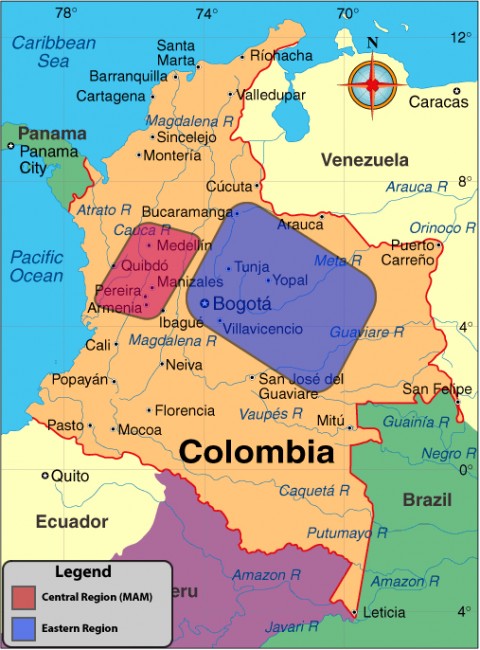
The best-known coffee-producing region in Colombia is "MAM," which takes in Medellín, Armenia, and Manizales.
Colombia's specialty coffee regions lie mainly in the south, at an average altitude above 1,500 meters, including San Agustín in Huila, Popayán in Cauca, Nariño, and Tolima. Beans from these areas carry delicate acidity and berry aromas, with caramel notes and full sweetness.
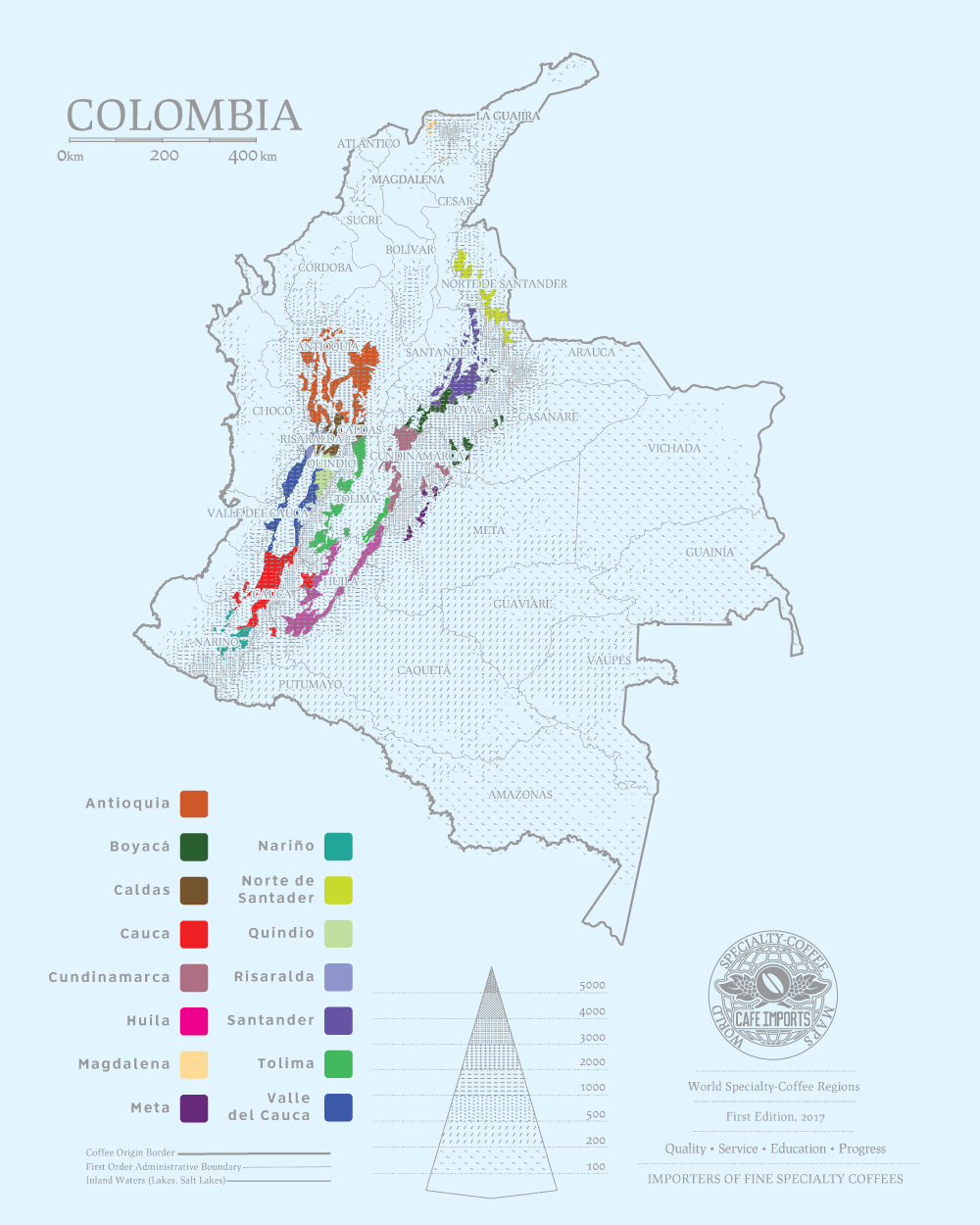
Next, FrontStreet Coffee introduces the character of the beans from each Colombian region.
Santander
Santander lies in northern Colombia, bordering the Magdalena River to the west, with a growing altitude of roughly 1,400 to 1,600 meters and an area of 30,537 square kilometers. Beans from here are known for intense flavor, a long finish, and a distinctive fresh herbal note.
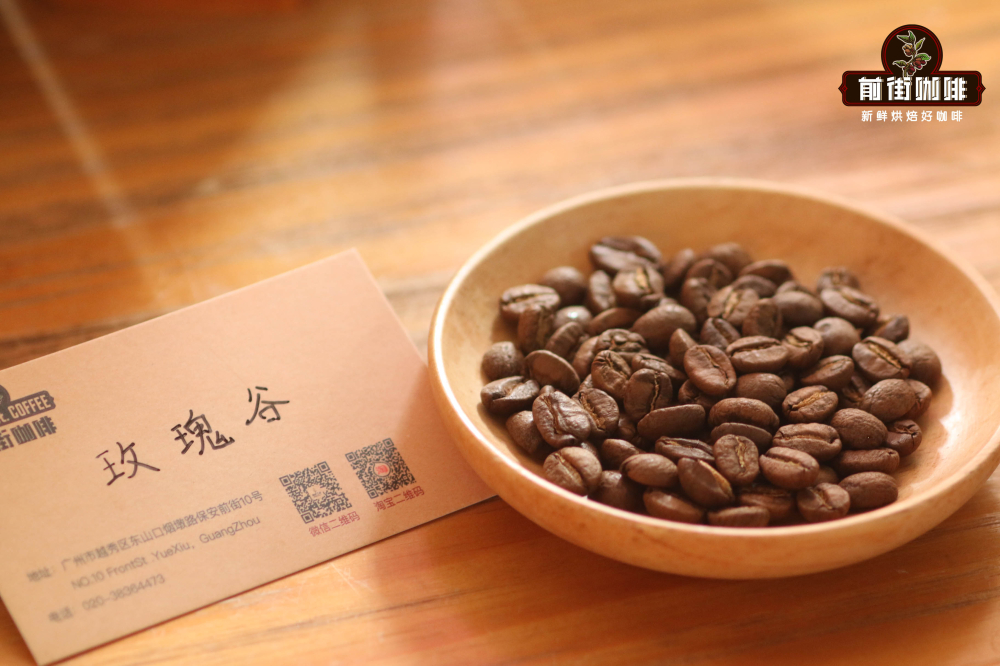
FrontStreet Coffee Colombia Rose Valley
- Region: Santander, Colombia
- Altitude: 1,700m
- Variety: Caturra
- Processing: Anaerobic Enzyme Washed
Antioquia
Located in central-northern Colombia, Antioquia accounts for 18% of national coffee production. Most of it is high mountain terrain belonging to the Andes, though it is tempered by warm sea breezes off the Caribbean.
Tolima
Tolima takes its name from the people who first lived there, the Pijao. In their ancient language, Tolima means "snow-covered." Farms in Tolima are generally a little larger than those in other southern Colombian regions, at about 10-15 hectares. Cooperatives are also common here, with farmers delivering their small lots of fresh cherries to cooperative processing plants. Some farmers process their own coffee as well, using small-scale facilities able to handle a single day's pick.
Huila
Huila lies in southwestern Colombia and is one of the country's main coffee-growing areas, contributing 12% of national production. Through cupping, FrontStreet Coffee found that coffee from this region shows strong nutty, chocolate, and caramel flavors.
FrontStreet Coffee Colombia Flower Moon Night
- Region: Huila, Colombia
- Farm: El Estorgarden Farm
- Altitude: 1,800m
- Variety: Caturra
- Processing: Anaerobic Natural

Cauca
Cauca lies in southwestern Colombia, and its total output accounts for 8% of the national figure. The average altitude of the Cauca region is 1,758 meters, reaching as high as 2,100 meters. The wide swing between day and night temperatures, the cold nights, and the altitude all slow the coffee's growth rhythm, letting the beans absorb the fruit's nutrients in full.
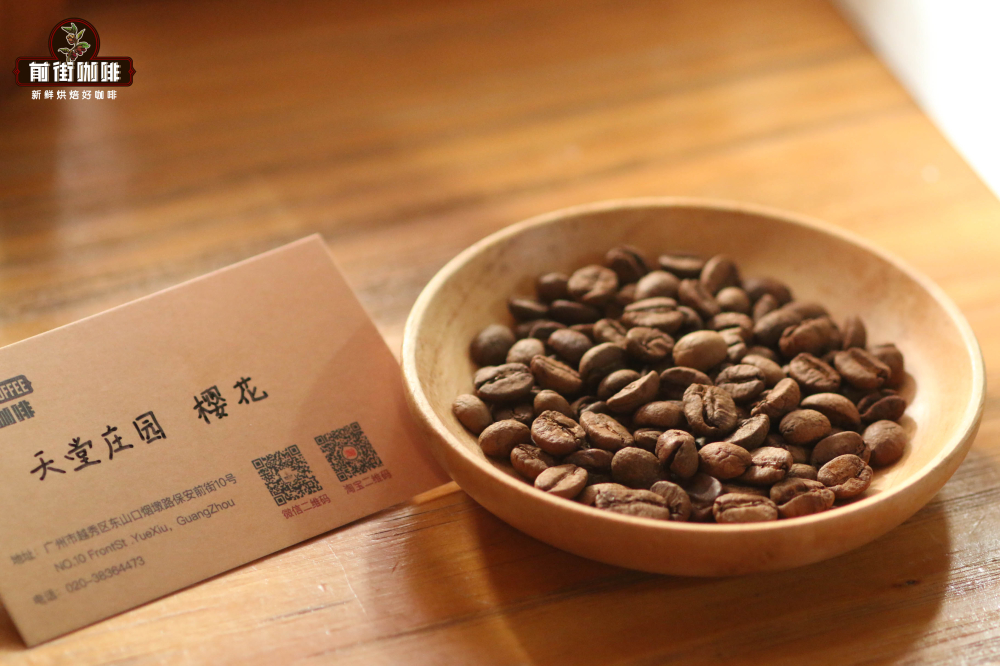
FrontStreet Coffee Colombia Sakura
- Region: Cauca, Colombia
- Estate: Paradise Estate
- Altitude: 2,050m
- Variety: Castillo
- Processing: Double Anaerobic Washed
Nariño
Nariño is the southwesternmost region of Colombia. It sits at 1° north latitude, close to the equator, with abundant sunlight all year. Altitude is mostly around 1,600 meters, and the volcanic soil supplies rich nutrients. Coffee from here tastes round and delicate, with some sweetness and cocoa, a rich aroma, and a walnut fragrance.
Colombian Coffee Grading System
Like any other coffee-producing country, Colombia has its own grading system, comparable to Kenya's AA and AB grades or Ethiopia's G1 and G2. Colombian beans are no exception. So how is Colombian coffee graded? FrontStreet Coffee explains below.
Colombian coffee is graded according to the size of the green beans.
FNC
FNC (the National Federation of Coffee Growers of Colombia, Federación Nacional de Cafeteros de Colombia) is a non-profit trade organization. Its primary purpose is to act as the voice of Colombian coffee, promising to buy from any farmer willing to sell. FNC serves as the international ambassador for Colombian coffee, marketing and promoting it in overseas markets and creating the enduring "Juan Valdez" image, while also investing substantial people and resources back home to support farmers' planting, production, management, and sustainable operations.
Brewing Recommendations
FrontStreet Coffee Colombian Coffee Brewing Parameters
- Water Temperature: 90°C
- Coffee Amount: 15 grams
- Coffee-to-Water Ratio: 1:15
- Grind Size: Fine sugar size (80% pass-through rate on China standard #20 sieve)
FrontStreet Coffee recommends brewing with freshly roasted beans to experience the full range of flavor. The beans FrontStreet Coffee ships are all roasted within 5 days, because the company understands how strongly freshness affects the cup. Its roasting philosophy is "freshly roasted good coffee," ensuring every customer receives the freshest possible beans on arrival. The resting period is about 4-7 days, so by the time an order arrives the coffee is at its peak.
FrontStreet Coffee Brewing Method
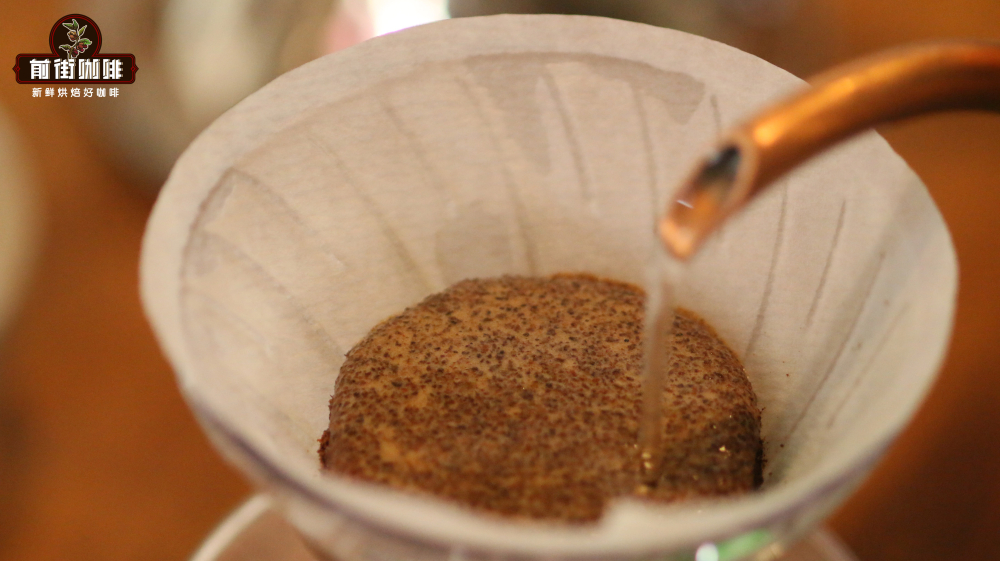
First, pour 30 grams of water for a 30-second bloom, then pour a further 95 grams (the scale showing about 125 grams), finishing in roughly 1 minute. When the water level drops to half the height of the bed, pour the remaining 100 grams (the scale showing about 225 grams), finishing in about 1 minute 35 seconds. Complete the drawdown at 2'04", remove the filter cup, and extraction is finished.
Flavor Description
[FrontStreet Coffee Colombia Rose Valley] Peach sweetness accompanied by rose aroma, with the fine sweet-and-sour quality of black grapes and the silky texture of cream toffee, followed by a finish reminiscent of liqueur chocolate.
[FrontStreet Coffee Colombia Flower Moon Night] An overwhelming sweetness of strawberry jam and the fermented character of ripe berries. On the palate, cranberry acidity and a berry-juice sensation spread to every corner of the mouth, chased by a liqueur-chocolate finish that rises into the nasal cavity.
[FrontStreet Coffee Colombia Sakura] The wet aroma reveals strawberry-jam sweetness and chamomile fragrance. The entry brings strawberry-like sweet-and-sourness and a jammy fermented sensation, followed by basil and rosemary, and finally a faint mint-tea coolness on the finish.
FrontStreet Coffee Recommendation
Colombian coffee may be wonderfully balanced, but Brazil — the world's largest producer — is the origin that best shows how far that balance can be pushed. Brazilian beans carry a moderate acidity and an excellent balance of sweetness, bitterness, and body, which is why medium roasting flatters them so well, drawing out a nutty aroma and a mellow cup with only a whisper of tartness. They shine both as a single origin and in blends. If you simply want a first taste of Brazil, the FrontStreet Brazil Cerrado Red Bourbon is a textbook single-origin Brazil: Cerrado is a distinguished region known for high-quality beans, and the lot is the Red Bourbon variety common throughout South America. Medium-roasted, it layers creamy peanut, toasted bread, caramel, and hazelnut over a round, smooth body with no sharp acidity and a gentle bitterness, and it performs as well in a moka pot, as an espresso SOE, in a siphon, or in a French press as it does as pour-over.
For something more distinctive, FrontStreet's Brazil Queen Manor Yellow Bourbon hails from Mogiana near southern Minas. There, fertile red volcanic soil lets the cherries take up abundant nutrients and develop full aromatics, and the variety is the rare Yellow Bourbon, a mutation of Red Bourbon whose fruit character is cleaner still. Brewed by hand, in a moka pot, or on a home espresso machine, it delivers a sugarcane sweetness found in few other origins, balanced with fruit and chocolate.
Brazil is also the backbone of FrontStreet's Italian-style blends, where its low acidity and agreeable price make it a natural first choice: the crema-rich Classic Blend, the nut-forward Premium Blend, the even-keeled Black Cocoa Blend, and FrontStreet Coffee's Commercial Blend built for cafés all contain Brazilian coffee. Beyond chocolaty, creamy aromatics, Brazil brings a soft and balanced sweet-sour-bitter profile that makes extraction consistently stable.
Important Notice :
FrontStreet Coffee is a long-established specialty coffee roaster in Guangzhou China, selling freshly roasted beans from its own farm in Yunnan as well as dozens of carefully selected single-origin beans from around the world for both pour-over and espresso. The products deliver consistently excellent quality and great value, with shipping within 24 hours. Guangzhou's FrontStreet Coffee shop is recommended by many coffee lovers, and the beans are now available online at the Tmall 。
FrontStreet Coffee has moved to a new address:
FrontStreet Coffee Address: 315,Donghua East Road,GuangZhou
Tel:020 38364473
 Scan and follow the En Gafei WeChat official account. Please indicate that the reprint comes from "En Gafei".