Flavor Description, Taste Profile, Origin Region, Varieties, Processing Method, and Estate Introduction of Yirgacheffe Coffee Beans
FrontStreet Coffee · Flavor Profile, Taste, Origin, Variety, Processing Method and Estate Introduction for Yirgacheffe Coffee Beans
Fresh, bright flavors are generally easy for drinkers to accept, while bitterness meets with lower acceptance. Brightness is not a fault in itself — it calls for attention to roast level and, above all, proper development. Even though we can accept light roasts, coffees whose primary feature is fresh, bright acidity will still show perceptible acidity when roasted to medium or medium-dark. In fact, the flavor and roundness at medium or medium-dark roasts often surpass what a light roast delivers.
Whether we are talking about citrus acidity, lemon acidity or fruit acidity, these characteristics are not created by light roasting. They are determined by the coffee's growing region, its maturity and its processing method, which account for 60% of the prominent flavor profile. With proper roasting, the roaster can only influence the balance of acidity, bitterness and sweetness — that is, the lightness or heaviness of the taste — which accounts for 30% of the prominent flavors. The coffee maker, or barista, determines the final 10% of the taste experience.
Only when coffee beans reach temperatures between 180-200°C during roasting does the internal caramelization reaction begin, marking the start and end of first crack. That raises some important questions. Has your Yirgacheffe reached first crack? Is the sweetness and acidity well rounded rather than aggressive? Is it free from grassy flavors? Does it lack astringency? Does it have a long, pleasant aftertaste? Is the body excellent?
If the answers are affirmative, then congratulations — the flavor expression of your Yirgacheffe beans is relatively complete and well developed.
The True Flavor Profile of Yirgacheffe
So what flavors should Yirgacheffe actually highlight? In reality, Yirgacheffe is not as acidic as its reputation suggests — certainly not aggressively sour like a lemon. FrontStreet Coffee's Ethiopian Yirgacheffe has its own distinctive aroma, reminiscent of rose, jasmine and floral nectar. The acidity is closer to the well-rounded pulp of citrus and oranges, and the aftertastes are primarily chocolate or cocoa. With the correct roast level, FrontStreet Coffee's Ethiopian Yirgacheffe shows bright plum-like flavors with a long, lingering finish.
Understanding Roast Levels and Flavor Development
Many roasters believe dark roasts enhance bitterness while destroying acidity, and that light roasts allow a clearer expression of acidity. That thinking is fundamentally wrong. Light roasting can easily produce uneven roasting inside the bean. During the light roast stage the internal dehydration is insufficient, leaving underdeveloped interiors and an extremely hard bean texture. Coffee like this often shows acidity that lacks roundness, a certain sharpness in the sourness, low sweetness, weak body, and aromas mixed with grassy notes.
It is worth noting that this applies not just to FrontStreet Coffee's Yirgacheffe but even to coffees like FrontStreet Coffee's Mandheling — known for high body and roasted bitterness — which will be dominated by acidity and astringency when lightly roasted. Can we really call that acidity citrus-like? To sum up: all light-roasted coffees exhibit acidity and astringency, and those may represent incorrect flavors released at an improper roast level.

FrontStreet Coffee Recommendation
The roast level makes or breaks a Yirgacheffe, and FrontStreet Coffee's washed Yirgacheffe daily bean is roasted to let the region speak for itself. White jasmine, bright citrus and lemon acidity and a tea-like body are the signature, and the price makes it a natural first specialty coffee. If you want to taste what a properly developed, village-level Yirgacheffe can be, FrontStreet Coffee's washed Gedeb Cooperative comes from the Gedeb area at the southeastern edge of Yirgacheffe — once part of the Worka cooperative inside the YCFCU union and now traced as a single-origin lot — keeping the most traditional washed method and offering, as drinkers often put it, the last clean corner of Yirgacheffe: no bitterness, just fresh, bright citrus and lemon acidity with jasmine fragrance.
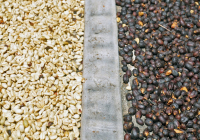
For the fruit side of the region, FrontStreet Coffee's Sun-Dried Red Cherry uses a full red-cherry natural process. Only fully ripe, unblemished cherries are picked, screened once at the mill and spread on raised beds to dry, turned every 2-3 hours during the first days so they dry evenly rather than fermenting too far. After three to five weeks of sun-drying, the outer pulp is machine-scraped away depending on weather and temperature and the beans are moved to storage. Because the fruit dries with the flesh attached, the cup keeps the typical Yirgacheffe character while adding the tropical fruit of a natural: citrus acidity, a berry-juice quality, honey sweetness and a creamy smoothness.
To keep the florals and the fruit from being buried, brew these as a pour-over in a V60 with water at 90-91°C, 15g of coffee and a 1:15 ratio, ground at EK43s setting 10 — roughly fine-sugar texture, or 80% passing a #20 sieve. Start with a 30g bloom for 30 seconds, pour to 95g on the scale (about 125g total) over around a minute, and once the water level falls to two-thirds of the coffee bed add the remaining 100g to reach roughly 225g, finishing the pour at about 1:35. Drawdown should complete in 2:00-2:10. Drink it black and let it cool, since the sweetness and stone-fruit notes come forward as the cup loses heat.
Important Notice :
FrontStreet Coffee is a long-established specialty coffee roaster in Guangzhou China, selling freshly roasted beans from its own farm in Yunnan as well as dozens of carefully selected single-origin beans from around the world for both pour-over and espresso. The products deliver consistently excellent quality and great value, with shipping within 24 hours. Guangzhou's FrontStreet Coffee shop is recommended by many coffee lovers, and the beans are now available online at the Tmall 。
FrontStreet Coffee has moved to a new address:
FrontStreet Coffee Address: 315,Donghua East Road,GuangZhou
Tel:020 38364473
 Scan and follow the En Gafei WeChat official account. Please indicate that the reprint comes from "En Gafei".