Geisha Coffee Beans Flavor Description Taste Origin Region Estate Detailed Brewing Methods Introduction How Much Does a Cup of Geisha Cost
What Is Geisha Coffee?
"Geisha" is pronounced the same way as the Japanese word for geisha, which is why the variety is sometimes also written as "Geisha coffee." Geisha trees grow taller than typical coffee trees, so they were first planted in small plots within estates and used as windbreaks rather than as a main crop.
Geisha Is a Variety
The Geisha variety was first discovered in 1931 in the Geisha forest of Ethiopia and later sent to the Coffee Research Institute in Kenya. In 1936 it was introduced to Uganda and Tanzania; in 1953 Costa Rica brought it in.
For a long time not many people paid Geisha any attention. Then Don Pachi brought it from the small town of Gesha in southwestern Ethiopia to Costa Rica, and from there Geisha traveled along the southern route into Panama. Panama's Hacienda La Esmeralda separated it from other varieties and won the national coffee championship, officially bringing Geisha into the spotlight.
A natural-processed Geisha from Elida Estate sold for $275.70 per pound.
Geisha is particularly picky about its growing environment, requiring high altitude, cloud cover and shade, fertile soil and sufficient accumulated heat. The average altitude is 1,625 meters, annual average temperatures run between 16°C and 25°C, and average rainfall is around 3,500 millimeters. The plantation uses semi-shade cultivation, and every shade tree is a local species.
The Iron Man at Aurora Coffee Estate is one example: it sits in the northwest corner of Chiriquí Province, Panama, and part of it is planted with high-altitude Hass avocado trees. (The natural-processed Geisha of Aurora Estate's owner Robert won the 2016 Best of Panama championship; "Iron Man Geisha" is a nickname for Panama's Aurora Geisha.)
By chance, the son of the owner of Panama's Hacienda La Esmeralda searched through every coffee tree variety on the estate to enter the annual Best of Panama competition, giving Geisha the opportunity to enter everyone's view. From then on it was unstoppable, entering coffee competitions around the world and collecting eleven championship trophies.
Priceless
Geisha is expensive, and shockingly so. The latest ranking of the world's most expensive coffees puts Geisha at number one, with a staggering price of $5,000 per kilogram.
Extremely low production is one excuse for the price. The real fascination lies in a flavor that surpasses every other coffee in the world, and that is the most important reason for Geisha's exceptional value. Today Geisha comes mainly from Panama and Colombia, and Gesha Village has recently emerged as well.
Panama's Emerald Estate, Hacienda La Esmeralda, produces what is regarded as the king of specialty coffee, commonly known as "Red Label Geisha," higher in quality and naturally higher in price. It takes your taste buds to an ethereal world. Red Label Geisha is harvested from areas above 1,600 meters and enters global auction bidding every May.
Emerald Estate sits on the slopes of Baru Volcano, the highest peak in Boquete, western Panama. A mild climate, fertile volcanic soil, appropriate rainfall and varied microclimates give coffee ideal natural conditions. In 2017 Panama's Emerald Estate Geisha won the natural-processed category, the estate's 18th championship trophy. To stand out among strong competitors year after year takes not only the delicious genetics of Geisha beans but also excellent estate management and careful harvesting and processing.
In the online public bidding for the 2017 Best of Panama auction, the highest price far exceeded all previous records. The natural-processed Geisha from Emerald Estate fetched a staggering $601 per pound, roughly 8,900 yuan per kilogram. A café in Shanghai once sold a cup of natural-processed Geisha for 1,000 yuan. Red Label Geisha auction prices run between 1,500 and 2,000 yuan per kilogram; at 15 grams of beans per cup, the raw bean cost alone reaches 133 yuan, before transport, labor and roasting. At FrontStreet Coffee in Guangzhou I once had a cup of Red Label Geisha that left a deep impression. It was like a cup of fruit tea, priced at 75 yuan per cup, while Blue Label Geisha was 60 yuan per cup, which is relatively approachable.
What Are Red Label, Green Label and Blue Label?
Emerald Estate: Red Label, Green Label, Blue Label
Only Emerald Estate's Geisha carries the Red Label, Green Label and Blue Label distinction.
Red Label (Special-Geisha):
The finest batches from Emerald Estate, all grown above 1,600 meters (some even above 1,900 meters), with cupping scores above 90 points.
Premium - Red Label [Auction Batches]
- Growing altitude: 1,600-1,800 meters
- Cupping score: above 90 points
- Mainly produced from the Jaramillo and Cañas Verdes farms, and the highest-quality Geisha beans of all
- Geisha harvested from the highest points of the Boquete mountains, with a special, bright floral and citrus aroma
- Processed into natural or washed green beans
- Available only through the annual global auction
Green Label (Private Collection-Geisha):
Geisha from different plots of Emerald Estate, grown at altitudes of 1,600-1,800 meters.
Second Best - Green Label [Reserve Batches]
- Growing altitude: 1,600-1,800 meters
- A micro-lot blend from three estates: Jaramillo, Quiel and Cañas Verdes
- Not the highest-grade auction beans, but this grade still keeps the classic Geisha flavors of floral, fruity and citrus acidity over a thick, juicy texture
- Selecting perfectly ripe cherries creates rich sweetness, bright fruit acidity and delicious flavor
- Available as both washed and natural-processed green beans
Blue Label (Geisha1500):
Geisha from various Emerald Estate farms, grown above 1,500 meters.
Regular - Blue Label [Selected Batches]
- Growing altitude: 1,500 meters
- A blend from three estates: Jaramillo, Cañas Verdes and El Velo
- Slight floral notes, fruit acidity and sweetness, with a less full body
- Only available as washed-processed green beans
Gesha Village, Geisha
The journey of Gesha Village began in 2007, when Adam Overton and Rachel Samuel helped the Ethiopian government film a documentary about Ethiopian coffee. During filming they met Dr. Girma and visited the Gera coffee forest near Jimma. Dr. Girma is a coffee researcher with extensive knowledge of coffee agriculture and farm management. While making the documentary, Rachel rediscovered her birth country and Adam became fascinated by the rich history of coffee's origin.
As their coffee journey came to an end, they hoped strongly to start their own coffee farm. They saw so much untapped potential and opportunity in Ethiopia's wild coffee forests, and Adam and Rachel established Gesha Village Coffee Estate.
Gesha Village Coffee Estate covers a total area of 471 hectares. By 2015 it had planted 300 hectares of coffee, adding another 50 hectares in 2016. The Geisha selection comes from the original coffee forest (Gori Gesha) 20 kilometers from the estate, which is also the source of Panama's Geisha variety.
Roasting Geisha
To highlight the characteristics and aroma of this bean, use a light roast. This level better brings out the bean's inherent qualities, while too dark a roast would damage the floral aroma and fruit acidity. Of course, the profile should also be adjusted to the bean's characteristics and the roaster's understanding of it.
Unique Floral and Fruit Aroma
Among the many coffees of the world, floral aroma and intense tropical-fruit sweetness are the consistent signature of Geisha.
How to Properly Taste a Cup of Blue Label Geisha
Taking Blue Label Geisha as an example, here is how to properly taste a cup of Geisha, broken into seven steps.
1. Smell the Dry Aroma of Coffee
Washed Geisha has subtle osmanthus and jasmine floral notes with pomelo and citrus undertones; light roasting reveals more tea rose fragrance. When brewed, it has a wet aroma of orange, with more floral notes and a rich honey sweetness emerging.
2. Perceive the Mouthfeel
When the coffee liquid enters your mouth and stimulates the taste buds, use your tongue to feel the liquid and sense its impact in the mouth.
In professional coffee tasting this indicator is also called texture, vividly explained as the difference between water and syrup or milk. Syrup and milk have a thicker texture than water. Blue Label Geisha (light roast) tastes very watery, while natural-processed Geisha has a full, rich texture, which can also be understood as viscosity.
Smoothness refers to a silky sensation, similar to drinking milk. A very smooth coffee, held in the mouth for a moment, feels round and natural as it is swallowed through the throat, effortlessly. Poor-quality coffee feels rough when swallowed, giving the throat a tight and scratchy sensation.
Coffee smoothness has a certain relationship with thickness, and the two are sometimes called "thickness and smoothness" together. The richer the coffee, the more pronounced the smoothness will be.
3. Understand Cleanliness
Some coffees have astringency, some a powdery quality, some earthy notes. Such coffees have an unclean cup. High cleanliness makes tasting easy and pleasant, and washed Blue Label Geisha has a clean, clear taste.
4. Understand Acidity
The sweet and acidic substances in coffee are what make up its flavor complexity. Like Yirgacheffe, Geisha has acidity, but it is a comfortable, rounded acidity within sweetness. Washed Blue Label Geisha contains rich acidity like peaches and plums.
5. Experience Sweetness
Sweetness is the simplest and most intuitive aspect of coffee tasting. A good Geisha has almost no bitterness, which makes the sweetness even more apparent.
Sweetness is universally liked and accepted. Pleasant, lively sweetness pairs well with acidity. When we drink a coffee with excellent sweetness and lively acidity, there is a balance between sweet and sour, with the two transforming into each other. Blue Label Geisha's sweetness is like a fruit: the beans contain fructose and a sweet-potato-like sweetness, similar to sucrose, brown sugar and caramel, creating a mouth-watering sensation.
6. Taste the Flavor
With coffee in your mouth you can feel its flavor, typically distinguishing sweet, salty, sour and bitter. Geisha has a fruit-like sweetness.
7. Perceive the Aftertaste
After drinking coffee, a flavor always returns from the throat, which is called the aftertaste. If it leaves the mouth dry, it is generally called a dry or throat-drying aftertaste.
The aftertaste of Blue Label is very persistent and clear, like eating licorice olives. A coffee with a good aftertaste lets the aroma linger longer in the mouth, with a more extended finish.
How to Brew Geisha Well
FrontStreet Coffee's pour-over reference: weigh 15g of Blue Label Geisha and grind to a medium setting, with particles slightly coarser than table salt. We use a BG grinder at setting 4B and 91°C water in a wave filter for extraction.
Pour the hot water from the kettle clockwise in circles centered on the middle of the filter, and start timing when brewing begins. Within 15 seconds, brew the coffee to 30g, then stop pouring. When the timer reaches 1 minute, pour the second time, again clockwise in circles centered on the middle of the filter. The water flow should not hit the area where the coffee bed meets the filter paper, to avoid channeling.
Leave a ring when pouring to the outer edge of the coffee bed, then work circle by circle back toward the center. At 2 minutes and 20 seconds, brew the coffee to 220g, and the brew is complete.
Cold Brew Geisha
FrontStreet Coffee's cold brew Geisha reference: Panama basket-label Geisha, light roast, BG grinder setting 4B at grind level 3, 20 grams of beans, 83°C water, pre-infusion for 3 minutes using a Chemex pot, then cold brew with ice water for a total water volume of 200ml.
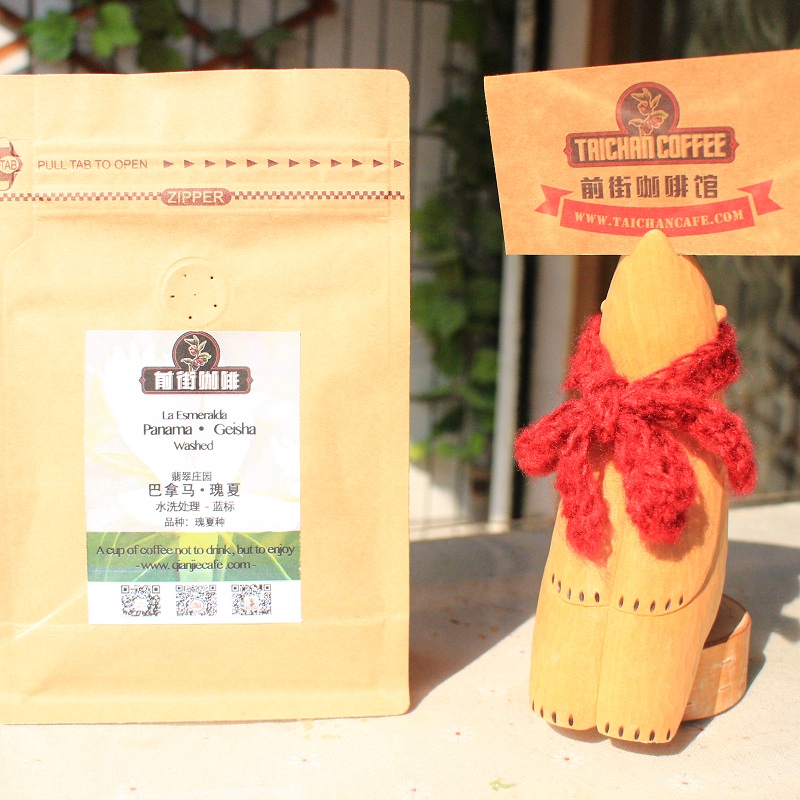
Emerald Estate's Geisha has become the dream luxury of the coffee world. As one enthusiast put it, its floral aroma is like fireworks, blooming continuously in the mouth during tasting, with lemon, citrus and strawberry-like juices that make it more like juice than coffee. "Which coffee can be as invincible as Geisha?" someone once asked. Drinking Panama Emerald Estate's Geisha every year has become an essential annual ritual for many coffee lovers, like a birthday feast.
Geisha's dry aroma is very uplifting and bright, with rose and jasmine characteristics and some pomelo and citrus notes; light roasting also brings out a nutty aroma. The wet aroma also shows hazelnut and will reveal more floral character. In terms of texture and flavor, the initial stage might be slightly milder and more reserved than the previously uplifting aroma, but as it cools slightly, the floral and fruit flavors gradually rise with the falling temperature. The cold aroma is exceptionally outstanding: sweet dried fruit, rosehip, orange glaze and strawberry jam, with hints of pine, cherry and vanilla gradually receding to reveal a lemon-like fruit aroma. With appropriate roasting, the experience is simply like sipping the fragrance of a fresh bouquet of flowers.
Emerald Estate's Geisha did not reach the top all at once. When the variety first appeared in coffee competitions it began to attract attention, but most people kept a wait-and-see attitude and some even thought it was a fluke. It won the championship again the following year, and could no longer be underestimated. Because production was low, people turned to other countries to buy Geisha coffee beans, yet Emerald Estate kept winning championships year after year, practically becoming a Panamanian national treasure. Recognition at home was not enough: in 2005 Emerald Estate's Geisha defeated competitors from around the world at the SCAA (Specialty Coffee Association of America) competition to win the title of world number one, then won again in 2006 and 2007. At that point Emerald Estate's Geisha had become a sensational topic in coffee circles worldwide.
The story of why Emerald Estate (La Esmeralda) became world-famous came from an accident. Retired Swedish-American banker Rudolph A. Peterson bought Emerald Estate in Panama to spend his later years, and this unintentional planting bore fruit. He casually sent the estate's coffee to competition and became famous overnight, winning the 2004 Panama Specialty Coffee Competition national championship.

FrontStreet Coffee Recommendation
If the price tags above have you wondering whether Geisha is only for special occasions, FrontStreet Coffee has built a ladder that lets you start lower and climb as far as you like. The most affordable way in is the FrontStreet Boquete Geisha, an entry-level Panamanian Geisha that still delivers the orange-blossom honey sweetness and oolong-tea mouthfeel of the classic style, with delicate fruit acidity and clear layering. For a genuinely everyday alternative, the FrontStreet Strawberry Candy blends a Panama Geisha with a Costa Rican honey-processed coffee, combining delicate floral notes with sweet fruit and working equally well as pour-over, moka pot, espresso or cold brew.
When you are ready to spend more, the Hacienda La Esmeralda Green Label "Private Collection" blends several plots into the estate's signature high-altitude Geisha character at a friendlier price than the auction lots, while the Red Label "Esmeralda Special" offers single-plot traces grown at 1,600-1,800 meters and cupping above 90 points. If you are curious about the variety's Ethiopian roots, the FrontStreet Gesha Village Gold Label is a refined natural-processed lot of the Geisha 1931 variety, representing 10% of the village's output and frequently chosen by competition baristas, and the FrontStreet Gesha Village Red Label "Growers Reserve" uses the Gori Gesha variety at 15% of production with full traceability. For a single-variety Ethiopian estate, the FrontStreet Grana Geisha is natural-processed over 14-20 days on raised beds and shows bright citrus acidity, elegant ginger-flower aroma and ripe-fruit sweetness.
Because Geisha is a medium-light, floral-and-fruit roast with a hard, dense bean, it benefits from a slightly coarser grind than you might expect: FrontStreet Coffee suggests about 78% pass-through on a Chinese standard No. 20 sieve, roughly the size of fine granulated sugar, and 91°C water. A 15g dose in a small Hario V60 at a 1:16 brew ratio is a good starting point. Begin with a 30g bloom for 30 seconds, pour slowly in circles to 125g and wait for the bed to drain about halfway, then pour carefully to 225g; the full drawdown should finish around 2:10 to 2:20. If you prefer espresso, the FrontStreet Grana Geisha SOE is roasted medium so the pressed shot keeps the variety's floral and fruit character alongside notes of dried apricot, caramel and nuts; pull about 20g in to 40g out at a 1:2 ratio in roughly 25 seconds, then add 200g of hot water for an americano or 200g of milk for a latte.
Important Notice :
FrontStreet Coffee is a long-established specialty coffee roaster in Guangzhou China, selling freshly roasted beans from its own farm in Yunnan as well as dozens of carefully selected single-origin beans from around the world for both pour-over and espresso. The products deliver consistently excellent quality and great value, with shipping within 24 hours. Guangzhou's FrontStreet Coffee shop is recommended by many coffee lovers, and the beans are now available online at the Tmall 。
FrontStreet Coffee has moved to a new address:
FrontStreet Coffee Address: 315,Donghua East Road,GuangZhou
Tel:020 38364473
 Scan and follow the En Gafei WeChat official account. Please indicate that the reprint comes from "En Gafei".