What Does 74110 Mean in Coffee? What Are Ethiopia's Selected and Cultivated Varieties?
What Does 74110 Mean in Coffee? A Look at Ethiopia's Selected and Cultivated Varieties

As specialty coffee has grown, the number of recognized and named varieties has climbed past a hundred by conservative estimate. You may have noticed that many carry numbers — 74110, 74112, and others. Today FrontStreet Coffee introduces 74110, a regular on Ethiopia's Cup of Excellence tables.
Heirloom Varieties
Before 74110 makes sense, you need the idea of "Heirloom." As the birthplace of coffee, Ethiopia is thought to hold around ten thousand varieties. For one thing, that sheer number makes genetic testing impractical for identifying and separating them, so farmers distinguish them by experience instead. For another, the government — to protect these unknown native varieties from coffee-growing countries competing to acquire them — uses "Heirloom" as a blanket designation.

JARC
After the 1970s, coffee anthracnose broke out in Ethiopia. When ripe and green berries contract the disease, water-soaked spots appear on the surface, followed by sunken lesions that darken to brown and grayish-black until the fruit dies on the tree or drops. The disease can cut yields by 20% to 30%, and in severe cases by 70% to 80%. At the time, the Harar and Yirgacheffe production areas in the eastern half of the Great Rift Valley suffered devastating losses, while coffee trees in the western half were comparatively spared.

Spraying pesticides was never a long-term answer; the real solution was finding local varieties with disease-resistant genes. As coffee's birthplace, Ethiopia had a unique advantage in that search. The Jimma Agricultural Research Center (JARC), in the western half of the Great Rift Valley, formed a "bean search team" that collected seeds from more than 600 coffee trees in the western forests of the Rift Valley. Experts then used scientific identification and field trials to isolate varieties resistant to anthracnose. 74110 is one of the first 13 new anthracnose-resistant varieties JARC released.
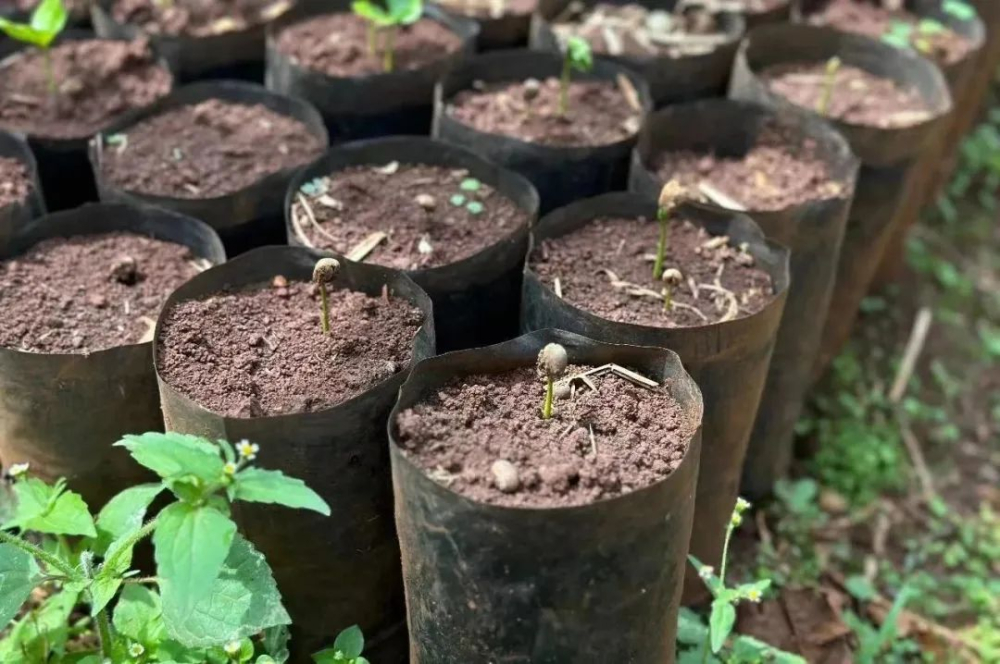
74110
74110 is a code assigned by JARC: "74" marks the year of discovery, and "110" is the experimental sample number. So 74110 is not a category — it is one specific variety.
The 74110 plant is short and compact, with small leaves, fruit, and beans, green tips, and short internodes, and it yields heavily. In the cup it shows citrus acidity and delicate florals, the typical profile of Ethiopian growing regions. To borrow Mr. Han Huaizong's description in "The Fourth Wave of Specialty Coffee," it is a "fruit bomb" — a phrase that captures how remarkable the flavor is.
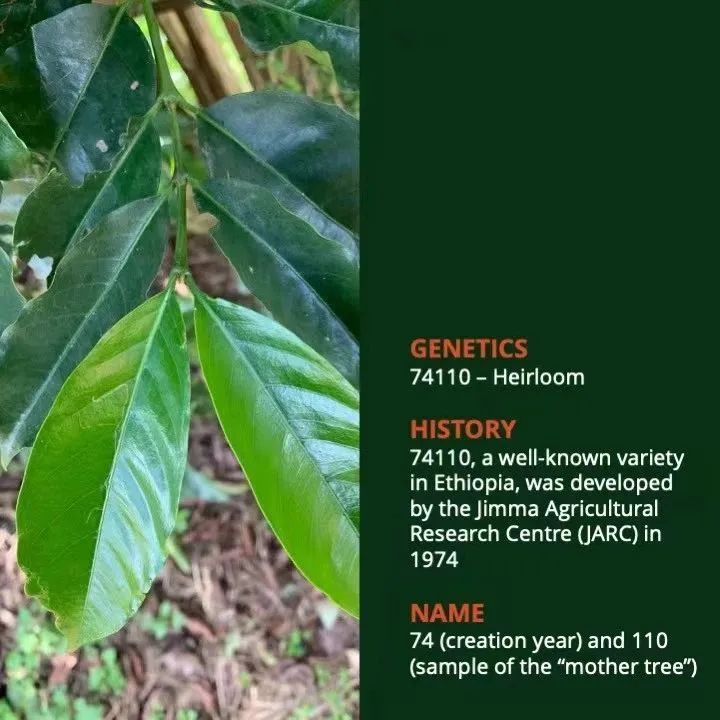
From its discovery in 1974 to today, 74110 has become one of the most widely cultivated modern varieties in Ethiopia — the other being 74112 — thanks to its strong disease resistance and its ability to adapt to different soils and water conditions. It is also the most in-demand of the improved modern varieties. With vigorous promotion and widespread planting, 74110 has appeared frequently on Ethiopia's Cup of Excellence leaderboard, taking no fewer than twenty awards between 2020 and 2022.

FrontStreet Coffee Recommendation
If variety codes have made you curious about Ethiopian coffee, the clearest way in is to taste the classics. FrontStreet Washed Yirgacheffe is the place to start: known for white jasmine, bright citrus and lemon acidity, and a tea-like body, it is many drinkers' first specialty bean and remains an everyday favorite.
To see what a single cooperative can do, try FrontStreet Gedingding Cooperative. Located in the Woka area at the southeastern edge of Yirgacheffe, it was once part of the Woka cooperative under the YCFCU alliance, and its traditional washed processing yields a cup with no bitterness, bright citrus and lemon acidity, and jasmine fragrance.
For a different expression of the same region, FrontStreet Sun-Dried Red Cherry is made only from fully ripe red cherries, laid out on raised beds for a natural dry, and turned every two to three hours in the first days to prevent uneven heating and over-fermentation. Three to five weeks later it carries both classic Yirgacheffe character and the tropical fruit of a natural, with citrus acidity, berry juice, honey sweetness, and a creamy smoothness.
To brew these, FrontStreet Coffee suggests a V60 at 90-91°C with 15 g of coffee and a 1:15 ratio, ground to an EK43s setting of 10 — fine-sugar size, about 80% passing a #20 sieve. Pour 30 g for a 30-second bloom, then add 95 g (to about 125 g on the scale) over roughly one minute; when the water drops to two-thirds of the bed, add the remaining 100 g (to about 225 g), finishing around 1 minute 35 seconds, with total drawdown at 2:00 to 2:10.
Important Notice :
FrontStreet Coffee is a long-established specialty coffee roaster in Guangzhou China, selling freshly roasted beans from its own farm in Yunnan as well as dozens of carefully selected single-origin beans from around the world for both pour-over and espresso. The products deliver consistently excellent quality and great value, with shipping within 24 hours. Guangzhou's FrontStreet Coffee shop is recommended by many coffee lovers, and the beans are now available online at the Tmall 。
FrontStreet Coffee has moved to a new address:
FrontStreet Coffee Address: 315,Donghua East Road,GuangZhou
Tel:020 38364473
 Scan and follow the En Gafei WeChat official account. Please indicate that the reprint comes from "En Gafei".