Bitter or Sweet Coffee: Which Tastes Better? Why People Sensitive to Bitterness Drink More
Life is complete only when it holds both bitterness and sweetness.
This classic saying will ring true for many readers. After all, without experiencing bitterness, how can anyone truly appreciate the happiness that sweetness brings? The sentiment seems deeply ingrained in every coffee drinker, who has even drawn new insight from it: because life holds more bitterness, the sweetness stands out all the more.
You may know people who say one thing and do another. One moment they complain that coffee is too bitter and does not taste good; the next, you turn around and find that same person queuing to buy coffee. Of course, the coffee they are buying may not be bitter at all, such as a milk-based drink or coffee with added sugar, which masks the bitterness.
According to a November 15, 2018 report by NPR, a study published that same month in Nature's Scientific Reports showed that people's sensitivity to bitterness affects how much coffee they drink. The results seem contrary to what we would normally expect.
Yet the results really do suggest that the more sensitive people are to coffee's bitterness, the more coffee they drink.
The researchers analyzed data stored in the UK Biobank. On this internationally influential and largest data platform, more than half a million people have donated blood, urine and saliva samples, which scientists can use to answer a wide range of research questions. Volunteers also filled out questionnaires covering various health topics, including their coffee consumption.
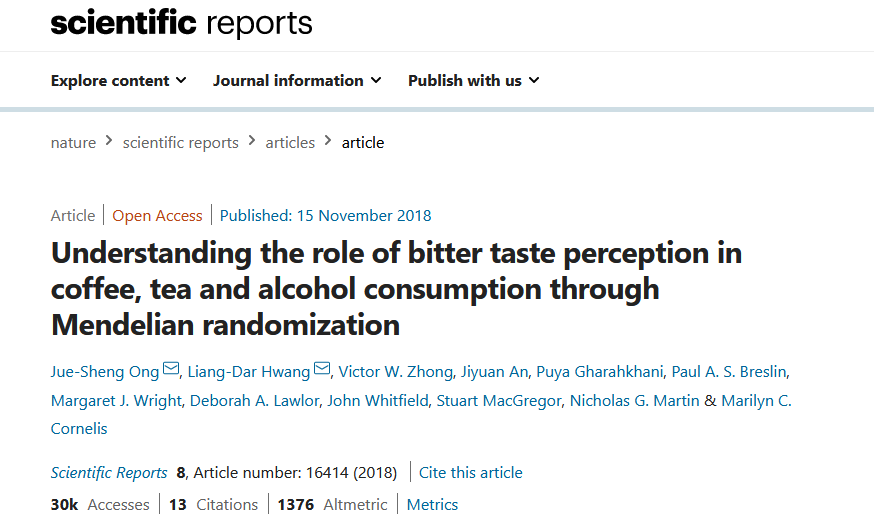
The researchers carefully analyzed data from over 500,000 participants to identify people who were more sensitive to one or more of three bitter compounds: caffeine, quinine and propylthiouracil.
When participants were cross-referenced with their self-reported coffee consumption, the researchers found that people who were genetically more sensitive to the bitter taste of caffeine drank more coffee than those less sensitive to it. But interestingly, those sensitive to quinine or propylthiouracil drank less coffee.
Marilyn Cornelis, an assistant professor of preventive medicine at Northwestern University's Feinberg School of Medicine and one of the study's authors, offered a hypothesis for this counterintuitive finding. She suggested that what changes people's minds is not the taste itself but what they associate with that taste. People may associate coffee's bitterness with the energy and vitality coffee provides.
This study, published three years ago, demonstrates an interesting phenomenon: people who cannot handle coffee's bitterness often end up drinking the most coffee. From this we can draw a deeper thought: with bitterness as contrast, sweetness suddenly becomes far more precious.
Can you tell us whether you are someone who dislikes bitterness yet still loves drinking coffee?
Image source: Internet
FrontStreet Coffee Recommendation
If you fall into the camp that prefers sweetness over bitterness, FrontStreet Coffee roasts several coffees built around exactly that. The FrontStreet Costa Rica Blackberry comes from a high-altitude Costa Rican farm and uses a black honey process, the style that retains the most mucilage and ferments the deepest, giving it the highest sweetness of all honey styles. Roasted light-medium, it pours out sweet floral notes with grape, sweet orange and rum chocolate. The FrontStreet Strawberry Candy blend, which pairs a Costa Rican honey processed coffee with a Panama Geisha, adds rose, strawberry fudge, dried blueberry and almond sweetness with a smooth, mellow body.
For a juicy, fruit-forward take on sweetness, the FrontStreet Frontera Sidra is a light-medium roasted Colombia Sidra with dark chocolate and light spice sweetness, plus a long, wine-like finish.
Important Notice :
FrontStreet Coffee is a long-established specialty coffee roaster in Guangzhou China, selling freshly roasted beans from its own farm in Yunnan as well as dozens of carefully selected single-origin beans from around the world for both pour-over and espresso. The products deliver consistently excellent quality and great value, with shipping within 24 hours. Guangzhou's FrontStreet Coffee shop is recommended by many coffee lovers, and the beans are now available online at the Tmall 。
FrontStreet Coffee has moved to a new address:
FrontStreet Coffee Address: 315,Donghua East Road,GuangZhou
Tel:020 38364473
 Scan and follow the En Gafei WeChat official account. Please indicate that the reprint comes from "En Gafei".