Colombian Coffee Variety - Catillo Chilloso: A Coffee Variety You Haven't Heard Of!
When you think of Colombian coffee, a whole roster of varieties probably comes to mind — FrontStreet Coffee's distinctly floral Huayuena (Flower Moon Night), Rose Valley, Sakura, San Jose, and more. Recently, though, a unique Colombian variety has taken the scene by storm with its striking floral aromas and citrusy acidity. Its name is Caturra Chiroso, and it remains unfamiliar to most drinkers. At the 5th LOD "Land of Plenty" coffee auction, three of the finalist lots were Caturra Chiroso — and Chinese buyers won two of them.
What Is Caturra Chiroso? How Is It Related to Caturra?
As most coffee lovers know, Caturra is a natural mutation of Bourbon, discovered between 1915 and 1918 in the state of Minas Gerais, Brazil. Because Caturra results from a single-gene mutation, the plants grow relatively compact — hence the name "Caturra," which means "small" in the Guaraní language.
Caturra Chiroso is said to be a natural mutation of Caturra, found only in the municipality of Urrao, in Colombia's Antioquia department. Why "said to be"? Because no official institution has yet published a formal genetic study of the variety, and since it was discovered only recently, research remains limited.
The variety entered the spotlight when Carmen Montoya, a coffee farmer from Urrao, Antioquia, won the first-ever Colombia Cup of Excellence in 2014 with her Caturra Chiroso, fetching $45 per pound — the highest bid of that year. Carmen named the mutation "Chiroso," meaning "uneven," because of the variety's irregularly growing leaves. Her Chiroso seeds came from her father, and the original Caturra Chiroso trees are now at least twenty years old.
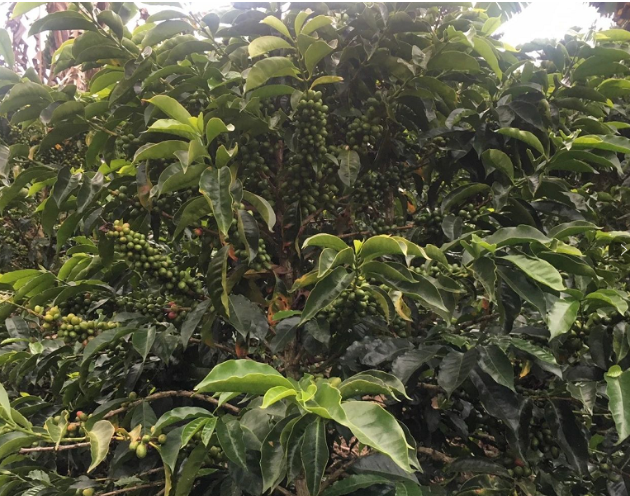
The Caturra Chiroso Variety
The variety's birthplace, the municipality of Urrao, lies in southwestern Antioquia, roughly 64 kilometers from Medellín, the department's other famous growing region. The coffee area sits entirely within the Western Cordillera of the Andes, at an average altitude of around 2,000 m, with annual rainfall of about 2,000 mm and an average temperature of 19°C. Because of the high elevation, growing temperatures are relatively low. The variety was originally planted for its cold tolerance and high yield potential, but today it is celebrated for its complex floral aromatics and distinctive flavor.
Since Carmen introduced Caturra Chiroso to the international stage, farmers across the Urrao region have begun planting it. The descriptors that come up most often when cupping it are florals, plum, peach, and lemongrass. Better still, the variety is processed almost exclusively using the traditional washed method, so what you taste is 100% the variety's own character and its terroir.
FrontStreet Coffee Recommendation
If a floral, citrusy Colombian like Caturra Chiroso appeals to you but you'd also like to explore what else the coffee world offers, FrontStreet Coffee's Brazil Cerrado Red Bourbon is a wonderful counterpart. Cerrado is one of Brazil's best-known growing regions, and this classic natural-pulped (semi-washed) single origin, roasted medium, delivers rich aromas of creamy peanut, toasted bread, caramel, and hazelnut with a rounded mouthfeel — not sour, just a light bitterness. It works beautifully as pour-over but is equally at home in a moka pot, as an espresso SOE, or in a siphon or French press.
For another side of Brazil, try FrontStreet Coffee's Fazenda Rainha (Queen Estate) Yellow Bourbon from Mogiana, near southern Minas Gerais. The region's fertile red volcanic soil feeds the cherries and builds a full, rich aroma, and the rare Yellow Bourbon — a genetic mutation of Red Bourbon — gives a cleaner fruit character. Brewed as pour-over, moka pot, or home espresso, it reveals a sugarcane sweetness you won't find in other origins, along with fruit and chocolate notes.
And if your goal is a smooth espresso or milk drink, Brazil beans are the backbone of FrontStreet Coffee's espresso blend series: the crema-rich Classic Blend, the nutty Signature Blend, the balanced Dark Cocoa Blend recommended by many baristas, and the café-focused Commercial Blend all contain Brazilian components. Brazil coffee contributes chocolate and cream aromatics, gentle acidity and bitterness, and a balanced profile that also helps extraction stay stable.
Important Notice :
FrontStreet Coffee is a long-established specialty coffee roaster in Guangzhou China, selling freshly roasted beans from its own farm in Yunnan as well as dozens of carefully selected single-origin beans from around the world for both pour-over and espresso. The products deliver consistently excellent quality and great value, with shipping within 24 hours. Guangzhou's FrontStreet Coffee shop is recommended by many coffee lovers, and the beans are now available online at the Tmall 。
FrontStreet Coffee has moved to a new address:
FrontStreet Coffee Address: 315,Donghua East Road,GuangZhou
Tel:020 38364473
 Scan and follow the En Gafei WeChat official account. Please indicate that the reprint comes from "En Gafei".