What are the Flavors of Colombian Coffee Nurtured by Volcanic Soil? Colombian Coffee Processing Methods
Professional Coffee Knowledge Exchange
For more coffee bean information, follow FrontStreet Coffee.
Colombia is blessed with lofty mountains, plentiful water, varied topography, clusters of volcanoes, fertile soil, and abundant rainfall — in FrontStreet Coffee's view, a natural paradise for coffee. From 2008 to 2011, Colombian coffee won the SCAA cupping competition four years in a row, an even longer streak than Panama Geisha's three consecutive BOP titles that began in 2004.
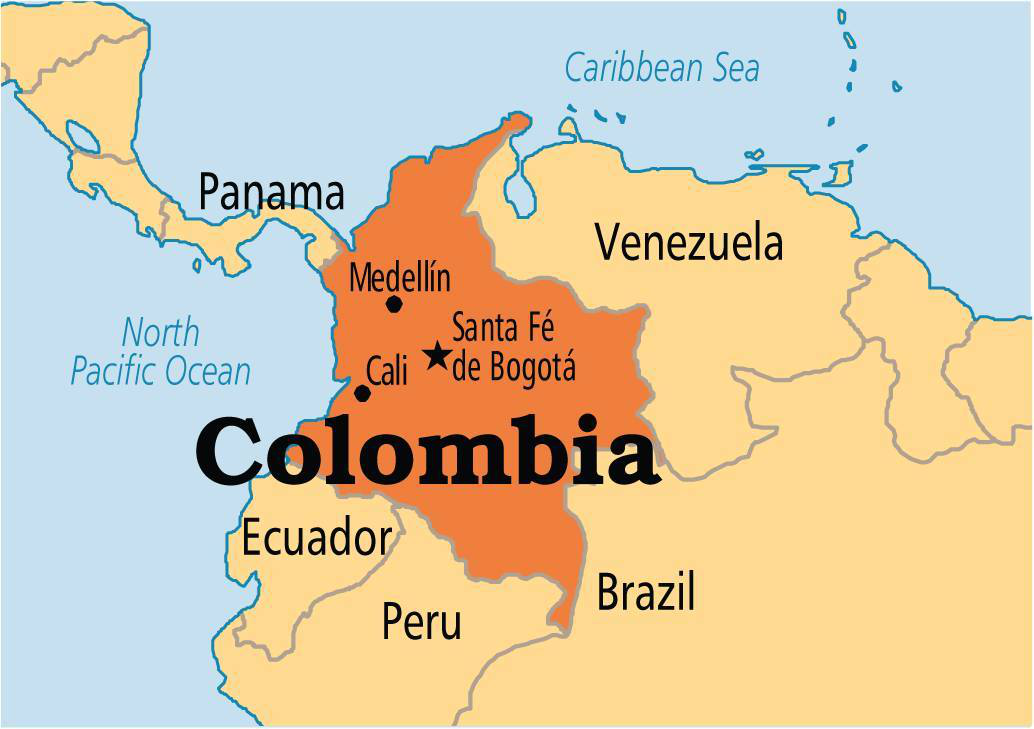
Colombia straddles both hemispheres, with its coffee regions spread between 2 and 8 degrees north latitude. Thanks to differing rainfall patterns from north to south, every region has two harvest periods: the main harvest runs from October to February, and the fly (secondary) harvest from April to September — in other words, Colombia harvests coffee year-round. The country grows no Robusta at all, which is how Colombian Arabica reaches an annual output of 12 million bags (each weighing roughly 60-70kg), making Colombia the second-largest Arabica producer in the world.
Colombian Coffee Regions
Colombian coffee country splits into two halves. One sits in central Colombia, producing mainly commercial-grade beans at lower altitudes around 1,000m. This zone is known as MAM — M for Medellín, capital of Antioquia; A for Armenia, capital of Quindío; and the second M for Manizales, capital of Caldas. Coffee from the central region has low acidity, a rich body, and good sweetness, somewhat reminiscent of an Indonesian Mandheling profile.
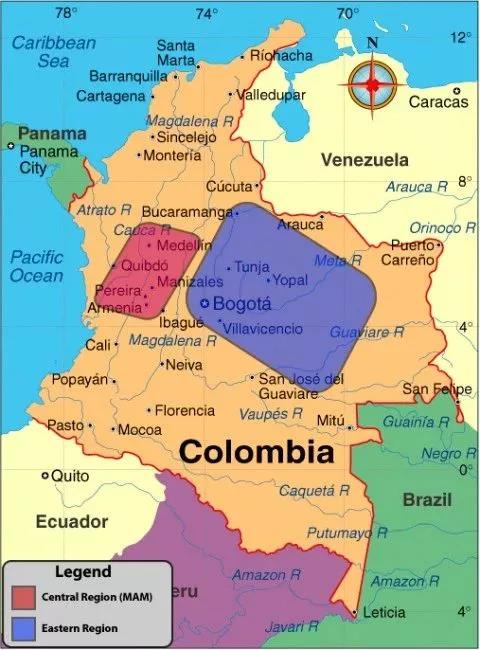
The other half lies in central-southern Colombia — the home of past SCAA Coffee of the Year winners. Volcanoes dot the landscape here, and the region is full of hidden specialty-coffee treasure, taking in the departments of Tolima, Cauca, Huila, and Nariño.
Huila Department
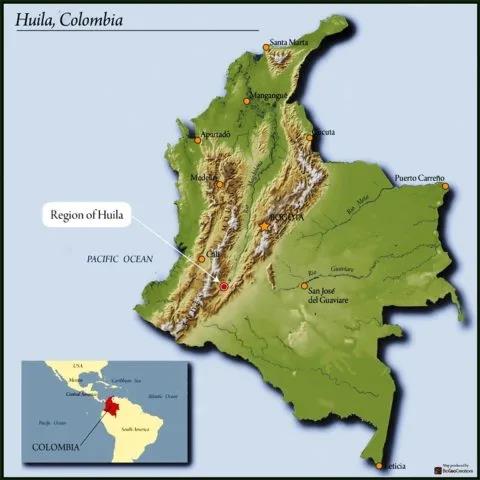
Located in the south of Colombia's Central Mountain Range, Huila is the country's most famous specialty coffee region. It is a hill country wrapped by mountains, with cultivation above 1,500 meters, and Colombia's most important rivers converge here, bringing abundant water and moisture. Contrary to the standard image of Colombian coffee as smooth and balanced, many small-farm micro-lots from Huila carry strong, distinctive regional characters.
In recent years, as the international market has put a premium on quality and demanded more Colombian specialty coffee, the traditional bean-size grading system has gradually given way to micro-regional selections organized by production area. Dozens of smallholders pool their harvests into a single micro-lot for sale, which makes it far easier to identify outstanding individual-farmer coffees through cupping, batch by batch.
Tolima Department
Bordering Huila and Cauca, Tolima is crossed by the Andes (M. Andes) and Cordillera ranges running north to south, with the Magdalena River (R. Magdalena) flowing between these two great mountain systems. The name Tolima comes from the Pijao people, the area's earliest inhabitants — in their language it means "snowed." Farms in Tolima tend to be slightly larger than elsewhere in southern Colombia, running between 10 and 15 hectares. Cooperatives are popular here: farmers deliver small batches of fresh cherries to cooperative mills, while some process their own coffee with small-scale equipment sized to their daily harvest.
Cauca Department
Cauca is an origin-certification region with an average altitude of 1,758m, climbing to 2,100m at its highest. Its topography, precipitation, temperature, and volcanic soil make near-perfect coffee country. Eighty percent of the department is mountainous, with parallel ranges in the east and center forming part of the Andes.
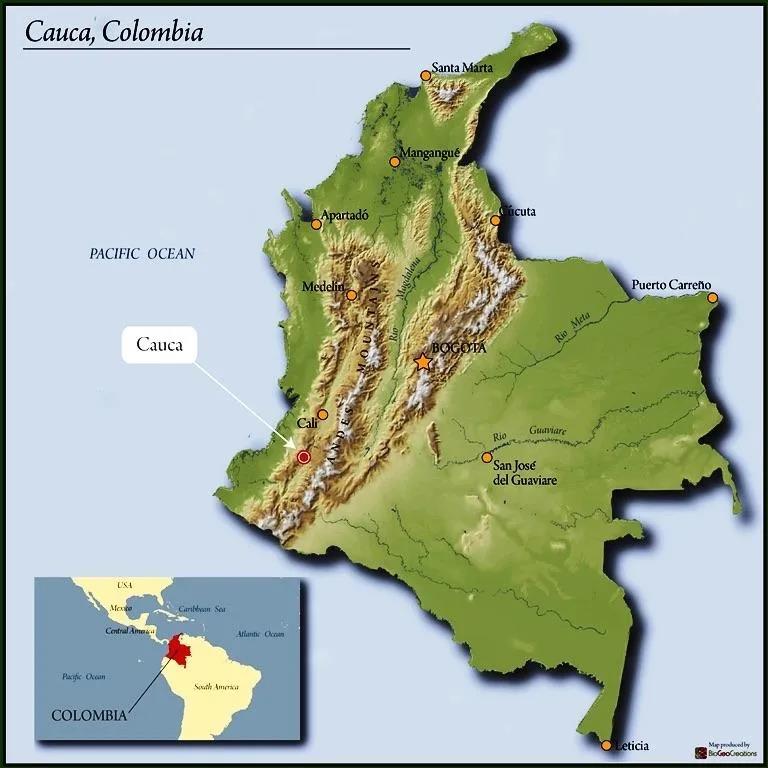
The central range holds two main volcanoes, Sotara and Petacas. Like other southwestern regions, Cauca shows a distinctly unimodal rainfall pattern: a dry season falls mainly in August-September each year, the following rainy season triggers concentrated flowering, and the next year brings a concentrated harvest.
Nariño Department
Nariño sits in the country's southwest, with the Pacific to the west and Ecuador to the south, and the Andes running clear through the department. Coffee grows in the high-altitude cloud forest belt between 1,600 and 2,300 meters on fertile volcanic soils; the beans are small but dense, with a vibrant green color. Most of Nariño's annual output is bought by large American coffee merchants. The department's dramatic ranges and scenery, laced with southward-flowing rivers, place it firmly in Colombia's high-mountain coffee zone, and it has nurtured many smallholder specialty producers. Nariño produces about 150,000 bags a year, of which only around 6,000 bags qualify as specially selected beans.
Volcanic Ash Enhances Flavor and Body in Colombian Coffee Beans
From 2008 onward, the Huila volcano stirred back to life, ejecting large amounts of mud and ash — though fortunately no lava. Far from worrying, local farmers welcomed it, hoping the ash keeps coming: volcanic material is rich in minerals that nourish the soil, helping coffee develop more flavors and aromas. Some growers even credit the volcanic ash for Colombian coffee's run of championship wins after 2008.
Coffee Varieties Cultivated
Any variety that struggles elsewhere grows comfortably in Colombia's fertile land — Typica, Bourbon, Caturra, Pacamara, Geisha, and more. Thanks to rich soils and big day-night temperature swings, Caturra, which never quite took to Brazil, thrives in Colombia, yielding abundantly and becoming one of the country's two main varieties. In 1980, Colombia bred a multi-generation Catimor derivative and named it "Colombia" after the nation, forming a dual mainstay with Caturra. In 2002, Colombia launched a second-generation "Colombia" called Castillo and strongly encouraged farmers to switch to it.
Caturra
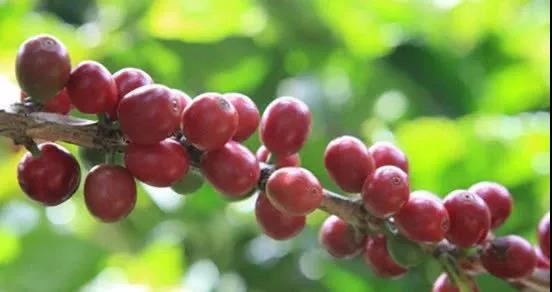
Caturra is a natural mutation of Arabica Bourbon, discovered in Brazil in 1937. The plant is more compact than Bourbon, and while it inherited Bourbon's lineage it has relatively weak disease resistance — though it yields more. Despite being found in Brazil, Caturra never suited conditions there and was never planted on a large scale; instead it spread widely across Central and South America, with Colombia, Costa Rica, and Nicaragua planting it extensively.
Colombia (Variety)
This variety has Caturra-and-Timor Hybrid parentage — in other words, it belongs to the infamous Catimor family. But the FNC insists that although Colombia descends directly from Catimor, its cup is far more elegant than typical Catimor, because the variety was repeatedly "backcrossed" with Arabica over multiple generations, eliminating the musty Robusta flavors. The result tastes much closer to Arabica while keeping the disease resistance and high yields of its Robusta heritage — a powerful tool for lifting Colombia's production.
Castillo
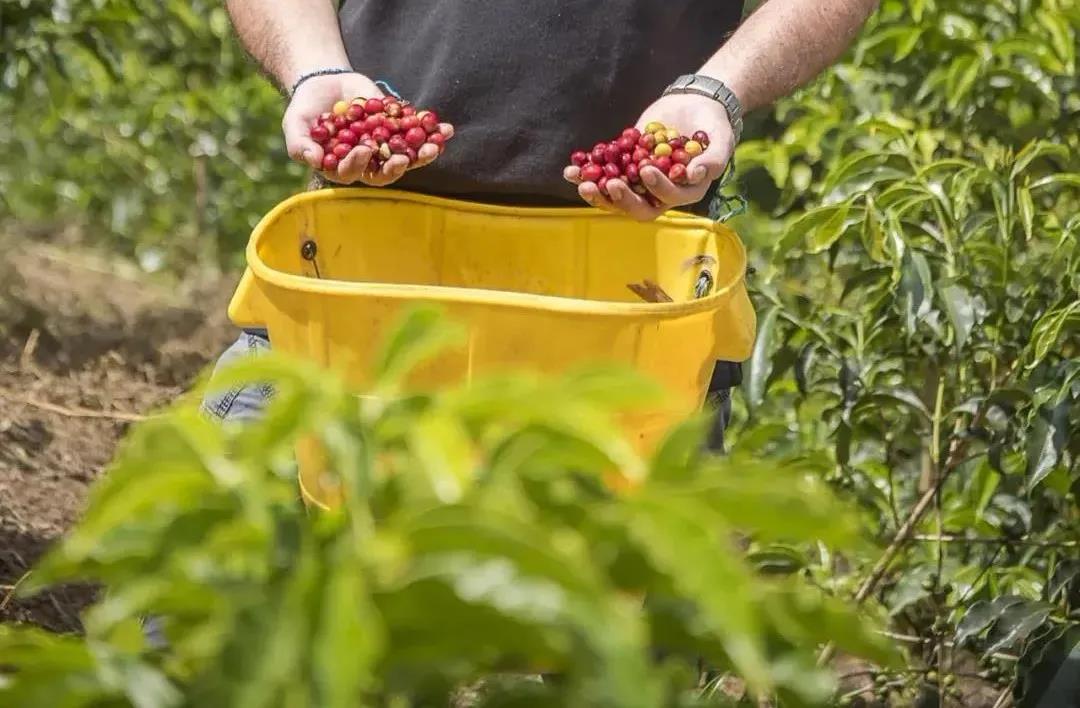
Castillo is the most widely planted variety in Colombia, prized for its leaf-rust resistance. Research began in 1961, when Cenicafe started working on the Timor Hybrid with its Robusta lineage. Cenicafe kept going, releasing Tabi — a cross of Typica, Bourbon, and Timor — as its second disease-resistant variety in 2002, and then, in 2005, its most successful disease-resistant variety to date: Castillo. After the major leaf rust outbreak of 2008, Colombia threw its weight behind planting Castillo nationwide.
Coffee Bean Processing Methods
Colombian coffee is processed mainly by the washed method. And with the rise of experimental processing — plus Colombian coffee's famously "all-embracing" character — more and more novel methods are being applied to Colombian beans, the most representative being anaerobic fermentation.
Washed Processing Method
Washed
Farmers first dump the harvested cherries into large water tanks: underdeveloped, inferior beans float while mature, dense cherries sink. The floaters are skimmed off, then a pulping screen removes the skin and outer pulp, leaving beans still coated in a slippery layer of mucilage.
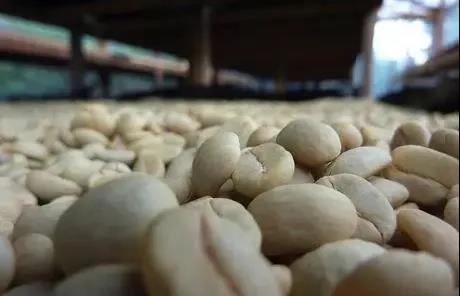
The mucilage-coated beans go into fermentation tanks for 16-36 hours, during which microorganisms break down the mucilage. Once fermentation is complete, copious clean water washes away the residue, and the beans are finally dried in the sun.
Anaerobic Fermentation Processing Method
Anaerobic Fermentation
Anaerobic fermentation goes by many names — some call it "anaerobic fermentation," others "carbonic maceration." Put simply, it is fermentation in a low-oxygen or oxygen-free environment, usually in pressure-rated stainless steel tanks that allow precise control of temperature, time, pH, and other variables. The best-known forms are anaerobic natural and anaerobic washed.
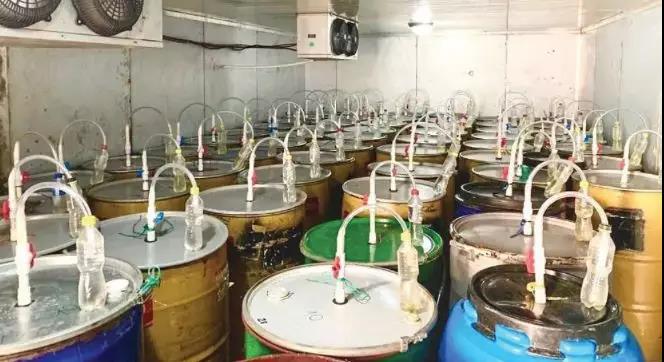
Anaerobic Natural Processing Method
Freshly harvested cherries are sealed into fermentation tanks for low-temperature fermentation, which must stay below 10-15 degrees Celsius. In the oxygen-free environment, the sugars in the mucilage break down more slowly and pH falls more gradually, extending the fermentation and building better sweetness and more balanced flavors. After more than three days of anaerobic fermentation, the cherries are moved to sun-drying.
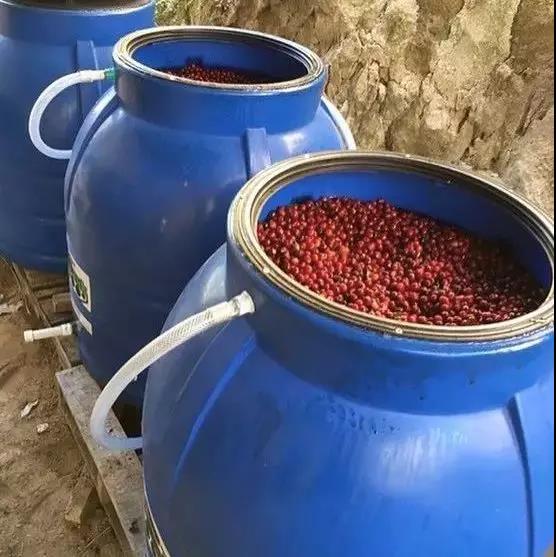
Anaerobic Washed Processing
Anaerobic washed processing first removes defective beans through washing, then places the processed beans in a sealed container and injects carbon dioxide to displace the oxygen. With no oxygen present, the sugars in the mucilage decompose more slowly and pH drops more gradually, extending fermentation to develop better sweetness and more balanced flavors.
Anaerobic double-enzyme washed: this builds on anaerobic washed by adding special enzymes for a second anaerobic fermentation. After the fruit leaves the first anaerobic environment, machines strip the skin and pulp, and the mucilage-coated beans are sealed into plastic bags or similar containers for a second round of anaerobic fermentation. A coffee that has gone through both stages is called a double anaerobic fermentation.
Differences Between Anaerobic Natural and Anaerobic Washed Coffee Beans
Now that you know the methods, you may wonder how the finished beans actually differ. FrontStreet Coffee compared two Caturra lots — the anaerobic natural "Kagetsuya" and the anaerobic double-enzyme washed "Rose Valley" — side by side at every stage: green beans, roasting, cupping, and brewing.
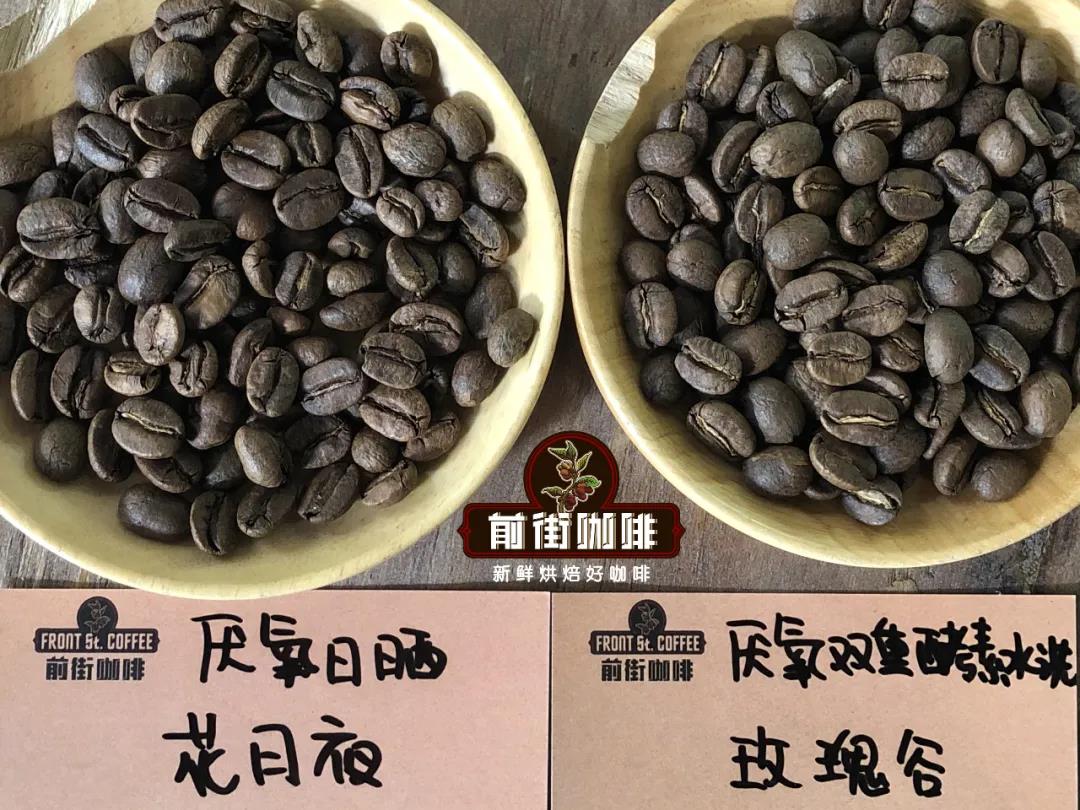
FrontStreet Coffee Raw Bean Comparison
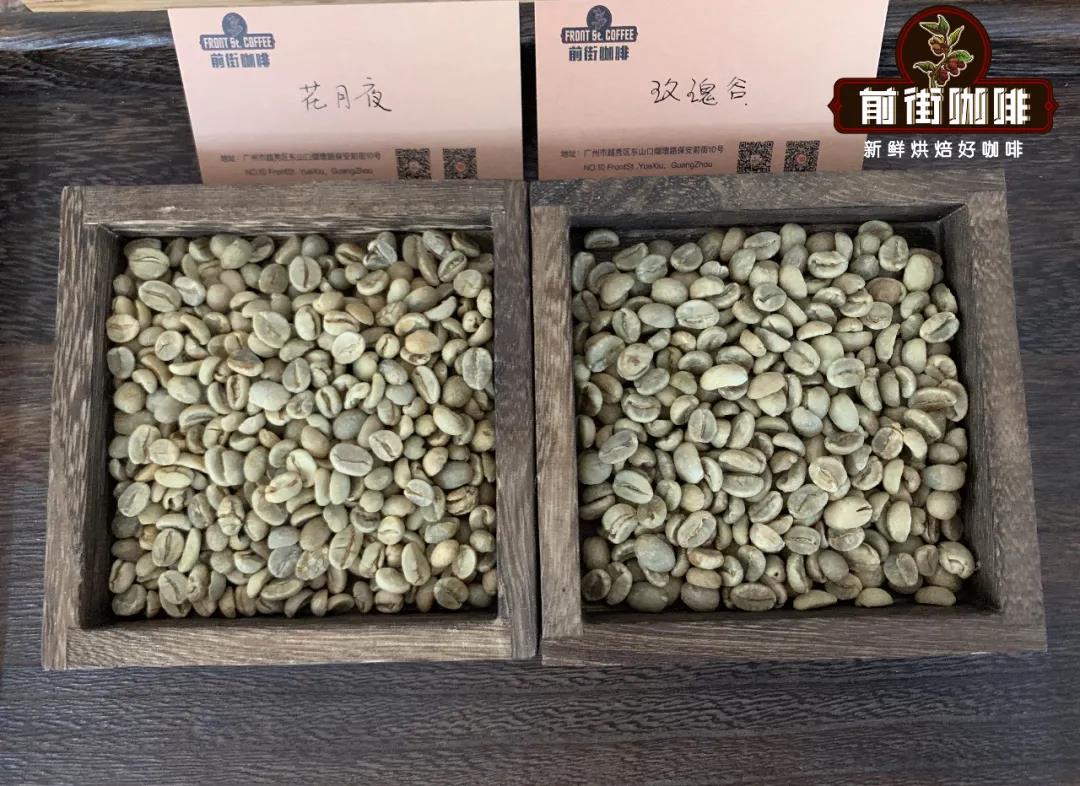
Raw, the anaerobic natural beans look yellow-green with more silver skin, while the anaerobic washed beans are blue-green with far less. That's because washed beans soak in water so long during processing that the silver skin separates from the bean; when the parchment is hulled off at the end, the silver skin peels away with it, leaving very little behind.
FrontStreet Coffee Roasting Records
Both are fresh-crop beans with high moisture content, so FrontStreet Coffee's roaster stretched the drying phase to make sure the surface and core of each bean heated evenly.
Kagetsuya Roasting Suggestions
Since Colombian Kagetsuya is anaerobic natural, a medium roast was chosen to keep the bean's fermentation character while showcasing full body and sweet flavors.
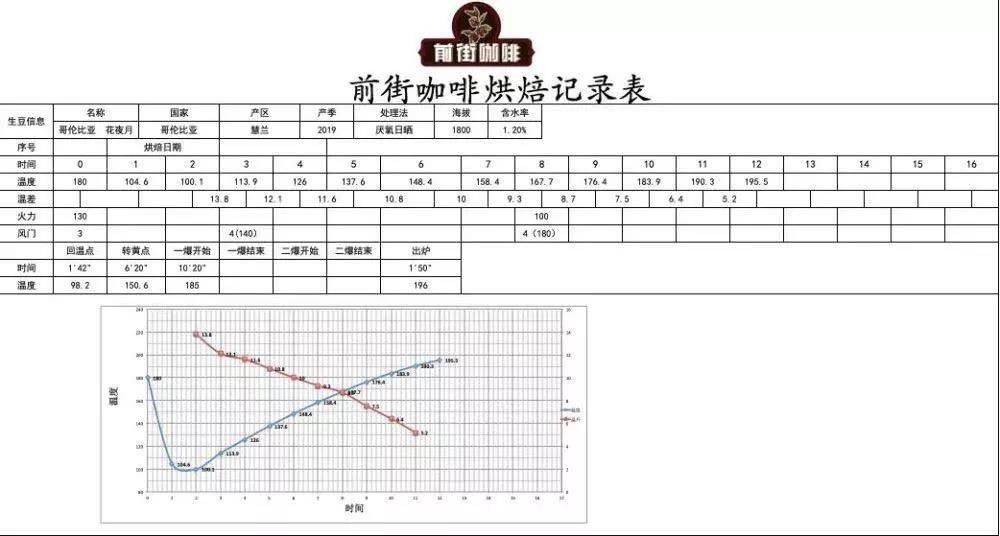
Yangjia 800N, charge 480g. Add beans at a furnace temperature of 180°C, damper at 3, heat at 130; turning point at 1'42". At 140°C open the damper to 4; at 150.6°C the yellowing point arrives at 6'20" — the bean surface turns yellow, the grassy smell disappears completely, and the dehydration stage begins. At 180°C, cut heat to 100, damper unchanged. At 8'45" the bean surface shows pronounced wrinkles and dark mottling, and the toast aroma clearly shifts toward coffee aroma — the prelude to first crack, so listen carefully. First crack begins at 10'20"; damper fully open, develop for 1'50" after first crack, discharged at 196°C.
Rose Valley Roasting Suggestions
Since Colombian Rose Valley is double-anaerobic washed, a medium roast was chosen to preserve its fruity notes and rich acidity while bringing out a clean mouthfeel and sweet-sour balance.
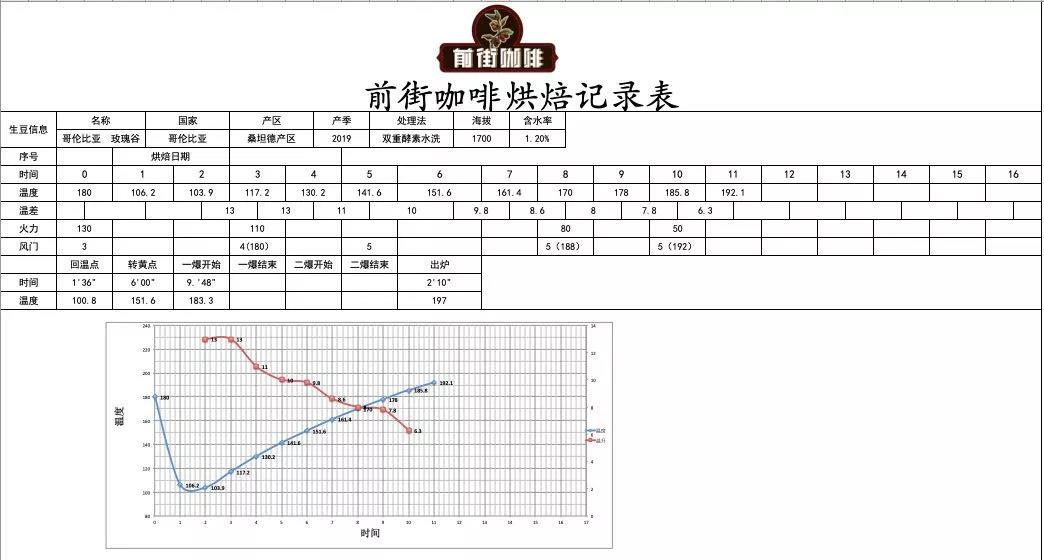
Yangjia 800N, charge 480g. Add beans at a furnace temperature of 180°C, damper at 3, heat at 130; turning point at 1'36". At 140°C open the damper to 4; at 151.6°C the yellowing point arrives at 6'00" — the bean surface turns yellow, the grassy smell disappears completely, and the dehydration stage begins. At 8'17" the bean surface shows pronounced wrinkles and dark mottling, and the toast aroma clearly shifts toward coffee aroma — the prelude to first crack, so listen carefully. First crack begins at 9'48"; damper fully open, heat cut to 80 at 188°C, then to 50 at 192°C; develop for 2'10" after first crack, discharged at 197°C.
FrontStreet Coffee Cupping Reports
Kagetsuya Cupping Flavors
Dry Aroma: Berries, nuts, fermented aroma
Wet Aroma: Berries, strawberry, chocolate
Flavor: Strawberry jam, fermented wine aroma, chocolate

Rose Valley Cupping Flavors:
Dry Aroma: Fermented, berries, strawberry
Wet Aroma: Honey, juicy sensation, strawberry
Flavor: Rose, peach, liquor-filled chocolate
FrontStreet Coffee Brewing Tips
Dripper: Hario V60 #01
Water Temperature: 90-91°C
Dose: 15 grams
Ratio: 1:15
Grind Size: Medium-fine / fine sugar size (80% pass-through rate on #20 sieve)

FrontStreet Coffee brews in three segments: bloom with 30g of water for 30 seconds. Pour in small circles up to 125g, then pause. When the water level drops and the coffee bed is about to break the surface, pour up to 225g and stop. When the level drops again and the bed is about to break the surface, remove the dripper (timing starts at the bloom). Extraction time: 2'00"-2'10".
Kagetsuya brewed flavor: rich strawberry aroma, strawberry acidity on entry, jam-like sweetness in the middle, a subtle cocoa aftertaste, and a juice-like mouthfeel.
Rose Valley brewed flavor: the sweetness of peach with rose and liquor-filled chocolate aromas, high-quality sweet-sour notes like black grapes, and a silky, creamy-toffee mouthfeel.
FrontStreet Coffee Recommendation
If anaerobic processing has you curious about other boundary-pushing coffees, Geisha is the natural next step — and FrontStreet Coffee's Geisha lineup covers every budget. Geisha first stunned the world at the 2003 Best of Panama competition, where the Emerald Estate lot took the crown with an average cupping score of 94.6, a BOP record. The estate's Red Label (Esmeralda Special) grows at 1,600-1,800 meters from single named plots and must cup above 90 points per batch; the Green Label (Private Collection) blends batches across plots to express the estate's signature high-altitude style at a friendlier price, making it exceptional value. For a first taste of Geisha flavor, the entry-level FrontStreet Coffee Boquete Geisha serves up classic orange-blossom honeyed sweetness, oolong-tea texture, and delicate fruit acidity.
Those drawn to Ethiopia — Geisha's birthplace — should look at FrontStreet Coffee's Granja Granadilla Estate Geisha, from a processing station established in 2014 and run by Mr. Israel Degefa at the border of Kochere and Granja Abaya, where 700 hectares of largely uncultivated, fertile, shade-covered land surround the station. Fully ripe cherries are hand-picked and raised-bed dried for 14-20 days depending on the weather. Roasted medium-light, it shows bright citrus acidity, elegant ginger-flower aromatics, full sweetness of ripe fruit, and a silky mouthfeel with Geisha's signature refined finish. For the ultimate Ethiopian experience, FrontStreet Coffee also carries Geisha Village Gold Label (the Geisha 1931 variety, 10% of the estate's output, its top non-auction coffee) and Red Label (Gori Gesha, 15% of output, scoring 88+ on the SCA 100-point scale with fully traceable lot numbers).
Brewing note: Geisha is dense and prone to clogging the filter bed, so FrontStreet Coffee suggests a medium-coarse grind (78% pass-through on a #20 sieve, about fine granulated sugar), water at 91°C, and a 1:16 ratio with 15g of coffee in a Hario V60 — bloom with 30g of water for 30 seconds, pour in small circles to 125g, top up to 225g once the bed drops to half, for a total extraction of about 2:10-2:20.
Important Notice :
FrontStreet Coffee is a long-established specialty coffee roaster in Guangzhou China, selling freshly roasted beans from its own farm in Yunnan as well as dozens of carefully selected single-origin beans from around the world for both pour-over and espresso. The products deliver consistently excellent quality and great value, with shipping within 24 hours. Guangzhou's FrontStreet Coffee shop is recommended by many coffee lovers, and the beans are now available online at the Tmall 。
FrontStreet Coffee has moved to a new address:
FrontStreet Coffee Address: 315,Donghua East Road,GuangZhou
Tel:020 38364473
 Scan and follow the En Gafei WeChat official account. Please indicate that the reprint comes from "En Gafei".