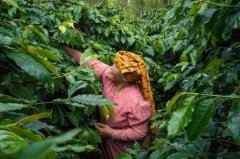
The Difference Between Honey Process and Raisin Honey Process in Costa Rica Musician Series Coffee Beans
FrontStreet Coffee, like many coffee connoisseurs, describes Costa Rican coffee as exceptionally mild and smooth, with a harmonious balance of fruity acidity, sweet fragrance, and chocolate-nutty bitterness. The country's innovative honey processing adds a notable layer of sweetness to that profile.
The Development of the Costa Rican Coffee Industry
Costa Rica started cultivating coffee early, exporting its first batch to Colombia and Chile in 1820. In 1825 the government actively promoted coffee growing by exempting the crop from certain taxes. In 1831 a decree granted ownership of any fallow land to anyone who had planted coffee on it for more than five years. Genuine coffee exporting began in 1832.
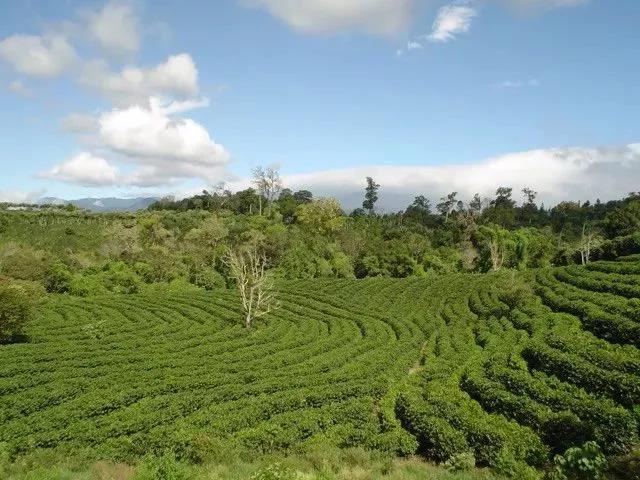
In 1843, shortly after the British increased their investment in Costa Rica, direct trade between the two began. In 1854 an importer successfully shipped over one hundred tons of coffee to London with the help of British merchant vessels; the shipment was an instant success and was praised by the British nobility as "golden beans" from Costa Rica. In 1863 the Anglo Costa Rican Bank was established in Colombia, supplying funding that allowed the industry to grow.
Coffee Drives Costa Rica's Infrastructure
For the fifty years between 1846 and 1890, coffee was the country's only export product. Coffee production also spurred infrastructure development, including the first railway crossing the entire country toward Gran Puntarenas, along with hospitals, post offices, and more. This coffee infrastructure long helped Costa Rica secure better prices on international markets. The wet processing method was introduced in 1830, and by 1905 the country already had 200 wet processing plants.

An Institution to Protect Coffee Farmers
In 1933, under pressure from the various coffee-producing regions, the government established a rather imposingly named Institute for the Defence of Coffee. Its original purpose was to protect small coffee farmers from exploitation, preventing unscrupulous merchants from buying their coffee cheaply and reselling it at a high price after processing. In 1948 the institution was renamed Oficina del Cafe, with some functions transferred to the government's Ministry of Agriculture. Today it has become the Instituto del Café de Costa Rica (ICAFE), deeply involved in the industry. It runs experimental farms and promotes Costa Rican specialty beans worldwide, funded by 1.5% of the country's coffee export profits.
The Innovative "Sweet as Honey" Process
In the mid-to-late 21st century, many micro-processing plants began appearing across the country. Farmers invested their own funds in post-harvest equipment so they could process most of their coffee themselves, giving them far greater control over their own lots and styles. Costa Rica mainly grows Caturra and Catuai, varieties with an elegant flavor. The country originally relied on the wet process, but in recent years an alternative approach called honey coffee has emerged.
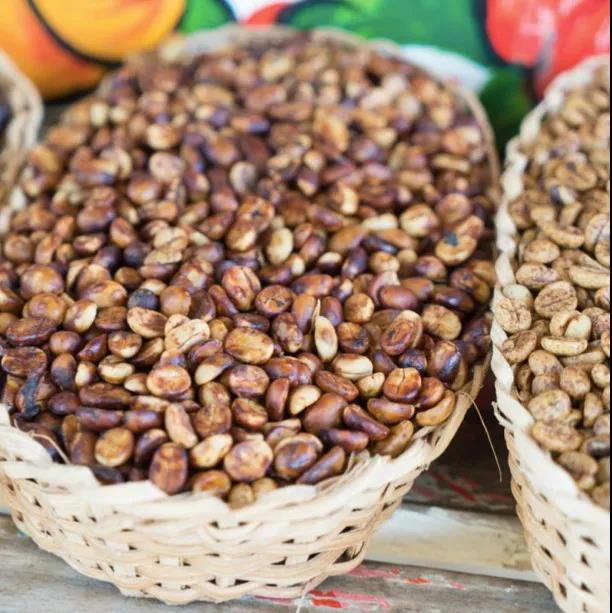
Honey processing is an improvement on the Brazilian pulped natural method, designed to heighten sweetness. The key is to leave as much of the mucilage layer on the beans as possible. After the pulp is removed, the sticky beans are taken to raised racks and sun-dried for about one to two weeks. Throughout this period the beans must be turned every hour for even drying, allowing them to fully absorb the sugars from the mucilage. FrontStreet Coffee believes honey-processed beans have superior flavor, with balanced acidity and sweetness. As with the natural process, the sun drying also amplifies the beans' own aroma, producing a rich, mellow cup. The method does carry risks, however: it is demanding to manage and prone to mold and spoilage.
How Raisin Honey Relates to Honey Processing
Raisin honey processing retains 100% of the mucilage with zero water treatment. That makes it harder to control and demands strict timing. On the day the cherries are harvested, the fruit is poured into large water tanks, where ripe, full cherries sink and underdeveloped or overripe ones float and must be removed. The selected cherries are dried on raised beds for at least three days, then the skin is removed while the mucilage is preserved before drying continues. At this stage, climate is the decisive factor in whether the honey process succeeds.
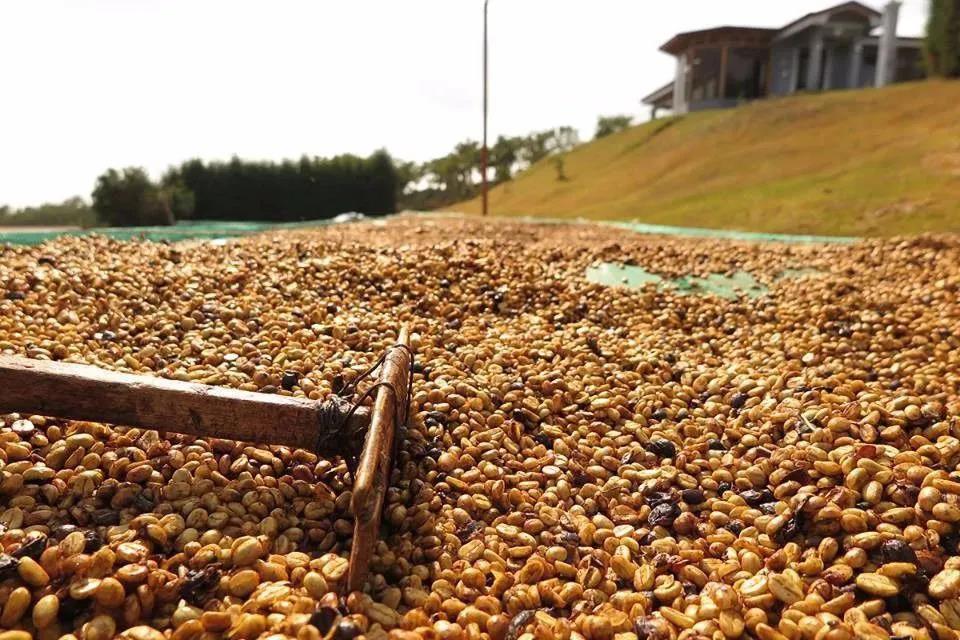
During drying, the cherries must be turned constantly for evenness, but the frequency has to be controlled so that drying stays slow enough for proper fermentation without going so slowly that it over-ferments. This sweet raisin honey method gives the coffee a white-wine mouthfeel and balanced acidity, with more intense fermentation aromas.
Costa Rican Coffee Growing Regions
Costa Rica has 7 coffee growing regions: West Valley, Central Valley, Tarrazu, Tres Rios, Orosi, Brunca, and Turrialba. Of these, Central Valley, Tarrazu, and Tres Rios are the most famous. As a rule, coffee from slopes facing the Pacific is of better quality than coffee from slopes facing the Atlantic.
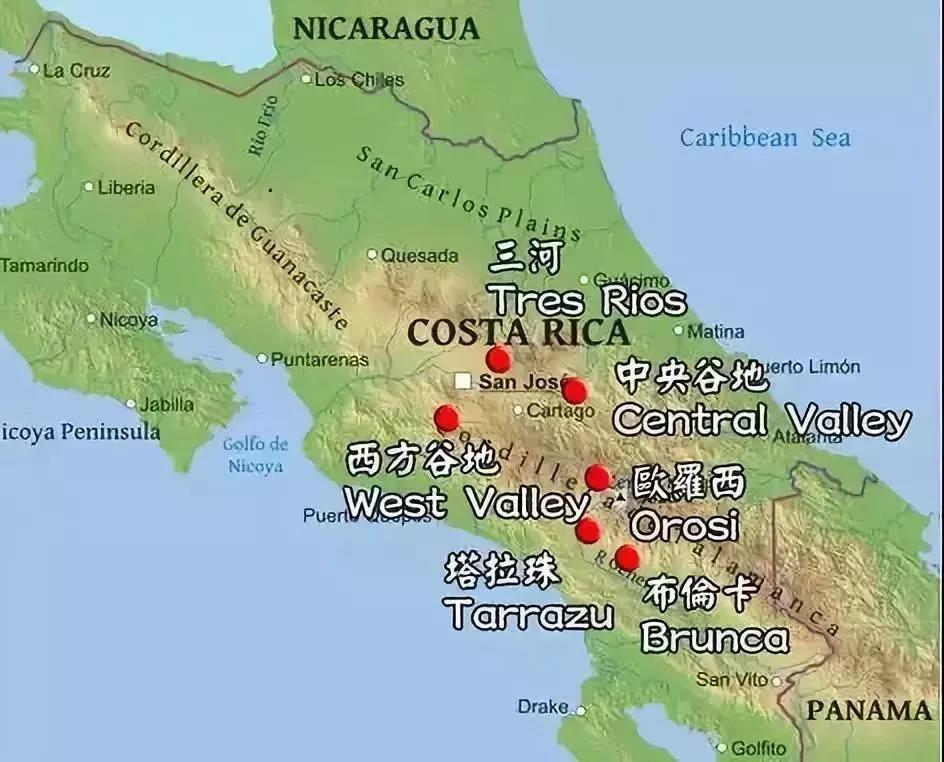
Central Valley
Altitude: 1,200-1,600 meters; harvest season: November to March. The region has three subregions, San José, Heredia, and Alajuela, and contains three high-altitude volcanoes, Irazú, Barva, and Poás, which feed the surrounding coffee areas with rich nutrients. The excellent microclimate combined with the fertile soils of the Poás and Barva volcanoes gives beans here superior characteristics: chocolate-cocoa flavors, bright fruit acidity, and elegant aromas. Central Valley is also where coffee was first cultivated before the industry spread to other regions. With moderate rainfall (118 inches annually) and an average annual temperature of only 19°C, together with high altitude, the beans are hard, aromatic, smooth, highly acidic, full-bodied, and fragrant. As Costa Rica's earliest coffee area, FrontStreet Coffee finds that its rich volcanic soil sometimes imparts a chocolate aroma. The coffee is washed first, then machine-dried at low temperature in the later stage.
Tres Rios
Altitude: 1,200-1,650 meters; harvest season: December to March. Located near the eastern side of the capital, the Irazú Volcano and local rivers create an excellent microclimate. In recent years, however, urban areas have expanded into the suburbs and farmland has been sold to developers, causing a sharp decline in coffee production here. Most of the remaining output is contracted by Starbucks, making it hard for the wider industry to buy. The renowned Aquiares Granja farm in this region has persisted since 1857. FrontStreet Coffee finds that coffee from this region has a bright fruit acidity that is gentle rather than sharp, with charming nutty, floral, and toffee sweetness, a smooth high acidity, hard and full beans, and an intense aroma. The climate is good, the mouthfeel distinct, and the balance excellent.
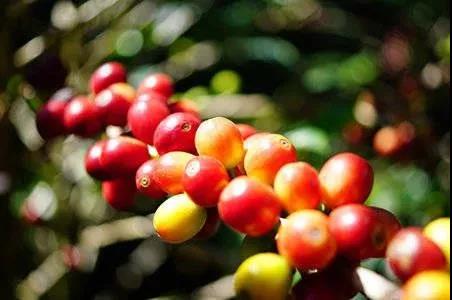
Tarrazu
Altitude: 1,200-1,700 meters; harvest season: December to March. The coffee is smooth with relatively high acidity, hard and full beans, and an intense aroma. This region is world-renowned, its hallmark being the peerless mouthfeel that high-altitude cultivation creates. Tarrazu sits in Central America's fertile volcanic belt, with a humid climate, fertile volcanic rock soil, abundant year-round rainfall, high altitude, and dense natural forest shade, giving coffee a uniquely favorable environment. No pesticides or artificial fertilizers are used during cultivation. Nearly 95% of the beans produced in the high mountains of Tarrazu are Strictly Hard Bean (SHB), generally grown above 1,500 meters.
Today the Tarrazu region has 26 member farms, and among them the Musician Series from Hacienda La Candela has introduced many beginners to specialty coffee from Costa Rica.
Hacienda La Candela
Hacienda La Candela is owned by three brothers who have been growing coffee for over 10 years and also run a small processing plant. The Musician Series takes its name from the owner's love of classical music, so the estate's coffees are named after "Beethoven," "Bach," "Chopin," and "Mozart." The series uses Caturra and Catuai varieties, processed with both raisin honey and washed methods to highlight each coffee's flavor profile. FrontStreet Coffee currently offers the Musician Series: "FrontStreet Coffee Costa Rica Beethoven," "FrontStreet Coffee Costa Rica Bach," and "FrontStreet Coffee Costa Rica Mozart."
Cultivated Varieties
Caturra
A natural mutation of Bourbon, discovered in Brazil in 1937. The plant is shorter and more compact than Bourbon. Although it carries Bourbon's lineage, it has relatively weak disease resistance but higher yields than Bourbon. Despite being discovered in Brazil, Caturra is not well suited to growing there and so was never widely planted. Instead it became hugely popular across Central and South America, with countries such as Colombia, Costa Rica, and Nicaragua planting it extensively.
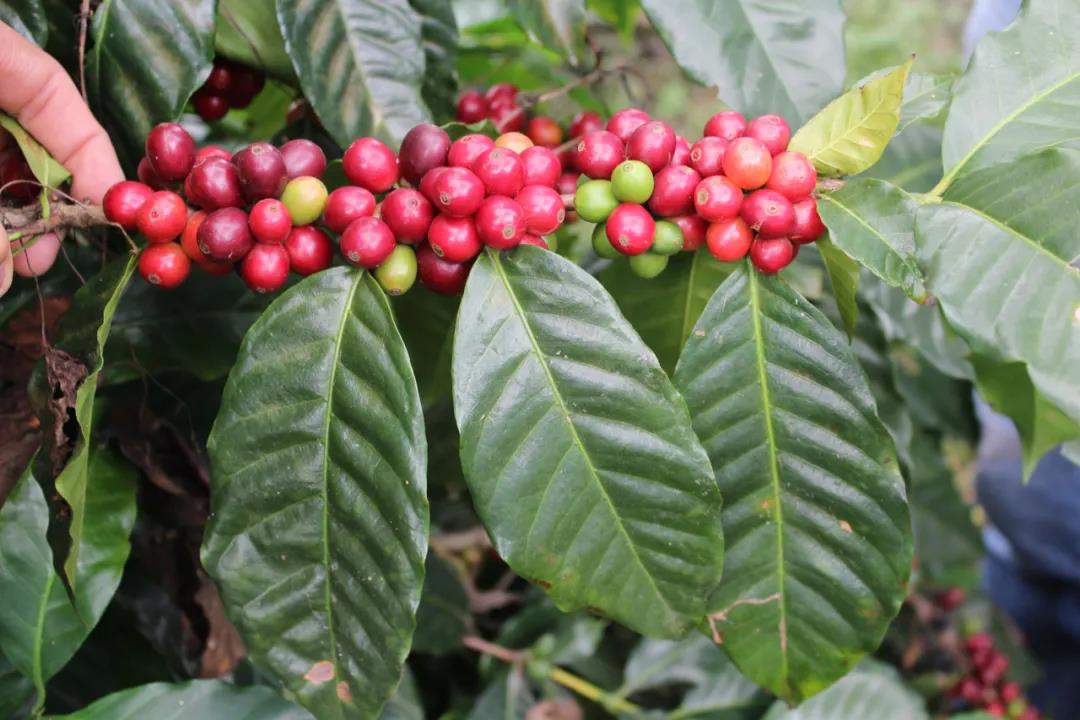
Catuai
A variety artificially hybridized from Caturra and Mundo Novo. Catuai inherits Caturra's compact structure and needs no shade, making it easy to grow and convenient to harvest. It also resists natural disasters better than Mundo Novo and shows good acidity in the cup. Catuai generally produces both red and yellow fruit types.
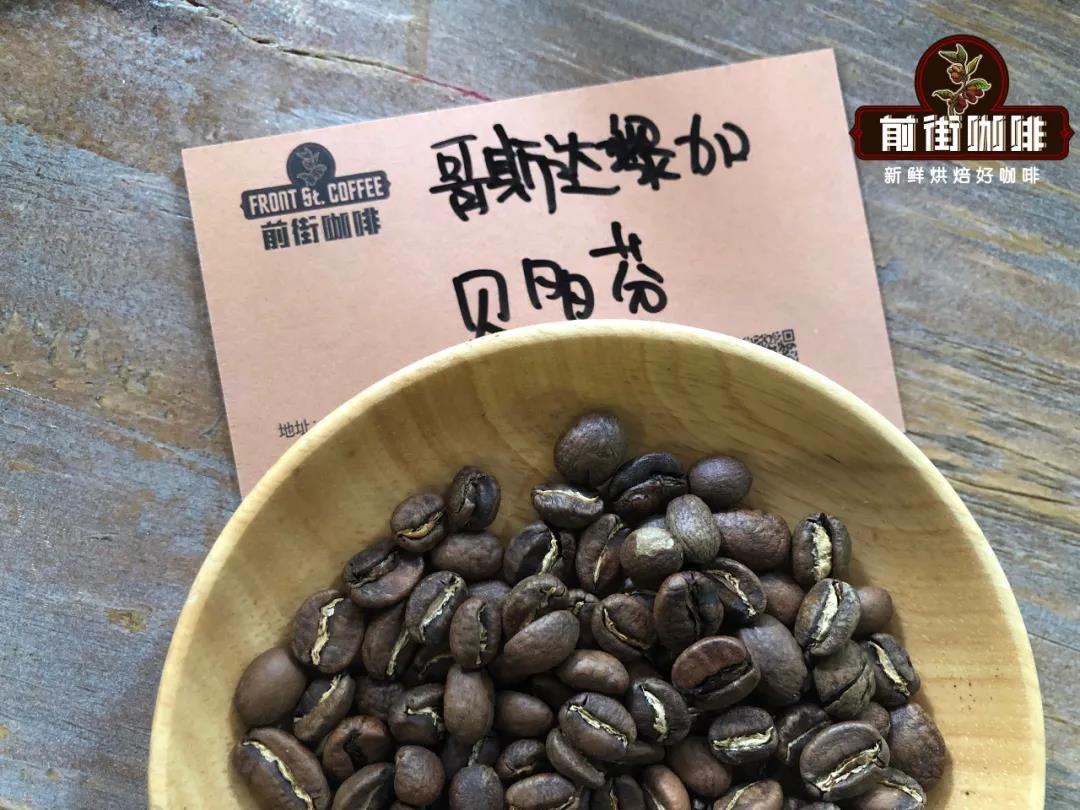
FrontStreet Coffee · Costa Rica La Candela Musician Series · Beethoven
Country: Costa Rica
Region: Tarrazu
Altitude: 1900m
Processing: Washed
Grade: SHB
Variety: Yellow Catuai
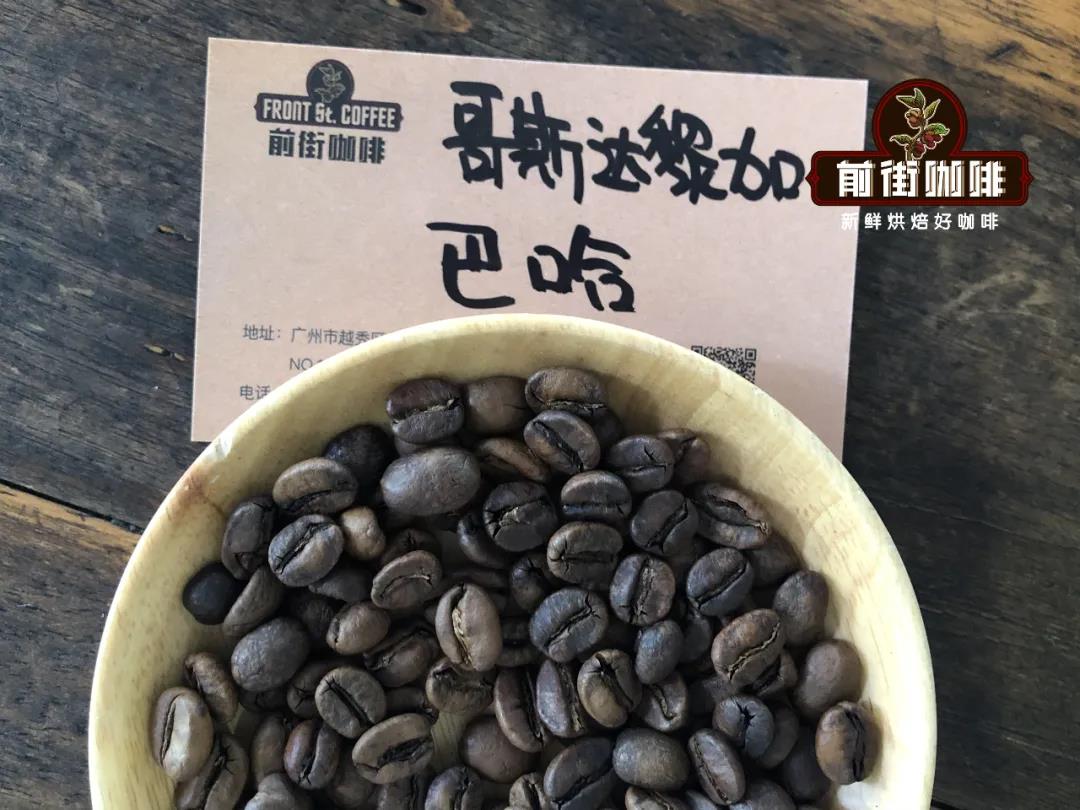
Among the romantics of classical music, Beethoven is undoubtedly the most famous, and beans that evoke his music naturally have exceptional flavor. The dry aroma opens with distinct red berries, strawberries most prominent, alongside floral fragrance. During brewing you notice florals, honey-like sweetness, and green grapes. FrontStreet Coffee's Beethoven delivers the sweet-and-sour taste of green grapes and red berries on entry, with an overall clean, smooth texture. As it cools, the red berry notes grow even more pronounced. Some overseas coffee blogs have described it as a coffee with the romance of summer.
FrontStreet Coffee · Costa Rica La Candela Musician Series · Bach
Country: Costa Rica
Region: Tarrazu
Altitude: 1950m
Processing: Raisin Honey
Grade: Strictly Hard Bean SHB
Variety: Caturra
Bach's music is refined, rich in layers, yet clear and organized, and the coffee named after him follows suit. The dry aroma carries strawberry, blackberry, and raisin-like fruit fragrances that also waft out during brewing. Freshly brewed, the floral and fruit aromas are distinct, with intense fruit fragrance and a sweet-sour taste on entry. The middle to late notes carry a subtle wine aroma, similar to red wine. As it cools, candied fruit sweetness develops and the wine notes grow more prominent, even revealing plum wine flavors. Each sip feels like experiencing the splendor and rigor of Baroque aesthetics.
FrontStreet Coffee · Costa Rica La Candela Musician Series · Mozart
Country: Costa Rica
Region: Tarrazu
Altitude: 1800m
Processing: Raisin Honey
Grade: SHB
Variety: Catuai, Caturra
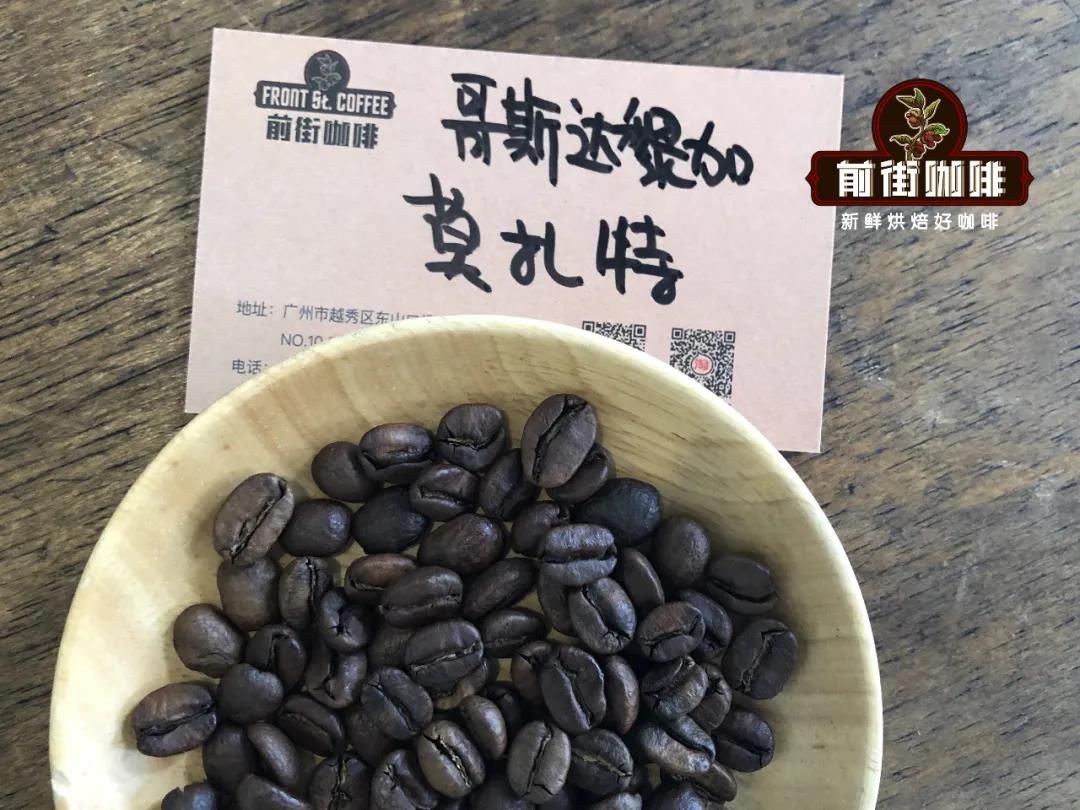
Mozart, the prodigy who synthesized classical music, was at his most magnificent, and the coffee is magnificent too. Magnificent aroma: elegant floral fragrance with white flower scents similar to orange blossom, also perceptible during brewing. Magnificent mouthfeel: abundant dark berries, raisins, and a trace of red berries, with subtle plum acidity and gummy-bear-like sweetness in the middle to late notes. The florals and sweetness hold even as the cup cools. Unlike earlier versions, FrontStreet Coffee's Mozart was originally made from the yellow Catuai variety processed with red honey, renowned for its exuberant floral aromas; this time, the sweetness of Caturra and Catuai represents FrontStreet Coffee's Mozart.
FrontStreet Coffee Roasting Records
FrontStreet Coffee Costa Rica Beethoven Roasting:
Roaster: Yangjia 800N semi-direct flame; roasting amount: 300g. Preheat the machine to 170°C before adding beans, adjust heat to 120, damper open to 3, return temperature at 1'36", maintain heat; at 140°C keep heat unchanged, open damper to 4. At 5'55" turn yellow, the grassy aroma disappears and the coffee enters the dehydration stage; at 151°C reduce heat to 100, keep damper at 4. At 176°C adjust heat to 85, damper unchanged.
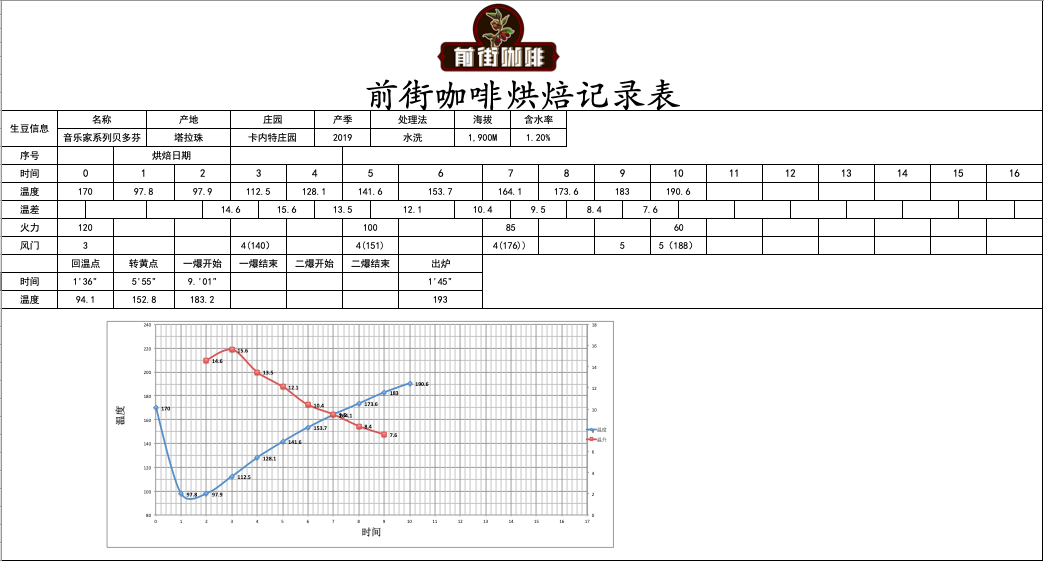
At 8'15" dehydration is complete, the bean surface shows wrinkles and black markings, and the toast aroma turns to coffee aroma, signaling the prelude to first crack, at which point one must listen carefully for the first crack sound. At 9'01" first crack begins, open the damper fully to 5, heat unchanged. Development time after first crack: 1'45", remove beans at 193°C.
FrontStreet Coffee Costa Rica Bach Roasting:
Roaster: Yangjia 800N semi-direct flame; roasting amount: 300g. Preheat the machine to 180°C before adding beans, adjust heat to 130, damper open to 3, return temperature at 1'43", maintain heat; at 140°C keep heat unchanged, open damper to 4. At 6'15" turn yellow, the grassy aroma disappears and the coffee enters the dehydration stage; at 151°C reduce heat to 100, keep damper at 4. At 176°C adjust heat to 70, damper unchanged.

At 8'15" dehydration is complete, the bean surface shows wrinkles and black markings, and the toast aroma turns to coffee aroma, signaling the prelude to first crack, at which point one must listen carefully for the first crack sound. At 9'40" first crack begins, open the damper fully to 5, heat unchanged. Development time after first crack: 1'45", remove beans at 196°C.
FrontStreet Coffee Costa Rica Mozart Roasting:
Roaster: Yangjia 800N semi-direct flame; roasting amount: 300g. Preheat the machine to 200°C before adding beans, adjust heat to 160, damper open to 3, return temperature at 1'36", maintain heat; at 140°C adjust heat to 160, open damper to 4. At 5'20" turn yellow, the grassy aroma disappears and the coffee enters the dehydration stage; at 166°C reduce heat to 130, keep damper at 4. At 176°C adjust heat to 100, damper unchanged.

At 8'05" dehydration is complete, the bean surface shows wrinkles and black markings, and the toast aroma turns to coffee aroma, signaling the prelude to first crack, at which point one must listen carefully for the first crack sound. At 8'55" first crack begins, open the damper fully to 5, heat unchanged. Development time after first crack: 1'30", remove beans at 193.2°C.
FrontStreet Coffee Cupping Reports
FrontStreet Coffee Costa Rica Musician Beethoven
Dry Aroma: Mature papaya, floral and fruit notes
Wet Aroma: Mature papaya, berries
Entry: Floral notes, citrus, berries, fermentation, almond
FrontStreet Coffee Costa Rica Musician Bach
Dry Aroma: Berries, fermentation fragrance
Wet Aroma: Berries, mature fruits
Entry: Fermented wine aroma, floral notes, mature fruits, pear

FrontStreet Coffee Costa Rica Mozart
Dry Aroma: Orange, floral notes
Wet Aroma: Berries, raisins
Entry: Raisins, Geisha, orange, berries, wind, caramel
FrontStreet Coffee Brewing Tips
Dripper: V60 #01
Dose: 15g
Ratio: 1:15
Grind: BG6m (80% passing through #20 sieve)
Water temperature: 90-91°C
*On grind size, FrontStreet Coffee determines this by sieving. Drawing on the Specialty Coffee Association (SCA) grind recommendations for pour-over, and verified through hands-on practice, FrontStreet Coffee has found that different grind sizes produce markedly different results and that every bean requires its own grind, which is the whole point of sieving. If you don't have a sieve at home, FrontStreet Coffee suggests judging by flow rate: if the water flows too fast, the grind is too coarse; if it flows too slowly, the grind is too fine.
FrontStreet Coffee uses segmented extraction, also known as three-stage brewing: use 30g of water for a 30-second bloom, then pour in small circles to 125g for the first segment, continue pouring to 225g once the water level drops to just expose the coffee bed, then remove the dripper when the level again drops to just expose the bed (timing starts from the bloom). Extraction time: 1'55"-2'05".

Brewing flavor of FrontStreet Coffee Costa Rica Bach: smells of fermented rice wine; tastes of sweet-and-sour mature tropical fruit and berries, with nut and cream flavors, a caramel aftertaste, and a subtle floral finish.
Brewing flavor of FrontStreet Coffee Costa Rica Beethoven: green grapes, vanilla, strawberries, cantaloupe, and citrus aromas, pomegranate juice acidity, excellent cleanliness, and a smooth texture with a hint of green kiwi acidity.
Brewing flavor of FrontStreet Coffee Costa Rica Mozart: the entry offers complex floral notes and a fermented sauce-like fragrance, with raisin and dried-fruit sweetness, starfruit and berry acidity, and a sugarcane aftertaste.
FrontStreet Coffee Recommendation
Sweetness driven by fermentation is the thread running through this article, and it is also the idea behind FrontStreet Coffee's Colombia Frontera Estate Xizhua. Grown in Colombia and processed with the anaerobic natural method, it converts fermentation into a big tropical fruit aroma, so a light-to-medium roast drinks with passion fruit, grape, apricot, and candied fruit complexity across pour-over, cold brew, drip bags, and moka pot.
If you prefer the foundational flavors of Colombia, FrontStreet Coffee's washed Huila is a bean to know, medium-dark roasted to bring forward black chocolate and nutty sweetness with a moderate oil and full body. It works equally well as a pour-over and as the base of an Americano or latte, making a natural companion to the Musician Series without repeating them.
Important Notice :
FrontStreet Coffee is a long-established specialty coffee roaster in Guangzhou China, selling freshly roasted beans from its own farm in Yunnan as well as dozens of carefully selected single-origin beans from around the world for both pour-over and espresso. The products deliver consistently excellent quality and great value, with shipping within 24 hours. Guangzhou's FrontStreet Coffee shop is recommended by many coffee lovers, and the beans are now available online at the Tmall 。
FrontStreet Coffee has moved to a new address:
FrontStreet Coffee Address: 315,Donghua East Road,GuangZhou
Tel:020 38364473
 Scan and follow the En Gafei WeChat official account. Please indicate that the reprint comes from "En Gafei".