How to Brew Freshly Ground Coffee for the Best Taste - Exploring the Ideal Coffee Brewing Methods
FrontStreet Coffee - Introduction to Single-Origin Coffee Pour-Over Methods
Espresso: The Foundation of Italian Coffee
In recent years Espresso has become popular in countries around the world, and it has created a trend in Taiwan as well. What exactly is its charm?
Espresso originally referred to a high-pressure, fast brewing method, and later the coffee brewed this way also took the name "Espresso." To brew it, finely ground coffee of consistent particle size is first compressed with a tamper. The coffee in the filter basket must form a solid, compact puck to resist the 8-9 bar of hot water pressure during brewing. Under that pressure, hot water finds paths through the puck. When the puck is compacted evenly and consistently, every particle receives even extraction and the coffee infuses completely into the cup, instantly yielding a small, rich, aromatic Italian espresso. Whether a balance can be struck between this pressure and resistance is a crucial factor in brewing a thick, delicious Espresso.
Because Espresso uses 8-9 bar of pressure to force hot water quickly through the coffee, each cup extracts in only about 25-30 seconds, saving a great deal of time and cost. Since the water passes through so quickly, the grind must be fine and stable. Good grinding quality depends on a good grinder: only a grinder that cuts beans quickly, heats up slowly and produces uniform fineness, combined with fresh coffee beans, can deliver a good cup.
A good Espresso should be strong but not overly bitter. Paired with milk and milk foam, it becomes a fragrant, rich milk coffee (a Latte or Cappuccino). Mellow Espresso and fine milk foam quickly won over countless consumers and helped build today's thriving coffee market.
Single-Origin Coffee Brewing Methods
Pour-Over Coffee
Preparation before brewing:
Use special filter paper - Kalita or Melitta style - and fold it. Take a sheet and check for damage or moisture. Fold the side seam forward by about one seam width, then fold the bottom edge backward, in the opposite direction to the side seam, by the same seam width. This pulls the paper fibers in two directions so the filter opens naturally.
Then open the paper into a funnel shape with your hands and set it in the dripper, fitting it closely. If the paper does not sit tightly and leaves gaps (air layers), those gaps hinder the passage of hot water and the normal flow of coffee. Ensuring there are no gaps between the paper and the dripper lets the flow run naturally and smoothly.
Grind to order. The ideal grind should meet the following criteria:
1. Stable particle size
2. Minimal heat generation and fines
3. A particle size suited to the brewing method
4. Freshly ground ingredients
Hold the dripper and tap it lightly with your palm so the coffee settles from the vibration. Then set the dripper back on the server. Pour about 10cc of boiling 100-degree water into the glass server to warm it. During brewing it is best to keep the coffee temperature as stable as possible, so it pays to build the habit of starting with equipment care. Shake the server to warm it, pour the water out, then set the dripper with the coffee on top.
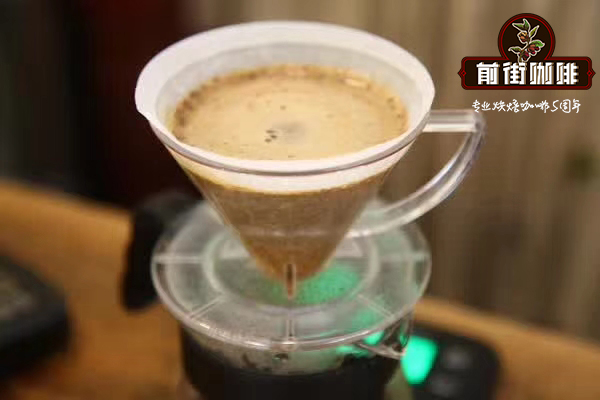
First temperature reduction - rest the kettle on a wet towel and add cold water to the boiling water for 25-30 seconds, bringing the temperature down to 93 degrees Celsius. The point of cooling is to keep the coffee from being scalded by direct contact with boiling water, which would harm aroma and taste. Then use a very fine stream, starting at the center of the dripper and spiraling outward, then rotating in the same direction from outside in, with a steady, uninterrupted flow. Use just enough water to wet the coffee, stopping when about 3 drops fall into the server.
The water should just wet the grounds. The coffee swells as it absorbs water and gives off a fragrant aroma; this step is called "blooming." At this point turn on the warming stove so the coffee does not cool and spoil the taste.
Second temperature reduction - after blooming, rest the kettle on the wet towel again for 25-30 seconds, bringing the water down to about 91 degrees Celsius, which is the most suitable temperature for brewing. Follow the same pouring pattern as the bloom, but with a slightly thicker stream.
The greatest technique in pour-over is controlling the thickness and stability of the stream. A steady, moderate flow spirals outward from the center of the dripper, like a stirring rod evenly mixing grounds and hot water, fully releasing all the rich, sweet flavors.
Circle the stream to add the right amount of water until the level reaches the edge of the dripper. Finally, finish the brew by stopping the flow at the center. The finished coffee will be slightly more than the cup holds, leaving a little for the brewer to taste. Be careful not to remove the dripper as soon as the flow stops, as that makes the coffee taste astringent.
When finished, the grounds left in the filter paper should be evenly level, which shows the coffee was rolled evenly and fully. This way the coffee is unlikely to develop off-flavors and can fully extract its four tastes and one aroma. To get well-leveled grounds, stable and uniform flow control is the key.
Siphon Brewing
Siphon brewing, also called the syphon or vacuum pot, is beautiful in shape, dramatic in process and rich in aroma. The siphon is basically two glass globes, one above the other, separated by a filter with a cloth in the middle. First, fill the lower globe with boiling hot water; the amount depends on the cup size, averaging about 140-150cc per cup. Then fix the upper pot, with the cloth filter attached, onto the base, add the ground coffee, and heat the water with an alcohol lamp or another heat source.
Once the water boils, steam pressure pushes it up through the tube, where the coffee in the upper pot meets the hot water. Stirring mixes it into a mud-like state, extracting the coffee's four tastes and one aroma. After letting the coffee soak fully, turn off the heat. As the air in the lower globe cools, a vacuum forms and sucks the coffee back down through the cloth filter. Pour it into a preheated cup and you can enjoy its unique fragrance and its sweet-and-bitter taste.
With the siphon, cleaning and storing the cloth filter is fairly troublesome. After its first use the cloth turns from white to brown and accumulates fat and protein that cannot be fully removed; exposed to air it gives off an unpleasant odor that seriously harms the coffee's flavor. Some people store the used cloth in a cup of clean water, which is a good method, but the water must be changed often. Good news for siphon users: disposable filter paper is now available to replace the traditional cloth, offering hygiene, convenience and affordability - a real blessing for those who love siphon brewing.
Knowledge Extension
The Kono dripper is suitable for brewing medium-dark roasted coffee and can produce a rich, mellow taste.
In Conclusion
In short, FrontStreet Coffee is a coffee research hall, happy to share coffee knowledge with everyone. We share without reservation, just to let more friends fall in love with coffee. Every month there are 3 low-price coffee activities, because FrontStreet Coffee wants to let more friends drink the best coffee at the lowest price. That has also been FrontStreet Coffee's purpose for the past 6 years.
FrontStreet Coffee Recommendation
If you are new to pour-over and want a cup that is practical, easy to learn and good-looking, the dripper most experienced drinkers will suggest is the V60. Hario, the company behind it, was founded in Tokyo in 1921 and is a well-known local maker of glassware that began by designing and producing heat-resistant glass instruments and equipment for research institutions - the heat-resistant glass server that commonly pairs with pour-over is one of its popular products. In 2004 Hario redesigned the prototype of the V60 so it looked much like the shape we know today, named it for its distinctive 60-degree cone angle and "V" form, and launched it a year later.
Compared with other drippers, the conical shape and 60-degree angle force the water to flow to the center before dripping into the server, extending contact between water and grounds so aroma and flavor extract fully. The V60 has a single signature large hole that lets water pass without obstruction, so the flow rate depends largely on the brewer's control and shows directly in the cup. Before the millennium, the market favored medium-dark roasts and prized a full body, high sweetness and a long finish, along with the caramelized notes of a darker roast - chocolate, maple, nuts, vanilla - which show best in a siphon or a cloth filter; Blue Mountain No. 1 and PWN Gold Mandheling were the popular specialty beans of that era. With the third wave, drinkers began to seek regional flavor, such as the white florals of Ethiopia or the berry acidity of Kenya, and roasting moved from dark toward light, with tasting shifting from a mellow sweetness toward refined acidity and aroma. The V60's fast extraction gives coffee a more three-dimensional aroma and lively acidity, bringing out florals, fruit acidity, fresh sweetness and tea notes - which is why floral-fruity coffees such as FrontStreet Coffee's Gutingting with its classic Yirgacheffe profile, the tropical-fruit Huakui, the Geisha-style Strawberry Candy and the raisin-forward Mozart suit the V60 so well. Today V60s come in resin, ceramic, glass, copper and stainless steel, each affecting looks, weight and heat transfer and thus the extraction slightly, though the structural design stays the same; FrontStreet Coffee favors the resin Hario V60 because resin blocks heat loss effectively, and in mass production it is the easiest material to mold with the smallest variation.
Important Notice :
FrontStreet Coffee is a long-established specialty coffee roaster in Guangzhou China, selling freshly roasted beans from its own farm in Yunnan as well as dozens of carefully selected single-origin beans from around the world for both pour-over and espresso. The products deliver consistently excellent quality and great value, with shipping within 24 hours. Guangzhou's FrontStreet Coffee shop is recommended by many coffee lovers, and the beans are now available online at the Tmall 。
FrontStreet Coffee has moved to a new address:
FrontStreet Coffee Address: 315,Donghua East Road,GuangZhou
Tel:020 38364473
 Scan and follow the En Gafei WeChat official account. Please indicate that the reprint comes from "En Gafei".