Introduction to Ancient Coffee Varieties from Xiaozhu Manor: Rume Sudan Coffee - Frequently Used in Variety Development
The world of coffee is enormous, and it is impossible to say just how far it stretches. What we can say is that we still know surprisingly little about the varieties that exist. Ethiopia, for instance, is often called the "coffee gene bank" — a nod to the fact that every coffee variety on earth traces its origins there, and that Ethiopia itself still shelters countless varieties that have never been identified.
The varieties most of us meet are Bourbon, Typica, and Geisha. Today FrontStreet Coffee wants to introduce you to a far older one: Rume Sudan.
Rume Sudan
Rume Sudan — also written RUME SUDAN or SUDAN RUME — is a wild, ancient coffee variety. In the coffee family tree, its history reaches back even further than Typica and Bourbon.
When people talk about African coffee origins, Ethiopia is always the first name to come up, while South Sudan is rarely mentioned. Yet South Sudan, alongside Ethiopia, is home to genuinely wild coffee varieties. Here, as in Ethiopia, coffee grows under natural conditions — thriving in forest-like surroundings alongside other plants. This region can fairly be called a gene bank of coffee varieties, with many of today's varieties having branched off from this vast gene pool.
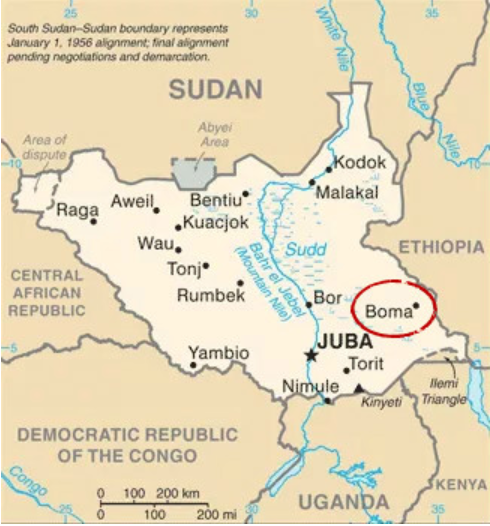
Rume Sudan was discovered in 1940 in the Rume Valley of the Boma Plateau, in southeastern South Sudan near the Ethiopian border. In the coffee world it carries the code RS-510. It is a wild variety native to the African tropical forests of the Marsabit Mountains, and it is distinguished by its bronze-colored leaves.

Rume Sudan only came to wider attention in 2015, when it was the competition coffee used by WBC champion Sasa. The trees are tall, with moderate spacing between branches and between branch buds, and they show strong disease resistance — particularly against coffee berry disease.
Rume Sudan is rarely encountered. Despite its relatively strong disease resistance, its low yield means it is seldom planted on a large commercial scale. Instead it is used mainly in variety research and development, to improve flavor and disease resistance. By crossing RS-510 with more productive varieties, farmers can obtain new hybrids that combine high yield, strong disease resistance, and good drinking quality. Many well-known modern varieties — Ruiru 11 and various F1 hybrids among them — were developed in exactly this way.
Variety Characteristics
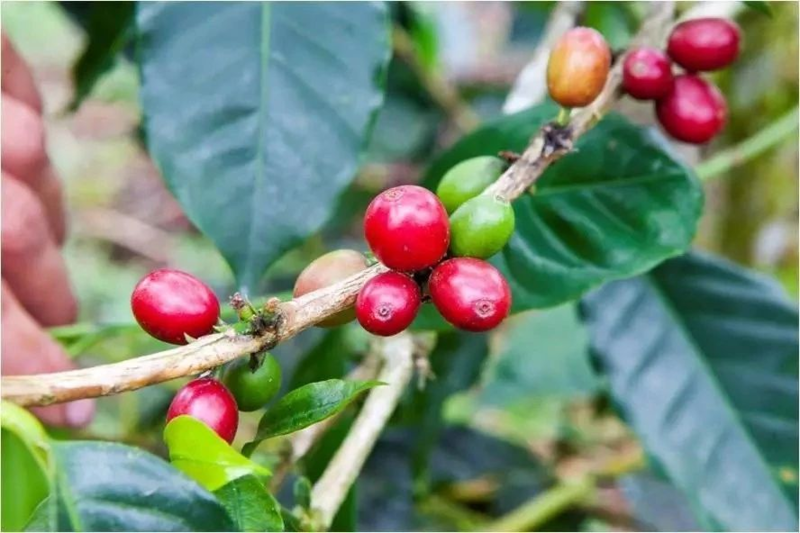
- Deep green, broad leaves
- Medium spacing between branch buds
- Medium spacing between branches
- Small, elongated bean shape
Although Rume Sudan is prized for its remarkable flavor and its excellent resistance to coffee berry disease, compared with most Arabica varieties it not only yields poorly but is also comparatively difficult to cultivate, demanding more day-to-day care.
For that reason, few estates have ever planted it on a large commercial scale. It has been used mainly in variety research and development, to obtain better plant disease resistance and better coffee flavor.
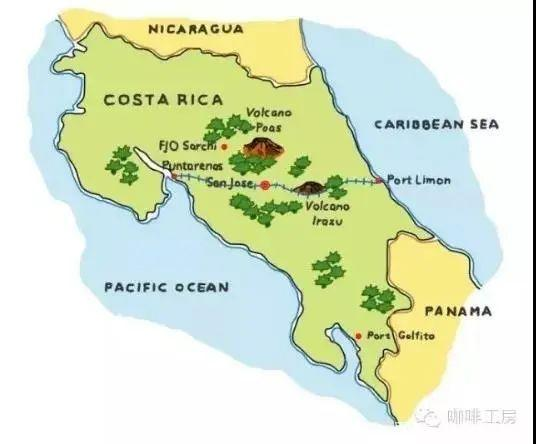
Costa Rica
Costa Rica, on the Central American isthmus, grows high-altitude coffee that is world-renowned for being rich and mild yet intensely acidic. The care taken in processing is what gives these beans their high quality. Costa Rica's Tarrazú region, south of the capital San José, is one of the country's most important coffee-growing areas.
Costa Rica was the first country in Central America to plant coffee, and it has a long history together with a complete system running from production through to sales. Sitting on the Central American isthmus, it has very fertile, well-drained volcanic soil, especially on the Central Plateau. The coffee areas benefit from fertile volcanic ash, mild and well-suited temperatures, and steady, abundant rainfall, which together make coffee one of the country's main agricultural products. Its beans are all Arabica. Clean in flavor and pleasing in aroma, they strike an impeccable balance between acidity and mouthfeel. The beans are full-bodied, with ideal acidity and a distinctive, powerful aroma.
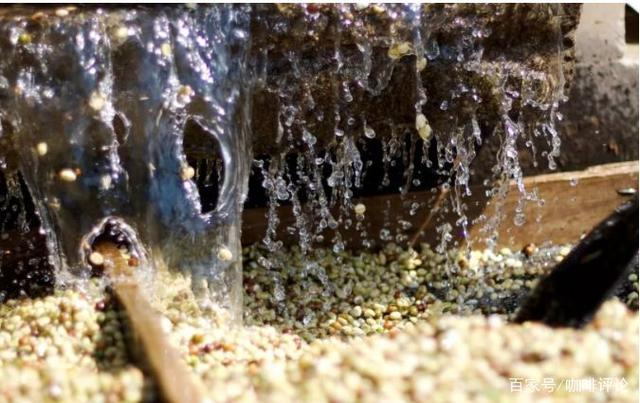
Washed Processing Method
Washed Processing Method
Screen the coffee cherries — remove the pulp — ferment — wash — dry — hull.
The screened cherries go into a pulper to strip away the skin and most of the pulp. The beans, still carrying pulp and pectin, are then placed in water to ferment for about 24 hours. After fermentation, the parchment coffee is moved into channels of flowing water to wash away the remaining pulp and pectin. Once washed, the beans are dried in the sun or in a dryer until moisture falls to about 12%. Finally, the parchment is removed from the beans.
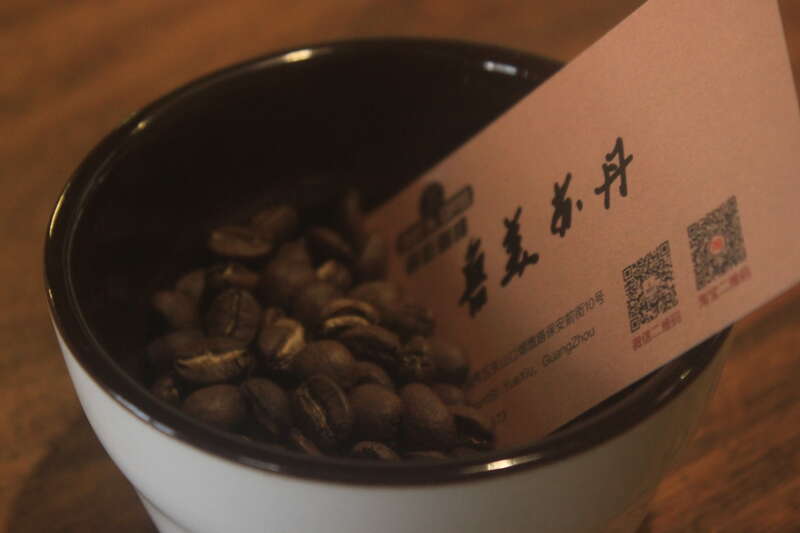
Representative Coffee Beans
FrontStreet Coffee Costa Rica Rume Sudan Coffee Beans
Costa Rica Rume Sudan
Region: Southern Costa Rica
Estate: Thousand Coffee Ten Thousand Flavors Estate
Altitude: 1250-1380m
Variety: Rume Sudan
Processing Method: Washed
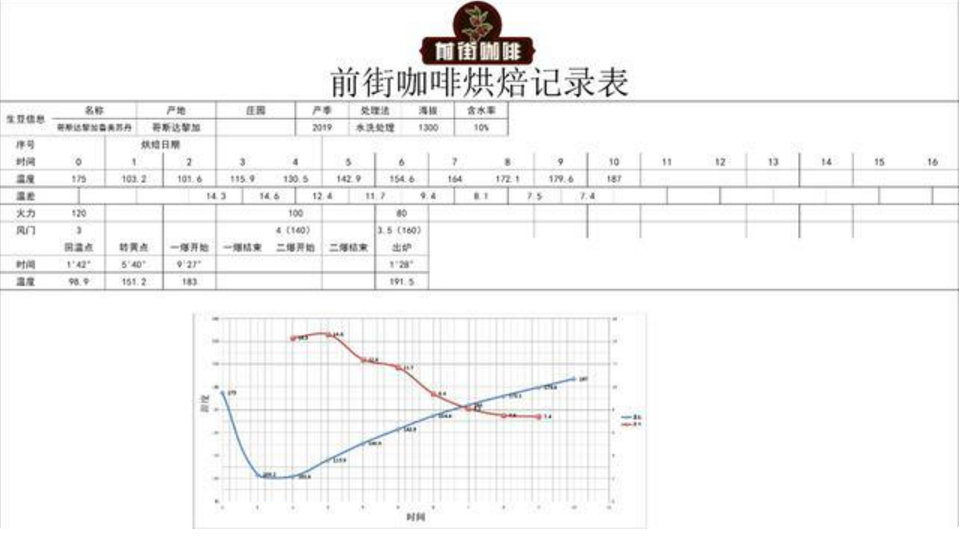
Roasting Curve
With the charge temperature set at 175°C, the yellowing point arrives at 5 minutes 40 seconds, first crack begins at 9'27", and the roast develops for 1'45" after first crack before being discharged at 194.8°C.
Charge at 175°C, heat at 120, damper at 3; the return-to-temperature point comes at 1'42" at 98.9°C. When the roaster reaches 140°C, open the damper to 4 and hold the heat steady. At 151.2°C the bean surface turns yellow and the grassy smell disappears completely, marking the start of the dehydration stage. At 166°C, reduce heat to 110 and keep the damper at 4. At 183.3°C, hold the heat and open the damper to 5. At 188°C, reduce heat to 50 and leave the damper unchanged.
At 9'27", first crack begins with the damper unchanged; develop for 1'45" after first crack, then discharge at 194.8°C.
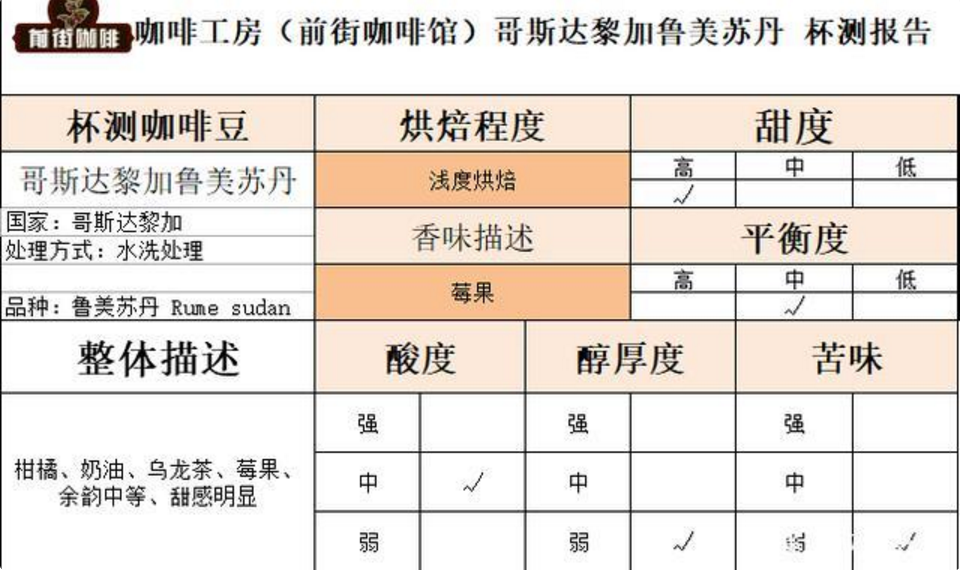
Cupping Notes
In the cup you will find very distinct citrus, cream, and a faint oolong tea sensation, along with berry-like flavors, medium-high acidity, and moderate sweetness.
FrontStreet Coffee Rume Sudan Cupping Data

Brewing Suggestions
Brewing parameters: 15 grams of coffee, a 1:15 coffee-to-water ratio, 90°C water, and a segmented pour with a total extraction time of 2 minutes. First pour: 30 grams, then steam for 40 seconds (start timing when the pour begins). Second pour: a small stream up to 124g. Third pour: a slightly larger stream up to 225g, reaching 1'52".
FrontStreet Coffee brewing Costa Rica Rume Sudan coffee beans
Looking at the roasted beans, you can see that the particle sizes vary, though they are not as small as Ethiopian beans; overall the grind is medium, and the bean shape is elongated.
FrontStreet Coffee brewing parameter sharing:
Coffee amount: 15 grams; medium-fine grind; Hario V60 dripper; water temperature: 90°C; coffee-to-water ratio: 1:15; brewing method: segmented extraction.
When ground, the coffee releases distinct fermentation and spice aromas. The wet aroma carries a light fermented note. Plum and citrus acidity greet you at the start, followed by nut, cream, and chocolate through the middle, and an oolong tea sensation with a sucrose-like aftertaste in the finish.
END
FrontStreet Coffee Recommendation
If Rume Sudan's wild, ancient character appeals to you, the same fascination with rare genetics runs through FrontStreet's Gesha lineup. Panama's Esmeralda estate is the estate that made Gesha famous. Its Red Label, officially "Esmeralda Special," is grown at 1,600–1,800 meters; every lot must cup above 90 points and is given its own number, with all the beans in a lot coming from a single plot. The Green Label, or "Private Collection," blends several plots instead, showcasing the estate's signature high-altitude Gesha at a friendlier price. For a first taste, FrontStreet's Boquete Gesha from Panama is an entry-level option that still delivers the classic orange-blossom honey, oolong-tea sensation, and delicate fruit sweetness.
Ethiopia, coffee's birthplace, has its own celebrated estate: Gesha Village, whose grading is even stricter. It grows three Gesha varieties — Gori Gesha, Gesha 1931, and Illubabor Forest — and sorts them into Gold Label Rarities, Red Label Growers Reserve, Green Label Single-Terroir, and Chaka lots. The Gold Label is Gesha 1931, about 10% of total production and often the choice of competition baristas; the Red Label is Gori Gesha, around 15% of production, scoring 88 or above on the SCA 100-point scale. FrontStreet's Grana Gesha, from a Yirgacheffe processing station at the junction of Kochere and Grana Abaya, is roasted light-medium to show bright citrus acidity, ginger-lily aroma, and ripe-fruit sweetness.
A dense, light-medium Gesha is best brewed around 91°C: use 15g of coffee in a Hario V60 at a 1:16 ratio, then pour in three stages — 30g to bloom for 30 seconds, to 125g, then to 225g, for a total of roughly 2:10 to 2:20. If you would rather explore a more approachable blend, FrontStreet's Strawberry Candy pairs a Costa Rican honey process with Panama Gesha; it suits pour-over but also works in a moka pot, an espresso machine, or as a cold brew — 30g of coffee ground to fine sugar, a 1:12 ratio with 360g of water, eight hours in the fridge, filtered, then three hours of resting.
Important Notice :
FrontStreet Coffee is a long-established specialty coffee roaster in Guangzhou China, selling freshly roasted beans from its own farm in Yunnan as well as dozens of carefully selected single-origin beans from around the world for both pour-over and espresso. The products deliver consistently excellent quality and great value, with shipping within 24 hours. Guangzhou's FrontStreet Coffee shop is recommended by many coffee lovers, and the beans are now available online at the Tmall 。
FrontStreet Coffee has moved to a new address:
FrontStreet Coffee Address: 315,Donghua East Road,GuangZhou
Tel:020 38364473
 Scan and follow the En Gafei WeChat official account. Please indicate that the reprint comes from "En Gafei".