How to Use ATAGO TDS Meter? How to Calculate Golden Cup Extraction | Coffee Extraction
A reader recently asked FrontStreet Coffee how to use a coffee TDS meter — so in this article we will walk through what the instrument actually does, how to operate it, and what the numbers are good for once you have them.
The Coffee Concentration Meter
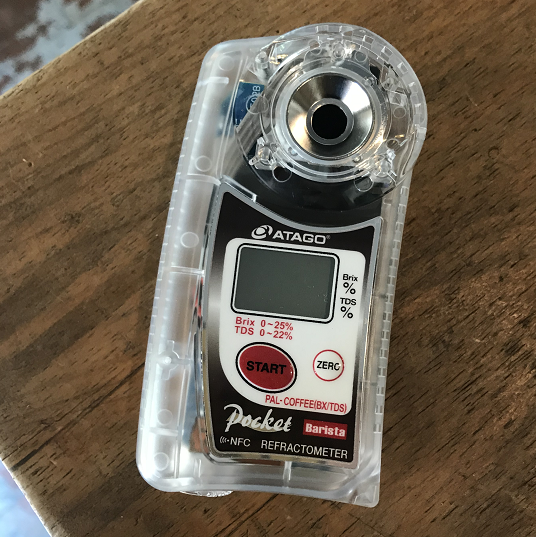
A TDS meter works on the principle of light refraction: it measures how light bends through a liquid sample to calculate the total dissolved solids in it.
On the display you will see two readings: Brix and TDS.
Brix: the concentration of soluble solid components in the sample — that is, everything dissolved in the water, whether sugar, salt, protein, or acids.
TDS: the ratio of dissolved substances to water in a cup of coffee. The higher the TDS, the more material the water has picked up from the grounds.
Now that we know what the meter is telling us, here is how to use it in practice.
How to Use the Concentration Meter
1. Press "START" to power on, drop pure water onto the refractometer's crystal prism, and press "ZERO" to calibrate.
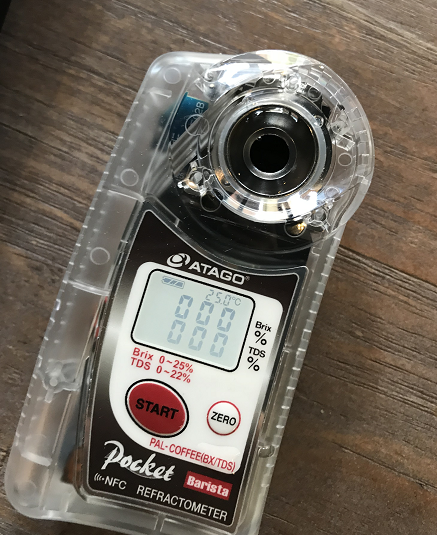
2. Stir the freshly brewed coffee thoroughly, then immediately draw a sample of about 1 gram of liquid and let it stand for roughly a minute to cool slightly. Drop it onto the crystal, press "START" to begin the measurement, and read the result after a few seconds.
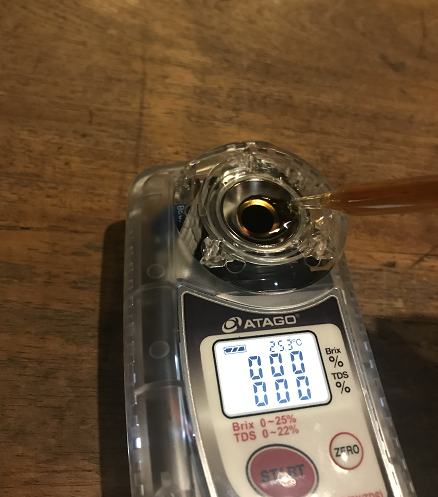
Clean the prism with water or alcohol after each use — leftover residue will throw off the next reading.
Understanding Extraction Yield
So what are these numbers actually for? Once you have TDS, you can calculate the extraction yield of your coffee.
Extraction yield expresses how much of the coffee's dry mass was dissolved into the beverage during brewing. Put simply: of everything you loaded into the filter, what percentage ended up in the cup?
Here is the intuitive version: brew with 100 grams of coffee grounds. Afterward, dry the spent grounds completely — oven or sun, either way — and if they weigh 80 grams, then 20 grams of soluble material went into the drink. That coffee's extraction yield is 20%.
The Golden Cup Standard
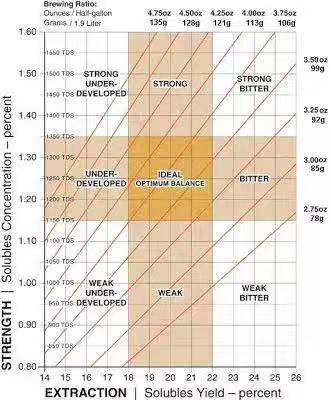
Coffee has a widely accepted framework for judging whether a brew is balanced: the Golden Cup standard.
The idea is that great-tasting coffee must simultaneously express the bean's intrinsic flavors while avoiding the harsh flavors created by pushing extraction too far. The trade-off point between those goals has been quantified, and "delicious coffee" is defined by two conditions met at once:
1. An extraction yield between 18% and 22%
2. A coffee concentration (TDS) between 1.2% and 1.45%
The formula: (beverage weight × TDS%) ÷ dose of dry grounds = extraction yield
Under-extracted coffee (yield below 18%) tends to taste sour, thin, and hollow — flat and one-dimensional. Over-extracted coffee (above 22%) drifts toward bitterness, ashiness, and astringency.
For drip coffee, a coffee-to-water ratio anywhere between 1:15 and 1:22 will generally land you in Golden Cup territory — but note that the ratio alone does not guarantee a Golden Cup. And keep the terms straight: coffee-to-water ratio is not the same as coffee-to-liquid ratio, and neither is the same as strength. Work backward from a proper ratio, though, and you will usually end up inside the standard.
FrontStreet Coffee Recommendation
Once your extraction numbers are dialed in, the fun part is choosing a coffee worth measuring. For fans of bright, fruity light roasts, FrontStreet Coffee's Yirgacheffe Guodingding from Ethiopia is the classic starting point: citrus, berries, and florals with a green-tea-like finish — its acidity is soft and bright, closer to fruit than to sharpness, which makes it very approachable for anyone new to pour-over. FrontStreet Coffee's Ethiopian Huakui goes further into the tropical end — strawberry, passion fruit, jackfruit, even lychee — with pronounced sweetness and almost no bitterness, the bean people jokingly call "coffee for people who don't like coffee."
If you want intensity and complexity together, FrontStreet Coffee's Kenya Asalia (Little Tomato) from the Thika region, grown at 1550-1750 meters on SL28 and SL34 and put through Kenya's 72-hour double washed fermentation, delivers unmistakable cherry-tomato and dark-plum acidity with a fresh-pressed-juice body, snow pear and black plum sweetness, and a long, clean finish of yellow sugar and green tea. For something wilder, FrontStreet Coffee's Ethiopian Kafa Forest comes from the UNESCO-designated Kafa Biosphere Reserve in southwest Ethiopia — the birthplace of Arabica itself, a mountain rainforest spanning 7,000-plus square kilometers at 1400-2100 meters, home to more than 5,000 wild Arabica gene lines (including the ancestors of Gesha). Naturally grown under rain and shade with no human intervention, it carries dense jasmine, citrus, and wild berry aromatics with a delicate, layered, vividly alive character.
Important Notice :
FrontStreet Coffee is a long-established specialty coffee roaster in Guangzhou China, selling freshly roasted beans from its own farm in Yunnan as well as dozens of carefully selected single-origin beans from around the world for both pour-over and espresso. The products deliver consistently excellent quality and great value, with shipping within 24 hours. Guangzhou's FrontStreet Coffee shop is recommended by many coffee lovers, and the beans are now available online at the Tmall 。
FrontStreet Coffee has moved to a new address:
FrontStreet Coffee Address: 315,Donghua East Road,GuangZhou
Tel:020 38364473
 Scan and follow the En Gafei WeChat official account. Please indicate that the reprint comes from "En Gafei".