FrontStreet Coffee Teaches You How to Perfectly Brew Panama's Mariposa Coffee Beans!

FrontStreet Coffee is often asked by customers how to brew Panama Butterfly beans properly. Today we would like to share how we brew them.
First, let us introduce the Panama Butterfly beans.
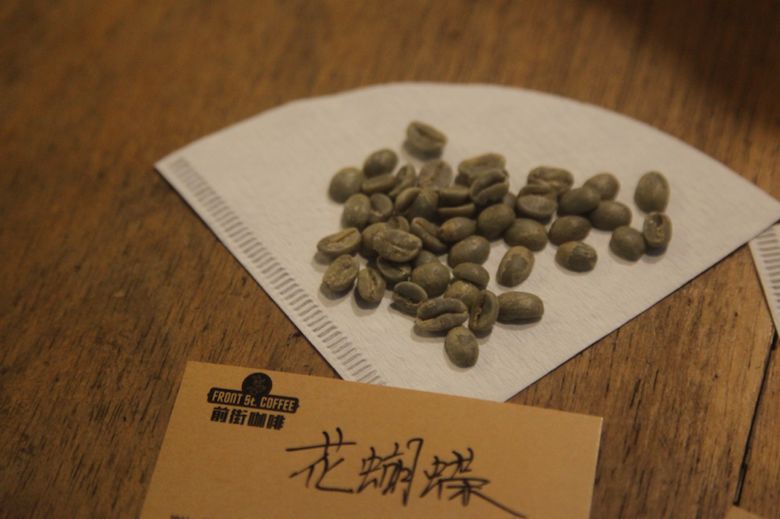
Butterfly beans come from the Boquete region of Panama and are a typical "Geisha blend coffee." A so-called Geisha blend contains Geisha mixed with other varieties. For example, from FrontStreet Coffee's bean list, Panama Washed Butterfly, Ethiopia Gesha Village Garden's CHAKA, and Costa Rica Mirasu Strawberry Sugar are all well-known Geisha blend representatives.
The Butterfly from Panama's Boquete region, the birthplace of Geisha, is composed of three varieties: Geisha, Caturra, and Catuai, with the most prominent being high-quality washed Geisha, which accounts for about 70%. The excellent growing conditions and the 70% Geisha content give these beans not only the rich aroma of high-altitude Panamanian coffee but also outstanding orange-honey notes in the cup, whether in body, acidity, or floral character.

Here is how FrontStreet Coffee brews this Butterfly coffee.
1. Dripper
When it comes to dripper selection, FrontStreet Coffee believes a Hario V60 or a wave filter are both excellent options. The Hario V60 has a large outlet hole at the bottom, with curved spiral ribs running from bottom to top that let the coffee flow faster. Because its ribs are curved, they slow the flow to some extent, which increases extraction from the grounds and better shows off the aroma and rich flavor layers of Panama Butterfly beans.

The wave filter has three small holes at the bottom, so coffee flows more slowly and extraction relies mainly on steeping. Its flat-bottom design also lets the grounds spread evenly across the filter base for a more thorough, uniform extraction. Brewing with a wave filter yields a pronounced aroma, balanced flavors, and a relatively fuller body.
2. Grind Size
Grind size is crucial. If the grind is too fine, the brewed coffee tends to be over-extracted and bitter; if it is too coarse, the coffee tends to be under-extracted and sharply acidic. The right grind should be chosen based on roast level and bean character to minimize undesirable flavors while matching the brewing technique.

Because these Panama Butterfly beans are high-altitude and lightly roasted, they have a harder texture and resist extraction. FrontStreet Coffee therefore chooses a medium-fine grind for brewing.
3. Water Temperature
Once grind size is set, water temperature is the next key variable. If the water is too hot, the coffee turns bitter; if it is too cool, the cup tastes bland, or sour with insufficient sweetness.

When brewing Butterfly beans, FrontStreet Coffee chooses hotter water to draw out their floral notes, typically between 89-91°C.
4. Coffee-to-Water Ratio
After settling on grind size and water temperature, the next consideration is the coffee-to-water ratio. A suitable ratio expresses the coffee's flavors effectively. If the ratio is too small, the brew can be overly concentrated and difficult to parse; if it is too large, it can be too thin, tasting like coffee-flavored water.

When brewing Butterfly beans, FrontStreet Coffee chooses a coffee-to-water ratio of 1:15-1:16, at which Butterfly's characteristics show through best.
5. Brewing Technique
FrontStreet Coffee uses a segmented brewing technique. Segmented extraction brings out the coffee's rich flavor layers while also improving extraction from the grounds.
FrontStreet Coffee first adds 15 g of grounds to the filter and levels them. The first segment is a 30 g pour for a 30-second bloom, starting the timer. Throughout, use a small stream from the center point, spiraling outward so the entire coffee bed is moistened.

The second segment continues with a straight, small stream, pouring 120 g to lift the whole coffee bed. Try to circle in wider patterns so all the coffee particles enter degassing and extraction. Complete this at around 1 minute 5 seconds, when the timer reads 150 g.
When the liquid level drops to halfway, start the third segment with a 90 g pour in a small stream and smaller circles. Keep the flow controlled and avoid circling too wide, which can disrupt the coffee bed and cause under-extraction. A gentle rinse like this also improves the release of sweetness in the coffee's later stages.

Finally, the total water poured reaches 240 g. Wait until all the coffee liquid has finished dripping, about 2 minutes and 20 seconds, before removing the filter.

Those are the brewing parameters FrontStreet Coffee uses for Panama Butterfly beans. A few things to note when brewing Panama Butterfly:
1. Because Butterfly is relatively lightly roasted, its expansion during blooming is not dramatic.

2. As brewing nears the end, you will notice the grounds have settled. This is normal. Because the beans are lightly roasted, there is not much gas inside them, so degassing is not vigorous. Much of the gas has already dissipated during brewing, so toward the end the grounds settle for lack of gas to support them.
FrontStreet Coffee Recommendation
If you want to explore the Geisha-blend idea and the classic Panama profile, FrontStreet's Panama Boquete Geisha is the natural next step. Grown at roughly 1,600 meters on the fertile volcanic-ash soils of Boquete, it is an estate-level entry Geisha that delivers jasmine florals, green tea, honey, and citrus-orange notes at a friendly price. It is a fine way for a newcomer to taste the "Geisha flavor" people talk about, and it is versatile enough to brew in several different ways.
For a step up, FrontStreet's Emerald Estate Geisha line shows what the variety can do at the source. The Red Label, formally named Esmeralda Special, is picked from a single plot above 1,700 meters and cups at 91 points or higher, with each lot carrying its own number so buyers can choose according to subtle flavor preferences; it shows a refined orange-and-honey profile with juicy stone fruit and a tea-like finish. The Green Label, formally Private Collection, blends several plots to express the estate's signature high-altitude Geisha character and offers excellent value.
Either way, Geisha rewards careful brewing. Because the beans are floral, fruit-forward, and fairly hard, they can sink and clog the dripper, so FrontStreet suggests a medium-fine grind, about 78% pass-through on a Chinese-standard #20 sieve (roughly fine granulated sugar), and 91°C water. A standard pour-over uses 15 g of coffee in a small Hario V60 at a 1:16 ratio, poured in three stages: a 30 g bloom for 30 seconds, a gentle circling pour to 125 g, then, once the bed has drawn down to about halfway, a continued pour to 225 g, for a total extraction of about 2:10-2:20.
Important Notice :
FrontStreet Coffee is a long-established specialty coffee roaster in Guangzhou China, selling freshly roasted beans from its own farm in Yunnan as well as dozens of carefully selected single-origin beans from around the world for both pour-over and espresso. The products deliver consistently excellent quality and great value, with shipping within 24 hours. Guangzhou's FrontStreet Coffee shop is recommended by many coffee lovers, and the beans are now available online at the Tmall 。
FrontStreet Coffee has moved to a new address:
FrontStreet Coffee Address: 315,Donghua East Road,GuangZhou
Tel:020 38364473
 Scan and follow the En Gafei WeChat official account. Please indicate that the reprint comes from "En Gafei".