Honduras Sherry Coffee Beans Flavor Profile & Highlights Which Honduras Coffee Variety is Best?

How Processing Methods Shape Coffee Flavor
Ask any coffee lover what determines a coffee's flavor, and you'll usually hear about variety, origin, or growing conditions. At FrontStreet Coffee, we'd add one more factor that people often overlook: the way the green beans are processed after harvest. Choose a different processing method and you end up with a genuinely different cup. As more and more experimental processing methods have appeared in recent years, FrontStreet Coffee's bean list has grown to cover virtually every mainstream method on the market today — so whatever your palate leans toward, you can find a single-origin coffee to match and order it from FrontStreet Coffee's Taobao store or FrontStreet Coffee's Tmall flagship store.
Barrel fermentation is one of the newest arrivals. Beans that have spent time fermenting in wooden barrels deliver flavor experiences that simply didn't exist before. Innovation in processing is clearly where the specialty coffee market is heading, and barrel aging is riding that wave. FrontStreet Coffee will keep hunting down distinctive barrel-processed beans and evaluating them, so you always have objective reference points to work from.
How Barrel Fermentation Works
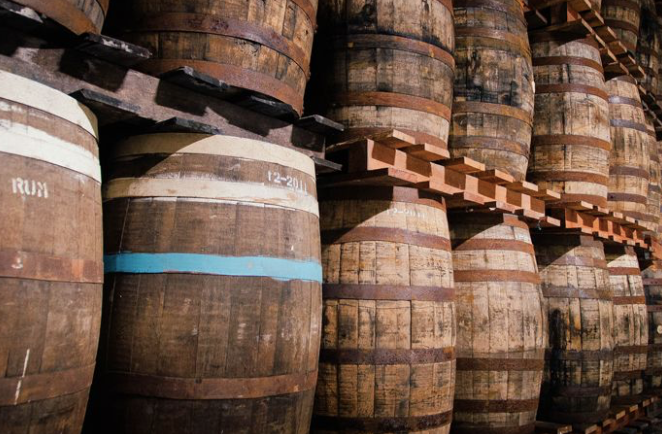
The idea was borrowed straight from winemaking. As the coffee ferments, the barrel wall lets tiny amounts of air seep through, exposing the beans to gentle, controlled oxidation. That measured oxygen intake speeds up fermentation, softens the tannins, and nudges the fresh fruit aromas toward the deep, layered bouquet of mature wine. Wood is the ideal vessel for this: it is firm but not rigid, keeps water out, and stores safely. Oak also carries its own tannins, and as the green beans rest inside the barrel, those tannins slowly permeate them, building structure and a rich vinous character into the coffee itself. Not long ago, FrontStreet Coffee got hold of a batch of Honduras Sherry whisky-barrel-processed beans — the moment we cut open the green bean bag, vanilla cream and wine aromas came pouring out.
Honduras Coffee
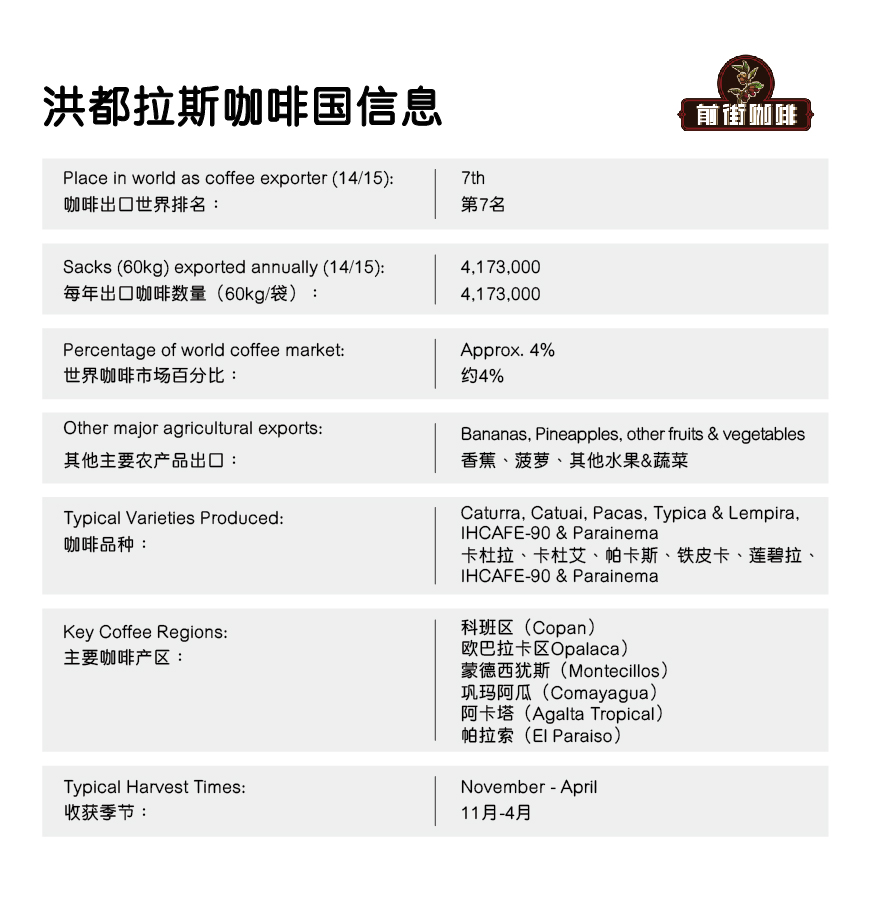
Honduras sits in the northern part of Central America, with the Caribbean on its northern coast and the Pacific's Gulf of Fonseca to the south. Nicaragua and El Salvador lie to its east and south, Guatemala to its west, and the country is overwhelmingly mountainous and highland. Coffee is planted across 280,000 hectares, dominated by smallholdings — most farms are smaller than 3.5 hectares — and together these small farms account for sixty percent of the country's total coffee output.
The country has six main coffee regions: Copán, El Paraíso, Comayagua, Opalaca, Montecillos, and Agalta. Average growing altitude runs from 1000 to 1600m, and the workhorse varieties are Bourbon, Caturra, Typica, Catuai, and Pacas. Mocca Estate, however, doesn't come from any of those six regions. It sits in Masaguara, a municipality in Honduras's Intibucá department, in the southern part of the Jesús de Otoro valley, ringed by mountains and hills. Coffee growing is the backbone of the local economy there, while the valley floor itself is given over to staple grains and livestock. As for the name: in Mr. Alberto Membreno's "Indigenous Place Names," Masaguara means "place of deer."

Coffee Varieties (Caturra, Catuai, Pacas)
Caturra is a natural mutation of Bourbon, first spotted in Brazil in 1937. The plant is more compact than its parent, and while it inherits Bourbon's rather weak disease resistance, it out-yields it. Ironically, Caturra never suited Brazil's growing conditions and was never planted there at scale; instead it spread across Central and South America, becoming a mainstay in Colombia, Costa Rica, and Nicaragua.
Catuai is the result of deliberate crossbreeding between Caturra and Mundo Novo. It shrugs off harsh weather better than most, wind and rain in particular. The trees are short, and the cherries grip the branch more firmly than on other varieties, which makes them harder to knock off — a real advantage in stormy regions. Both red and yellow Catuai exist.

Pacas is another natural Bourbon mutation — like the other widely planted dwarf Bourbons, it comes down to a single-gene change. Its selling points are a small tree, strong yield potential, and the fact that it can be intercropped with other fruit trees and plants, which lifts cherry production per hectare. The variety was found in 1949 on a Pacas family farm in El Salvador's Santa Ana region. In 1960 the Salvadoran Coffee Research Institute (ISIC) launched a pedigree selection program for Pacas (selecting individual plants generation after generation — also called single-plant selection). It caught on across Central America and now makes up about 25% of El Salvador's production. In 1974 the Honduras Coffee Research Institute brought the variety into Honduras and began cultivating it there.
FrontStreet Coffee picked two Honduras barrel-fermented coffees and set them side by side to see how they actually taste.
Comparing the Two Processing Methods
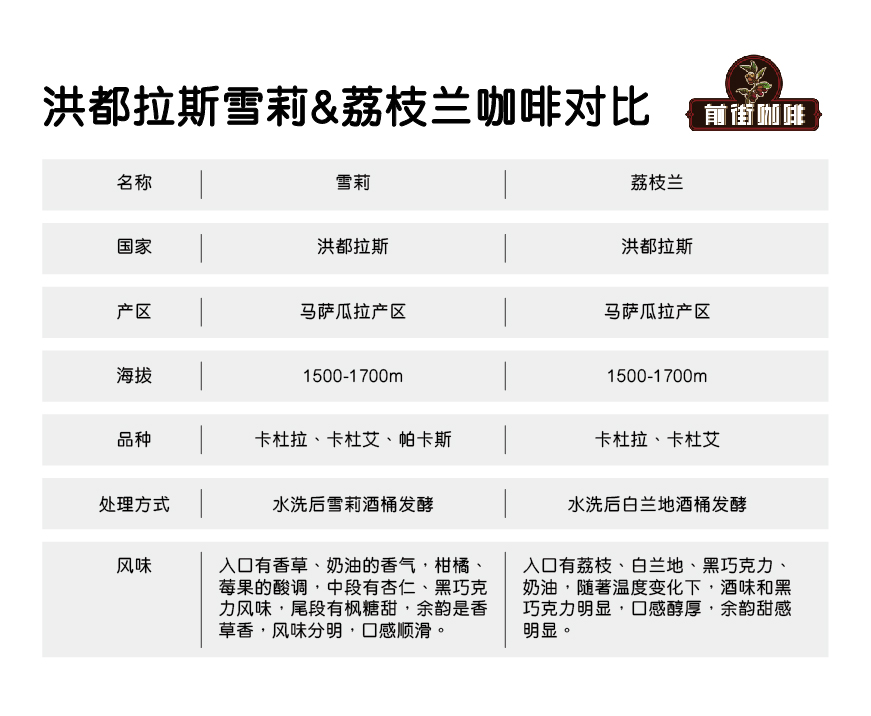
Both of these FrontStreet Coffee beans go through fully washed processing first, then move on to barrel fermentation. The difference is the barrel: FrontStreet Coffee's Sherry beans are fermented at low temperature (roughly 15-20°C) for 30-40 days in whisky oak barrels previously soaked with Sherry wine, while FrontStreet Coffee's Lychee Lan beans go into brandy barrels instead. Afterward both are dried in the shade until moisture drops to about 11%.
Roasting the Beans
These barrel-fermented beans arrive at FrontStreet Coffee as green coffee, and roasting is where we take over. It demands care, because Honduran coffee has always been rich and sweet with a smooth body but has traditionally lacked an arresting aroma on the first sip — that's precisely the gap the barrel fermentation was developed to close. To play to this bean's strengths, FrontStreet Coffee aimed for a light roast. And because flavor expression matters just as much, we ran two roast curves in parallel and compared them. That's standard practice here for every new bean we receive: roasting tests the roaster's understanding of the bean's origin, and cupping plus pour-over tastings then tell us whether the curve was right. A single coffee often goes through several rounds of evaluation at FrontStreet Coffee. It eats up time, but we consider it non-negotiable — without repeated trials, we simply won't put a bean on the shelf.

Using this Honduras Sherry as the example, here's how FrontStreet Coffee analyzes two different roasting curves.
The Sherry Beans

[Curve One]
Charge temperature: 190°C. Yellowing point: 5'45'', 151.8°C. First crack: 9'07'', 184.2°C. Development after first crack: 2'10'', dropped at 195°C.

Cupping notes: Vanilla, honey, citrus, cream, a wine-like finish; smooth on the palate, flavors layered, overall balance.
[Curve Two]
Charge temperature: 190°C. Yellowing point: 5'30'', 150.8°C. First crack: 8'38'', 184.3°C. Development after first crack: 1'40'', dropped at 196°C.
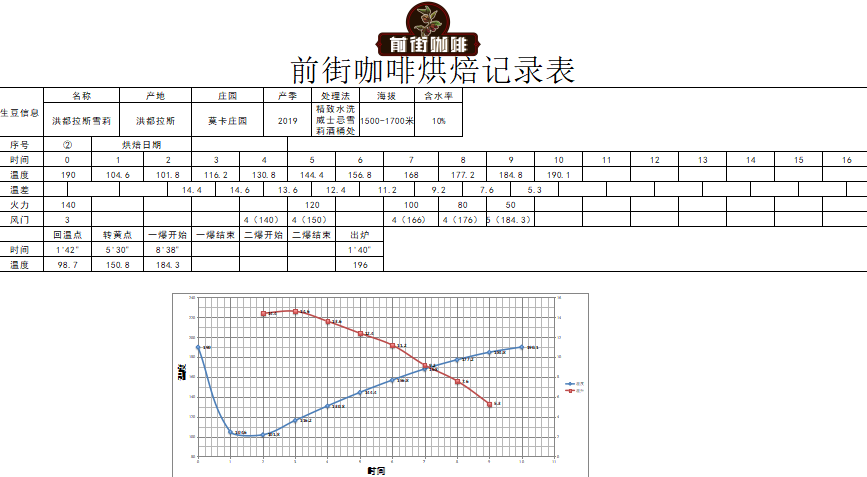
Cupping notes: Vanilla, cream, syrup, chocolate, fermented wine aroma; intensely fragrant, thick on the palate, pronounced sweetness — but astringency creeps in as the cup cools.

Once the cupping table was done, FrontStreet Coffee moved on to pour-over to hear what each curve had to say. Our pour-over setup: a Hario V60 dripper, 90°C water, a 1:15 coffee-to-water ratio, and a fine granular grind size (80% pass rate through a China-standard 20-mesh sieve). The right grind size shifts from bean to bean depending on variety, altitude, processing, roast, and more — so whenever a fresh roast comes off the machine, FrontStreet Coffee sieves a sample first to pin down the right grind.
We brewed using segmented extraction — the classic three-pour method. Start with 30g of water for a 30-second bloom, then pour 125g in slow circles for the second stage, and once the water level dips to just above the coffee bed, top up to 225g. Total brew time: 2 minutes, bloom included.

Pour-over notes:
[Curve One]
Vanilla and cream on the attack, citrus and berry acidity through the middle, almond and dark chocolate as it opens up, maple sweetness toward the finish, and a lingering vanilla aftertaste. Distinct flavors, silky mouthfeel.
[Curve Two]
A rich wave of vanilla cream up front, mellow citrus acidity in the middle, white grapefruit at the finish, syrup sweetness, and a slightly bitter tail. Thick body but a touch of astringency, and cleanliness suffers a little.

So which one won? Curve Two punches harder on aroma, body, and sweetness — there's a syrupy glide to it — but it gives up some cleanliness, shows astringency, and leaves a rather bitter aftertaste. Its flavors also run one-dimensional, and the cup turns a bit dull as you keep drinking. Curve One may trail slightly on aroma and sweetness, but it delivers distinct, well-separated flavors and a smooth mouthfeel, with vanilla and cream carrying from first sip to finish. Better still, the flavor stays stable from hot to cool, with no off-notes surfacing. FrontStreet Coffee therefore settled on Curve One as the roasting curve for this batch of Sherry beans — note, this specific batch. Every new batch goes through the same gauntlet, because no two batches behave alike, and parameters that worked for the last one may not suit the next.
The Lychee Lan Beans
The second contender is a barrel-fermented bean from the same estate: Lychee Lan. Like the Sherry, it's loaded with wine aroma, but side by side FrontStreet Coffee found it lighter and fresher, layered over chocolate and a honeyed sweetness. The first sip brings a clean, lychee-like sweetness — fragrant and sweet without ever turning muddy — braided with brandy notes, and the sweetness holds on deep into the finish. Brandy-barrel fermentation gives these beans a gentle lychee and honey sweetness wrapped around a full-bodied brandy character and a whisper of oak.

Roast Recommendation
To let this bean's flavors shine while keeping the cup balanced overall, FrontStreet Coffee's roaster went with a light roast. Charge temperature: 220°C. Yellowing point: 5'50", 152.6°C. First crack: 9'15", 183°C. Development after first crack: 2'10", dropped at 195°C.
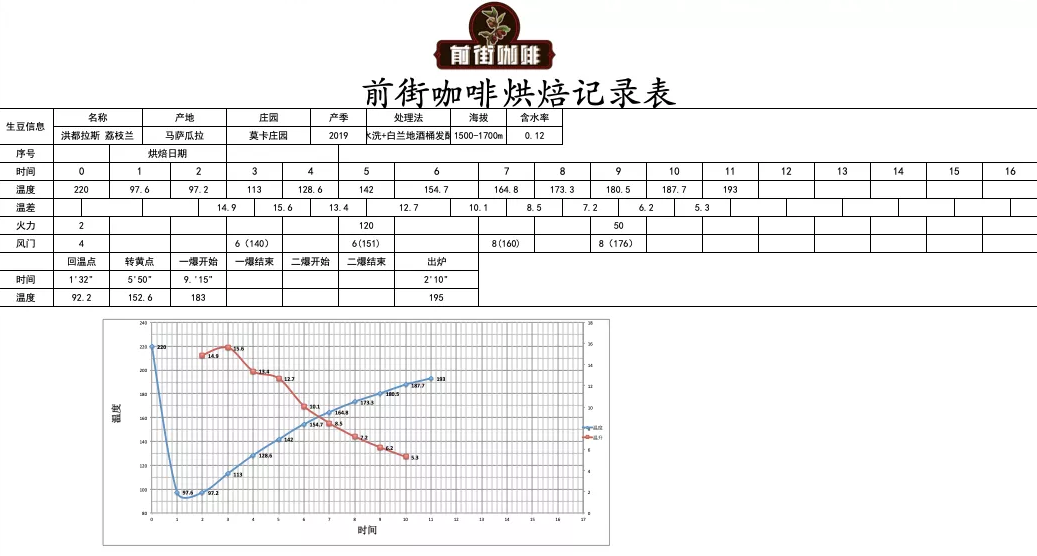
Pour-over flavor notes:
Lychee, brandy, dark chocolate, and cream on entry. As the cup cools, the wine character and dark chocolate step forward, the body turns rich, and the aftertaste is unmistakably sweet.
FrontStreet Coffee Recommendation
If barrel-aged coffee has you curious but you'd rather start with a proven classic, FrontStreet Coffee's Brazil Queen Estate Coffee Beans is a safe bet. Where a Mandheling is all power, the Queen Estate is gentler and beautifully balanced: clear nut, cocoa, and caramel aromas, a rounded and silky texture, modest acidity, and sweetness that really carries the cup. It holds steady across pour-over, moka pot, and espresso, and Brazil's naturally generous crema makes it a longtime favorite as a daily-drinker bean at home.
For those who prefer the traditional side of coffee, FrontStreet Coffee's Jamaica Blue Mountain No.1 is another classic worth trusting — grown on the Clifton estate in Jamaica's certified Blue Mountain region, where high-altitude cloud cover, volcanic soil, and a mild climate let the cherries ripen slowly into a famously harmonious cup: acidity, sweetness, bitterness, and aroma all in step, with cream, caramel, chocolate, nuts, and honey unfolding layer by layer.
Important Notice :
FrontStreet Coffee is a long-established specialty coffee roaster in Guangzhou China, selling freshly roasted beans from its own farm in Yunnan as well as dozens of carefully selected single-origin beans from around the world for both pour-over and espresso. The products deliver consistently excellent quality and great value, with shipping within 24 hours. Guangzhou's FrontStreet Coffee shop is recommended by many coffee lovers, and the beans are now available online at the Tmall 。
FrontStreet Coffee has moved to a new address:
FrontStreet Coffee Address: 315,Donghua East Road,GuangZhou
Tel:020 38364473
 Scan and follow the En Gafei WeChat official account. Please indicate that the reprint comes from "En Gafei".