Papua New Guinea Bird of Paradise Coffee Beans Sigri Estate Coffee Bean Variety Flavor Description

Papua New Guinea: The "Little Blue Mountain" of Coffee
Papua New Guinea is a small country that somehow feels both unfamiliar and familiar, and its coffee beans are known as the "Little Blue Mountain." What earns the country's coffee such a distinguished title? Driven by curiosity, FrontStreet Coffee acquired a Paradise Bird coffee from Sigri Estate. By exploring the country's cultivation history, tracing the bean's origins, and then running it through FrontStreet Coffee's roasting, cupping, and brewing, we can see how this Paradise Bird performs.
Geography of Papua New Guinea
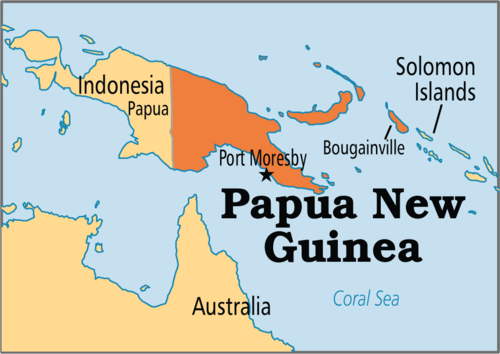
Most of the country's territory sits on the island of New Guinea, split into eastern and western halves by a straight boundary line. The western half belongs to Indonesia; the eastern half is Papua New Guinea. The name is long, so it is commonly shortened to "Papua" or its English acronym "PNG." Many people call Papua's coffee the Little Blue Mountain because Papua's varieties are Typica introduced from Jamaica's Blue Mountains, and the growing environment, altitude, and rainfall are strikingly similar.
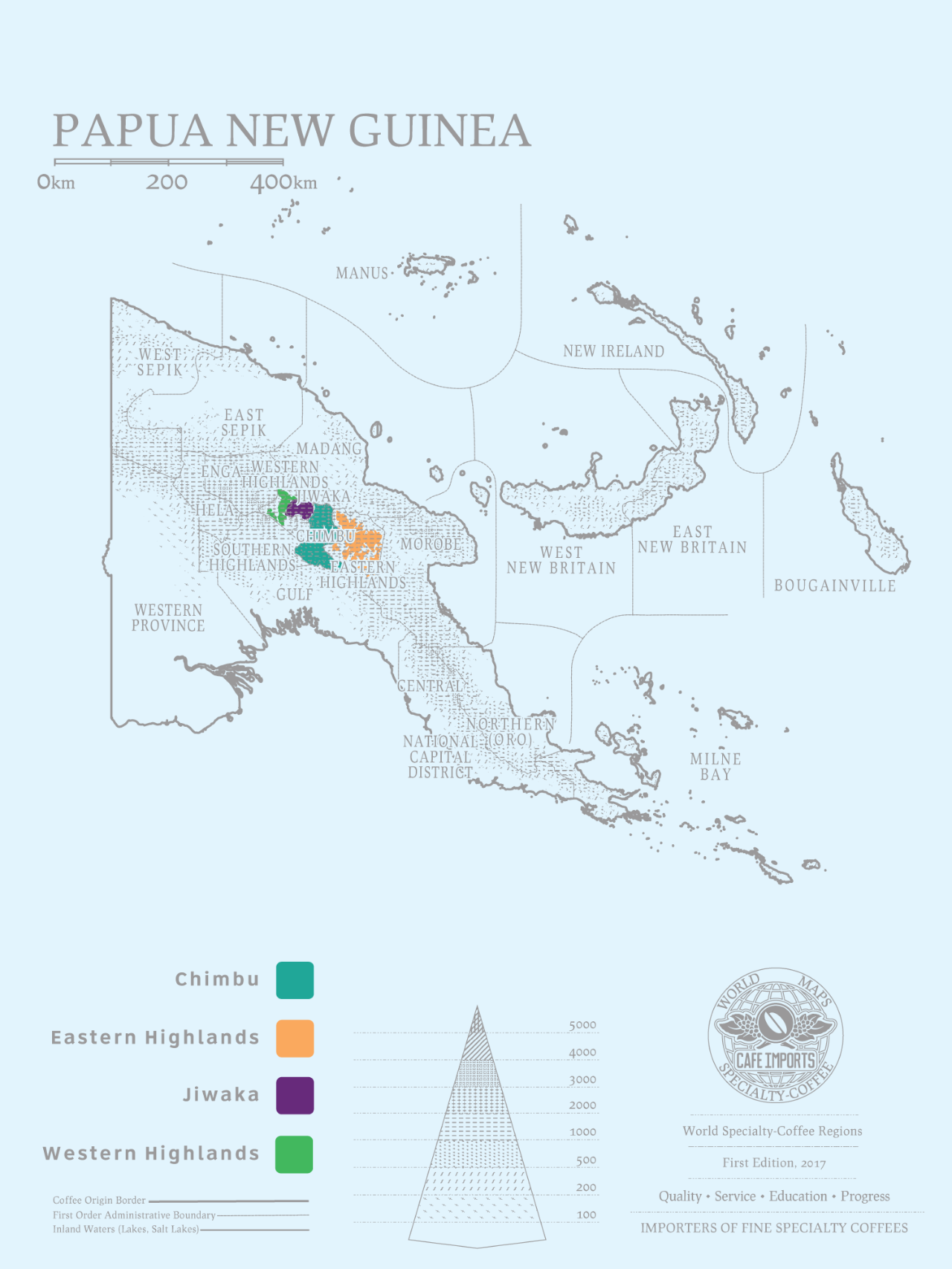
The imported Typica adapted quickly to the environment of New Guinea Island, making the Little Blue Mountain title genuinely deserved in both variety and island-type climate. Papua New Guinea's coffee-growing region (6° South Latitude) sits closer to the equator than the Blue Mountains (approximately 18° North Latitude). Through cupping, FrontStreet Coffee found that while the flavors share real similarities with Blue Mountain, Papua coffee adds its own distinctive sweet-and-sour dark fruit notes.
Papua New Guinea's Coffee Cultivation History
In 1931, Typica was introduced to Papua New Guinea from Jamaica. Britain had by then occupied Jamaica for nearly 300 years, and Jamaica's most representative coffee was its Blue Mountain Typica. Since Australia maintained friendly relations with Britain, it was natural for Papua New Guinea to source its Typica there. FrontStreet Coffee uses the "Little Blue Mountain" name to introduce Papua New Guinea coffee to customers because the history genuinely supports it - and because "Little Blue Mountain" is far more memorable than "Papua New Guinea coffee."
In 1950, Bourbon varieties arrived from Kenya - Kenya, too, was a British colony at the time. With government encouragement of open cultivation, the coffee industry grew substantially through the 1970s and 1980s.
In 1962, Mundo Novo and Caturra were introduced from Brazil, marking a major leap in Papua New Guinea bean quality. The 1975 frost destroyed most of Brazil's coffee crop but stimulated the development of Papua New Guinea's industry: the government funded rural areas to create plantations of roughly 20 hectares each, deepening coffee's penetration into the local economy. By 1990, annual production had reached 1 million bags.

Sigri Estate
This year, FrontStreet Coffee selected the Paradise Bird coffee from Sigri Estate. Sigri Estate is located in the Wahgi Valley of Papua New Guinea's Western Highlands Province. Established in 1950, it has been operating for over 60 years and is a pioneer of the local coffee industry. The estate sits in the Waghi Valley of the Western Highlands at approximately 1,500 meters above sea level, on volcanic soil rich in minerals, with a cool climate, fertile ground, and abundant rainfall.
The first Papua coffee beans FrontStreet Coffee introduced came from Sigri Estate, and they were named "Paradise Bird" domestically at the time. Later, coffee bags from the Prosa Estate also featured the Paradise Bird pattern, but to tell the two beans apart, the later arrival had to be called by its estate name. That may seem unfair to the newcomer, but years of subconscious association have bound Sigri and Paradise Bird together.
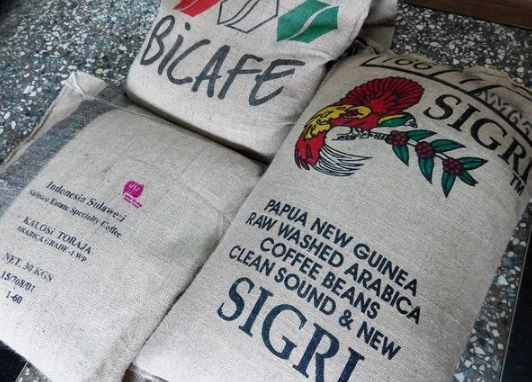
Paradise Bird Estate also takes ecological protection seriously, refusing pesticides and insecticides to protect the soil and water sources while caring for the ecosystem and the birds nearby. The estate has maintained high standards of cultivation and processing for many years. During the harvest season from April to September each year, only fully ripe red cherries may be hand-picked, ensuring a perfect balance of acidity and sweetness in the fruit.
The beans from Sigri Estate truly live up to the Paradise Bird name. FrontStreet Coffee observed that the 2020 harvest beans were plump and emerald green, with excellent appearance. We chose this Paradise Bird Estate coffee precisely because of the estate's strict production chain, which safeguards the quality of the beans from cherry to bag.

Coffee Varieties
Papua New Guinea cultivates primarily Typica. Typica offers elegant flavors but has a weaker constitution and low disease resistance, leaving it susceptible to leaf rust. FrontStreet Coffee considers the most distinctive feature of Typica trees to be their bronze-colored terminal leaves, which is why some call it "red-topped coffee." Typica beans are larger, with a pointed conical or slender pointed shape, unlike the round-bodied Bourbon. Typica coffee has a uniquely subtle and clean flavor profile with balanced characteristics and outstanding clarity in the mouthfeel.
Coffee Processing Methods
After harvesting mature red cherries, Sigri Estate sends them to its own wet-processing facility. The local washed process in Papua New Guinea differs from the methods used in Central and South America.

Sigri employs triple-wash fermentation, soaking for approximately 24 hours each time and changing to clean water to steer the flavor. After washing, the parchment is removed and the beans are graded into classifications such as AA, AB, and PB (peaberries). This meticulous post-harvest method gives the coffee a bright, delicate fruit acidity and a clean, lingering sweetness. FrontStreet Coffee has noticed a common trait among regions with strict grading systems: uniform bean size and fewer defects. Under those conditions, roasting produces even coloring and a much cleaner taste.

FrontStreet Coffee - Papua New Guinea Paradise Bird
Country: Papua New Guinea
Estate: Sigri Paradise Bird Estate
Altitude: 1600-1800m
Processing: Washed
Variety: Typica
Grade: AA
FrontStreet Coffee's Papua New Guinea Coffee Bean Roasting Profile
FrontStreet Coffee recommends a medium roast, since Typica is a lower-density green bean. To highlight its natural refreshing acidity and fruity aroma, the emphasis falls on heat management after first crack. Charge the roaster at 170°C with the damper at 3 and heat at 140, turning point at 1'36". When the temperature reaches 140°C, open the damper to 4. Roast to 6'25" at 151°C, when the bean surface turns yellow and the grassy aroma fully disappears - dehydration complete. At 176°C, reduce heat to 110.

Change the damper to 4. At 180°C, reduce heat to 90; ugly wrinkles and black spots appear on the bean surface, and the toast aroma clearly shifts into coffee aroma - the prelude to first crack. At this point heat rises to 183.5°C, first crack begins at 10'08", and the damper goes fully open; at 188°C reduce heat to 60 with the damper fully open (adjust heat very carefully - not so low that the crack stalls - and keep the post-first-crack rate of rise within 6°C). First crack development time is 3'00", dropping the batch at 198.5°C.
FrontStreet Coffee's Papua New Guinea Coffee Bean Cupping Report
FrontStreet Coffee cups sample roasts within 8-24 hours after roasting. Our baristas typically use 200ml ceramic cupping bowls marked with 150ml and 200ml lines. Following SCAA standards, the water TDS is around 150ppm - TDS that is too low invites over-extraction, while too high affects mouthfeel and easily causes under-extraction. Cupping water temperature is 94°C. Grind size is set to a 70%-75% pass rate through a #20 standard sieve (0.85mm). The ratio is 11 grams of coffee to 200ml of hot water - 1:18.18 - which lands the extraction concentration precisely within the 1.15%-1.35% Golden Cup range, with a steeping time of 4 minutes.

Dry Aroma: Caramel, citrus
Wet Aroma: Spices
Flavor: Citrus, nuts, cocoa, gentle fruit acidity, balanced sweet and sour notes
FrontStreet Coffee cupped the Paradise Bird side by side with Jamaica Blue Mountain. The Paradise Bird carries a faint spicy aroma by comparison. Its balance of sweet, sour, and bitter resembles Jamaica Blue Mountain, though it is not as rich and full-bodied as the Jamaican original.
FrontStreet Coffee's Brewing Experience with Papua New Guinea Coffee Beans
FrontStreet Coffee recommends the Kono dripper, which has few ribs located at the bottom. That design lets the filter paper sit tightly against the dripper wall, restricting airflow, slowing the water flow, and lengthening the contact time between water and coffee. The result is more immersion-style extraction, which enhances the rich mouthfeel. Water temperature of 88°C is deliberately on the low side to avoid pulling excess bitterness, since the darker the roast, the more bitterness emerges.
Dripper: Kono Coffee
Dose: 15g, Water ratio: 1:15
Grind Size: Sugar-like consistency (75% pass rate through #20 sieve)
Water Temperature: 88°C

*On grind size: FrontStreet Coffee determines this through sieve testing. Based on the Specialty Coffee Association's brewing recommendations for pour-over coffee, combined with practical verification, we tested different grind settings and found significant differences in the cup. Each coffee needs its own grind size - that is the whole point of sieve testing. If you do not own a sieve, FrontStreet Coffee suggests judging by flow rate: water running too fast means the grind is too coarse; too slow means it is too fine.

First, wet the filter paper with hot water and preheat the brewing equipment. FrontStreet Coffee uses segmented extraction: bloom with 30g of water for 30 seconds, pour in small circles to 125g, then pause. When the water level drops and the coffee bed is about to show, pour again to 225g and stop. When the bed is about to show once more, remove the dripper. Total extraction time is 2'00" (timed from the start of the bloom).
Brewing Flavor: Toast-like sweetness and nutty sweetness, a slight fruit acidity creating a pleasant layered effect, and a distinctive sweet spice aftertaste. The taste is rich and balanced, with sweet notes and bright acidity and a fruity aroma throughout.
FrontStreet Coffee Recommendation
If the "Little Blue Mountain" story has you curious about the original, the FrontStreet Coffee Jamaica Blue Mountain No.1 is the benchmark against which every imitator is measured. Blue Mountain No.1 is the highest grade of Jamaican Blue Mountain coffee, with strict standards for bean size, defect rate, and overall quality. Ours comes from the historic Clifton Estate, which has been growing coffee since roughly 1750, at an average of 4,300 feet (1,310.64 meters) - enough altitude, gentle afternoon cloud cover, ample sunshine, and mineral-rich soil to let the cherries ripen slowly. FrontStreet Coffee holds the complete origin certification for this lot, along with the traditional wooden barrels (15kg, 45kg, and 70kg formats) in which genuine Blue Mountain coffee has always been shipped - both visible proof of authenticity.
FrontStreet Coffee roasts its Blue Mountain No.1 medium-dark to bring out the classic profile: hazelnut, cream, chocolate, and caramel with a perfectly balanced, full-bodied mouthfeel and no harsh edges. For brewing, we suggest resting the beans 4-7 days from the roast date, then using a Kono dripper with 15g of coffee at a 1:15 coffee-to-water ratio, a grind slightly coarser than you would use for light roasts (around white-sugar texture), and water at 87-88°C. Bloom with 30g of water for 30 seconds, pour to 120g, then finish at 225g with a faster, steadier spiral to avoid over-extraction.
Then taste them side by side - the Papua New Guinea Paradise Bird and its Jamaican ancestor. One carries faint spices and dark fruit over a balanced frame; the other delivers that legendary, seamless equilibrium. Few tastings teach the meaning of terroir and variety better than this family reunion, and both are roasted fresh to order at FrontStreet Coffee.
Important Notice :
FrontStreet Coffee is a long-established specialty coffee roaster in Guangzhou China, selling freshly roasted beans from its own farm in Yunnan as well as dozens of carefully selected single-origin beans from around the world for both pour-over and espresso. The products deliver consistently excellent quality and great value, with shipping within 24 hours. Guangzhou's FrontStreet Coffee shop is recommended by many coffee lovers, and the beans are now available online at the Tmall 。
FrontStreet Coffee has moved to a new address:
FrontStreet Coffee Address: 315,Donghua East Road,GuangZhou
Tel:020 38364473
 Scan and follow the En Gafei WeChat official account. Please indicate that the reprint comes from "En Gafei".