Which Country Produces Kopi Luwak Coffee: Flavor Characteristics and Story of Kopi Luwak Beans

Somewhere along the way, Kopi Luwak became a trophy drink for the wealthy. According to local people, Kopi Luwak was originally the drink of the poor in Indonesia, because the good beans had all been sold. Locals happened to discover that coffee beans in civet droppings had not been digested, so they began washing and drying them before brewing. Others turned the practice into a business, marketing Kopi Luwak under a "rarity equals preciousness" model that made it a favorite of the rich - and led to many civets being kept in captivity for production. FrontStreet Coffee has sourced and stocked Kopi Luwak, and we often hear people call it cruel. FrontStreet Coffee believes the cruelty lies not in Kopi Luwak itself, but in the people who cage civets and force them to eat nothing but coffee cherries.
Civet Habitat
Asian palm civets mainly inhabit tropical rainforests and the edges of subtropical evergreen broadleaf forests in hills and mountains below 2100 meters, including shrub thickets and grasslands, sheltering in rock caves, soil burrows, or tree hollows. Wild civets are omnivores. Their animal-based diet includes small mammals, birds, amphibians, reptiles, crustaceans, and insects - mice, small birds, snakes, frogs, fish, crabs, bird eggs, insects, earthworms, and wild fowl. Their plant-based diet includes the stems and leaves of nightshade plants, seeds of various figs, and fruits such as brosimum and winter cherry. Among the coffee cherries they eat, both Arabica and Robusta beans appear. Since Arabica normally tastes better than Robusta, pure Arabica civet coffee is especially prized.

The Formation of Kopi Luwak
Because Kopi Luwak output is so low, many people assume the beans, though not digested in the civet's digestive tract, are corroded on the surface by the strongly acidic digestive fluids. Those fluids contain a special protease said to break down the beans' original protein chains - decomposing long-chain proteins into small particles and forming short-chain peptides and amino acids. Seizing on this story, many businessmen began capturing civets in large numbers for cage breeding. The naturally carnivorous animals were fed nothing but coffee berries, whose nutrients cannot keep a civet healthy.

FrontStreet Coffee is skeptical! Because of that unnatural coffee-only diet, the time between a caged civet eating coffee cherries and excreting the beans can be just one or two hours. Beans staying in the stomach for only an hour or two are not enough to undergo the series of changes described above - the beans are the same coming out as they were going in, and any flavor change is minimal. What truly makes a coffee taste good is the original variety. Those businessmen feed mostly Robusta, sometimes even unripe cherries. So even if some fermentation happens inside the animal, the bean's original quality is already fixed. Claiming the result tastes good is largely a deceptive sham.
FrontStreet Coffee's Neutral View on Kopi Luwak
The formation of Kopi Luwak itself is not the problem. Civets pick out ripe coffee cherries by scent - much like how Ethiopia's Red Cherry lots are harvested only at full ripeness. The problem lies with the people who cage civets, forcing them to eat ripe and unripe cherries alike just to increase output. That is where the cruelty comes in, and it falls outside anything we would call coffee.
The In-Body Fermentation Process
Although the beans are not digested in the civet's digestive tract, the strongly acidic digestive fluids do etch their surface. Those fluids contain a special protease that can break down the beans' original protein chains, decomposing long-chain proteins into small particles and forming short-chain peptides and amino acids. For definition: short-chain peptides composed of 3-9 amino acid residues are sometimes also called oligopeptides.

FrontStreet Coffee's Kopi Luwak
Origin: Indonesia, Aceh
Altitude: 1200m
Variety: Arabica
Process: In-body fermentation
Indonesia's low-altitude Robusta coffees naturally carry earthy and herbal-medicine notes with high consistency. This civet coffee therefore has the earthy character of aged beans with a consistency approaching syrup, and a very distinctive aroma. If you enjoy the earthiness of aged Indonesian beans or Indian monsooned coffee, you may well fall in love with this civet coffee.
FrontStreet Coffee's Dripper Recommendations for High-Body Coffee
To better express the herbal flavors and rich mouthfeel of Kopi Luwak, FrontStreet Coffee roasts it medium-dark. Medium-dark beans generally lose more moisture during roasting, so they are lighter in weight. During brewing, the grounds do not fully sink; they are absorbed as soon as the first water is poured. Vigorous degassing forms bubbles around the grounds, creating channels - and the fresher the beans, the longer these channels persist, making the water level drop quickly. I generally use a thick water stream and circle slowly.

The KONO dripper brings out a rounder, fuller-bodied flavor with a more direct taste. Its weakness is relatively poor degassing, because its ribs are straight and extend only one-quarter of the dripper's depth; above that quarter, the paper clings tightly to the wall and forms a seal. I choose the KONO precisely because its only degassing zone is that quarter of ribs. Once the water level rises past the rib area, the water volume in the dripper keeps increasing, building pressure through the water's weight. Since the outlet is relatively small, this extends the contact time between grounds and water, so the flow extracts soluble substances more effectively - generally achieving the heavy body customers expect.
How Does FrontStreet Coffee Brew Kopi Luwak?
Brewing parameters: KONO dripper
Water temperature: 86°C
Dose: 15 grams
Coffee-to-water ratio: 1:15
Grind size: Medium-fine (70% pass rate through the #20 standard sieve)

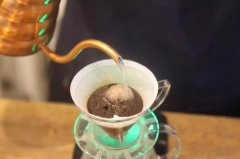
FrontStreet Coffee uses segmented extraction, also called three-pour brewing: bloom with 30g of water for 30 seconds, then pour in small circles up to 125g. When the level is about to expose the coffee bed, pour again up to 225g and stop. Once the bed is about to surface again, remove the dripper. (Timing starts at the bloom.) Extraction time is 2'01".
Kopi Luwak flavor description: herbal, nuts, dark chocolate, fermented notes, high body, viscous and smooth mouthfeel.

Given its scarcity and price, FrontStreet Coffee does not recommend that everyone rush to drink Kopi Luwak. Real Kopi Luwak does have excellent flavor, but outstanding coffees come from many origins. For floral lovers, FrontStreet Coffee recommends Panama Geisha, one of the world's most expensive coffees. For those who prefer fresh, acidic cups, there are FrontStreet Coffee's Ethiopian Huakui beans with their black tea and berry notes. For fans of balanced nut-and-caramel flavors - coffee that is neither sour nor bitter - Brazilian beans are the answer. And if you simply love the robust, full-bodied character of Indonesian coffee, buy the highest-grade FrontStreet Golden Mandheling: it has undergone multiple manual selections to minimize defects, giving a clearer aroma and a better aftertaste. All of these beans are available at FrontStreet Coffee stores and online.
FrontStreet Coffee Recommendation
If it is Indonesian depth you are after, FrontStreet Coffee's Sumatran lineup delivers it without the controversy. The FrontStreet wet-hulled Mandheling from the Toba Lake area of Linthong is processed with the classic wet-hulled (giling basah) method, then roasted medium-dark for a low-acid, full-bodied cup with caramel, dark chocolate, and toasted bread aromas and a long sweet finish. For the top tier, FrontStreet PWN Golden Mandheling is rigorously graded for density, screen size, shape, and color, then machine- and hand-sorted to yield complete, even, luminous beans with minimal earthy or grassy taint - expect sandalwood, herbs, spice, roasted hazelnut, caramel, and dark chocolate in a clean, richly layered cup.
Important Notice :
FrontStreet Coffee is a long-established specialty coffee roaster in Guangzhou China, selling freshly roasted beans from its own farm in Yunnan as well as dozens of carefully selected single-origin beans from around the world for both pour-over and espresso. The products deliver consistently excellent quality and great value, with shipping within 24 hours. Guangzhou's FrontStreet Coffee shop is recommended by many coffee lovers, and the beans are now available online at the Tmall 。
FrontStreet Coffee has moved to a new address:
FrontStreet Coffee Address: 315,Donghua East Road,GuangZhou
Tel:020 38364473
 Scan and follow the En Gafei WeChat official account. Please indicate that the reprint comes from "En Gafei".