Pour-Over Coffee Techniques | Coffee Water-to-Bean Ratio | Coffee Blooming Tips | Coffee Bean Resting Period
Introduction
Hello, everyone! Many coffee lovers buy equipment and beans to brew at home, and as an editor I get all kinds of questions from readers whose enthusiasm is genuinely impressive. Today I would like to answer several common questions that beginners ask.
Question 1: No Water Dripping During the Bloom?
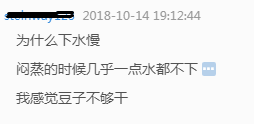
Our first question: "When I pour water for the bloom, I notice no water drips through. Is that the right technique?" Actually, this is the proper approach.
The purpose of the bloom is to let hot water gradually penetrate the center of the coffee bed so that substances in the grounds dissolve into the water first, forming a highly concentrated coffee liquid. During the second pour, a concentration gradient takes over: the concentrated bloom liquid moves toward the lower-concentration fresh water until the two reach equilibrium.
So if you use too much water for the bloom and a large amount of coffee liquid drains through, the water does not linger and instead extracts from the outer layer of the grounds first. By the time the outer layer is dissolved, the inner layer is still dry, and as the hot water finally reaches the inside, the undesirable flavors and astringency from the outer layer dissolve too. Coffee brewed this way ends up both weak and over-extracted.
If the bloom water is too little and nothing drips through at all, the grounds have not absorbed enough water and some particles have not released enough gas, which leads to under-extraction.
So how much water should be used for the bloom?
Generally there are two ways to calculate it:
1. Use 1.5-2 times the weight of the coffee. For example, with 15 grams of coffee, use about 23-30 grams of water for the bloom. Light roasts can use slightly less.
2. Use one-tenth of the total extraction amount. For example, to extract 240 milliliters of coffee, use 24 grams of water for the bloom. Again, light roasts can use slightly less.
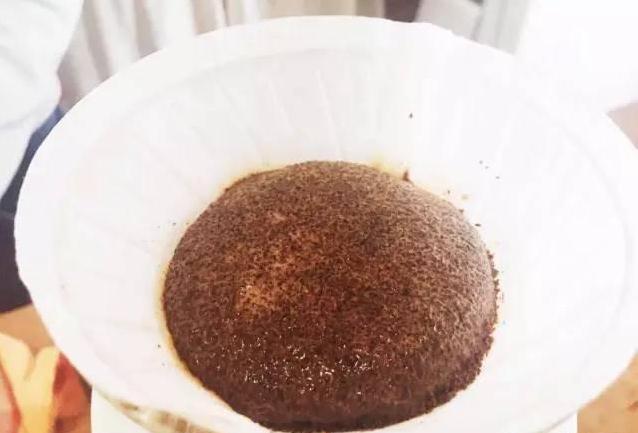
The correct bloom, then, is a few drops falling through - that is ideal - provided that, as shown above, the bloom water is poured completely and distributed evenly across the bed so every particle can absorb water.

Question 2: Where Does Coffee's Acidity Come From?
Second question: let us first look at where coffee's acidity originates. Coffee is one of the plants with the highest chlorogenic acid content in the plant kingdom, and chlorogenic acid is a powerful antioxidant. Coffee also contains formic acid (oxalic acid), citric acid, malic acid, and other acidic compounds. During green-bean processing, acetic acid (vinegar acid) and lactic acid are produced. Finally, during roasting, although some acids break down with heat, citric, malic, lactic, and acetic acids generally tend to survive. So coffee always has some acidity - after all, coffee is a fruit.
As a result, even medium-dark roasts such as Blue Mountain and Mandheling still carry acidity, though less than medium and light roasts. Coffee flavor is also a complex interplay in which the four basic tastes - sour, salty, bitter, and sweet - both enhance and suppress one another. A certain level of sweetness can suppress acidity, for instance, while a certain saltiness can enhance sweetness. When judging coffee acidity we should consider not only its level but also its quality.
Medium-dark Blue Mountain, for example, is often described as very balanced, with low acidity of excellent quality. Its acids are gentle and high in quality, leaving a refreshing sensation in the mouth.
Kenya coffee with its bright berry and citrus acids is another example. Although highly acidic, a good Kenya's acidity can turn into a fruit-like sweet-tart sensation, which is also excellent acidity quality.
Low-quality acids, on the other hand - the kind that are sharply sour and make you pucker, or that are low but dull and lifeless - can never be considered excellent.

Question 3: How to Control the Water-to-Coffee Ratio
Third question: how should you master the water-to-coffee ratio for pour-over? Honestly, as an editor I believe that when you brew coffee, whatever you like is best. Some people prefer it strong, others prefer it light.
But it is worth asking why we always recommend a ratio between 1:14 and 1:16.
First, the ratio we use for cupping is 1:18.8.
That ratio is designed to keep concentration and extraction within the Golden Cup standard: an extraction rate of 18%-22% and a coffee concentration of 1.2%-1.45%.
The pour-over ratio, by contrast, is the ratio recommended to make your coffee "taste better." Anyone who has cupped knows that cupping coffee is relatively weak - that is to distinguish flavors more clearly. A cupping round also lasts about 20 minutes, during which the grounds stay fully immersed and release their flavors completely. Pour-over, on the other hand, extracts within 2-3 minutes. To achieve the same extraction, the ratio needs to be tighter - 1:14 to 1:16, depending on roast level - and at those ratios, as long as you avoid major mistakes, the result will rarely be unpleasant.
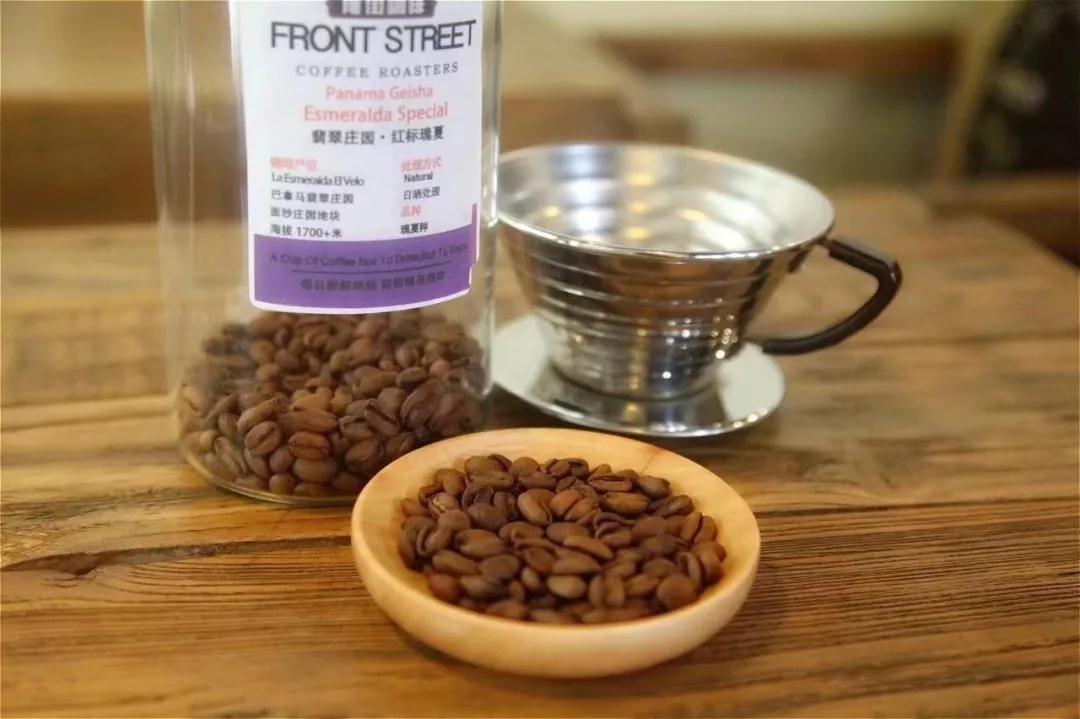
Of course, every rule has exceptions. Personally I enjoy brewing Hacienda La Esmeralda Natural Red Label Geisha at 1:18, which shows off its full floral and fruit aromas. You can also use 1:13 or even 1:12 for Blue Mountain or Mandheling, extracting only the early and middle flavors.
As for pour-over technique, it varies widely. My advice: as long as the coffee tastes good, who cares how you brew it.

Question 4: How Long Should Ethiopia Kochere Rest (Degas)?
Today's last question: how long should Ethiopia Kochere be allowed to rest? Readers of our article "FrontStreet Coffee Teaches You Coffee Making | The Importance of Fresh Coffee - The Resting Chapter" already know. Ethiopia Kochere is a light roast, and light-roasted beans degas relatively evenly and slowly, so they need more time to mature. Resting for 5-7 days is normal, and if your storage environment is cooler, resting for 8-10 days is perfectly fine.
Conclusion
The above covers only a small portion of beginner questions. If there are omissions or inaccuracies, everyone is welcome to add to the discussion. If you have other coffee-related questions, we are happy to hear from you and will do our best to answer.
Looking forward to the next coffee beginner Q and A session. Let us work together to raise our professional standards.
FrontStreet Coffee Recommendation
If you are just getting into pour-over and want a dripper that is practical, easy to use, and good-looking, chances are an experienced drinker will point you to the V60. Hario, the company behind it, was founded in Tokyo in 1921 and was originally known for designing and producing heat-resistant glassware for research institutions; the heat-resistant glass server commonly paired with pour-over is one of its popular products. In 2004 Hario redesigned the prototype of the V60, bringing it close to the form we know today, and named it for its distinctive 60-degree cone and "V" shape before launching it a year later.
Compared with other drippers, the cone and 60-degree angle force the water to flow to the center before dripping into the server, extending contact between water and grounds so aroma and flavor extract fully. The V60's single large opening lets water flow without obstruction, meaning the flow rate largely depends on the brewer's control - and that shows up directly in the cup. As the third wave took hold and roasting moved from dark to light, the V60's fast extraction proved ideal for the delicate aromatics and lively acidity of floral and fruity coffees.
Today the V60 comes in many materials, including resin, ceramic, glass, copper, and stainless steel; the material affects looks, weight, and heat conduction, but the structure stays the same. FrontStreet favors the resin Hario V60: resin effectively blocks heat loss, and in standard industrial production it is the easiest material to shape with the smallest tolerances.
For beans that shine in a V60, FrontStreet offers several floral and fruity options. FrontStreet Yirgacheffe Gedingding is a favorite starting point, with bright citrus, berry, and floral notes and a green-tea sweetness. FrontStreet Ethiopia Hua Kui leads with tropical fruit - strawberry, passion fruit, and even jackfruit - and a juicy body with very little bitterness. And FrontStreet Panama Esmeralda Estate Red Label Geisha brings elegant jasmine florals together with citrus, bergamot, and black-tea notes in a clean, layered cup.
Important Notice :
FrontStreet Coffee is a long-established specialty coffee roaster in Guangzhou China, selling freshly roasted beans from its own farm in Yunnan as well as dozens of carefully selected single-origin beans from around the world for both pour-over and espresso. The products deliver consistently excellent quality and great value, with shipping within 24 hours. Guangzhou's FrontStreet Coffee shop is recommended by many coffee lovers, and the beans are now available online at the Tmall 。
FrontStreet Coffee has moved to a new address:
FrontStreet Coffee Address: 315,Donghua East Road,GuangZhou
Tel:020 38364473
 Scan and follow the En Gafei WeChat official account. Please indicate that the reprint comes from "En Gafei".