How to Brew Delicious Mandheling Coffee? Where are Indonesian Mandheling Growing Regions Located?

Ask a room full of coffee drinkers about Sumatran coffee and you will rarely hear a neutral opinion. Some people are devoted fans; others cannot stand it. If you gravitate toward bright, acidic cups, beans from this island probably never make it into your shopping cart — but if acidity is exactly what you avoid, Sumatra is likely already on your radar. What gives Mandheling coffee its unmistakable character is, above all, the way the beans are processed after harvest.
Sumatra: Indonesia's Coffee Powerhouse
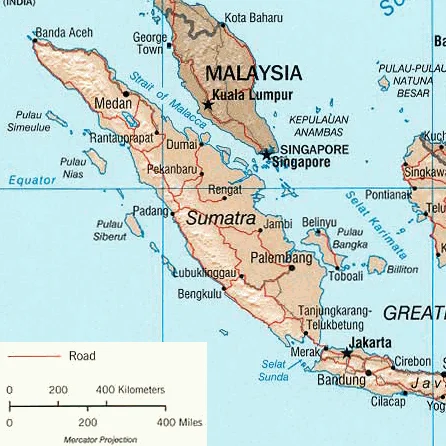
Sumatra is Indonesia's second-largest island and, by a wide margin, the country's most important coffee-producing region. It accounts for 74.2% of Indonesia's total coffee output, while the second-largest producing region manages only 12%.

Coffee, of course, is not native to Indonesia. The Dutch government planted the first trees on the island during the early colonial period, after driving out the Portuguese. Two centuries later, however, World War II dealt the industry a heavy blow: most coffee harvests were replaced with more practical subsistence crops such as rice, corn, and cassava. By 1950, production had collapsed to just one-eighth of its pre-war peak. From that low point, coffee rebuilt itself into a pillar of the local economy. Today Indonesia exports 67% of the coffee it produces, earning roughly $849 million a year. Another notable difference from most coffee-growing countries: 95% of Indonesia's coffee plantations are owned by smallholder farmers.
The Unique Wet-Hulling Process
Sumatra's frequent rainfall and the limited resources of local farmers shaped a distinctive semi-washed method known in the local language as "Giling Basah" — wet-hulling. This technique is what gives Sumatran Mandheling its heavy, syrupy body and unmistakable flavor profile. The coffee made the process famous just as much as the process made the coffee famous; the two have become inseparable.
Here is how it works. On the same day the cherries are picked, farmers run them through machines that strip away the skin and pulp. The mucilage-coated parchment beans then spend the night fermenting in water tanks. The following day, fresh water is added while the beans are stirred to wash off as much of the sticky pectin layer as possible. The parchment beans are then spread out to dry — but only partially. While they are still semi-moist, they are bagged up and sold to nearby processing stations.
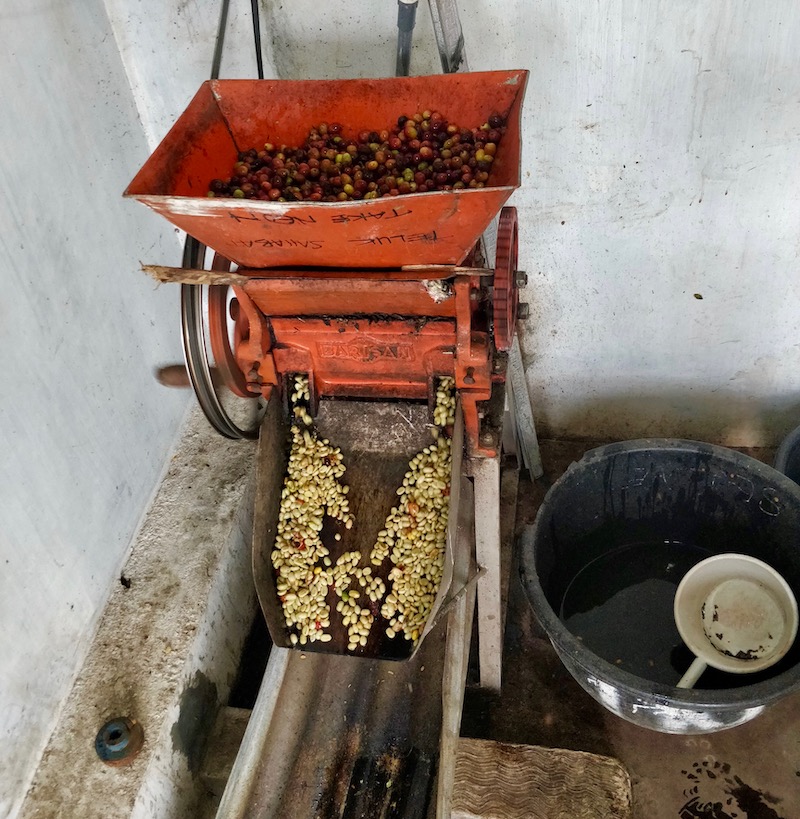
When the processing stations take delivery, they use hulling machines to strip off the parchment entirely, exposing the green beans directly to the air so the drying finishes faster. Drying continues until the moisture content drops to around 13%, at which point the beans are ready to be collected and stored.
Characteristics of Wet-Hulled Coffee
The defining difference between wet-hulling and most other processing methods is timing: the parchment is removed before the beans are fully dried. Hulling semi-moist parchment is a risky business — green beans can easily be damaged along the way. In the Americas, by contrast, many farmers treat the parchment as a protective shell that guards the bean against contamination. Their approach takes longer to dry, but it delivers more even drying, better overall quality, a longer shelf life, and gentler flavors.
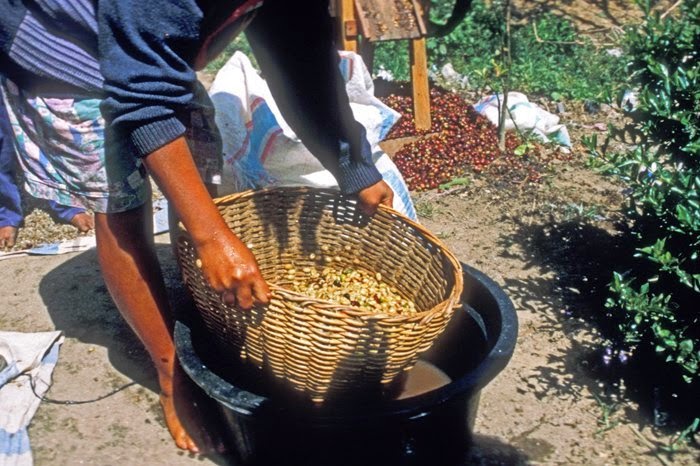
One consequence of wet-hulling is the so-called "goat hoof" shape of many Sumatran beans. These are not defects; they are simply a signature of Mandheling coffee. Beans from different origins and different processes naturally look and taste different, and it would be unfair to judge Mandheling as inferior just because its green beans are less photogenic than others.
FrontStreet Coffee's Premium Mandheling Selection
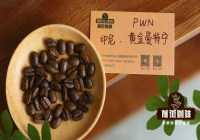
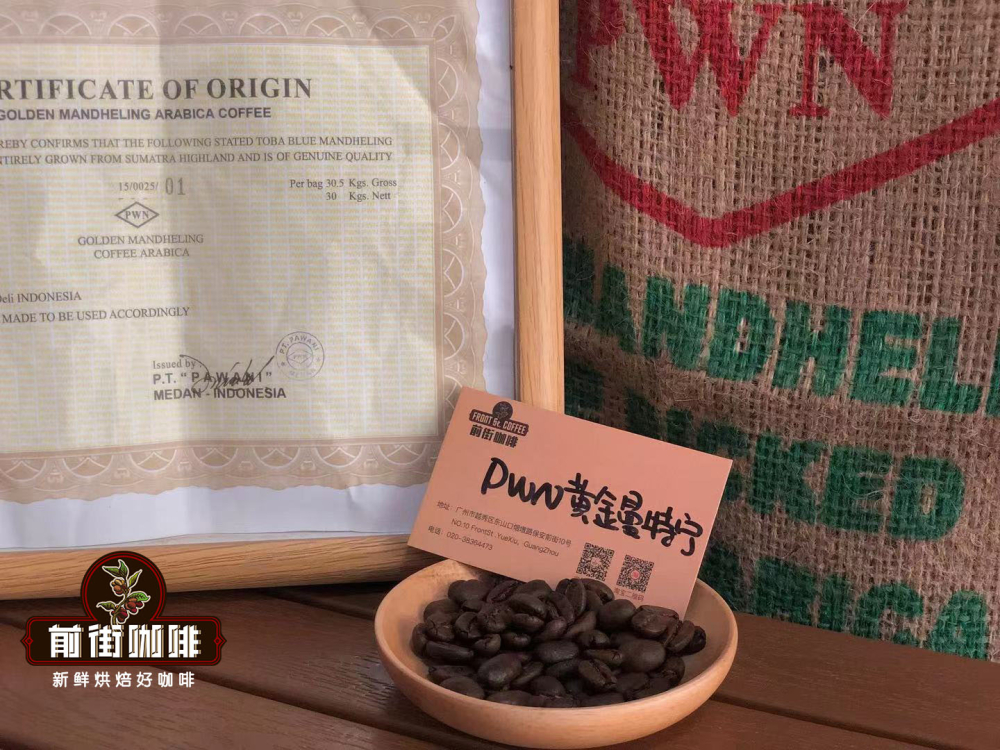
Wet-hulling is one of coffee's traditional processing methods, and it has naturally earned a spot on FrontStreet Coffee's bean menu. FrontStreet Coffee's PWN Gold Mandheling is wet-hulled, and before that it passes through PWN Company's machine sorting for top-grade G1 beans — large, dense, and visually clean — followed by three rounds of hand selection to remove every defective bean. The result is a Mandheling with noticeably greater cleanliness and sweetness.
FrontStreet Coffee: Indonesia PWN Gold Mandheling
Region: Aceh Gayo Mountains, Sumatra, Indonesia
Altitude: 1,100-1,600 meters
Variety: Ateng
Grade: G1, Triple hand-selected
Processing Method: Wet-hulling
Gold Mandheling's exceptionally clean cup has won over countless experienced coffee drinkers, and newcomers who know it only by reputation are usually eager to taste it for themselves. One detail worth knowing: PWN Company has registered "Gold Mandheling" as a trademark, while a Japanese company holds the trademark for "Premium Gold Mandheling." In other words, only Gold Mandheling produced by PWN Company is authentic Gold Mandheling in the strictest sense.
If you want to confirm that your Gold Mandheling really came from PWN Company, ask the seller for the original jute bags bearing the PWN markings and the certificates issued by PWN Company. Both of these proofs of authenticity are on display at FrontStreet Coffee's shop.

Roasting and Brewing Recommendations
When FrontStreet Coffee's roasters received the PWN Gold Mandheling green beans, they chose a medium-dark roast to bring out the rich, full-bodied character that defines great Mandheling.
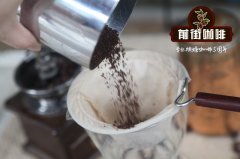
For brewing, FrontStreet Coffee suggests a slow-flow dripper such as the KONO, which draws out the coffee's thick texture and a fuller range of flavor compounds. Because the slow flow rate raises the risk of over-extraction and bitterness, pair it with 88°C water and a medium-coarse grind.

Brewing Parameters:
Dripper: KONO dripper
Water Temperature: 88°C
Coffee Dose: 15g
Coffee-to-Water Ratio: 1:15
Grind Size: 70% pass-through through China standard #20 sieve
Frequent readers of FrontStreet Coffee's articles will have noticed that the three-pour method is the house standard. Compared with a single continuous pour, splitting the water into three stages builds noticeably more layered complexity into the cup.

Start by pouring 30g of hot water to saturate the grounds completely and let the coffee bloom for 30 seconds. Next, pour from the center with a small, steady stream, spiraling slowly outward until the scale reads 125g for the first segment. Once the coffee bed begins to show through, pour again from the center, circling gently up to 225g, then stop. Let the water drain fully into the server before removing the dripper. Total brew time should land at roughly 2 minutes.
FrontStreet Coffee Recommendation
If this article has you craving a classic Sumatran cup, FrontStreet Coffee's Indonesia PWN Gold Mandheling is the bean to reach for. Produced by PWN Company to the strictest standards — only beans above an 18 screen size are used, with fewer than 3 defects allowed per 300g green coffee sample to meet the top G1 grade, followed by three rounds of hand selection — it brews into a black coffee with a clean sweetness, full syrupy body, and rich roasted aroma after its medium-dark roast. It is an ideal pick for anyone who prefers their coffee without acidity.
For something a touch more traditional, FrontStreet Coffee's Lintong Mandheling, from the classic Lintong growing region around Lake Toba, delivers the quintessential Mandheling profile: deep herbal and woody aromatics, a bold, intense mouthfeel, notes of clove and spice, and a strong, lingering sweetness — with the low acidity and minty, spice-cabinet character that medium-dark roasting brings out. Brewed as pour-over with 87-88°C water, a 15g dose at a 1:15 ratio, and a coarse-sugar grind in three pours, it shows off thick body and caramel sweetness with chocolate and nut tones.
Important Notice :
FrontStreet Coffee is a long-established specialty coffee roaster in Guangzhou China, selling freshly roasted beans from its own farm in Yunnan as well as dozens of carefully selected single-origin beans from around the world for both pour-over and espresso. The products deliver consistently excellent quality and great value, with shipping within 24 hours. Guangzhou's FrontStreet Coffee shop is recommended by many coffee lovers, and the beans are now available online at the Tmall 。
FrontStreet Coffee has moved to a new address:
FrontStreet Coffee Address: 315,Donghua East Road,GuangZhou
Tel:020 38364473
 Scan and follow the En Gafei WeChat official account. Please indicate that the reprint comes from "En Gafei".