Arabica Gesha Typica Coffee Bean Varieties Introduction Are Robusta Coffee Beans Delicious?

The world's first coffee tree was discovered in Ethiopia, Africa. As wars and trade moved people around, coffee trees were transplanted again and again until they spread across the globe. A small bean gradually worked its way into daily life, and coffee rose in popularity worldwide.
1. Coffee Arabica
Accounting for three-quarters of world production, Arabica is the quality benchmark. Because the tree is highly sensitive to heat and humidity, it demands highland climates—at least 900 meters above sea level. The higher the altitude, the greener the beans, which are oval with curved creases. Roasted, these beans are of excellent quality, and the variety carries lower caffeine (1.1–1.7%), gentler on the body.

About the name "Arabica": it's easy to assume the variety came from the Arabian Peninsula. In fact, it originated in Ethiopia. The name is a historical accident of geography—the Arabian Peninsula sits at the crossroads of Asia, Europe, and Africa and was a hub of cultural exchange well before the Age of Discovery. Much as Indian numerals reached Europe through Arab scholars and became known as "Arabic numerals," the coffee took its name through a similarly long process of transmission.
It wasn't until 1753 that the botanist Linnaeus, believing the coffee came from the Middle East, gave it the scientific name Coffea arabica L. In 2002, a coffee genetics project funded by Europe found that gene diversity in places like Yemen was far lower than in Ethiopia—which finally located Arabica's true homeland.

Before the 15th century, coffee was long monopolized by the Arab world, which is why Europeans called it "Arab coffee." Originally, all commercial coffee worldwide was Arabica; only after a massive disease outbreak in the late 19th century did growers start seeking resistant alternatives. Today Arabica still dominates, at about 3/4 of global production, grown mainly in Latin America with some cultivation in Indonesia and the Pacific islands. Brazil, the world's largest producer—over 1/3 of world output—has geography and climate ideally suited to Arabica, and Arabica is its main variety.
2. Robusta
Robusta originated in the Congo region of West Africa. We habitually compare Arabica with Robusta, but botanically that's not rigorous: they aren't even at the same taxonomic level. Robusta belongs to the Canephora (Congo) species—the way Typica belongs to Arabica. Unfortunately, only one Canephora variety, named Robusta, was ever successfully commercialized, so the variety's name has all but replaced the species name.
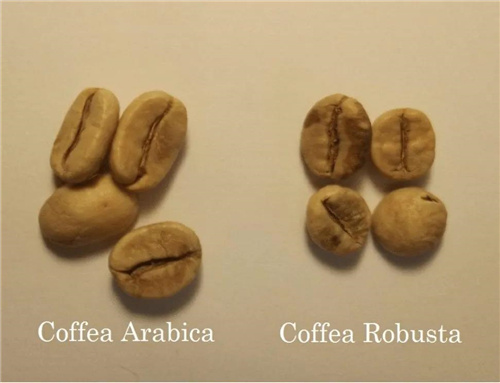
The global coffee belt lies between the Tropics of Cancer and Capricorn, and Robusta is no exception. But Robusta's growing conditions are less demanding: it tolerates lower altitudes and higher temperatures, grows faster than Arabica, and withstands extreme weather better. It's widely grown in Vietnam, Brazil, and India, and also in Hainan, China.
Pest resistance: Robusta's caffeine content runs 2.7%–4%, twice that of Arabica. Caffeine is a natural pesticide, shielding the plant from most insects.

Disease resistance: Arabica has 44 chromosomes while Robusta has 22. Usually more chromosomes mean greater gene complexity, but Arabica is self-pollinating while Robusta is cross-pollinating, and cross-pollination introduces genetic reshuffling.
Is Robusta tasty, then? Typically it serves espresso blends and instant coffee for its strength and crema, while the specialty world favors Arabica for purity and complexity.
Arabica, moreover, is a whole category: the varieties we constantly name—Typica, Bourbon, Geisha—all belong to it. Today, FrontStreet Coffee introduces the varieties within Arabica.
Start with the renowned Geisha from Panama's Hacienda La Esmeralda. The variety was collected in 1931 in the forest near Gesha, Ethiopia, sent to Kenya's coffee research institute, introduced by Uganda and Tanzania, then brought to Costa Rica in 1953. Finally, Panama received Geisha from Costa Rica—thus the legendary route by which Geisha entered Panama.
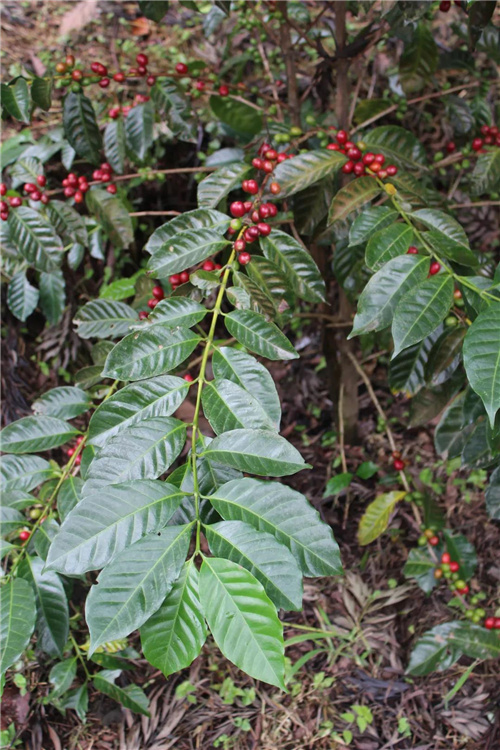
Geisha's road to fame was winding. After arriving in Panama it was never widely planted—used merely as windbreaks for coffee farms. FrontStreet Coffee can't help remarking: using Geisha as windbreaks was extravagance of the highest order! Nowadays Red Label Geisha must be obtained through auction bidding. The owner of La Esmeralda noticed these windbreak trees tasted far better than the rest, entered them in the Panama green coffee competition, and won first place.
FrontStreet Coffee has recently listed several Geishas. Cupping FrontStreet's La Esmeralda washed Green Label against the natural-processed Green Label, the washed lot's acidity proved more pronounced—lemon and citrus forming a stark contrast—while the natural lot showed more obvious sweetness, somewhat like passion fruit. The experiments demonstrate clearly that washed coffee tastes cleaner, while natural processing delivers even better sweetness and aroma.

After Geisha, come the world's oldest varieties: Typica and Bourbon. Many of FrontStreet Coffee's listings are Typica—Jamaica Blue Mountain, Indonesia Mandheling, and Yunnan Huaguoshan among them. Typica is grown very widely: the Dutch planted it in Java, Indonesia; the French later carried it to the Caribbean, and from there it spread through Central and South America. Because Typica yields notoriously little and is susceptible to leaf rust, most regions no longer plant it exclusively.
Typica has excellent mouthfeel and high sweetness, but terrain and climate shape the cup: the same variety tastes different everywhere. FrontStreet Coffee's Indonesia Mandheling is famous for its wild herbal character; Indonesia's hot, rainy weather made long drying impractical, so a local wet-hulled process was developed—which gives Mandheling its exceptional body and flavor, rich herbal notes and a hint of sweetness in the finish. Note, though, that most coffee now planted in Sumatra is Catimor, which yields more and resists disease better than Typica.

Typica in Jamaica's Blue Mountains, however, tastes nothing like Indonesian coffee. Take FrontStreet Coffee's Jamaica Blue Mountain No. 1: its Typica delivers a supremely balanced cup, sweetness and acidity blended perfectly—one of the best-tasting coffees in the world is no exaggeration.
Under environmental pressure Typica's genes have also shifted: Bourbon is a Typica mutant. Bourbon out-yields Typica but needs shade trees, and its green-topped young leaves earned it the name "green-topped coffee." It's named for its original home, Bourbon Island—today's Réunion—from which the French exported it. Bourbon cherries are small with denser pulp, hence higher sweetness and bright acidity.

Brazil, one of the world's largest coffee exporters, grows plenty of Bourbon and its mutants, which include Caturra and Pacas. "Bourbon" generally means Red Bourbon, and Brazilian Red Bourbon brewed up shows classic nut and chocolate notes with rich peanut and cream flavors—FrontStreet Coffee's Brazilian Red Bourbon carries exactly that unique Brazilian character.
Beyond Red Bourbon, Brazil also gave the world Yellow Bourbon, which grows mainly at high altitude. Naturally processed, it carries Bourbon's inherent nuttiness, balanced acidity, and slight bitterness. FrontStreet Coffee's Brazil Queen Estate (Fazenda Rainha) Yellow Bourbon interprets the variety perfectly: obvious sugarcane sweetness, a light lemon aroma, rich nuttiness, and an aftertaste of dark chocolate, with a rich, thick mouthfeel overall.

According to FrontStreet Coffee's research, Kenya's two main varieties, SL-28 and SL-34, were bred by Scott Laboratories—SL-28 from Bourbon, SL-34 from Typica. FrontStreet Coffee's Kenya beans show rich berry acidity and a fermented wine aroma, very different in acid quality from the lemon-citrus notes of FrontStreet Coffee's Ethiopian Yirgacheffe, even though both are African beans.
This is only a small slice of the coffee-variety story. As technology advances, varieties keep multiplying: through continuous hybridization, yields improve and disease resistance strengthens, and FrontStreet Coffee believes coffee flavors will only keep enriching.
For more specialty coffee beans, please add FrontStreet Coffee on private WeChat (FrontStreet Coffee), WeChat ID: kaixinguoguo0925
FrontStreet Coffee Recommendation
Geisha is one of Arabica's most coveted varieties, celebrated for unique florals and superb sweet-tart balance—and priced accordingly, thanks to low yields, weak disease resistance, and demanding management. Knowing the landscape helps you find great value. Newcomers should start with FrontStreet Coffee's Boquete Geisha from Panama: an entry-level Geisha offering the classic Panamanian orange-blossom and honeyed-tea character, oolong-like texture, and delicate fruit acidity at an accessible price. The Esmeralda Red Label (grown at 1,600–1,800 meters, each batch cupping above 90 points and traceable to a single micro-plot such as Hiramio) and the blended, more affordable Green Label represent the summit.
Ethiopia, Geisha's birthplace, has its own estates. Geisha Village, just 12 miles from the original Gesha forest, grows three varieties—Gori Gesha, Geisha 1931, and Illubabor Forest—graded into Gold Label (Rarities, 10% of output, the village's top non-auction coffee, meticulously natural-processed), Red Label (Growers Reserve, Gori Gesha, 15% of output, 88+ points on the SCA scale, fully traceable by block, variety, and processing date), Green Label (Single-Terroir), and Chaka. For a gentler introduction, FrontStreet's Genlana Estate Geisha—hand-picked, dried 14–20 days on raised beds, roasted medium-light—offers bright citrus acidity, elegant ginger-flower aromatics, ripe-fruit sweetness, and a silky, refined finish.
Brewing Geisha: it's a light-medium roast with a dense bean that tends to sink and clog, so grind coarser—78% pass-through on a China #20 sieve (fine-sugar texture)—and use 91°C water. FrontStreet's pour-over recipe: 15g of coffee in a small Hario V60, 1:16 ratio, three-stage pouring—30g bloom for 30 seconds, then to 125g, then to 225g after the bed drains halfway, for a total of about 2:10–2:20. Geisha also makes a striking SOE (20g dose, 1:2 ratio, 25 seconds, 40g out: apricot, caramel, nuts), and the FrontStreet Strawberry Candy blend—Panama Geisha plus Costa Rican honey process—extends the floral-fruit experience to moka pot, espresso machine, and cold brew alike.
Important Notice :
FrontStreet Coffee is a long-established specialty coffee roaster in Guangzhou China, selling freshly roasted beans from its own farm in Yunnan as well as dozens of carefully selected single-origin beans from around the world for both pour-over and espresso. The products deliver consistently excellent quality and great value, with shipping within 24 hours. Guangzhou's FrontStreet Coffee shop is recommended by many coffee lovers, and the beans are now available online at the Tmall 。
FrontStreet Coffee has moved to a new address:
FrontStreet Coffee Address: 315,Donghua East Road,GuangZhou
Tel:020 38364473
 Scan and follow the En Gafei WeChat official account. Please indicate that the reprint comes from "En Gafei".