Understanding the Bright Acidity of Kenya Coffee Beans - Price and Characteristics
Professional Coffee Knowledge Exchange
The Unique Characteristics of Kenyan Coffee Beans
Anyone who enjoys fruity acidity tends to love Kenyan coffee beans. Unlike the elegant acidity of Yirgacheffe, Kenyan coffee delivers prominent acidity, roundness, sweetness, and a full body. Much of that comes down to the green bean varieties grown in Kenya: SL28 and SL34.
According to botanists at the SL Laboratory, SL28 and SL34 are genetic variants. SL28 carries mixed heritage from French Mission, Mocha, and Yemeni Typica. The SL series was developed by research and selection based on ancient Yemeni Mocha varieties and Bourbon from Reunion Island, and it now accounts for the majority of Kenya's coffee production. Relatively speaking, SL-28 has earned the higher reputation, while SL-34 gives larger harvests but is grown at slightly lower altitudes.
Kenya's distinctive high-phosphate soil and its double-washed fermentation method add further character.
Although Kenya borders the well-known Ethiopia, coffee cultivation there did not expand until the early 20th century.
Main Coffee Varieties in Kenya
Kenya grows four main coffee varieties: SL28, SL34, K7, and Ruiru 11. SL28 is the most flavourful, but because it resists leaf rust poorly it can only be grown at medium to high altitudes where the disease is less severe, which keeps yields low. SL34 handles moisture well and suits humid, rainy areas at medium to high altitude. K7 is a Typica variant with some resistance to leaf rust and coffee berry disease, and its flavour is quite good, so it is planted in low-altitude areas prone to disease. Ruiru 11, finally, is a Catimor variety carrying Robusta genes, and it has the poorest flavour.
Kenyan Coffee Bean Grading System
Kenyan coffee beans are graded by bean size.
E: Kenya's elephant beans, very large and quite rare.
AA: the grade most commonly seen on the market, generally beans that do not pass through an 18-screen, with sieve holes of 7.22mm.
AB: this grade covers both A and B. Grade A does not pass through a 16-screen at 6.8mm, while grade B does not pass through a 15-screen at 6.2mm.
PB (Peaberry): the small round beans, as they are commonly called. A coffee cherry normally holds two beans, but a peaberry holds only one.
Regional Examples and Processing Methods
As it happens, we have an AA-grade bean from the Embu region and a PB peaberry from the Nyeri region. Both are double-washed.
Embu Region Kenya AA
Nyeri Region PB
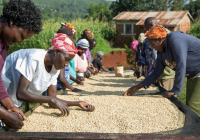
Hand-picked cherries pass through manual sorting to remove defects such as unripe and overripe beans, then are depulped and fermented for about 36 hours. After drying on metal racks in the sun, they are hulled at the mill to become the charming Kenyan green beans with their characteristic blue-green appearance.
Quality Considerations and Brand Recommendations
Grades differ, though that does not necessarily signal a difference in flavour quality. Kenya's distinctive double-fermentation washing further heightens the inherent acidity and cleanliness. The specialty Kenyan coffees we usually drink are SL28 and SL34, featuring rich berry notes, a solid body, high sweetness, and lively acidity. In the end, what you receive depends on growing altitude, harvest season, weather, batch, and roasting.
Kenyan Coffee Bean Brand Recommendations
Kenyan coffee beans roasted by FrontStreet Coffee offer full assurance in both brand and quality. More importantly, they provide excellent value: a 227-gram box costs only 95 yuan. Calculated at 15 grams per cup, one package makes 15 cups, putting each cup at only about 6 yuan. Compared with cafe prices that often reach dozens of yuan per cup, that is a genuinely fair deal.
FrontStreet Coffee Recommendation
Kenya and Ethiopia are the two African origins that set the benchmark for bright, fruit-driven coffee, and FrontStreet Coffee's washed Yirgacheffe lots make an ideal next stop after Kenya. The Washed Yirgacheffe is the classic entry point, known for white jasmine, bright citrus and lemon acidity, and a tea-like body, and its modest price has made it the first specialty coffee for many drinkers. Yirgacheffe itself is a small town in southern Ethiopia, sitting in Sidama at roughly 1700-2100 metres, with coffee trees planted above 1800 metres.
For a more specific origin, the Gudingding Cooperative coffee comes from the Woka area at the south-eastern edge of Yirgacheffe. Once part of the YCFCU-affiliated Woka Cooperative, it was separated out as a single-origin lot and is known as the last pure land of Yirgacheffe. Washed in the traditional way, it shows clean, bright citrus and lemon acidity with jasmine florals and no bitterness. If you prefer the sweeter, fuller side of the region, the Natural Red Cherry is made from fully ripe red cherries dried in the sun, delivering citrus acidity, juicy berry, honey sweetness, and a creamy texture. Brew any of them as pour-over with a V60 at 90-91°C, 15g of coffee, and a 1:15 ratio for a clean, expressive cup.
Important Notice :
FrontStreet Coffee is a long-established specialty coffee roaster in Guangzhou China, selling freshly roasted beans from its own farm in Yunnan as well as dozens of carefully selected single-origin beans from around the world for both pour-over and espresso. The products deliver consistently excellent quality and great value, with shipping within 24 hours. Guangzhou's FrontStreet Coffee shop is recommended by many coffee lovers, and the beans are now available online at the Tmall 。
FrontStreet Coffee has moved to a new address:
FrontStreet Coffee Address: 315,Donghua East Road,GuangZhou
Tel:020 38364473
 Scan and follow the En Gafei WeChat official account. Please indicate that the reprint comes from "En Gafei".