Kenyan Coffee Processing: K72 Double Wash Method - Characteristics, Flavor Profile and Story
FrontStreet Coffee recently provided a systematic introduction to Ethiopia, the African coffee-producing country. Today we turn to Kenya, another African coffee producer. Kenya and Ethiopia share a border, and comparing the two, the greatest similarity lies in their flavor being concentrated on acidity. FrontStreet Coffee's Ethiopian coffee, however, has a relatively gentler acidity - a bright citrus and lemon sharpness - while FrontStreet Coffee's Kenyan coffee has a more intense acidity, a direct, nerve-striking sensation like cherry tomatoes and preserved plums, tending toward richness.
Kenya Coffee Development
Geographically, Kenya sits right next to Ethiopia, the birthplace of coffee. Yet Kenya's coffee development did not simply lean on that advantage. Coffee was not introduced to Kenya until the 19th century, by the British.
FrontStreet Coffee has summarized how Kenya gradually established its own coffee development system:
- In 1883, the British brought coffee to Kenya - the same year the French brought coffee to Yunnan, starting at the same time but taking different paths.
- In 1922, Kenya established the Scott Agricultural Laboratory (Scott Labs, where SL28 and SL34 got their names) to carry out coffee cultivation research. In the decade that followed, they selected SL28 and SL34 from 42 coffee varieties as the most suitable for the region, giving the industry a good start. Today these two varieties occupy 90% of Kenya's cultivation area.
- In 1931, the Kenya Growers Cooperative Union and the Kenya National Coffee Committee were established, guiding the industry from both the civil and the national level.
- In 1937, the Nairobi Coffee Exchange was established, launching Kenya's coffee auction system, where good coffee commanded good prices and set the tone for coffee pricing.
- In 1938, the Kenyan government issued a coffee grading system - what we now know as AA, AB and PB - giving buyers a basis for judging the quality of Kenyan coffee.
K72 Processing Method

Beyond those points, Kenya's coffee achievements also owe much to the K72 processing method, an extension of the standard washed method that produces a noticeable difference in bean quality. Some people love the intense acidity, others do not. Natural processing dries the beans directly in the sun after harvest and separates them afterward, which saves a great deal of labor, but it inevitably produces some defective beans during drying - insufficient or excessive drying means the cherries must be turned by hand constantly. The main difference in washed processing is that it is not labor-saving: after harvest the pulp is removed directly before drying, which requires investment in machinery and equipment but returns higher-quality beans.
The Kenya 72-hour processing method, also known as K72, starts with cherries harvested at a sweetness level of 21, with only the best fruit selected for pulping. They are then soaked in a fermentation tank for 24 hours using clean river water. After 24 hours they are washed clean, then soaked again in clean river water for another 24 hours of fermentation, washed clean, and fermented again - repeating the process three times for a total fermentation time of 72 hours. A standard washed fermentation typically lasts no more than 36 hours. This repeated washing and fermenting gives FrontStreet Coffee's Kenyan beans their intense acidity and delicate texture.

The time fermentation needs depends on many factors. The hotter the environment, the faster it proceeds. After a period of fermentation, washed processing removes most of the mucilage, then places the beans in a clean water pool for a secondary fermentation. Note that during fermentation the circulating water needs to be replaced every few hours to keep the beans from developing unpleasant odors.
Kenya Auction System
When FrontStreet Coffee first entered the coffee industry, we engaged in cultivation and have our own plantations. We also take part in coffee auctions in producing regions. On one hand, this is how FrontStreet Coffee understands changes in the global coffee industry; on the other, we want to share what we learn through words and images so that everyone can understand coffee better.

Returning to Kenya's auction system, FrontStreet Coffee understands that most beans are uniformly graded and inspected by the Kenya Coffee Board before being sold at auction. This open auction system can be traced back to before 1934 and operates through an agency system. Kenya has 50 licensed agents who send sample beans to their clients for cupping. Clients can bid on the coffee they prefer through agents at auction. That system, however, seems to reward the middlemen while eroding farmers' income, so in 2006 Kenya allowed 32 independent sales agents to negotiate directly with foreign coffee buyers without going through auction.
All of it must still meet the Kenya Coffee Board's standards for quality, storage and bank guarantees, and both systems run in parallel. After years of development it has become one of the most transparent auction distribution systems, where better-quality coffee can achieve higher prices through cupping, encouraging more cooperatives and farms to take part.
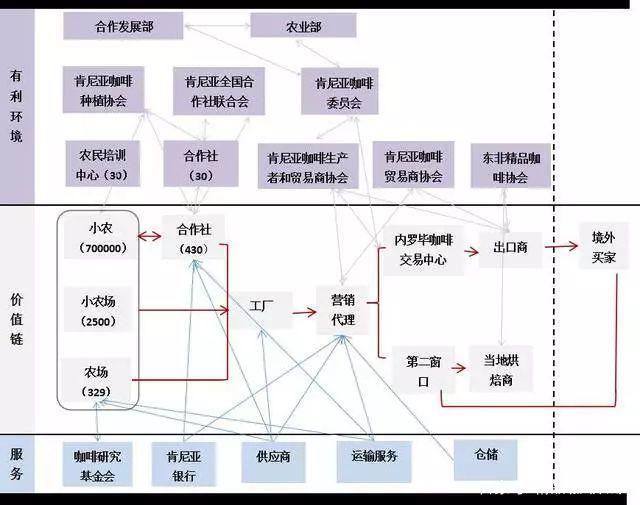
There are two main trading models for Kenyan coffee:
- Auction at the Nairobi Coffee Exchange (Central Auction System): 85% of beans are traded through the auction system.
- Direct trade, often called the "Second Window": only 15% of beans are traded this way.
Kenya Coffee Trading Process
Model 1: Nairobi Coffee Exchange Auction
Since the auction system was established in the 1930s, the vast majority of Kenyan coffee has been traded this way. Auctions are held every Tuesday during the harvest season. The system evolved from an open-outcry auction where each trader bids by pressing an electric trigger. Through this competition among agents, the prices of high-quality, highly sought-after coffee soar.

Model 2: Direct Trade
After 2006, the Kenyan government allowed farmers to trade directly with foreign buyers such as roasters or importers. They can discuss and set a price different from the auction price before or during the harvest. Some exporters also buy directly from marketing agents or factories, using the previous week's auction prices for specific grades as a reference. Direct trade lets farmers who produce high-quality coffee earn more. When direct trade is not feasible, the coffee returns to the exchange for auction.
Kenya Coffee Cultivation Model
Large plantations: more than 3,000 large farms, including 40,000 hectares of coffee, account for about 25% of Kenya's coffee-growing land. The remaining 75% consists of agricultural cooperatives - 270 cooperatives made up of roughly 700,000 small-scale farmers growing coffee.
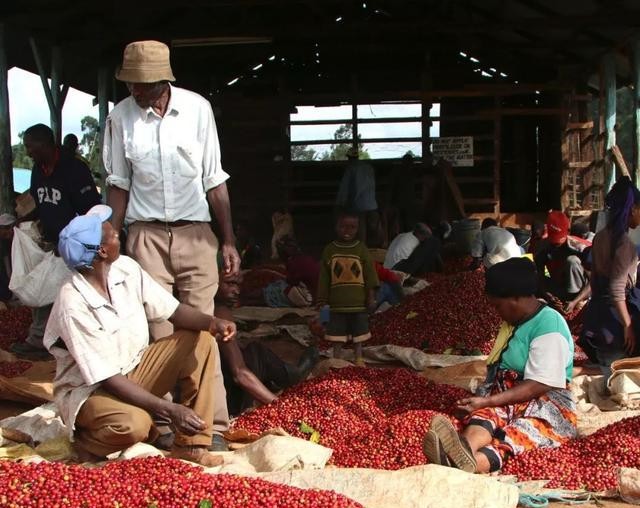
In the 1960s, smallholder cooperatives began developing shared processing plants, letting them harvest and process coffee much like large plantations. To this day, the high-quality output from these specialized factories has made Kenyan coffee known to the world.
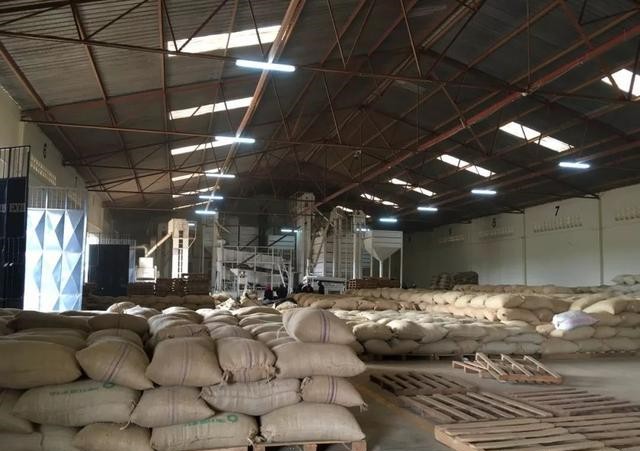
Small farmers typically harvest a few hundred kilograms a year on a small scale. They decide which nearby processing factory to sell their fruit to based on transport distance and purchase prices. Because farmers own very small plots, often measured by the total number of trees on a piece of land, producers have considerable autonomy to pick their cherries strategically and can deliver the ripest fruit to local factories. Factories generally have abundant water for fine washed processing, including soaking the beans in fresh water for extended periods to consolidate the unique Kenyan flavor profile.
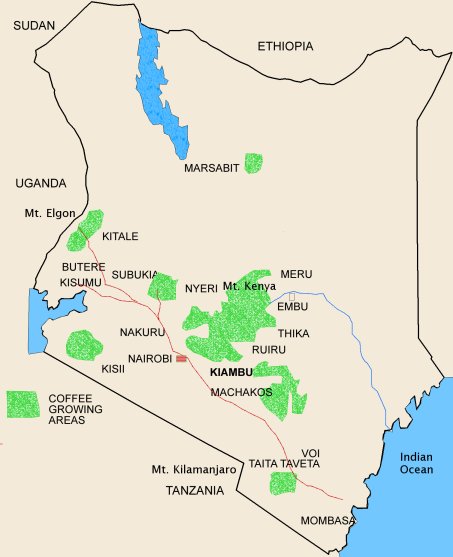
Kenya Coffee Growing Regions
Kenya's coffee growing regions are mainly distributed across the central and western parts of the country. The main central regions include Kiambu, Nyeri, Kirinyaga, Muranga, Embu, Machakos, Ruiri and Thika. In the west there are Kisii and Bungoma on Mt. Elgon.
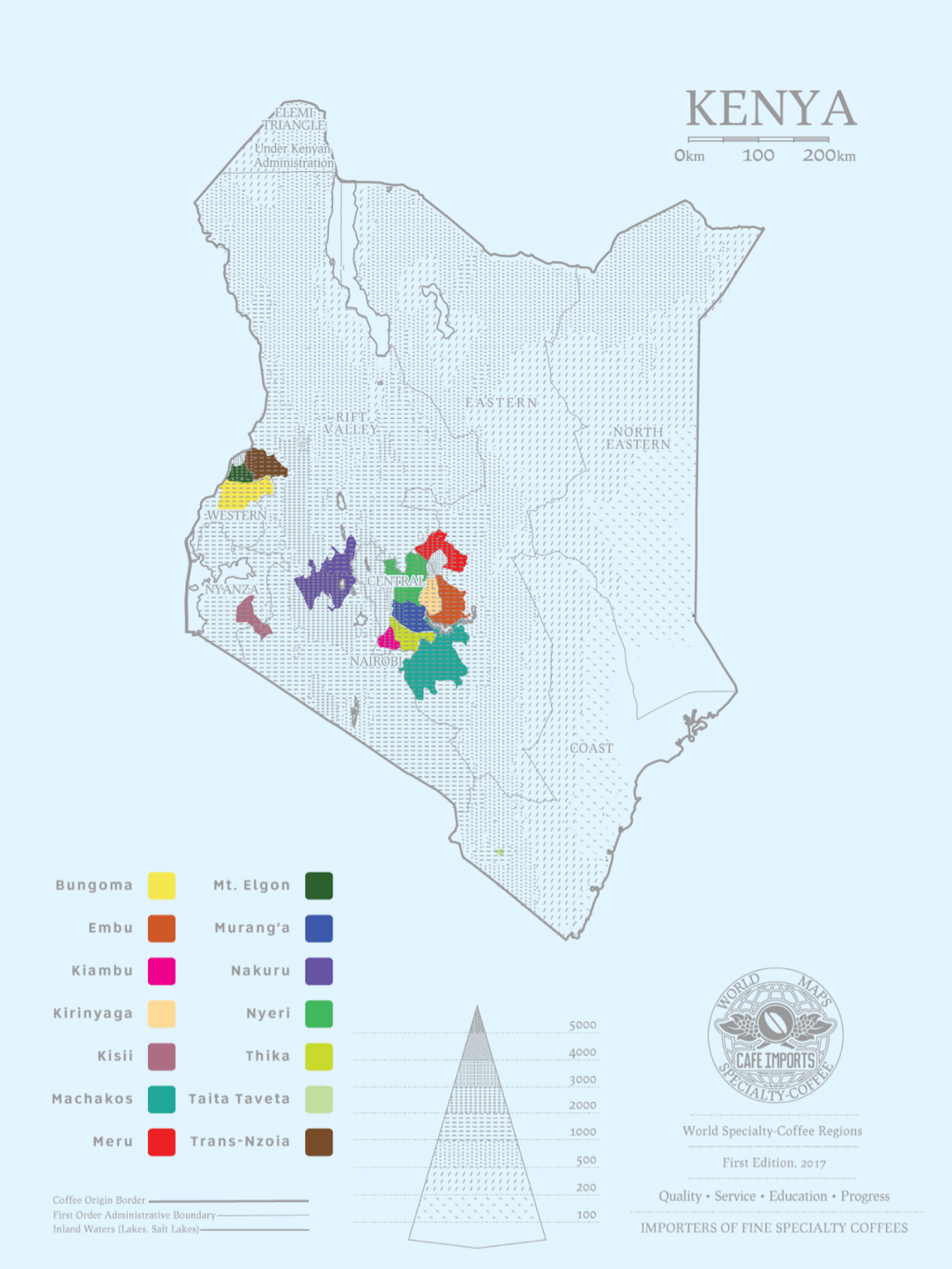
FrontStreet Coffee periodically updates the growing regions on its bean list, and Kenya is no exception. Last month, FrontStreet Coffee ran tasting sessions on a batch of new-season Kenyan beans from different regions, through roasting, cupping and pour-over brewing, and found that each region has its own character.
- Kiambu and Muranga show relatively bright and full acidity.
- Nyeri has bright citrus and floral aromas. Although slightly inferior to FrontStreet Coffee's Ethiopian Yirgacheffe, it has a full-bodied berry acidity.
- Kirinyaga's acidity also tends toward brightness and richness, with delicate sweetness.
- Embu's acidity is not as full-bodied or strong as the previous regions, with flavors leaning toward balance and a persistent aftertaste.
- Machakos also shows outstanding acidity with a delicate mouthfeel and persistent aftertaste, gradually gaining attention from coffee buyers.
- Kisii and Bungoma differ most from other regions in their prominent fruity sweetness, gentle acidity and nutty flavors.
FrontStreet Coffee's Kenyan Coffee Varieties
In Kenya, common varieties include SL28, SL34 and Ruiru 11.
In the 1930s, the Kenyan government commissioned the newly established Scott Labs to select varieties suitable for the country. After screening 42 initial varieties and numbering them one by one, SL-28 and SL-34 were finally selected. The former originated from Bourbon, while SL-34 originated from Typica - the two are not varieties from the same series.
The original goal in selecting SL28 was to mass-produce beans combining high quality with disease resistance. In some regions the selection goal was primarily high yield and disease resistance. Thanks to its Bourbon genetics, although SL28's yield later fell short of expectations, its copper-colored leaves and broad bean shape offer wonderful sweetness, balance and complex, varied flavors, plus significant citrus and preserved plum character.

SL34 has flavors similar to SL28 but with a softer, cleaner mouthfeel, in addition to its complex, varied acidity and wonderful sweet finish. SL34 carries French Mission, Bourbon and more Typica lineage. Its bean appearance is similar to SL28, but it is better adapted to rainforest growth.
Subsequently proven, the former received quite high praise, typically with blackcurrant-like acidity and complex flavor presentation, while the latter, although slightly inferior, still has impressive fruity flavors. These two varieties currently account for 90% of Kenya's production and have become the generally recognized representatives of Kenyan coffee. Today South America is also actively introducing SL28 as a cultivation variety.

Ruiru 11: in 1985, during the global coffee leaf rust outbreak, Kenya developed this hybrid variety with a priority on yield over quality. Its flavor quality is far inferior to SL28 and SL34, and it did not gain traction in the specialty coffee industry. Even so, many suppliers, including some importing famous beans, mix this hybrid into blends to reduce costs.
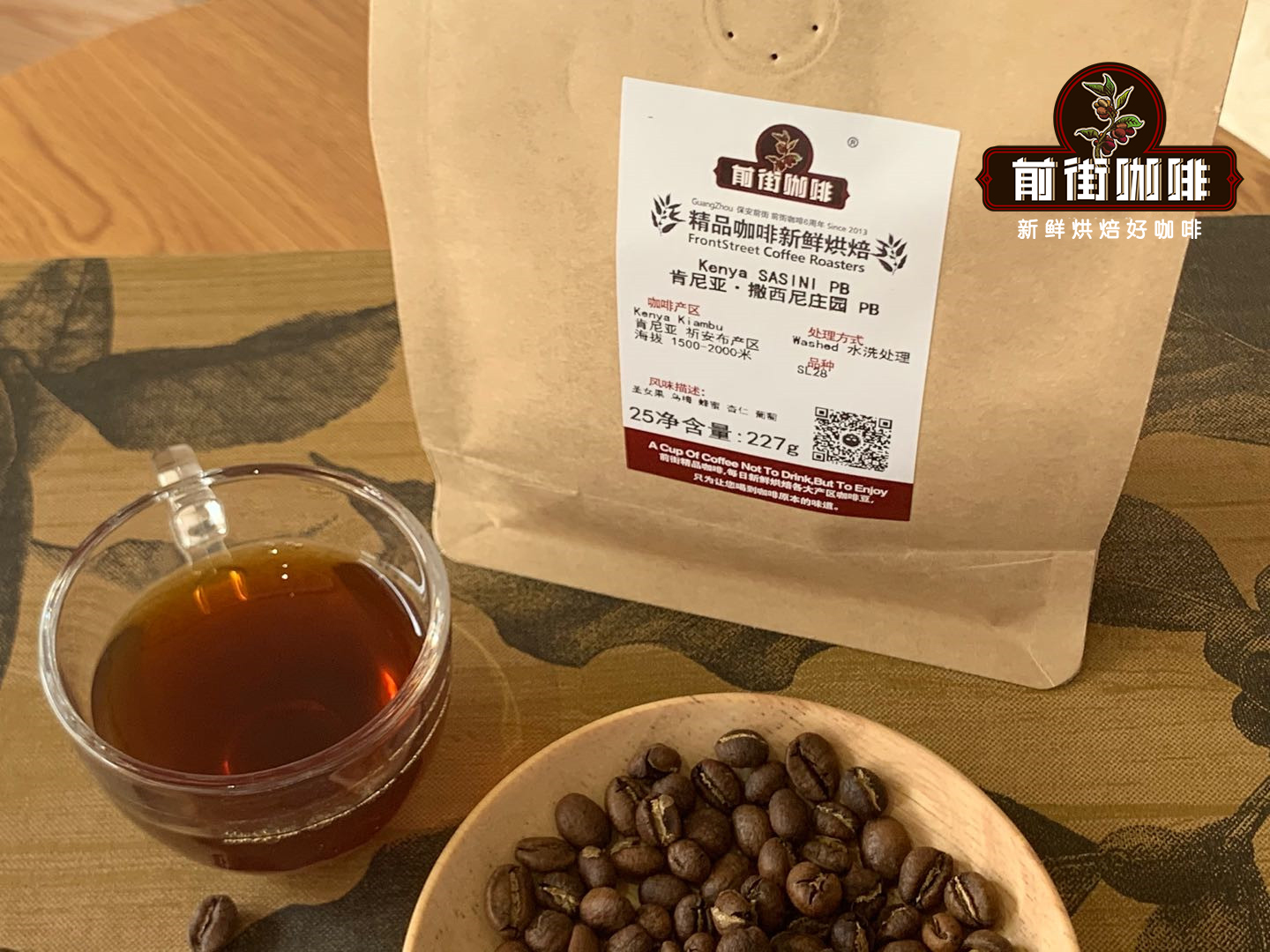
On FrontStreet Coffee's bean list there is a Kenyan coffee from Sasini Estate that includes the Ruiru 11 variety. It has distinct preserved plum and cherry tomato flavors, almond notes in the middle and honey in the finish, with a juice-like mouthfeel and bright acidity.
Kenya Coffee Grading
Kenyan coffee beans have used a strict grading system since the 1930s, mainly based on the size, shape and hardness of the beans. From high to low the grades run AA or AA+, AB, PB, C, E, TT and T. This can be used as a basis for selection, with coffee flavor also considered as a reference. In the mass market the most common grades today are AA, AB and PB.
Coffee Size Grading
AA grade is a level name for green coffee beans, mainly referring to bean size. AA indicates larger beans, generally green beans with particles above 17 mesh (17 mesh = a sieve diameter of 6.75 mm). AA is 17 and 18 mesh, AB is 15 and 16 mesh.
- AA Plus (AA+): exceptional cup quality (flavor, mouthfeel) within AA grade
- AA particle size (screen size): 17-18
- AB particle size (screen size): 15-16, accounting for the majority of production
- C particle size (screen size): smaller than AB
- TT: lighter-weight beans blown out by an air classifier from AA and AB grade beans
- T: lighter-weight beans blown out by an air classifier from C grade beans
- E Elephant Bean: large mutant beans where two beans have merged, also known as elephant ear
- UG: those not meeting the above standards
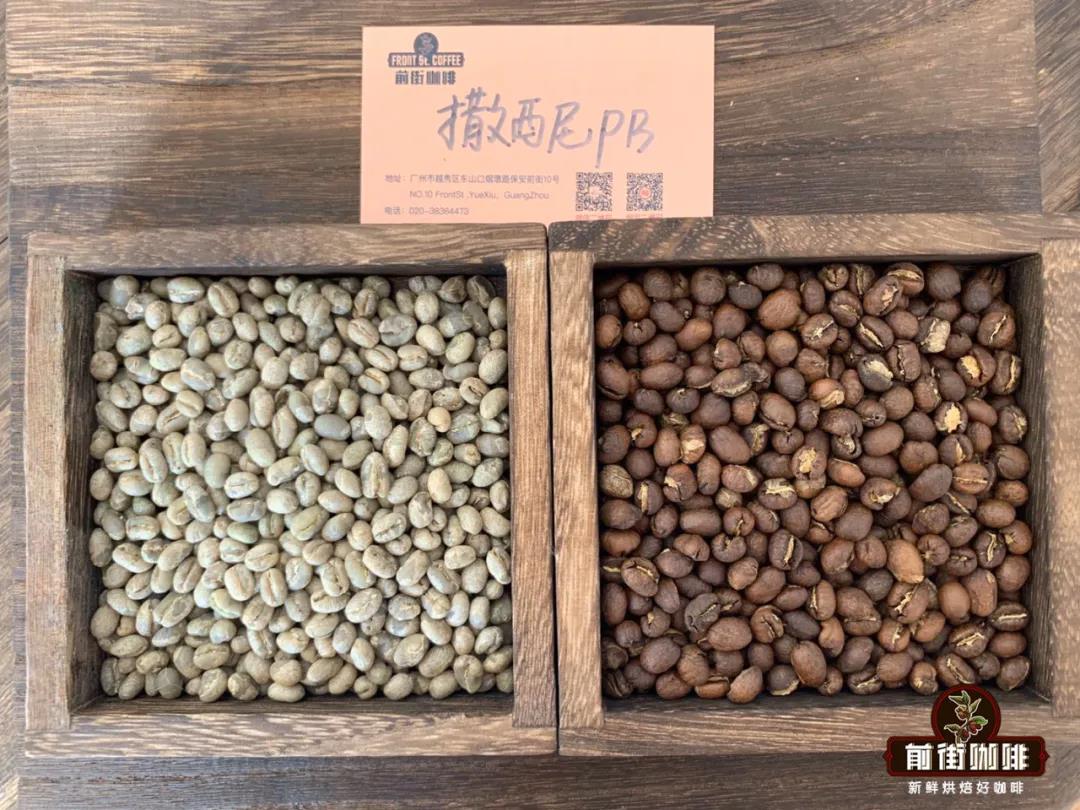
- PB Round Bean (Peaberry): classified by shape, unrelated to flavor or weight
Flavor Grades
Besides size grading, Kenya also uses a flavor grading system of TOP, PLUS and FAQ to select delicious coffee. The indicators are green beans (size, color, defects), roasted beans, and cup quality (acidity, body, flavor characteristics, defects). In practice this is simplified to acidity-body-flavor, quickly scoring each bean 1 to 3 points per item. A bean marked 1-1-1 corresponds to TOP AA.
Several factors shape the actual trading of Kenyan coffee: high prices, many batches (the three-item scoring system was designed specifically to handle so many), direct trading channels outside the exchange, and small quantities.
For that reason, FrontStreet Coffee collects samples frequently, gathering 40 to 50 different Kenyan samples for our roasters to roast, tasting all sorts of Kenyan acidity, and finally selecting the one or two that best represent Kenya to put on the shelf.

FrontStreet Coffee's Kenya Asalia Coffee Beans
FrontStreet Coffee brews its Kenya Small Tomato AA TOP coffee to experience the flavor and mouthfeel brought by Kenya's K72 double-washed processing method.

- Region: Thika, Kenya
- Processing station: Asali Honey Processing Station
- Altitude: 1550-1750 meters
- Grade: AA TOP
- Varieties: SL28, SL34
- Processing method: K72
Roasting Suggestions
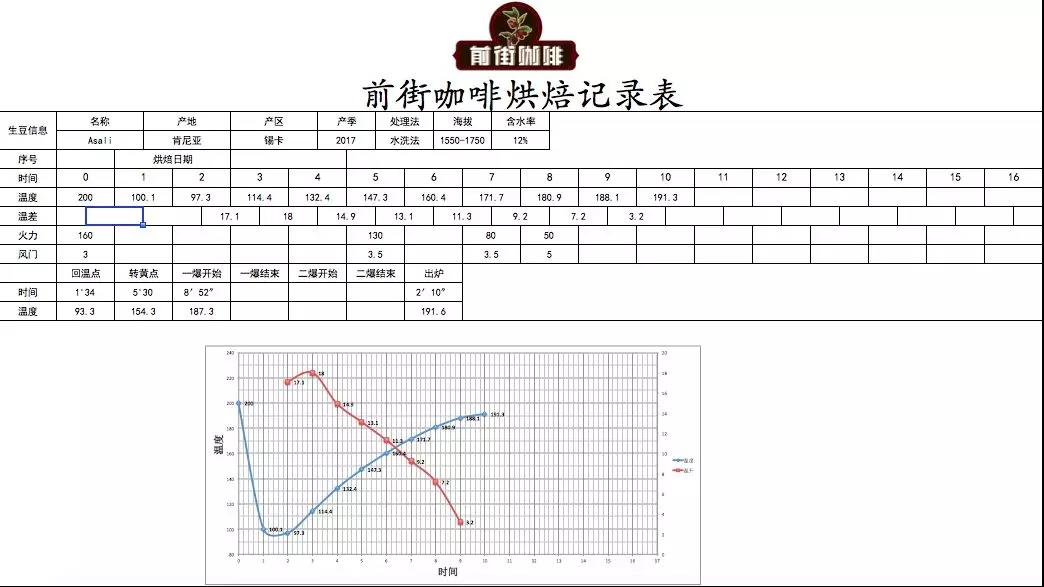
When FrontStreet Coffee roasts this Kenya Asalia bean, we focus on highlighting its bright acidity and adopt a light roast.
- Machine: Yangjia 800N, 550 g green beans input
- Bean entry temperature: 200°C
- First crack: 5'30", 154.3°C
- Development after first crack: 2'10", removed from roaster at 191.6°C
Cupping Flavors
When FrontStreet Coffee roasts, we use a multi-group comparison mode, using cupping to evaluate which roast curve best expresses the bean's flavor.
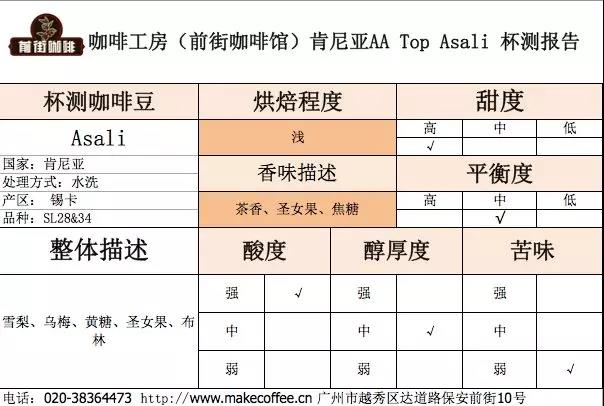
- Dry aroma: cherry tomato, berries
- Wet aroma: tea aroma, caramel
- Palate: snow pear, preserved plum, cherry tomato, brown sugar, plum

Brewing Suggestions
Because this FrontStreet Coffee Kenya Asalia uses a light roast, FrontStreet Coffee uses a higher water temperature and a fast-flow dripper. We need high temperature to extract its bright acidity, but we do not want over-extraction from that heat, so we choose the faster-flowing V60. The main parameters are: V60 dripper, 1:15 coffee-to-water ratio, 15 g coffee, 90°C water, grind size 80% passing a No. 20 standard sieve.

FrontStreet Coffee Brewing Water Temperature Suggestions
The reason FrontStreet Coffee does not specify a particular grind setting is that everyone uses different grinders, and different beans also require different settings - this relates to variety, altitude, processing method and roast, among other factors. So when FrontStreet Coffee gets a newly roasted bean, we first sieve it to determine the appropriate pour-over grind. For this Kenya Asalia bean, FrontStreet Coffee settled on BG#5D after sieving. Even with the same brand of grinder, running it through a sieve is the more rigorous approach.

For technique, FrontStreet Coffee uses segmented extraction, the three-stage pouring method. Pour 30 g of water for the bloom and wait 30 seconds, then pour 125 g in a circular motion for the second stage. When the water level drops to just about to expose the coffee bed, continue pouring to 225 g. Total time is 2 minutes, including the bloom.

FrontStreet Coffee V60 Pour-over Coffee Blooming

FrontStreet Coffee V60 Pour-over Coffee Second Stage Pouring

FrontStreet Coffee V60 Pour-over Coffee Third Stage Pouring
FrontStreet Coffee's Kenya Asalia Pour-over Flavors

On the palate there are flavors of preserved plum and cherry tomato, with an intense, full acidity. The middle section has prominent sweetness with a juice-like sensation, and the aftertaste brings berry aroma, brown sugar sweetness and a green tea fragrance.
FrontStreet Coffee Recommendation
Readers who enjoy the clean, structured character of a well-executed washed coffee will find a familiar pleasure in Yunnan. FrontStreet Coffee's Yunnan small-lot coffee comes from the Baoshan region and is washed and roasted to a medium level, bringing out a gentle caramel sweetness while keeping some acidity, so the cup expresses the terroir of the region with soft nut and chocolate notes and a light plum acidity. For a daily single-origin it is an approachable way to meet Chinese Arabica.
If you want a more clearly defined Yunnan flavor, FrontStreet Coffee's 2013 sun-dried Typica is the next step up. FrontStreet built its own estate in 2013 and planted Typica there, one of the oldest and purest Arabica varieties, with an elegant, clean character. Only fully ripe red cherries are used, the coffee is dried in the sun, and the medium roast keeps the cup balanced and highlights the sweet-and-sour balance; the result shows dark berry notes with caramel sweetness, chocolate and a hint of dried apricot, finishing with the aftertaste of black tea.
Important Notice :
FrontStreet Coffee is a long-established specialty coffee roaster in Guangzhou China, selling freshly roasted beans from its own farm in Yunnan as well as dozens of carefully selected single-origin beans from around the world for both pour-over and espresso. The products deliver consistently excellent quality and great value, with shipping within 24 hours. Guangzhou's FrontStreet Coffee shop is recommended by many coffee lovers, and the beans are now available online at the Tmall 。
FrontStreet Coffee has moved to a new address:
FrontStreet Coffee Address: 315,Donghua East Road,GuangZhou
Tel:020 38364473
 Scan and follow the En Gafei WeChat official account. Please indicate that the reprint comes from "En Gafei".