Indonesian Civet Coffee: Flavor Profile, Taste Characteristics, and Story Introduction - Is Civet Coffee Sour or Bitter?

The fame of Kopi Luwak rivals that of Jamaican Blue Mountain. Whether or not they follow specialty coffee, most people have heard of it. On the surface the flavor hardly sounds appealing, so why is it so famous — and so expensive? Below, FrontStreet Coffee shares the story of Indonesian Kopi Luwak.
The Origin of Kopi Luwak Coffee Beans
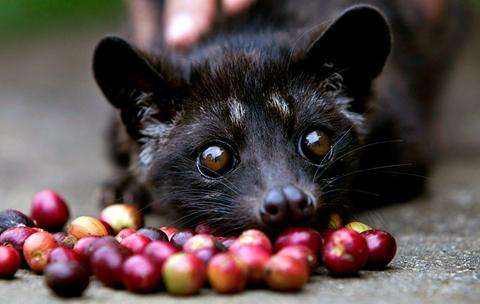
Kopi Luwak is produced in Indonesia. In the early 18th century, Dutch colonists introduced coffee trees to the islands of Sumatra and Java to develop the coffee trade, and forbade local farmers from picking or consuming the fruit. Against that backdrop, local farmers noticed that wild civets would often slip in to steal the coffee cherries. Civets cannot digest the fruit — they break down the ripe pulp but pass the hard beans semi-digested.
The farmers wanted to taste the coffee they grew, so they collected these beans and washed, roasted, ground and brewed them so they could drink coffee too. That is how Kopi Luwak came to be.
How Does Kopi Luwak Taste?
As FrontStreet Coffee understands it, civets mainly inhabit hills below 2100 meters in Indonesia — low-altitude regions where the dominant variety is Robusta. So Kopi Luwak contains not only Indonesian Typica but also Robusta, which gives it the earthy, herbal aromas typical of Robusta. Indonesia's distinctive processing methods make the coffee richer still.

As noted earlier, Indonesian coffee grows mainly on Sumatra and Java, so Kopi Luwak's flavor is in fact very close to Indonesian Mandheling, also from Sumatra. The difference is that Mandheling is picked by hand, so the fruit varies in quality.
Kopi Luwak, by contrast, is chosen by civets using their keen sense of smell to pick the ripest, sweetest cherries. This resembles Ethiopia's Red Cherry Project — one selects 100% fully ripe cherries by hand, the other lets an animal select them. Those naturally ripe cherries lay the foundation for Kopi Luwak's superior flavor.

Civet Fermentation Processing Method
FrontStreet Coffee has often said that a bean's flavor is decided mainly by region, variety and processing method. So does the civet fermentation method really have such a large effect?
Some merchants argue that although the beans are not digested, the strongly corrosive digestive fluids corrode their surface. Those fluids contain a special protease that can break the bean's original protein chains, splitting long-chain proteins into smaller particles — short-chain peptides and amino acids — making the coffee taste better.

In reality, as FrontStreet Coffee understands it, a civet excretes the beans within an hour or two of eating them. The beans stay in the stomach for only one or two hours. FrontStreet Coffee believes that is far too short a time for the changes described above to occur. The beans are essentially the same as when they were eaten, and any flavor change is subtle at most.
So the fermentation method is largely a gimmick. After collection, farmers still process the beans using Indonesia's own wet-hulling method. The civet's only real contribution is selecting ripe cherries.

Why Is Kopi Luwak So Expensive?
Even so, Kopi Luwak remains very expensive. Things are valued for being rare, and Kopi Luwak does have its merits. Because it uses fully ripe cherries, authentic Kopi Luwak is very thick compared with regular coffee, almost syrupy, with a strong sweet aroma. On the palate it has less of coffee's usual bitterness and acidity but more astringency and earthy flavor, with an odd sweet aftertaste. Its thickness makes the mouthfeel quite smooth.
That is why curious consumers are willing to pay for it. It is also the lowest-yield coffee in the world, and the imbalance between supply and demand naturally drives the price up.

According to FrontStreet Coffee's understanding, among the many Kopi Luwak varieties sold today, the most expensive is wild Indonesian original beans, followed by Philippine beans, with Vietnamese beans relatively cheaper. There is also so-called "Grade A" Kopi Luwak, whose beans are excreted by artificially fed civets or possibly other animals. Wild civets live free and select the beans themselves; as noted above, because they are picky and will not eat unripe fruit, choosing only newly ripe cherries, the beans they leave are guaranteed to be of the highest quality and defect-free. Artificially fed civets offer no such guarantee, and the beans vary in quality. FrontStreet Coffee therefore suggests that enthusiasts curious about Kopi Luwak avoid fakes, since the loss would outweigh the gain.
On FrontStreet Coffee's bean list there is another Indonesian coffee that is hand-sorted multiple times to minimize defect rates, so that it presents a rich yet clean cup — FrontStreet Coffee's Golden Mandheling. It is dark-roasted, with dark chocolate, caramel and spice notes, and suits moka pot, pour-over, French press and coffee machine alike.

FrontStreet Coffee's Kopi Luwak Coffee Bean Brief Introduction
Below is a brief introduction to the Kopi Luwak bean available at FrontStreet Coffee stores.
FrontStreet Coffee Indonesian Kopi Luwak Coffee Beans

Country: Indonesia
Region: Sumatra
Altitude: 1600-2100m
Variety: Arabica
Processing Method: Civet fermentation method
Flavor: Herbal, nutty, dark chocolate, fermented notes
FrontStreet Coffee Brewing Recommendations
To better express the herbal flavors and rich mouthfeel of Kopi Luwak, FrontStreet Coffee uses a medium-dark roast. Medium-dark beans generally lose more moisture and weigh less. During brewing, the grounds do not fully sink, water is absorbed at once on the first pour, and active degassing forms bubbles around the grounds that create channels. Those channels last longer with fresher beans, so the water level drops quickly. FrontStreet Coffee typically pours a coarse stream in slow circles.

When brewing Kopi Luwak, FrontStreet Coffee chooses the KONO dripper, because its only degassing area is the quarter-rib design. Once the water level passes the ribs, the level keeps rising, increasing pressure through the weight of the water. Because the outlet is relatively small, it extends the contact time between the coffee particles and the water. As the flow carries soluble material through, extraction is more effective, generally achieving the high richness customers expect.
Brewing Parameters: Water temperature: 86-87°C | Grind size: BG#6w | Coffee-to-water ratio: 1:15 (15g coffee to 225ml water)
Brewing Method: Three-pour method.

1. First pour: 30g of water, bloom for 25 seconds.
2. After the bloom, pour the second water to reach 125g on the scale. Wait for the water level to drop halfway.
3. When the coffee bed is about to be exposed, pour the third water to reach 225g on the scale. Total extraction time is approximately 1'50"-2'00".
Kopi Luwak Flavor Description: Herbal, nutty, smooth mouthfeel, rich body.
FrontStreet Coffee Recommendation
If Kopi Luwak's rarity is what draws you in, Jamaican Blue Mountain is the other classic that earns its legend on balance rather than scarcity alone. Strictly speaking, only coffee grown in the designated area of Jamaica's Blue Mountains and certified by the Jamaican authorities may be called Jamaica Blue Mountain Coffee. The range lies in eastern Jamaica and includes the island's highest peak at 2,256 meters; it is shrouded in mist year-round, which gives it its name. High altitude lengthens the ripening of the fruit, fertile volcanic soil feeds the trees, and even rainfall lets the cherries accumulate sugars and flavor slowly.
Blue Mountain has long symbolized high-end coffee. The growing area is small — total annual output is under 2,500 tons, a tiny fraction of world production — and Japan historically bought more than 70% of it, so even less reaches the wider market. Scarce supply and strong demand keep prices high. For buyers, authenticity matters: reputable importers hold full export certification and proof of origin, and traditional Blue Mountain is shipped in wooden barrels of 15, 45 and 70 kilograms, each one a mark of the genuine article.
FrontStreet Coffee's Jamaica Blue Mountain No.1 is the highest grade of the lot, sourced from the historic Clifton Estate, which has grown coffee since around 1750; its cultivation and processing area sits at an average of 4,300 feet (1,310.64 meters). A medium-dark roast draws out the classic balance — nuts, dark chocolate, creamy caramel and a soft sweetness unfolding in layers, with acidity, sweetness, bitterness and aroma in harmony. Brew it as pour-over with a Kono dripper, 15g of coffee rested 4-7 days, a grind a little coarser than for a light roast (about the texture of granulated sugar), 87-88°C water and a 1:15 ratio: bloom 30g for 30 seconds, pour to 120g, then pour to 225g and finish.
Important Notice :
FrontStreet Coffee is a long-established specialty coffee roaster in Guangzhou China, selling freshly roasted beans from its own farm in Yunnan as well as dozens of carefully selected single-origin beans from around the world for both pour-over and espresso. The products deliver consistently excellent quality and great value, with shipping within 24 hours. Guangzhou's FrontStreet Coffee shop is recommended by many coffee lovers, and the beans are now available online at the Tmall 。
FrontStreet Coffee has moved to a new address:
FrontStreet Coffee Address: 315,Donghua East Road,GuangZhou
Tel:020 38364473
 Scan and follow the En Gafei WeChat official account. Please indicate that the reprint comes from "En Gafei".