The Origin of Blue Mountain Coffee - Flavor Profile and Why It's So Expensive
The Blue Mountains: Geography and Origin
The Blue Mountains run through the eastern part of Jamaica. The range earned its lovely name when a British soldier arriving in Jamaica saw the peaks wrapped in a blue glow and exclaimed, "Look! Blue mountains!" From then on they were known as the Blue Mountains. Jamaica itself is ringed by the Caribbean Sea.
On clear days, sunlight bounces off the water, and the surrounding mountains take on a subtle blue haze as the azure ocean light refracts through the air, giving them an ethereal, mysterious look.
Most of the Blue Mountains rise above 1,800 meters, and the highest peak stands at 2,256 meters, the tallest in the Caribbean and a well-known tourist destination.
Unique Climate
The distinctive flavor of Blue Mountain coffee is closely tied to the range's exceptional location and climate. The Blue Mountains lie within the coffee belt between 25°N and 25°S latitude, with fertile new volcanic soil, fresh pollution-free air and year-round rainfall. Most important, every afternoon clouds settle over the summits, shading the coffee trees and delivering abundant moisture, which is what lets Blue Mountain coffee reach its outstanding taste and aroma.
Only coffee grown in the Blue Mountain region above 1,800 meters can be called Blue Mountain coffee. Some enthusiasts even insist that "only coffee grown at 2,256 meters is true Blue Mountain coffee." Beans grown at lower elevations differ in quality and can only be labeled "Jamaica High Mountain Coffee." What is more, the same coffee trees planted in similar climates such as Hawaii, Kenya or Papua New Guinea still cannot produce the distinctive taste of Blue Mountain beans.
Historical Legacy
The first coffee to reach Jamaica arrived in 1728 from Haiti in Latin America. By 1790, refugees from Haiti included coffee farmers who brought coffee-growing techniques to the region. In 1838, when Jamaica abolished slavery and freed slaves were allowed to cultivate their own land, many moved into the mountains to specialize in coffee and exported it to Britain. The coffee won admirers among British high society and gradually became famous. This is the coffee that captivates enthusiasts around the world today: Blue Mountain coffee.
Exceptional Flavor Profile
Pure Jamaican Blue Mountain coffee blends acidity, bitterness, sweetness and richness into a perfect whole, producing a strongly appealing, elegant aroma that other coffees cannot match. Jim, general manager of Peet's Coffee & Tea, the American company famous for coffee and tea, described it this way: "Its taste is aromatic, smooth, and rich; it feels as precious as a gem to me." Because Blue Mountain coffee is so perfectly balanced, it is usually drunk black. It also has very low caffeine content, less than half that of other coffees, which fits modern ideas about health.
Production Traditions
Blue Mountain coffee's ability to hold its premium status today is inseparable from local production policy. In 1932, Jamaica passed policies encouraging coffee production. Unlike most producing countries, which raised output by planting large quantities of lower-quality coffee, Jamaica put quality ahead of quantity and was willing to sacrifice yield to protect the quality of Blue Mountain coffee. As a result, Jamaica is among the countries with the smallest coffee production in the world. Brazil, the world's largest coffee exporter, produces 30 million bags a year, while Blue Mountain coffee yields only about 40,000 bags a year.
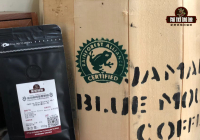
Processing and production are also handled with extreme care. Detailed standards govern processing, roasting and packaging, down to regulations on which organic fertilizers may be used during the growing period. All harvesting is done by hand. Jamaica is also the last country to use traditional wooden barrels to package and transport coffee.
Only coffee that passes the string of stringent standards set by the Coffee Industry Board of Jamaica (C.I.B.) can receive the government-issued certificate and be officially designated with the "Blue Mountain" name.
Brewing Recommendations
FrontStreet Coffee's pour-over suggestion: use a small Fuji grinder with a flannel filter, water at 88°C, a 1:13 coffee-to-water ratio, and a total brew time of 1 minute 30 seconds.
FrontStreet Coffee Recommendation
If you want to taste the authentic article rather than a substitute, the grade makes the difference, and Blue Mountain No. 1 sits among the highest in Jamaica's system, held to strict standards for bean size, defect rate and overall quality. FrontStreet's Jamaica Blue Mountain No. 1 draws on the long-established Clifton Mount estate, which has been growing and processing coffee since around the middle of the 18th century, roughly 1750, on land averaging 4300 feet (1310.64 meters). The altitude, the mild afternoon cloud that shades the wooded slopes, the generous sunshine and the mineral-rich soil all favor slow ripening of the cherries. Genuine Blue Mountain has traditionally been shipped in wooden barrels, and FrontStreet's lots come with full origin documentation, so the source can be traced clearly. Roasted to a medium-dark level, the cup opens layer by layer into nut, dark chocolate, creamy caramel and soft sweetness, with acidity, sweetness, bitterness and aroma held in harmony.
Because Blue Mountain is balanced enough to suit any brewer, FrontStreet suggests a straightforward pour-over: a Kono dripper, 15g of coffee per serving, and letting the beans rest 4-7 days from the roast date for the best flavor. Grind a little coarser than for a light roast, about the texture of granulated sugar, and brew with water at 87-88°C, since water that is too hot is the usual culprit behind a scorched, bitter cup. A 1:15 ratio brings out the coffee's full character, though a tighter ratio such as 1:13 will taste richer at the cost of a muddier finish. Pour in three stages: 30g of water to bloom for 30 seconds, then pour to 120g and pause with a vertical, slow circling stream, then pour to 225g with a slightly faster stream and circle to keep the filter from clogging and over-extracting. The result is a very clean, complex and gentle cup with chocolate sweetness, a strong body and a long, persistent fruit note.
Important Notice :
FrontStreet Coffee is a long-established specialty coffee roaster in Guangzhou China, selling freshly roasted beans from its own farm in Yunnan as well as dozens of carefully selected single-origin beans from around the world for both pour-over and espresso. The products deliver consistently excellent quality and great value, with shipping within 24 hours. Guangzhou's FrontStreet Coffee shop is recommended by many coffee lovers, and the beans are now available online at the Tmall 。
FrontStreet Coffee has moved to a new address:
FrontStreet Coffee Address: 315,Donghua East Road,GuangZhou
Tel:020 38364473
 Scan and follow the En Gafei WeChat official account. Please indicate that the reprint comes from "En Gafei".