Panama Esmeralda Estate Red Label Geisha Coffee Bean Auction Story and Flavor Profile Differences Between Red, Green, and Blue Labels
The Fascinating World of Geisha Coffee: Exploring Panama's Hacienda La Esmeralda
When it comes to Geisha coffee, FrontStreet Coffee believes enthusiasts need no introduction to Panama's Hacienda La Esmeralda. It was both the discoverer and the promoter of Geisha coffee, and at the estate the quality of Geisha is strictly classified - the Red Label, Green Label, and Blue Label tiers, each with distinct characteristics. In this article, FrontStreet Coffee explains what makes Panama's Hacienda La Esmeralda Geisha coffee so special.
Hacienda La Esmeralda: Panama's Coffee Treasure
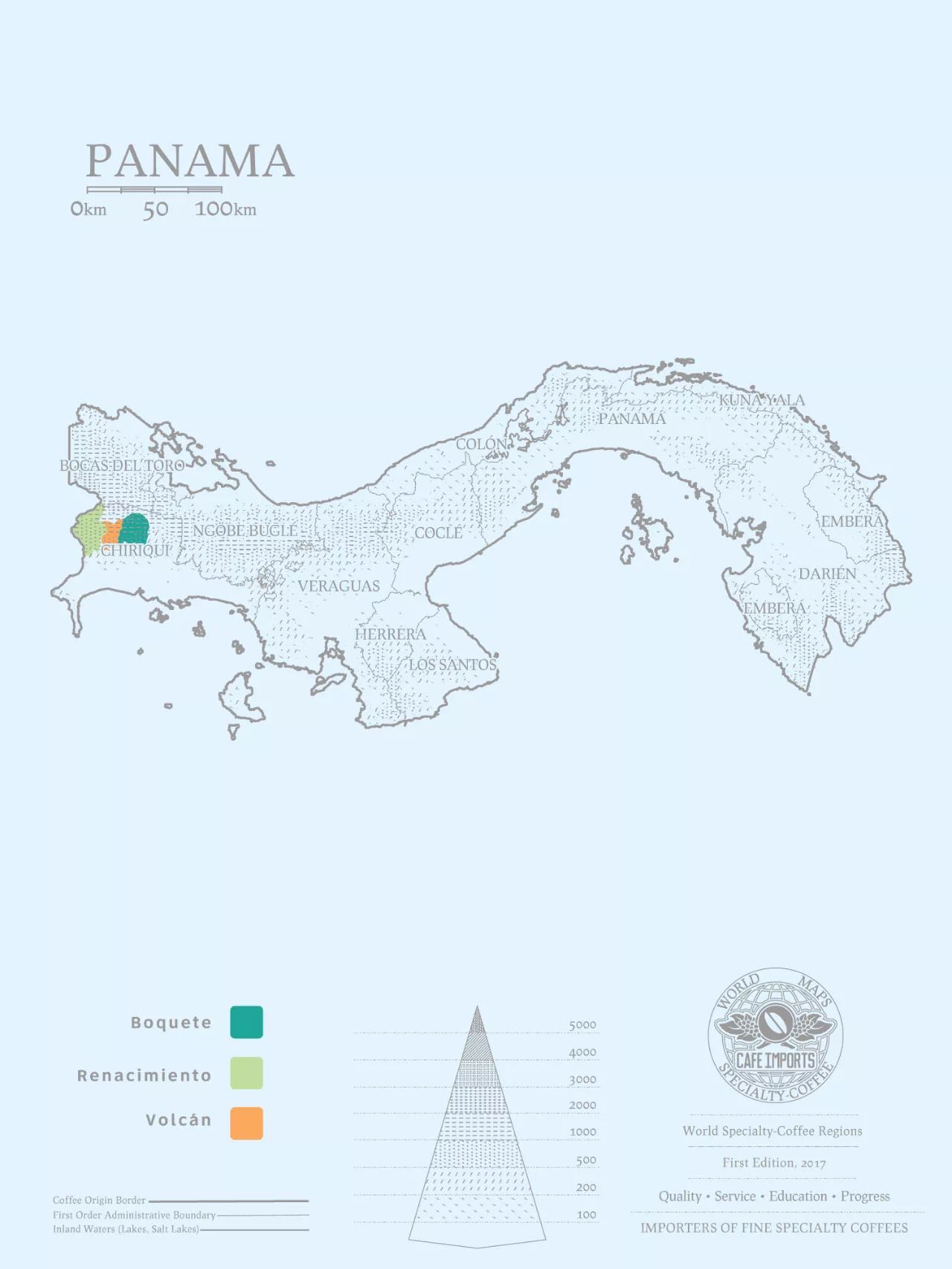
Panama sits in Central America. As is well known, the Panama Canal was built by the United States and was independently controlled by the U.S. for a period after its completion. It was precisely the construction of the canal that drew many American elites south in the late 20th century - partly for work and partly to explore business opportunities. Hacienda La Esmeralda is a witness to that era.
In 1964, the American banker Rudolph Peterson retired and moved to Panama, purchasing Hacienda La Esmeralda in Boquete and initially focusing on dairy farming. Later, his son Price resigned from his medical position to help his father run the farm. In 1987 they introduced the Caturra and Catuai varieties, and in 1994 they built a washed processing plant, giving the estate its own mill. In 1996 they acquired the nearby Jaramillo farm, whose superior geographical environment and excellent original coffee varieties were folded into Hacienda La Esmeralda.
Jaramillo caught the Petersons' attention precisely because its original coffee carried pleasant orange and floral-fruit aromas unlike the traditional taste of Panamanian coffee. After cupping beans from different areas of the farm, they traced the source to an unknown coffee tree growing at the highest point of the farm. Because of its low yield, the previous owner had used it only as a windbreak. The Petersons, however, recognized its promise and decided to separately cultivate and propagate the trees from that area. This is the coffee the world now knows as Geisha.

The bean made a stunning debut by winning the 2004 Panama Best of Panama (BOP) competition. After expert evaluation, it was confirmed to be the Geisha variety originally from Ethiopia. The Peterson family then devoted most of their energy to building the infrastructure needed for outstanding batch separation and refined processing - which brings us to the Red Label, Green Label, and Blue Label classifications.
Plot Division at Hacienda La Esmeralda
As noted above, Hacienda La Esmeralda is located in the Boquete region of Panama, an important coffee-producing area that is also home to well-known estates such as Elida Estate and Kotawa Estate. Since discovering the treasure of Geisha coffee, the estate has divided its Geisha production into extremely fine-grained plots, organized around three main farms: Jaramillo, Canas Verdes, and El Velo, each further subdivided into smaller plots.
High-quality Geisha comes mainly from the Jaramillo and Canas Verdes farms.
Jaramillo
Annual rainfall of 4000ml, average daytime temperatures of 19-25°C, nighttime temperatures of 11-15°C, and an average altitude of 1600-1700m. The Jaramillo farm is divided into 5 small plots: Mario, Noria, Reina, Bosque, and Buenos Aires.

Canas Verdes
Annual rainfall of 3500ml, average daytime temperatures of 16-23°C, nighttime temperatures of 10-15°C, and an average altitude of 1600-1800m. It includes 9 small plots: Lino, Coronado, Fundador, León, Montaña, Trapiche, Chinta, Cabaña, and Tumaco.
El Velo
El Velo is the most recently acquired estate of Hacienda La Esmeralda, with an average altitude of 1700-1900m. Besides Geisha and Catuai, it also grows small amounts of other exotic varieties such as Laurina, Pacamara, Mocha, and SL28. El Velo is divided into 7 small plots: Guabo, Portón, Durazno, Mural, Higo, Buena Vista, and Guila.
Classification Standards: Red, Green, and Blue Labels

As noted above, Hacienda La Esmeralda strictly grades the beans produced on the estate, a marketing strategy that sets it apart from other farms. It divides its output into five major brands based on cupping performance, variety, and growing plot. For the Geisha variety there are three brands: Esmeralda Special (Red Label), Private Collection (Green Label), and Geisha 1500 (Blue Label). For the Catuai variety there are two: Diamond Mountain and Palmira.
Hacienda La Esmeralda Red Label Geisha
Esmeralda Special's Geisha is what we commonly call the Red Label. It selects Geisha beans grown at altitudes of 1600-1800 meters, with cupping scores above 90 points, produced in the Jaramillo and Canas Verdes regions.

Additionally, only Geisha batches that participate in bidding at the estate's own independent auction count as auction Red Labels. There are also non-auction Red Labels on the market today - these are Geisha beans selected from the same plots that did not enter the auction but circulate commercially. The variety and quality are identical; only the pricing differs. This grade uses natural or washed processing, with flavors featuring distinctive, bright floral aromas and citrus notes.

FrontStreet Coffee: Panama · Hacienda La Esmeralda Red Label Geisha Coffee Beans
Country: Panama
Region: Boquete (Hacienda La Esmeralda)
Altitude: 1700 m
Variety: Geisha
Processing: Natural
Flavor: Citrus, Complex Fruits, Rose Tea, Honey
Hacienda La Esmeralda Green Label Geisha

Private Collection, commonly known as the Green Label, consists of non-independent competition batches. It selects Geisha grown at altitudes of 1600-1800 meters from different plots such as Jaramillo and Canas Verdes, blended as micro-lots. Because it follows a mixed-lot model without detailed plot specification, one Green Label batch can taste strikingly similar to the Red Label, while the next batch may show differences.
Although the Green Label does not reach the Red Label's grade, it still delivers classic Geisha flavors - florals, fruit, citrus acidity, and a thick, juicy mouthfeel. Green Label Geisha is available in both washed and natural processing. Since it grows at the same altitudes as the Red Label, simply harvested as a blend, FrontStreet Coffee regards it as the more cost-effective grade from Esmeralda. The batch we acquired uses washed processing.

FrontStreet Coffee: Panama Hacienda La Esmeralda Green Label Geisha Coffee Beans
Country: Panama
Region: Boquete (Hacienda La Esmeralda)
Altitude: 1700 m
Variety: Geisha
Processing: Natural
Flavor: Jasmine, Citrus, Honeydew, Berries
Hacienda La Esmeralda Blue Label Geisha

The Geisha 1500 brand is what we commonly know as Blue Label Geisha. It selects blended beans grown at altitudes of 1400-1500 meters across three farms: Jaramillo, Canas Verdes, and El Velo. The flavors feature subtle floral notes, fruity acidity, and sweetness, with a less rich mouthfeel. Blue Label Geisha is available in both washed and natural processing, with the natural processed Geisha beans introduced in small batches at the end of 2019.

FrontStreet Coffee: Panama Hacienda La Esmeralda Washed Blue Label Geisha Coffee Beans
Country: Panama
Region: Boquete (Hacienda La Esmeralda)
Altitude: 1400-1500 meters
Variety: Geisha
Processing: Washed
Flavor: Lemon, Oolong Tea, Brown Sugar, Peach
The biggest difference between the three labels, then, is altitude. FrontStreet Coffee has noted in previous articles that beans grown at higher altitudes develop better flavors, so the quality of Red and Green Label surpasses that of Blue Label. The difference between Green Label and Red Label, however, is that Green Label beans come from mixed harvests, while Red Label beans are specified by plot and participate in the auction - hence the significant price gap. Yet FrontStreet Coffee believes the flavor difference between Red Label and Green Label Geisha is not obvious, which makes Green Label far better value. Coffee lovers who adore Geisha but have limited budgets should therefore consider trying the Green Label.
FrontStreet Coffee has learned that Geisha has a peculiar characteristic: it performs best when grown in extremely demanding environments. That means Geisha is particularly difficult to harvest and yields very little. Not every estate can produce delicious Geisha - it takes the right conditions and equipment to bring out its excellent flavor. This is precisely why Hacienda La Esmeralda's Geisha beans stand out.

Panama Hacienda La Esmeralda Geisha Processing Methods
As noted above, the three Geisha grades at Hacienda La Esmeralda all rely on the most common washed and natural processing methods. The difference is that washed beans show cleaner, brighter flavors that express the character of the growing region, while natural processing layers fermentation and aroma on top of that base, making the flavors sweeter and more fragrant.

Washed Processing
- First, farmers pour all the harvested coffee fruit into water. Defective beans float to the surface while quality fruit sinks to the bottom, which greatly reduces the time wasted on individual sorting.
- The selected fruit goes into a pulping machine to remove the outer skin and pulp. Even after this, a layer of mucilage still clings to the beans, so large amounts of clean water are needed to wash the sticky substances off the fruit's surface.
- Next, fermentation removes the remaining mucilage completely, a process that takes about 18 hours. Once fermentation is finished, fermentation bacteria adhere to the surface of the fruit, so another thorough wash with clean water is required. Producing 1 kilogram of coffee beans at this step consumes 40 to 50 kilograms of clean water - a very large figure by FrontStreet Coffee's reckoning, and the reason drought-affected countries cannot adopt washed processing.
- The cleaned beans can then be dried. Some regions lay them outdoors in the sun, while better-equipped producing areas send them to mills for machine drying, reducing the moisture content to about 11%.
- Finally, the dried beans are stored, packaged, and prepared for sale and export.


Natural Processing
- The first step is to harvest mature coffee fruit and hand-sort it, picking out defective, overripe, or insect-damaged cherries and keeping only the good ones. This is also why the beans at FrontStreet Coffee's shops generally look uniform and attractive.
- The hand-sorted fruit is sent to dry. Different producing regions use different drying setups - waterproof tarps, raised beds, or concrete floors. Drying averages 27-30 days, until the coffee's moisture content drops to 11%.
- This next step is also crucial. Once drying is complete, the fruit goes to specialized mills for hulling and even polishing, which removes the pulp and other layers to yield the coffee beans we know.
- The hulled green beans undergo another round of sorting to remove any with poor appearance. Over-dried beans are more fragile and may break into fragments during hulling, while under-dried beans retain too much moisture, which can allow bacteria and mold to develop. After this final selection, the beans are sent to warehouses for storage, packaging, and export.


That is FrontStreet Coffee's rundown on Hacienda La Esmeralda Geisha. Before launching any coffee bean, FrontStreet Coffee runs extensive cupping and brewing tests to find the optimal parameters for coffee lovers. Here, then, are the brewing recommendations for these three Hacienda La Esmeralda Geisha grades.
FrontStreet Coffee Panama Hacienda La Esmeralda Brewing Recommendations:
Filter: Hario V60
Water Temperature: 90°C
Dose: 15 grams
Ratio: 1:15
Grind Size: Medium-fine

FrontStreet Coffee Technique: Multi-stage Pouring

Bloom with 30g of water for 30 seconds, then pour in small circles up to 125g for the second stage. When the water level drops and the coffee bed is about to be exposed, pour up to 225g and stop. Once the level drops again and the bed is about to show, remove the dripper. (Timer starts from the bloom.) Extraction time: 2'00".

Panama Hacienda La Esmeralda Geisha Flavor Descriptions
[Red Label] Bright rose and citrus aromas, brown rice, berries, apricot, complex fruits, and honey, with a thick juice sensation, richly layered flavor, and distinct sweetness.
[Green Label] Intense jasmine on the entry, high sweetness, citrus, berries, juicy body, cream, green tea, orange peel, and cantaloupe - richly layered overall, with a persistent floral and citrus aftertaste.
[Blue Label] Gentle lemon and grapefruit acidity on the entry, with oolong tea, honey, and brown sugar sweetness emerging as the cup cools, and a cleaner, brighter mouthfeel.
For more specialty coffee beans, please add FrontStreet Coffee's private WeChat: kaixinguoguo0925
FrontStreet Coffee Recommendation: Tracing Geisha Back to Its Birthplace
Once you've tasted Panama's pinnacle, it's worth exploring Geisha at its origin. FrontStreet Coffee recommends the entry-level Granana Estate Geisha from Ethiopia's Yirgacheffe: grown at the Granana processing station founded in 2014 near the border of Kochere, its fully ripe cherries are hand-picked and dried on raised beds for 14-20 days. Roasted medium-light, it offers bright citrus acidity, elegant ginger-flower aroma, the full sweetness of mature fruit, and a silky texture with Geisha's signature refined finish. For the ultimate challenge, the Geisha Village Estate - a 475-hectare farm built just 12 miles from the original Geisha forest - produces the Gold Label (Geisha 1931, refined natural, just 10% of output) and Red Label (Gori Gesha, scoring 88+ on the SCA 100-point scale), the kind of competition-grade Geisha that advanced brewers dream about.
Important Notice :
FrontStreet Coffee is a long-established specialty coffee roaster in Guangzhou China, selling freshly roasted beans from its own farm in Yunnan as well as dozens of carefully selected single-origin beans from around the world for both pour-over and espresso. The products deliver consistently excellent quality and great value, with shipping within 24 hours. Guangzhou's FrontStreet Coffee shop is recommended by many coffee lovers, and the beans are now available online at the Tmall 。
FrontStreet Coffee has moved to a new address:
FrontStreet Coffee Address: 315,Donghua East Road,GuangZhou
Tel:020 38364473
 Scan and follow the En Gafei WeChat official account. Please indicate that the reprint comes from "En Gafei".