Can Money Really Buy Anything? Are Consumers Buying into Luckin Coffee's Money-Burning Model?
Suddenly, I've noticed that major coffee media outlets have been recently criticizing Luckin Coffee's money-burning model. I think that burning money to first capture market share is indeed a correct strategy for a new brand. Simply put, having customers means having business. But more importantly, you must value user experience! User experience!
Previously, our Coffee Workshop posted a thread where a netizen wrote an open letter to the little blue cup: Please stop contacting me. How about using a billion to improve the user experience of the coffee delivery market?
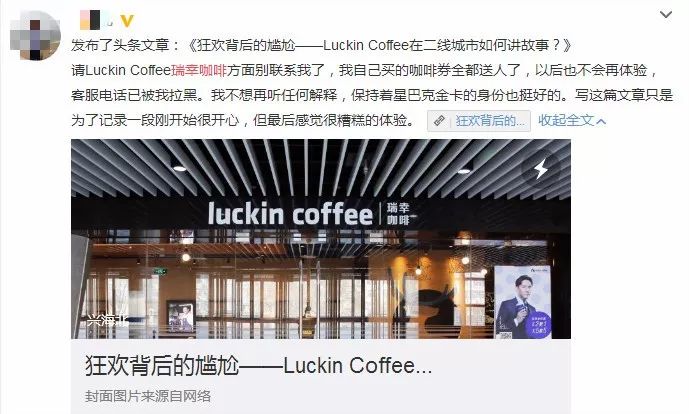
Looking at our followers' comments, it seems that the customer experience aspect hasn't been adding points for Luckin:
@Cat Debbi
I tried it for the first time the other day, it was super unpleasant, I've already uninstalled it, and the coffee doesn't taste good.
@Zen Barista - Alice*z
I've tried Luckin's iced Americano, and it's really hard to drink. Moreover, the smoky and bitter flavors are extremely heavy. They claim it's Arabica, but drinking it feels somewhat like Robusta. I've had it once and don't want to drink it again.
@denni
With so much money available, why not use it to improve the fundamental product quality? What's the point of promoting such upside-down priorities? The Chinese coffee industry needs more capital flowing into coffee brands that focus on products, not these fleeting money-burning ventures.
@sunni
I think relying on this delivery model to build a business cannot cultivate truly loyal customers. Two things increase customer satisfaction: delivery speed and quality. But apparently, neither is very good. I ordered an Americano once, and the taste was quite average. I never ordered again. Relying on money and advertising only attracts temporary attention.
@Above the Clouds
No matter how aggressive the expansion, no matter how appealing the celebrity endorsements, no matter how cheap the products, if the product and service themselves have problems, it won't last long. Consumers are not fools.
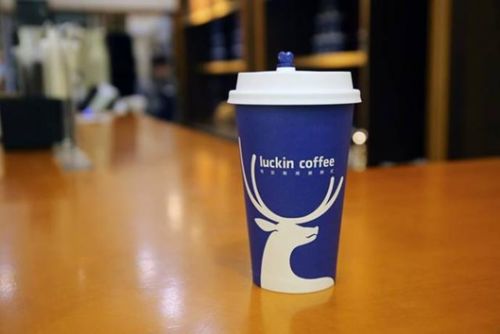
Why do I keep emphasizing that making coffee requires valuing customer experience? Products are tangible, but service is intangible - the experience must be done well. Why do consumers come back for a second time? What's most important for restaurants is heavy consumption - second, third, repeat visits - not always new customers. Anyone who understands the coffee market knows what kind of path Luckin is taking. When the discounts end, will fans continue to pay? This data is very important.
Regarding the original intention behind founding Luckin Coffee, founder and CEO Qian Zhiya told reporters that the coffee industry is undergoing transformation, and the Chinese coffee market is in a rapid growth period, presenting huge opportunities. However, there's still a big difference between running a coffee shop and making a good commercial specialty coffee. "We have sufficient funds, an efficient team, full confidence and determination to provide users with a high-quality specialty coffee."
Anyone who has encountered specialty coffee knows that selecting premium Arabica coffee beans does not equal specialty coffee. This can only be considered commercial coffee!
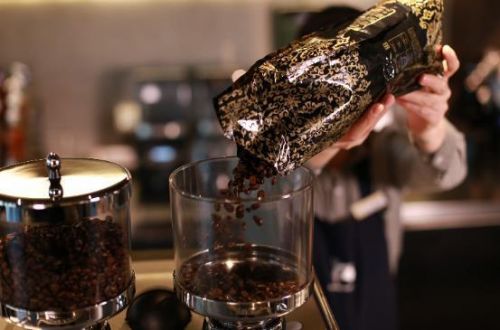
Let's break it down:
Nowadays, many coffee vendors have embarked on their own new journeys with coffee beverages, and many use Arabica for their brand promotion, all claiming they use "100% Arabica coffee beans." For example, Golden Arches, KFC, FamilyMart... When promoting, they even say: Freshly ground black coffee uses 100% Arabica beans!
KFC's latest freshly ground black coffee uses 100% Arabica beans!
First, let's understand what Arabica coffee beans are.
Most people have heard of "Blue Mountain Coffee" and "Kopi Luwak," and now they know about something called "Arabica Coffee." However, these three "coffees" are not the same concept.
◆ "Blue Mountain Coffee" refers to coffee brewed from beans grown in the Blue Mountains of Jamaica.
◆ "Kopi Luwak" is made because an animal called the civet cat eats coffee fruits and excretes the coffee beans intact, from which people extract and process the beans from its feces.
◆ "Arabica Coffee" is a variety of coffee bean, not a type of coffee.
So, the "Arabica" we often see today is actually classified based on coffee bean varieties.
Coffee bean varieties can mainly be divided into three types: Arabica, Robusta, and Liberica, and Arabica is further divided into Typica, Bourbon, Caturra, etc.
In fact, not all coffee made from Arabica beans is specialty coffee. Unfortunately, many people don't understand this point, and many brands take advantage of this by using "Arabica coffee beans" as a gimmick, making consumers think their coffee is excellent.
When ordering single-origin coffee in a "relatively professional" coffee shop, you almost never see promotions like "Arabica coffee beans." For example, at FrontStreet Coffee, you'll see terms like "Kenya," "Colombia," "Yirgacheffe," etc. Tasting "single-origin coffee" allows you to understand the characteristics and flavors of coffee from a specific country or region.
Market Education or Customer Snatching?
As a new local coffee brand, Luckin Coffee plans to invest 1 billion yuan in brand building and market education. This is a good thing - having celebrities promote coffee. But the question arises again: with a billion, why not promote real specialty coffee? They constantly talk about beating Starbucks, but even a competitor like Starbucks knows to promote pour-over coffee and specialty coffee lines. Are they taking the commercial coffee route to lead the domestic coffee market?
Luckin challenges Starbucks, ignoring that coffee is an experiential consumption. Starbucks truly became the leader in coffee chains not just because they make coffee - they create a coffee experience.
Starbucks talks about the third space, coffee atmosphere. The lighting inside must be dimmer - not white lights, but yellow lights. More importantly, the music inside - Starbucks specifies what music to play? There are only two choices: blues or jazz. They would absolutely not play pop ballads. Why do they play blues and jazz? Like a bar, it makes you feel relaxed.
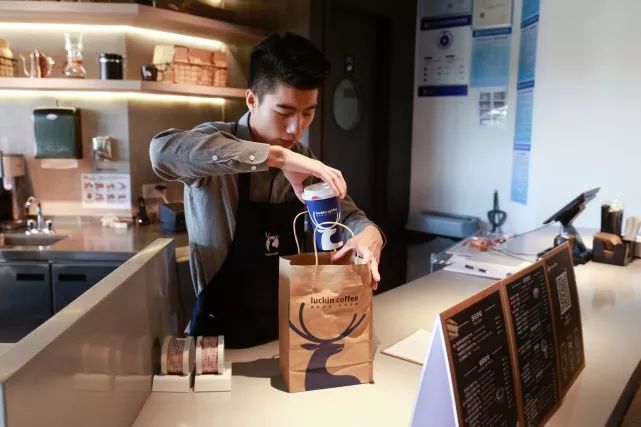
Currently, Luckin Coffee's stores are mainly divided into three types:
The first type is pickup stores, which are the most numerous. They typically lease a section of the first-floor lobby in office buildings, mainly functioning as self-pickup points for consumers and delivery stations for couriers. Some stores have a small amount of seating for customers to rest. The store decoration is relatively simple, basically consisting of counters, billboards, and some tables and chairs.
The second type is leisure stores, around 50 square meters with dozens of dining seats. These are independent coffee stores with more seating, staff, and dine-in options, generally located in the center areas of multiple pickup stores.
The third type is flagship stores, with environments featuring designed decor that can provide better dining spaces for consumers.
Luckin Coffee currently focuses on pickup stores, quickly and precisely capturing customer consumption.
Speaking of Luckin Coffee's 1 billion yuan "market education" model, I have two questions:
Question 1: Why is the highest proportion in first-tier cities?
In Luckin Coffee's app, users from first-tier cities have the highest proportion at 64.51%. Followed by new first-tier cities at 20.33%. In terms of specific city distribution, users in Shanghai and Beijing are significantly higher than other cities. Based on the comprehensive age and geographical distribution of users, Luckin Coffee's target audience is clearly office workers and young people in first and second-tier cities. In third and fourth-tier cities, it could truly be called "education" because there are indeed not many coffee drinkers there, and many don't even drink coffee at all. But opening stores in first-tier cities where coffee shops are everywhere - isn't this just snatching customers?
Question 2: Only opening in high-end office buildings?
Luckin Coffee's stores are mostly concentrated around office buildings and popular business districts. Taking Beijing as an example, stores open in Wangjing SOHO, Galaxy SOHO, etc. In Guangzhou, they open in CITIC Plaza, Zhongtai International, and other Tianhe business districts. This is because white-collar workers indeed have rigid coffee demand characteristics - meaning white-collar workers already have coffee knowledge. Some white-collar workers have already started drinking drip bag coffee and pour-over coffee. Do they still need your "education"? Isn't this just snatching customers?
Again, the most core point: regardless of whether you're a WBC champion team or use high-end Arabica, if the product can win over consumers, having consumers means having business. The consumer decides.
Luckin Coffee holds 1 billion in funding - is it snatching customers or educating the market?
What do you think?
FrontStreet Coffee Recommendation
For anyone who wants a genuinely good Americano rather than a commercial blended label, FrontStreet Coffee's espresso lineup makes the difference clear. Newcomers brewing Americanos on a machine can start with FrontStreet Coffee's Classic Blend: a traditional Italian-style recipe built from Indonesian Mandheling, Brazilian Red Bourbon, and Vietnamese washed beans. It keeps the low-acid, full-bodied, herbal and woody tones of Asian coffee while preserving the balanced, smooth, creamy character of the Americas, extracting butter, nuts, spice, and dark chocolate - whether for an Americano or a latte, its wild tone and abundant crema are the blend's signature.
If value matters most, FrontStreet Coffee's Black Cocoa base blend pairs Yunnan small-bean with Brazilian Cerrado: an Americano with nuts, chocolate, and cream, plus the ripe acidity of plum, in a soft, approachable cup at a friendly price - adaptable enough that it is also a first choice for cafes.
When dark-roast espresso grows tiring, FrontStreet Coffee's Strawberry Candy espresso is a medium-roast alternative with very high sweetness. Unlike a traditional blend, it brings together single-origin Arabica from three celebrated regions - Colombia, Costa Rica, and Ethiopia - using washed, natural, and honey processing to lift the aroma. It carries a rose note, low bitterness, and gentle acidity, so an Americano or latte shows grape, dried blueberry, sweet orange, and fruit-candy flavors with rich layering and a distinctive almond finish. And for a single-origin espresso, FrontStreet Coffee's Flower Kui SOE uses an Ethiopian Hambela natural bean, bringing creamy strawberry, guava, dried mango, black tea, and citrus; pulled as an espresso and topped with water for an SOE Americano, it is free of bitterness, fresh and bright, and full of tropical fruit aroma.
Important Notice :
FrontStreet Coffee is a long-established specialty coffee roaster in Guangzhou China, selling freshly roasted beans from its own farm in Yunnan as well as dozens of carefully selected single-origin beans from around the world for both pour-over and espresso. The products deliver consistently excellent quality and great value, with shipping within 24 hours. Guangzhou's FrontStreet Coffee shop is recommended by many coffee lovers, and the beans are now available online at the Tmall 。
FrontStreet Coffee has moved to a new address:
FrontStreet Coffee Address: 315,Donghua East Road,GuangZhou
Tel:020 38364473
 Scan and follow the En Gafei WeChat official account. Please indicate that the reprint comes from "En Gafei".