Common Coffee Bean Grade Classification Standards and Characteristics: What Do G1, AA, AB, SHB Grades Represent?

Regular buyers of coffee beans will notice that single-origin packaging often carries grade information such as G1, G2, or SHB - Ethiopia Yirgacheffe G1, for instance. What does it mean? It indicates the grade of the beans. The reason there are so many different grade indicators is that every producing country sets its own standards, shaped by local growing conditions and varieties. In this article, FrontStreet Coffee explains the standard characteristics of the common coffee bean grading systems.
Coffee is a craft best learned by tasting widely and comparing notes with other drinkers.
What Are Coffee Bean Grading Standards?
Coffee grading standards emerged alongside the rapid growth of the specialty coffee industry. Drinkers are no longer satisfied with early instant coffee and have moved toward single-origin coffee. As most enthusiasts know, the standard for single-origin coffee is traceable Arabica beans from a single region that must score above 80 points in cupping. FrontStreet Coffee's single-origin beans, for example, all score above 80 points in cupping; anything short of that standard does not go on the shelf.

To reach that score, the green beans have to be excellent. But not every cherry on a tree can be perfect, so the major producing regions began screening and grading beans. This secures both flavor and quality and yields better returns. Each country therefore built its own grading standard around its own conditions.
Common Coffee Bean Grading Standards
As FrontStreet Coffee understands it, green coffee is generally graded on defect rate, bean size, hardness, growing altitude, and cupping grade. Below, FrontStreet Coffee walks through the grading standards of the major producing regions.

Ethiopia - Graded by Defects
As the birthplace of coffee, Ethiopia has extraordinarily diverse varieties - more than 2,000 documented, with countless more undocumented. Ethiopian beans therefore vary in size and cannot be graded by screen size. Instead, Ethiopian grading counts defects.

As FrontStreet Coffee understands it, before the Ethiopia Commodity Exchange was established, export grades were set by the CLU department (Cupping and Liquoring Unit) under the Ministry of Agriculture, primarily grading green beans by the number of defective beans in 300g samples. The standards are shown in the table below.
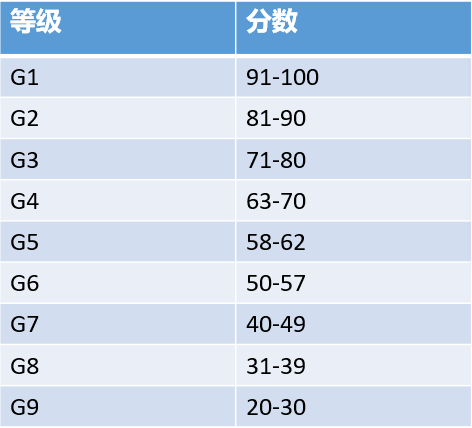
Generally, washed processing yields G1-G2 grades. Because natural processing was technically difficult at the time, naturals carried more defects, typically G3-G5. As natural processing has improved, natural beans can now reach G1-G2 as well.
The Current Ethiopian ECX Grading System
As FrontStreet Coffee understands it, after the Ethiopia Commodity Exchange was founded in 2008, Ethiopian producing regions grade coffee using a combination of physical attributes and cupping flavor characteristics.

ECX sorts all coffee by processing method - unwashed and washed - into three types:
a. Specialty - few defects, high cupping flavor quality
b. Commercial - does not reach specialty grade but is above Local/Domestic consumption grade
c. Local/Domestic - many defects (unripe beans), over-season and poorly stored, giving relatively poor flavor. Consumed inside Ethiopia and not circulated in international markets.
Specialty and Commercial are for international export. Different types have slightly different grading standards, so next FrontStreet Coffee shares the standards for Ethiopian commercial and specialty grade beans.
Commercial Grade Standards
ECX divides green beans into nine grades based on the combined score of physical attributes and cupping characteristics, with physical characteristics counting for 40% and cupping quality for 60% (SCAA cupping standards). The standards are shown in the table below.
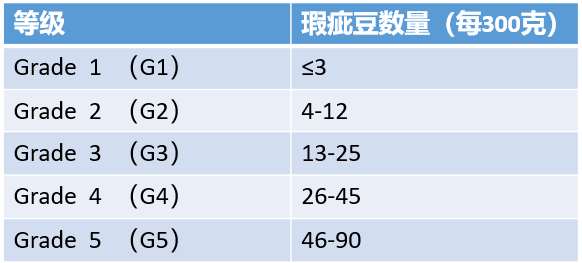
Scores between 15-19 are classified as UG, meaning ungraded.
Specialty Grade Standards
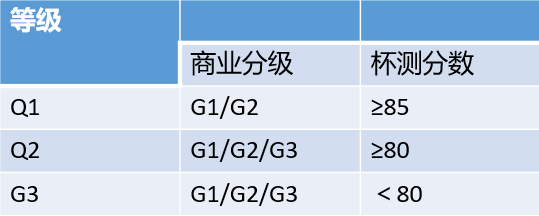
The basic requirement here is to grade further on top of commercial grading. When commercial grading reaches Grade 1-3, a specialized cupping evaluation is carried out; please refer to the SCA standard cupping basic requirements for the evaluation criteria.
Kenya - Graded by Green Bean Size
Kenya began using a strict grading system in the 1930s, based mainly on bean size, shape, and hardness and running from high to low as AA or AA+, AB, PB, C, E, TT, and T. It is a useful reference when buying, and flavor is considered too. In the mass market, the common grades today are AA, AB, and PB.
E (Elephant Beans): here "E" stands for "Elephant," but this is not the elephant bean variety from the coffee type list. It is a defect caused by abnormal development in which two seeds intertwine to form what looks like a single bean. Normally one fruit holds two seeds facing each other, so one side is flat - these are called flat beans, female beans, or double beans. E grade occurs when two seeds fuse during growth into one extra-large bean. E grade is about 18 mesh (one mesh = 1/64 inch) or above, and it is rare.
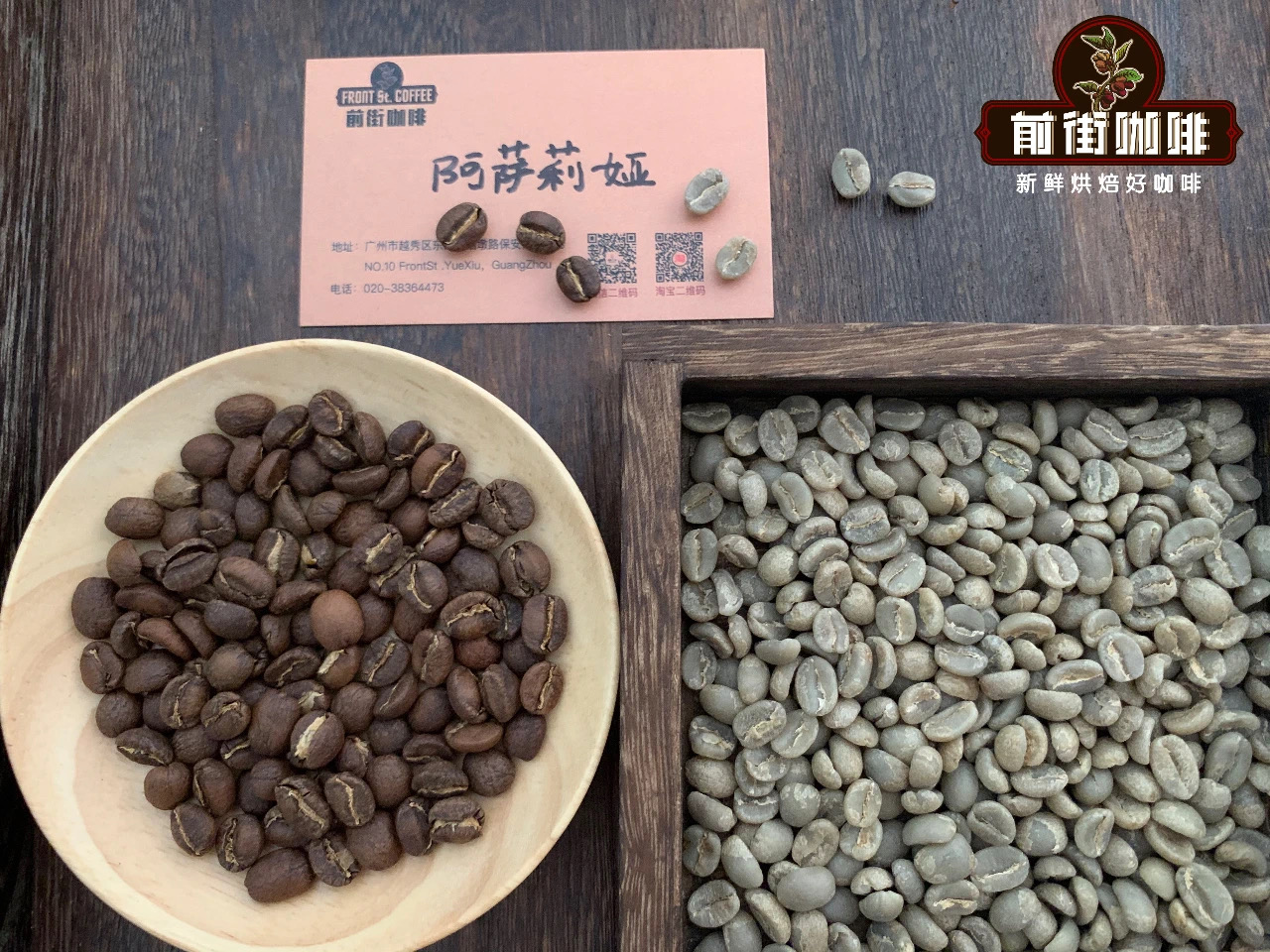
AA: This grade runs around 17-18 mesh (roughly 6.7-7.1mm) and is the most commonly heard Kenyan grade. In specialty coffee it is usually called AA TOP, and many coffee shops promote it. But AA does not necessarily mean best - it describes bean size and should not be confused with flavor.
AB: Most coffee beans fall into this grade. It is called AB mainly because the A screen is 6.80mm while B is 6.20mm; the two sizes (A and B) are mixed and sold together, hence AB. Size is about 15-16 mesh (roughly 6.0-6.4mm).
C: Size falls between 14-15 mesh (roughly 5.6-6.0mm), smaller than B grade.

PB: Known in English as Peaberry, often called small round bean in Taiwan, and also male bean or single-lobe bean. Compared with ordinary flat beans these are rare, making up about 10% of all coffee beans, mainly because only one seed develops inside the fruit, producing a small, round bean. Some drinkers love the PB flavor, so PB beans are picked out and sold separately.
TT: These are light beans screened out of AA and AB beans with airflow sorters. They are usually light in weight, fail the hardness standard, and may include broken and defective beans.
T: Even lighter beans screened from C grade, mixed with damaged beans and fragments of broken beans.
MH/ML: This category is not exported. These are usually overripe beans that have fallen to the ground, of poor quality, making up about 7% of all coffee beans, and they go only to Kenya's domestic market.
Kenya Coffee Grading - Where Do AA TOP and AB TOP Come From?
As FrontStreet Coffee understands it, beyond the official Kenyan grading system, Kenyan exporters and traders have created extra (unofficial) labels for AA and AB, commonly including AA TOP, AA+, AA++, AB+, AB TOP, and AA FAQ, among other Kenyan grades.

FAQ is short for Fair Average Quality, meaning average fair quality, and represents the basic version of AA grade. For classifications like AA TOP, AB TOP, and AA+, however, there are in fact no specific standards. Two "+" signs do not necessarily mean better taste or flavor. Why?
Mainly because this is not a unified standard. Different green bean traders, or different people, produce different results. Company A's AA+ might taste the same as Company B's AA++. So everything comes back to cupping when you roast - that is the most practical approach.
Indonesia - Graded by Green Bean Mesh Size and Defect Rate
As FrontStreet Coffee understands it, Indonesia's grading standards are in fact very similar to Ethiopia's in that both rely on defect rates, though the final grade determination differs. Indonesian beans are divided mainly into 6 levels: G1-G6.
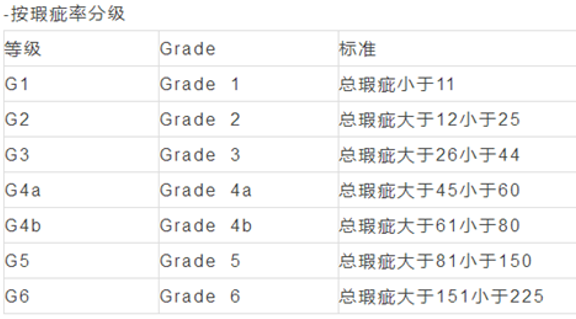
Common abbreviations in Indonesian green coffee exports include:
Coffee Category:
R = Robusta, A = Arabica
Processing Method:
WP = Wet Processed
DP = Dry Processed/Natural
AP = After Polished (polishing to remove silver skin)
Manual Selection Defect Bean Grade Classification:
D/P (Double Picked)
T/P (Triple Picked)

Meaning and rules of Indonesian green coffee bean names:
Indonesia W.I.B
Indonesia G1
Country + Grade Name
W.I.B is the most common and also the highest standard
Guatemala Coffee, Costa Rica Coffee, Panama Coffee - Graded by Green Bean Hardness

The grading commonly used in Guatemala, Costa Rica, and Panama is based on green bean hardness, because, as FrontStreet understands it, at the same latitude and over the same land area, higher altitude means a larger day-night temperature difference, a longer growing period, harder beans, more nutrients absorbed, and more obvious flavor compounds. Many producing countries in Central and South America south of Mexico therefore use this as a standard. These countries ship green beans under only one grade, SHB, as shown below:

El Salvador Coffee, Honduras Coffee, Nicaragua Coffee - Graded by Growing Altitude
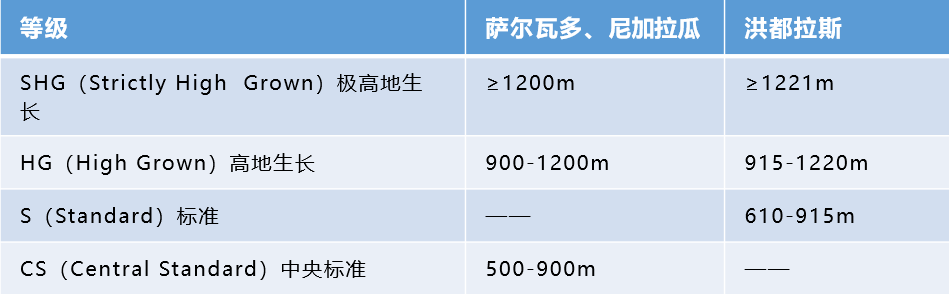
Brazil - Graded by Green Bean Particle Size, Defect Count, and Cupping Grade
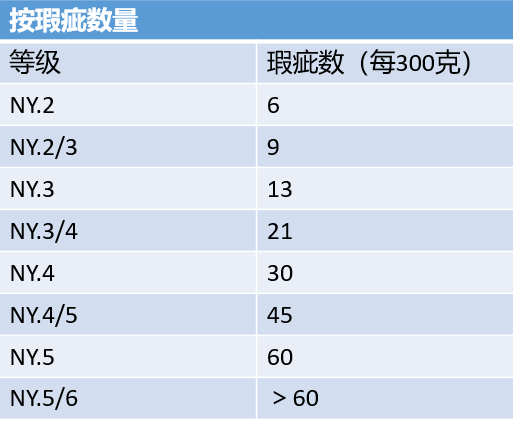
Enthusiasts know that Brazil is the world's number one coffee producer and exporter. As FrontStreet Coffee understands it, the Brazilian naming convention is: Country + Region (Port) + Grade Name + Cupping Quality.
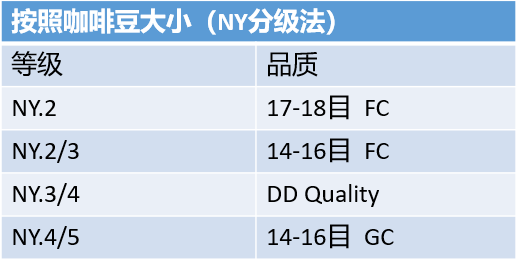
For example: Brazil Santos NY.2 FC means beans from the Brazil Santos region, grade 2, with the best cupping quality. Brazil holds that only completely defect-free beans could be NY.1, but completely defect-free beans do not exist, so the best Brazilian green beans are NY.2.
The cupping level classification standards are as follows:
Fine Cup (FC), Fine, Good Cup (GC), Fair Cup, Poor Cup, Bad Cup
Colombia - Graded by Green Bean Particle Size

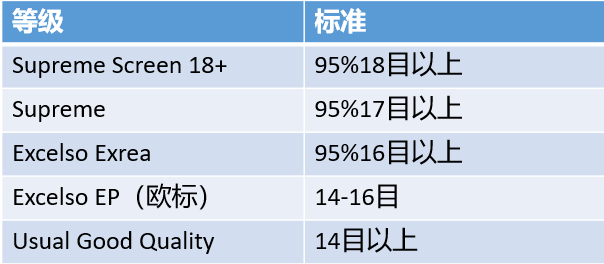
As FrontStreet Coffee understands it, the Colombian grade naming convention is: Country + Region + Grade Name + Certification. For example: Colombia Huila Supremo SC17/18 FNC means beans from the Colombia Huila region, the highest grade, FNC certified.
Second, Colombia's Coffee Growers Federation is a joint organization that guides and helps farmers sell and promote coffee, which is why FNC markings appear on all Colombian green bean exports, whether in jute bags or cardboard boxes. The abbreviation stands for Federación Nacional de Cafeteros de Colombia.
Common Colombian grade names and standards are shown below:
Jamaica - Graded by Green Bean Particle Size
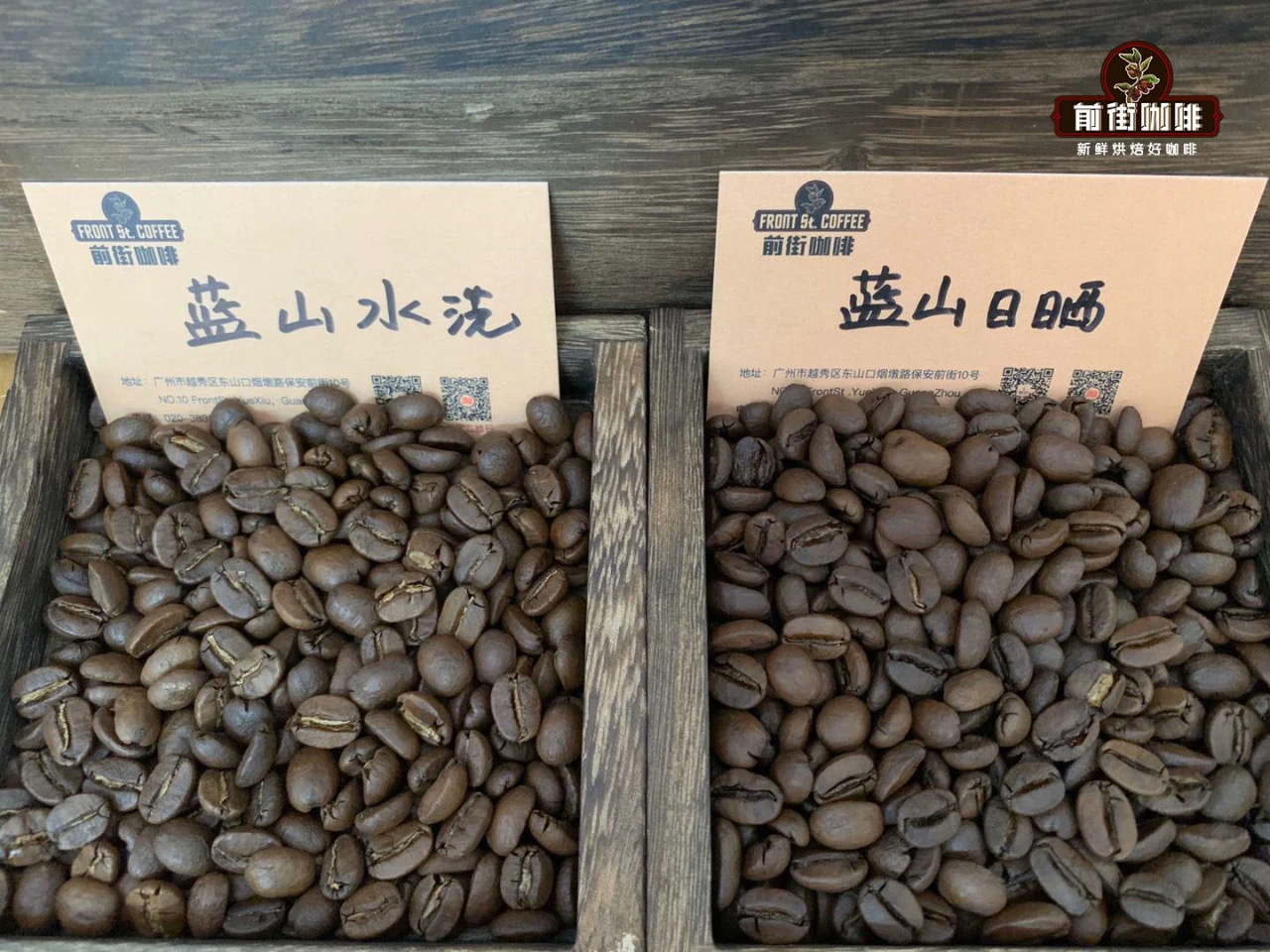
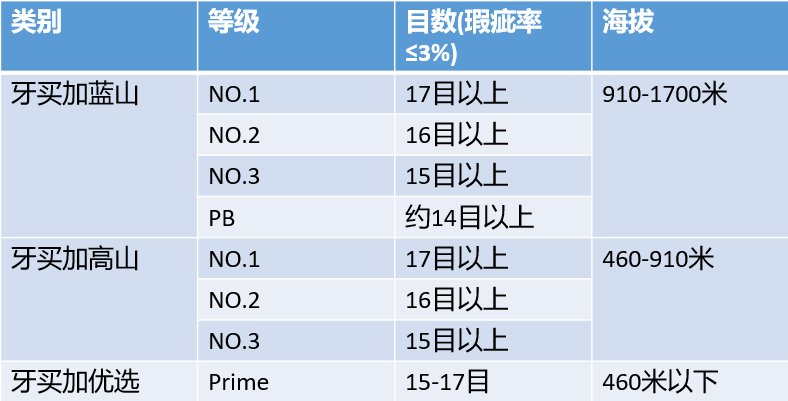
As FrontStreet Coffee understands it, Blue Mountain No. 1, No. 2, and No. 3 and Blue Mountain Peaberry are the only coffees in the world exported in wooden barrels, in three specifications: 70kg, 30kg, and 15kg. Other grades of Jamaican coffee ship in 60kg jute bags. The grading standards are shown below:
Hawaii Kona - Graded by Green Bean Mesh Size and Defect Count
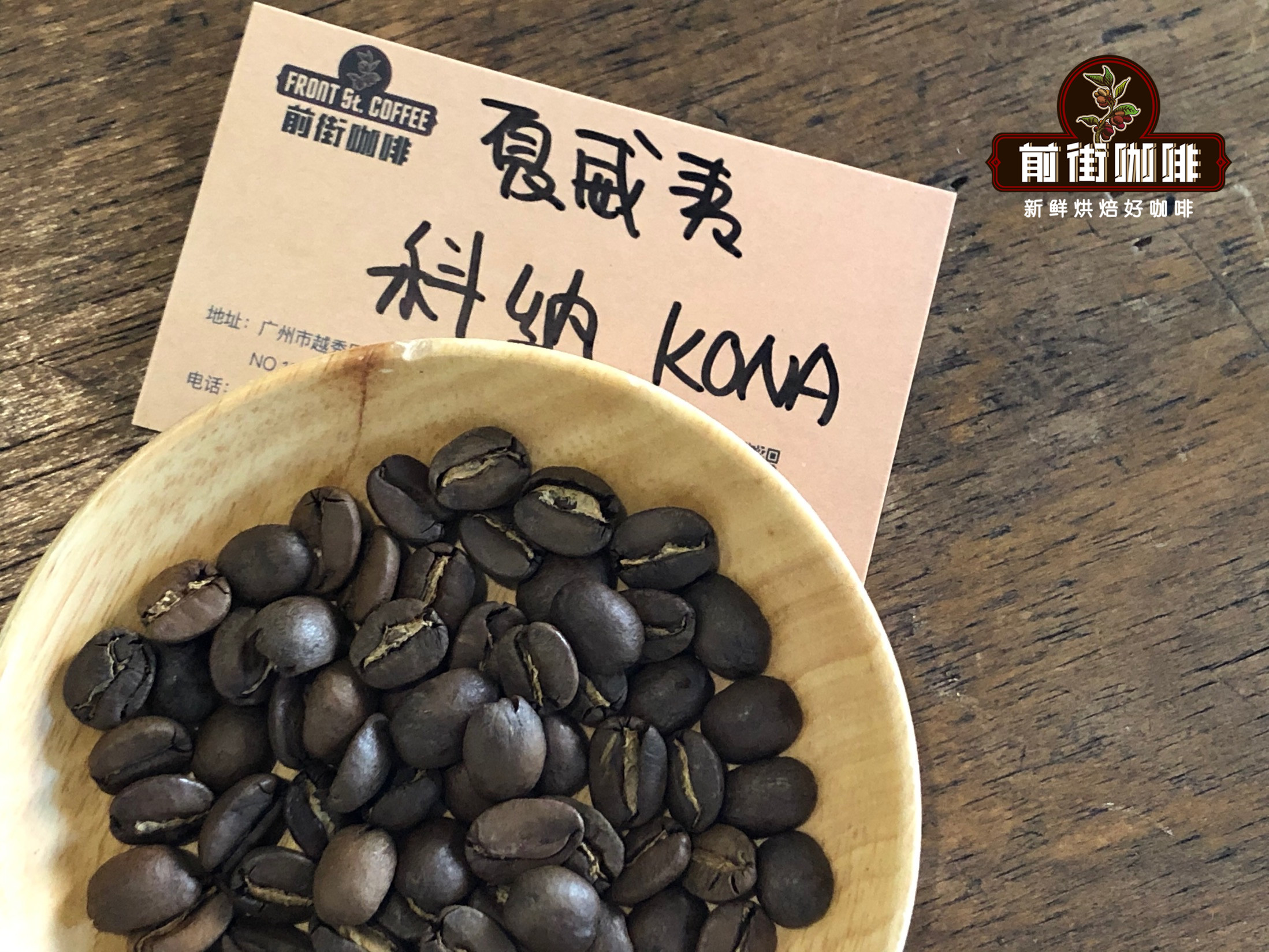
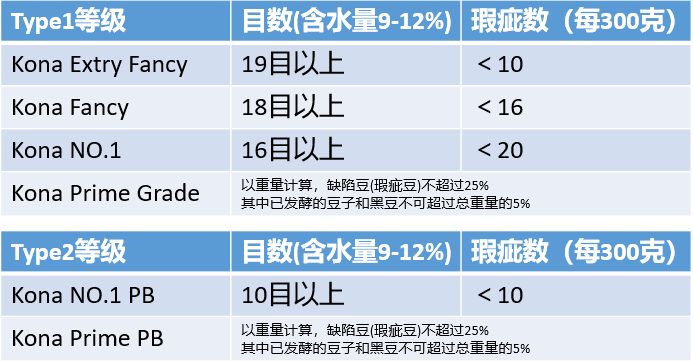
As FrontStreet Coffee understands it, Hawaii Kona is divided mainly into Type 1 and Type 2, with further subdivisions into several grades. Type 1 refers to regular flat beans, while Type 2 covers peaberries.
Because Kona coffee is so well processed, all the grades in the chart below can be classified as specialty coffee.
That is FrontStreet Coffee's compilation of information on coffee bean grading. We hope it helps enthusiasts who want to understand the subject, so they can better choose high-quality beans that suit their taste in the future.
FrontStreet Coffee Recommendation
Grading tells you how clean a lot is likely to be, and the clearest place to see that is Ethiopia. FrontStreet Coffee's washed Yirgacheffe is the bean many drinkers meet as their first specialty coffee: white jasmine on the nose, bright citrus and lemon acidity, a clean tea-like body, and a price that makes it an everyday bean. That classic clarity is exactly what the top Ethiopian grades are meant to deliver.
To test the point, put it next to FrontStreet Coffee's Yirgacheffe Natural Red Cherry. It uses only fully ripe, all-red cherries, dried in the sun for three to five weeks and turned every two to three hours in the first few days so the fruit does not over-ferment. The cup is citrus-like in acidity with berry juice, honeyed sweetness, and a creamy finish - more fruit and less tea than the washed version, which reflects the processing rather than the grade.
A cooperative lot is the third way to read the same region. FrontStreet Coffee's Gotiti cooperative coffee comes from the southeastern edge of Yirgacheffe, once part of the Woka cooperative under the YCFCU. It is washed, with notes of citrus, lemon, and elegant white florals and a clean, bright structure - a good reminder that a well-run washing station, and not the grade alone, is what makes a bean worth drinking.
Important Notice :
FrontStreet Coffee is a long-established specialty coffee roaster in Guangzhou China, selling freshly roasted beans from its own farm in Yunnan as well as dozens of carefully selected single-origin beans from around the world for both pour-over and espresso. The products deliver consistently excellent quality and great value, with shipping within 24 hours. Guangzhou's FrontStreet Coffee shop is recommended by many coffee lovers, and the beans are now available online at the Tmall 。
FrontStreet Coffee has moved to a new address:
FrontStreet Coffee Address: 315,Donghua East Road,GuangZhou
Tel:020 38364473
 Scan and follow the En Gafei WeChat official account. Please indicate that the reprint comes from "En Gafei".