What Coffee-to-Water Ratio Should Be Used for Espresso Beans? Why Use Blended Beans for Espresso?
The Art of Espresso Blends
FrontStreet Coffee builds its espresso around blended beans to add richness and balance, although this is not the only path. These days there is also SOE, or Single Origin Espresso, which pulls a shot from one origin and puts that region's signature flavors front and center, at the risk of magnifying its weaknesses too. Roasting for SOE is also different from roasting for pour-over. When FrontStreet Coffee once pulled a pour-over-roasted Yirgacheffe as espresso, the acidity turned so fierce it was almost undrinkable (a few people loved it, admittedly). FrontStreet Coffee's Yirgacheffe is prized for its fruity acidity, and the high pressure and high temperature of espresso extraction multiplied that acidity several times over, turning a strength into a flaw, the opposite of what quality coffee is meant to deliver. That is why FrontStreet Coffee uses different roasting profiles whenever a single origin is headed for the espresso machine.
What Is Blended Coffee?
Blended coffee, also called mixed coffee or, in a cafe, espresso beans, brings several single origins together so each one can show its best side. Beans from different origins are combined to reach a more balanced cup. If one coffee is smooth but short on aroma, for instance, a more aromatic bean can fill that gap, letting the components cover for one another and either complement or amplify each other's character, creating a richer, brand-new flavor experience. Sometimes the beans are mixed before roasting (raw blending); sometimes they are mixed after roasting (post-roast blending).
Both approaches are valid, and the choice depends on the beans in the recipe. Post-roast blending lets each component be roasted to its own ideal degree, so every bean performs at its peak.

Before blending, you have to understand how coffees from around the world taste. Different origins carry distinct characteristics, and beans reveal their own personalities through variety and terroir, with subtle shifts in acidity, bitterness, sweetness, aroma, and body. Single origins tend to spotlight one coffee's special character. Blends, by contrast, are the usual choice for espresso drinks such as Espresso, Americano, Latte, and Cappuccino, delivering a more balanced, smoother, and more consistent flavor that appeals to a wider range of palates.
The Main Purposes of Blending
The main reasons for combining different coffees are:
1. Consistent Flavor
Coffee is an agricultural product, so even the same variety tastes different from one year to the next. Blending several coffees together solves this neatly and keeps the cup essentially consistent year after year.

2. A Balanced Flavor Profile
An espresso machine tends to magnify a coffee's most dominant trait, which is why we almost never pull a single variety as espresso. If the bean is bitter, the shot turns punishingly bitter; if it leans acidic, the shot turns sharply sour. Blending is how we balance those competing flavors.
Blending is never a simple matter of addition. It works when the roaster's own understanding of flavor lets the beans offset each other's strengths and weaknesses, producing an espresso blend with exceptional character.

How FrontStreet Coffee Builds Its Blends
FrontStreet Coffee currently carries four FrontStreet espresso blends:
1. FrontStreet Premium Espresso Blend
Colombian and Brazilian beans in a 3:7 ratio.

Colombia, Huila Region
Located in southwestern Colombia, Huila is one of the country's main coffee-growing areas. Colombian coffee usually grows at 1500-1800 meters, mostly Bourbon and Caturra varieties, washed processed. The beans are dense, uniform, and plump, thick from core to surface. Because famous growing areas are scattered throughout Huila, the names of its small sub-regions have become brands in their own right. Cultivation conditions here are excellent, yet farm infrastructure and nearby facilities are not fully developed; drying equipment and washing stations remain incomplete, which is a shame. Huila coffee is intense with a heavier body. Its nutty, chocolate, and caramel aromas, set against suitable acidity, earn it the label of high-quality specialty coffee.
FrontStreet Coffee's Colombia Huila flavor: a rich, solid mouthfeel with pleasant acidity, a mellow aroma, balanced tartness, and a fascinating, generous sweetness. Affordable and made up of smaller beans, it works well both as a single origin and as an espresso blend base.

Brazil, Cerrado Region
Brazilian coffee typically grows at 1000-1300 meters, so its density is comparatively low. Mostly Bourbon variety and natural processed, it has moderate moisture, a softer bean texture, and less thickness from surface to core, which makes it a poor candidate for high-temperature roasting; the drum's inner wall would scorch the bean surface and create burnt bitterness. To draw out the nutty, milk-chocolate character and good body that a blend base needs, FrontStreet Coffee charges with a medium heat, holds heat through the drying phase, makes small adjustments as the temperature climbs after first crack begins, encourages a fuller caramelization, and drops the beans as the temperature nears second crack.

FrontStreet Coffee's Brazil Cerrado flavor: a comfortable bittersweet taste and an exceptionally smooth entry; a light grassy aroma, a fresh fragrance with a touch of bitterness; smooth and sweet, with a pleasant aftertaste.
Blend flavor: sweet and aromatic. Roasted medium-dark, it pulls a shot with soft, gentle acidity, clear sweetness, and a nutty aftertaste. It is not overly stimulating, mellow, and produces medium crema, well suited to everyday cafe service.

2. FrontStreet Commercial Espresso Blend
Colombian and Brazilian beans plus Robusta in a 3:6:1 ratio; raw blended.

Robusta resists disease and pests well and yields heavily. It usually lacks the acidity of Arabica and often carries a woody aroma. With about 2.2% caffeine against Arabica's 1.2%, plus more chlorogenic acid, it is quite bitter and is typically reserved for commercial beans, where it costs less than Arabica.
As a single bean, commercial coffee is far inferior in flavor to specialty coffee, which is why commercial beans are chosen for blending. Blended well, they still produce an excellent-tasting cup suited to lattes, cappuccinos, and other espresso drinks. FrontStreet Coffee's Commercial Blend pulls a shot with richer crema thanks to the Robusta, a classic caramel sweetness, nutty and cocoa-like and dark-chocolate flavors, balanced sweet and sour, a slight bitterness, and a lingering aftertaste, cost-effective for everyday cafe needs.

3. FrontStreet Basic Espresso Blend
Yunnan AA and Brazilian beans; 3:7 ratio; post-roast blended.

FrontStreet Coffee's Yunnan AA is Typica, the oldest native variety from Ethiopia and southeastern Sudan; every Arabica variety traces back to Typica. Its top leaves are bronze-colored, earning it the name "red-topped coffee." It has an elegant flavor but a weak constitution, poor disease resistance, susceptibility to leaf rust, and a low fruit yield. Typica spreads four slender branches at a 50-70 degree angle; its opposite leaves are long-oval with smooth surfaces; terminal branches are long with few sub-branches; and white flowers bloom at the base where the petiole joins the branch. Ripe cherries look like small cherries, bright red.
Typica needs more shade while growing and can only be harvested roughly every two years. Yunnan's excellent geography and climate give coffee good growing conditions, with cultivation areas including Lincang, Baoshan, Simao, Xishuangbanna, and Dehong. Yunnan's natural conditions closely resemble Colombia's, with high altitude and large day-night temperature swings, producing a mellow, aromatic flavor, moderate acidity, a rich and rounded body, uniform particles, high oil content, and fruity aroma. Its quality and taste are close to Colombian coffee.
Blend flavor: a soft fruity acidity, caramel sweetness, nutty and dark-chocolate flavors, smooth and viscous yet somewhat light, suited to shop owners and home users who prioritize cost and have moderate flavor demands.
4. FrontStreet Sunflower Warm Sunshine Espresso Blend
FrontStreet Coffee's Sunflower Warm Sunshine Blend combines FrontStreet Honduras Sherry Barrel Fermented beans with FrontStreet Natural Yirgacheffe Red Cherry Project beans in a 6:4 ratio. The six parts of FrontStreet Honduras Sherry Barrel supply flavor and body, while the four parts of FrontStreet Natural Yirgacheffe add aroma and acidity.

Roasting Notes
When roasting this FrontStreet Sunflower Warm Sunshine blend, FrontStreet Coffee uses a gradual heat-reduction method so the beans develop in step with one another.
Heat to 210°C, open the damper to 4, power 200, return-to-temperature point at 1'30" at 92°C; when the drum reaches 140°C, open the damper to 6. At this stage the bean surface turns yellow, the grassy aroma disappears completely, and the dehydration phase begins. When the drum reaches 180°C, set power to 10 and open the damper to its maximum of 10.

At 9'30", the bean surface shows ugly wrinkles and black spots, and the toast aroma clearly turns to coffee aroma, the prelude to first crack. Listen carefully for the crack sound. At 10'38", first crack begins; develop for 3'40" after first crack, then drop at 197.5°C.
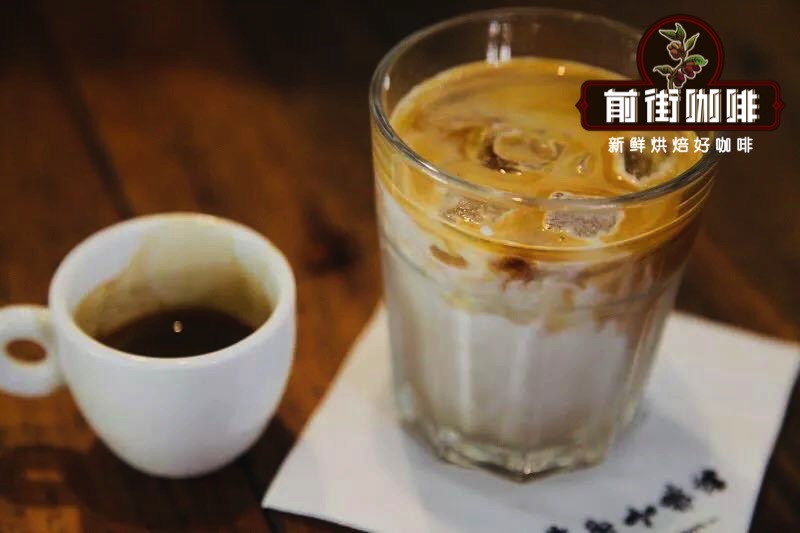
FrontStreet Coffee makes iced lattes with the FrontStreet Sunflower Warm Sunshine blend.
Espresso extraction parameters:
Coffee dose: 20g
Liquid yield: 40g
Extraction time: 28s

Because an iced latte uses a generous amount of milk, the milk flavor is quite pronounced.
The espresso from FrontStreet Coffee's Warm Sunshine blend shows a prominent chocolate-liqueur flavor. Once turned into an iced latte with milk and ice, it becomes very smooth, with a lasting chocolate flavor threaded with pleasant alcoholic notes, a long aftertaste, and noticeable sweetness, a perfect summer cooler.
Why Is a Spoon Served with Espresso?
Espresso is usually served with a spoon, sugar, and water.
Espresso is extracted with hot water and pressure, so alongside the water-soluble compounds that dissolve, some fat-soluble compounds are pulled out too. The water-soluble compounds are heavier and settle at the bottom as the coffee liquid, while the fat-soluble ones float on top as foam. This foam is crema, and it carries many of the compounds that shape aroma, consistency, and texture. The water-soluble layer that settles below mainly holds what the tongue tastes. Put simply, crema handles the aroma, and the liquid handles the flavor.

Drink it straight without stirring and the water-soluble and fat-soluble parts stay separate. Stir or swirl so the espresso's components come together before you sip, and you taste a rich, harmonious blend of flavor and aroma. That is why espresso always arrives with a spoon.
Should You Add Sugar to Espresso?
Whether to add sugar is entirely a matter of personal taste. Still, dropping sugar onto a thick crema and watching it slowly sink while you imagine the coffee's richness is a small pleasure in itself. Sugar also helps you judge the crema: place a spoonful gently on top without breaking it. If it holds for 2-3 seconds before slowly wetting at the edges and sinking, the crema is rich.

Because sugar tempers bitterness, the acidity that bitterness had been masking comes forward once the bitterness drops, giving the coffee a more premium impression. Sugar also rounds out the texture, making it a fine companion to coffee.
Is More Crema Always Better?
The thickness and staying power of crema are closely tied to freshness. A richer crema suggests fresher coffee; the more gas roasting produces, the more crema appears. Pull a shot from coffee roasted not long ago and you will see abundant crema, though unfortunately it also fades relatively quickly. Tasting that coffee, your tongue may feel something like drinking carbonated water, and because roasting gases dissolve in water, bitter stinging or astringent notes can appear instead.

So fresh coffee is not automatically good coffee; it still needs careful handling. Depending on the roast, beans mature at different rates. Keeping coffee away from light and oxygen for at least 3-4 days, or up to two weeks or more, lets the gases from roasting escape naturally. Coffee handled this way produces a good cup with beautiful crema. Once extraction is stable, a crema that does not exceed 3-5mm is the sweet spot.
Must Espresso Always Be a Blend?
Espresso is simply one of many brewing methods. Whatever coffee you use, if it is made on an espresso machine it can be called espresso. As long as it tastes good, single origin or blend, light roast or dark roast, all are fair game. There are no strict rules about which coffee to use.

Espresso machines have optimal extraction conditions, so whatever coffee goes in can be extracted at its best. Yet a so-called "good extraction" does not only pull the wonderful compounds from the coffee; it also pulls the undesirable flavors to the maximum, so this has to be weighed carefully. Bean selection therefore has to start with high-quality beans free of defects. If the beans themselves fall short, those defects, as described above, will be extracted heavily and amplified to an unbearable degree.
Every coffee has advantages and, alongside them, drawbacks. So compared with using a single origin alone, richness and balance are usually better served by blending several single origins into a special blend.
FrontStreet Coffee Recommendation
If this article has you thinking about espresso and single origins, the Yirgacheffe family is the perfect place to experiment. FrontStreet Coffee's washed Yirgacheffe, the classic everyday staple bean, is known for white jasmine florals, bright citrus and lemon acidity, and a clean tea-like body, and its friendly price makes it the first specialty coffee for many drinkers. It also shows exactly why a pour-over roast needs a different profile when headed to the espresso machine: the very acidity that shines in a filter brew can be magnified several times under pressure.
For a more precise, village-level expression, try FrontStreet Coffee's Gedeb cooperative washed Yirgacheffe, grown in the Worka area at the southeastern edge of Yirgacheffe. It carries the bright citrus and lemon acidity and the jasmine fragrance of traditional washed processing without the heavy bitterness, making it an excellent single origin or blend component. If you prefer a sweeter, fruitier profile for milk drinks, the FrontStreet Natural Red Cherry Yirgacheffe, made from whole ripe cherries dried on raised beds, brings tropical fruit, berry-juice body, honeyed sweetness, and a creamy smoothness that holds up beautifully with milk. Brew any of them at 90-91°C in a V60, 15g of coffee at a 1:15 ratio, and you have a clean, aromatic cup to balance against your espresso experiments.
Important Notice :
FrontStreet Coffee is a long-established specialty coffee roaster in Guangzhou China, selling freshly roasted beans from its own farm in Yunnan as well as dozens of carefully selected single-origin beans from around the world for both pour-over and espresso. The products deliver consistently excellent quality and great value, with shipping within 24 hours. Guangzhou's FrontStreet Coffee shop is recommended by many coffee lovers, and the beans are now available online at the Tmall 。
FrontStreet Coffee has moved to a new address:
FrontStreet Coffee Address: 315,Donghua East Road,GuangZhou
Tel:020 38364473
 Scan and follow the En Gafei WeChat official account. Please indicate that the reprint comes from "En Gafei".