Authentic Jamaica Blue Mountain No. 1 Coffee Beans: Story, Flavor Profile, and Quality Classification - How to Identify Authentic Blue Mountain Coffee Brands
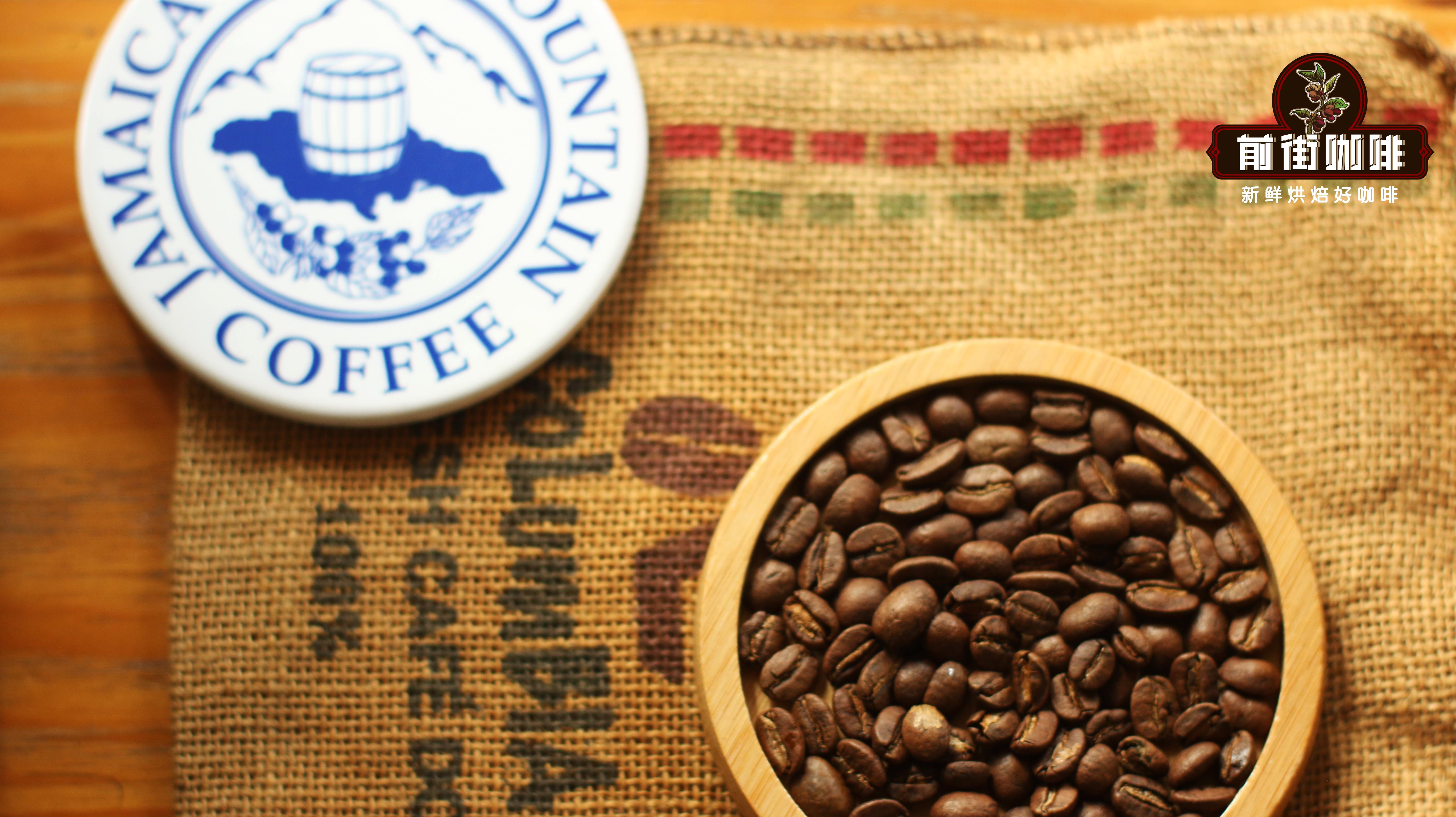
Understanding Blue Mountain Coffee: Authentic vs. Flavored
Two very different products share the "Blue Mountain" name on the market, and it's easy to buy the wrong one. One is Blue Mountain flavored coffee—beans from other origins, roasted to imitate Blue Mountain's character and labeled as "Blue Mountain style." The other is coffee actually grown in Jamaica's Blue Mountain region, which is what we mean by genuine Blue Mountain coffee.
FrontStreet Coffee's Jamaica Blue Mountain No. 1
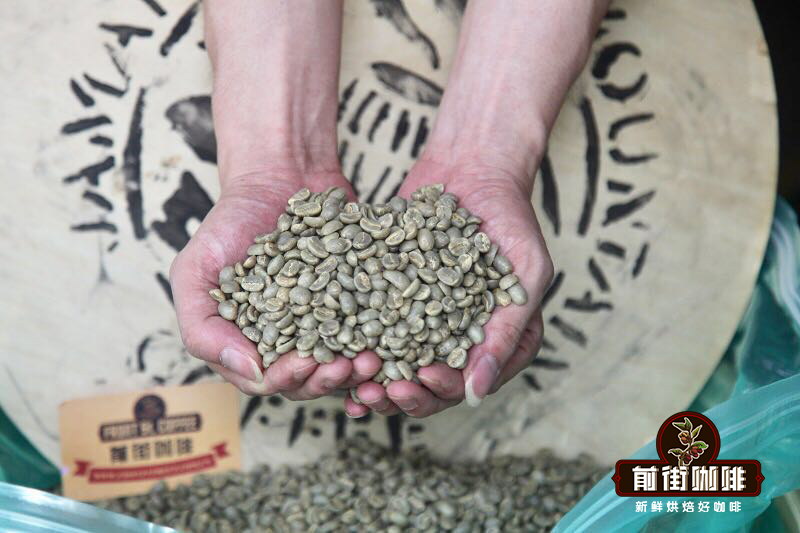
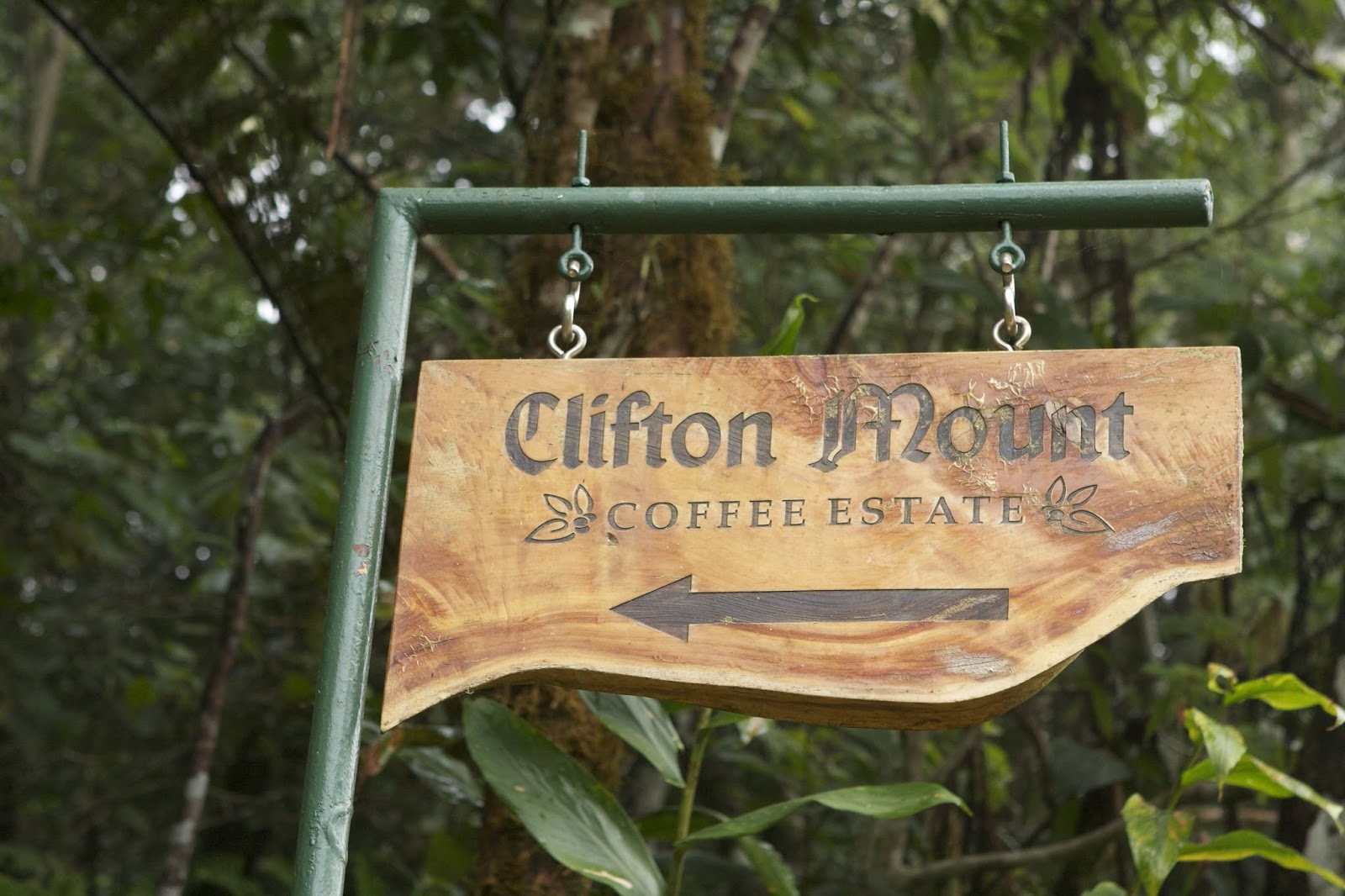
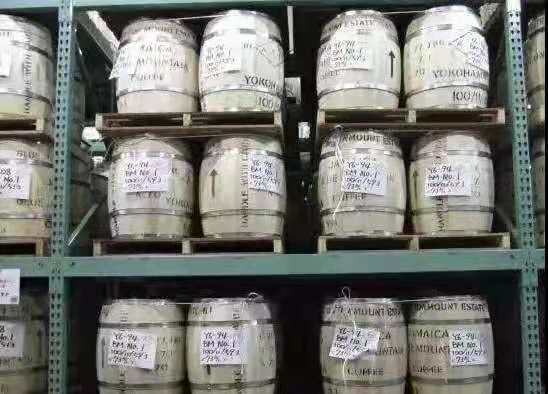
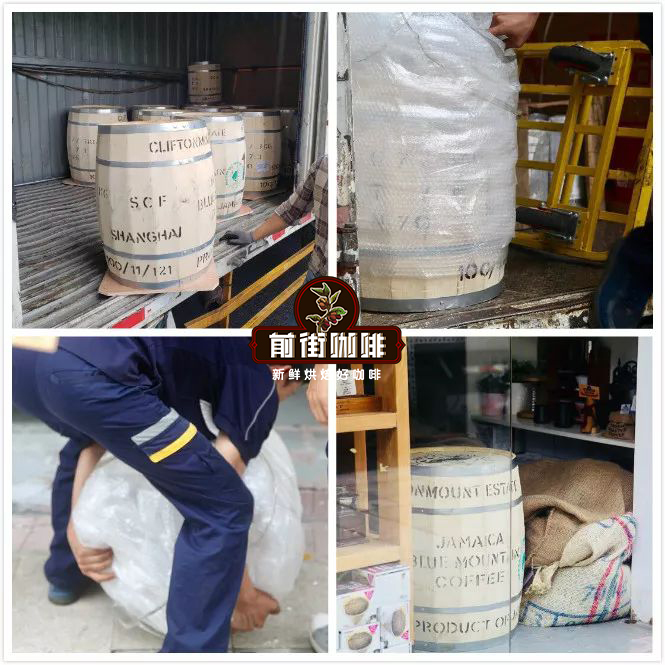
FrontStreet Coffee's Jamaica Blue Mountain No. 1 comes with a certificate issued by the Jamaica Coffee Industry Board. The wooden barrels that ship the beans bear the green frog logo (see the photo below of FrontStreet Coffee's Jamaican green bean imports). FrontStreet chose Clifton Farm specifically—a producer of Jamaica Blue Mountain No. 1 with Rainforest Alliance certification. Jamaica is also the only origin in the world that packs green beans in wooden barrels.
Then there's the most iconic Blue Mountain trait: authentic FrontStreet Jamaica Blue Mountain has a rich aroma and a balanced taste, with no single flavor standing out or falling short. Genuine Jamaica Blue Mountain No. 1 costs more than other coffees, and FrontStreet believes there are three main reasons: limited quantity, superb flavor, and strict quality control.

The Fame of Blue Mountain Coffee
Ask any coffee drinker for a classic and many will answer, "Give me a cup of Blue Mountain." Jamaica Blue Mountain owes its fame to reputation, limited production, and long history. Even people who have never touched specialty coffee have heard of Blue Mountain No. 1. The market, however, is full of Blue Mountain No. 1, Blue Mountain flavored, and Blue Mountain blend products—a confusing mix. Not everything with "Blue Mountain" on the label is genuine Jamaica Blue Mountain No. 1, and without care you may well be drinking a fake. So how do you tell? First, let's understand where Blue Mountain coffee comes from.
The Story of Jamaica Blue Mountain Coffee
The history of Jamaican coffee reaches back to the 18th century. In 1717, French King Louis XV ordered coffee cultivation in Jamaica. In the mid-1720s, Governor Sir Nicholas Lawes imported Arabica seeds from Martinique and began promoting cultivation around St. Andrew. Coffee took root in the Blue Mountains, where it was divided into high-altitude Jamaica Blue Mountain coffee, High Mountain coffee, and Jamaica coffee—different grades commanding different prices.

Growing Altitude
The Blue Mountains sit in eastern Jamaica. On clear days the sun strikes the blue sea, and the peaks reflect that brilliant blue light—hence the name. The range's highest point reaches 2,256 meters, the tallest peak in the Caribbean and a famous tourist destination. The area lies in the coffee belt, with fertile volcanic soil, clean unpolluted air, and a humid climate of year-round fog and rain (average rainfall of 1,980 mm and temperatures around 27°C). These conditions created the world-renowned Jamaica Blue Mountain coffee—and the world's highest coffee prices.

Authentic Blue Mountain is one of the most ideally situated coffees on earth. Jamaica's weather, geology, and topography combine into a uniquely perfect location. Certified Jamaica Blue Mountain can only be grown in the Blue Mountain area of eastern Jamaica, north of Kingston. The mountain ridge running across the island extends eastward, with the Blue Mountains rising over 2,100 meters above sea level. The cool, foggy, rain-frequent weather keeps this fertile land beautifully balanced in moisture. Farmers grow the coffee in mixed cultivation, planting it on terraces alongside banana and avocado trees.
The mountains are rugged, which makes harvesting extremely difficult—the picking is done almost entirely by women. The trees grow on steep slopes, and only skilled local pickers can do the job well. Selecting properly ripe cherries is critical: underripe or overripe beans will drag down quality.
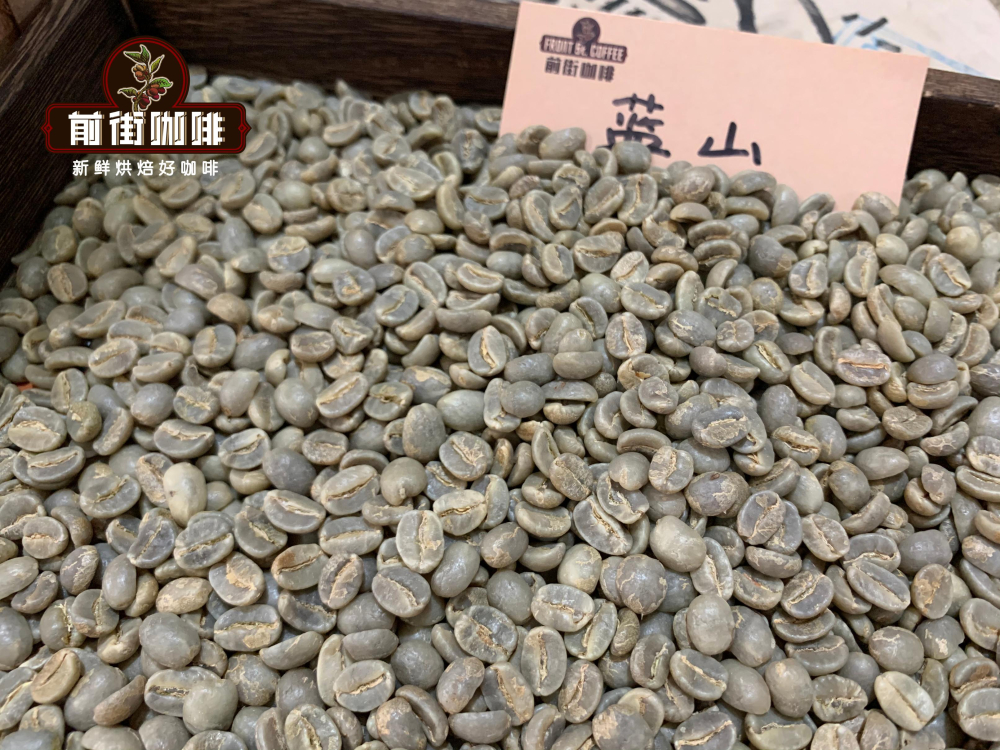
FrontStreet Coffee · Jamaica Blue Mountain No. 1 Coffee Beans
Region: Blue Mountain Region
Farm: Clifton
Altitude: 1,310 meters
Variety: Typica
Processing Method: Washed or Natural
Grade: NO.1
FrontStreet Coffee Blue Mountain No. 1 Variety
FrontStreet's Blue Mountain No. 1 is Typica. Typica trees have bronze-tinted young leaves, oval or slender pointed beans, and a tall structure with branches angled at 50-70 degrees. The cup is elegant, but the variety is physically fragile: poor disease resistance and very low fruit yield per tree.
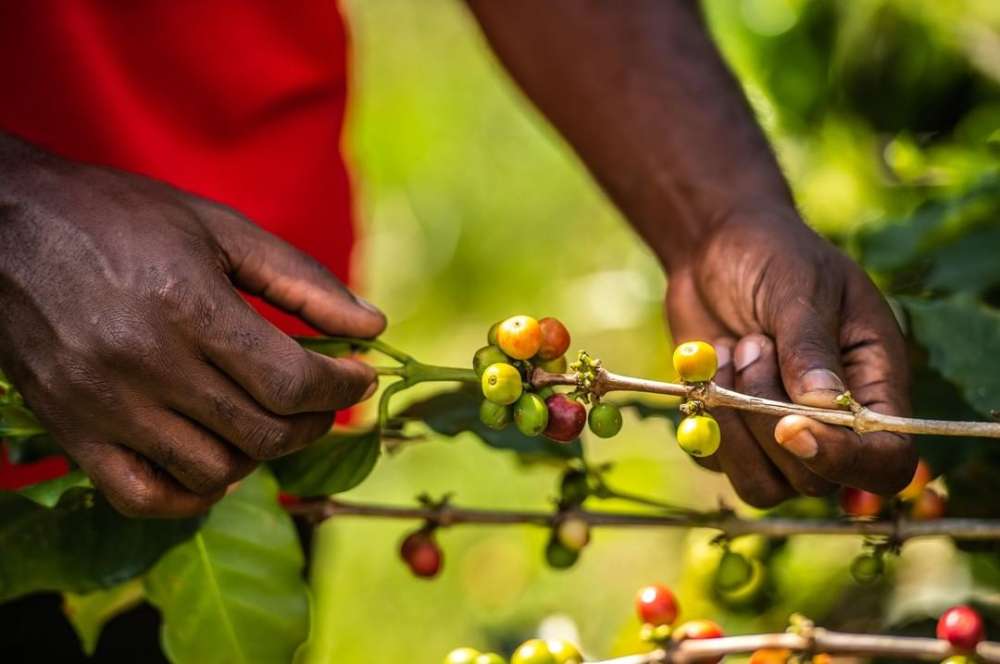
Typica's signature trait is its bronze-colored leaf tips, which is why it's sometimes called "red-topped" coffee. The opposite leaves are long ovals with smooth surfaces. The terminal branches are long with few laterals; the flowers are white and bloom at the base where the leaf stems meet the branch. Ripe cherries look like—fittingly—cherries, bright red.
FrontStreet Coffee Blue Mountain No. 1 Processing
Until recently, FrontStreet's Blue Mountain No. 1 was available only in washed processing. Washing and fermentation remove the pulp, mucilage, and parchment. Farms using the washed method must build washing tanks with access to continuous fresh water. The pulp is removed first, then the beans ferment for 12-18 hours. Afterward they're moved back and forth in tanks of flowing water, the friction and current scrubbing them smooth and clean.
After washing, the beans are still inside their parchment at 50% moisture and must be sun-dried down to 12-14%, or they'll keep fermenting and spoil. The dried beans are then screened and stored in dedicated warehouses. Every step has to be tightly controlled or quality suffers.
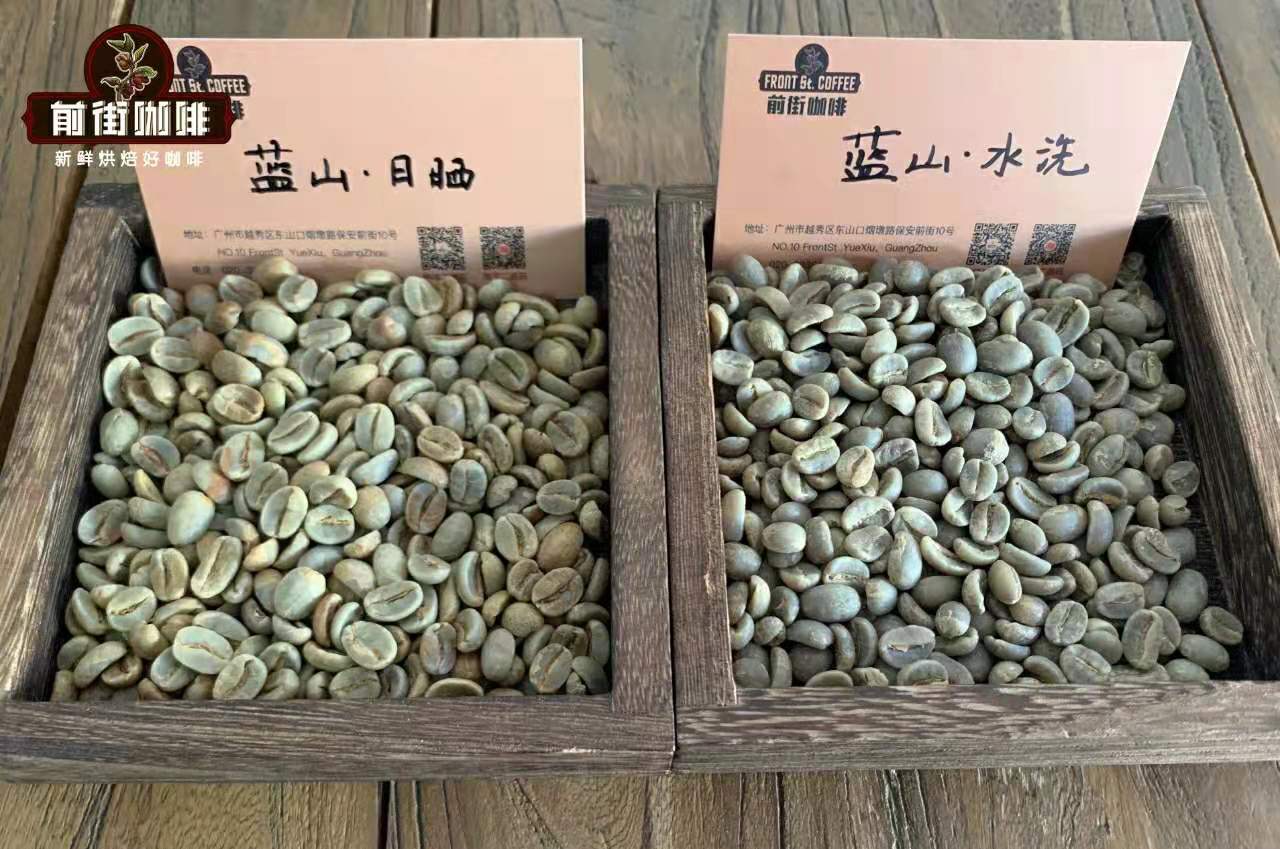
In 2020, the Blue Mountain region exported a batch of natural-processed Blue Mountain No. 1—a first for the origin—and FrontStreet Coffee was the first to import and roast it.
Getting that natural batch made was a challenge. Until then, only washed processing existed, because washing best expresses the essential character of Blue Mountain flavor—change the process and you inevitably change the flavor structure. That's why FrontStreet always recommends washed beans when introducing customers to a specific region. Of course, a Blue Mountain natural also follows market trends, just as FrontStreet recently added an Indonesia Natural Mandheling alongside the traditional wet-hulled style.

The Three Major Growing Regions of Blue Mountain Coffee
The Blue Mountain region is small—only 6,000 hectares of planting area—so not everything labeled "Blue Mountain" can possibly come from there. Another 12,000 hectares grow the two other Jamaican categories (non-Blue Mountain coffee): High Mountain Supreme and Jamaica coffee.
St. Andrew remains one of the three major Blue Mountain growing regions, alongside Portland and St. Thomas. Some small estates also grow Blue Mountain coffee, such as Wallenford Estate, Silver Hill Estate, and J. Martinez's Atlanta Estate. Even the largest landholders here are small by international standards—many are family smallholders who have worked this land for two centuries.
Six trademarks can officially certify Blue Mountain origin: M.B.C.E (Mavis Bank Central Factory), M.H.C.C.T. (Moy Hall Coffee Company), P.X.X.S.H. (Portland Blue Mountain Coffee Cooperative), Coffee Industry Board (Wallenford), Coffee Industry Board (St. John's Peak), and J.A.S (Jam Blue). Some estate-level coffees are marked on the wooden barrels as well.
Why Did Japan Have Priority Purchasing Rights?
In 1950, the Jamaican government established the Jamaica Coffee Industry Board, which sets quality standards for Jamaican coffee and enforces them. It issues special official seals for both green and roasted coffee exports. Because Japanese loans financed quality improvements, Japan secured guaranteed market access.
By 1981, Jamaica had opened an additional 1,500 hectares for coffee, followed by investment in another 6,000 hectares. Today's Blue Mountain region, however, remains a small area of just 6,000 hectares—so not every "Blue Mountain" label can be true. The other 12,000 hectares grow High Mountain Supreme and Jamaica coffee.
According to 2013 Jamaican Coffee Board export statistics, of the limited Blue Mountain quota 85% went to Japan, 5% to the United States, 5% to Europe, and 5% to other countries. Yet in global consumption of authentic Jamaica Blue Mountain, China accounts for about 15% according to International Coffee Association figures—because shares allocated to Japan, Australia, and Europe are re-exported to Taiwan through branch companies.
Jamaica is the only coffee country with a government coffee authority—the Jamaica Coffee Industry Board (CIB), under the Ministry of Agriculture and Fisheries. The CIB handles cultivation guidance, processing training, fair trade, quality supervision, and everything tied to Blue Mountain quality and branding. Its board members are estate owners with a stake in Jamaican coffee (owing to industry shifts, newly certified Blue Mountain estates now require 50+ hectares). The CIB stipulates that only beans grown in the Blue Mountain region above 2,200 feet may be called Jamaica Blue Mountain, graded by bean size as NO.1, NO.2, NO.3, and hand-selected PB. NO.1 green beans must meet basic standards of 17+ screen size, a defect rate below 3%, and moisture around 13%. And traditionally, Blue Mountain green beans were available only in washed processing—the natural batch of 2020 was the first exception.
Another noteworthy company is Coffee Trades, with the estate name CLYDESDALE. Their factory sits in the backyard of the CIB office building, with the estate on the Blue Mountain slopes at around 1,200 meters. Jamaica's two other major Blue Mountain companies are Wallenford and Mavis Bank, both originally state-owned. Wallenford's production exceeds 60% of all Jamaica Blue Mountain output, while Mavis Bank exceeds 20%. Mavis Bank is also one of the few producers of all three Jamaican grades: Jamaica Blue Mountain, Jamaica High Mountain, and Jamaica Prime.
Jamaican Blue Mountain Classification and Grading
Jamaican coffee's history goes back to the 18th century, when coffee was planted in the Blue Mountains and divided into high-altitude Jamaica Blue Mountain coffee, Jamaica High Mountain coffee, and Jamaica coffee—grades that determine price.
(1) Jamaica Blue Mountain Coffee
Blue Mountain and High Mountain coffee are each divided into four grades, ranked from highest to lowest: NO.1, NO.2, NO.3, and PB (Peaberry). Under CIB standards, only coffee grown above 666 meters altitude may be called Jamaica Blue Mountain. The crown jewel of the coffee world is produced in the Jamaican mountains at roughly 910-1,700 meters. Precipitous mountainsides limit production, but the large, dense beans deliver excellent quality and balance—appropriate acidity, bitterness, aroma, body, and sweetness all at once, which is why it's globally recognized as supreme. That's why national-treasure Blue Mountain No.1 commands the highest price of all Blue Mountain coffees.

(2) Jamaica High Mountain Coffee
Coffee grown in the Blue Mountain region below 910 meters is High Mountain coffee—the second-highest quality after Blue Mountain, known in the trade as Blue Mountain's brother. Because genuine Blue Mountain is so limited, High Mountain is your best choice if you want a taste of the Jamaican character.
(3) Jamaica Prime Coffee
Jamaica Prime grows below 460 meters and is generally consumed within Jamaica.
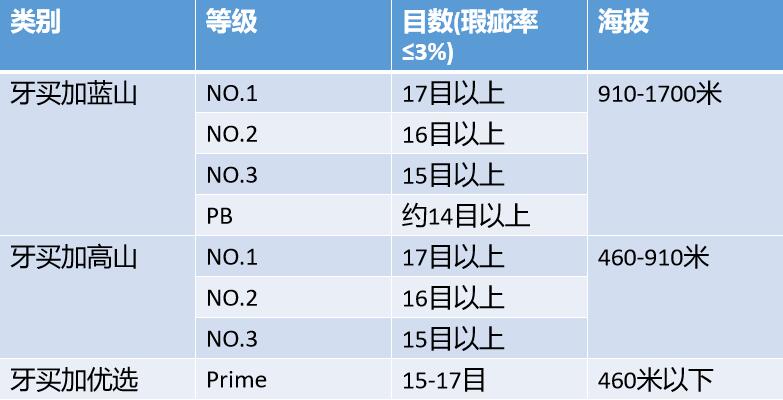
(All altitudes in the image are converted from feet to meters: 910 meters ≈ 3000 feet, 460 meters ≈ 1500 feet)
Authentic Blue Mountain Comes with Certificate Authentication
The Jamaican government long insisted that all Blue Mountain coffee be roasted in Jamaica to guarantee consistent quality. But roasting is a delicate craft requiring experience, training, and expensive equipment—and from the consumer's side, beans should be consumed soon after roasting. Jamaica-based roasting simply couldn't meet that. Green beans can now be exported.
FrontStreet Coffee buys Jamaica Blue Mountain directly from origin. The Jamaican Coffee Board can issue certificates for all exported Blue Mountain coffee on the market.
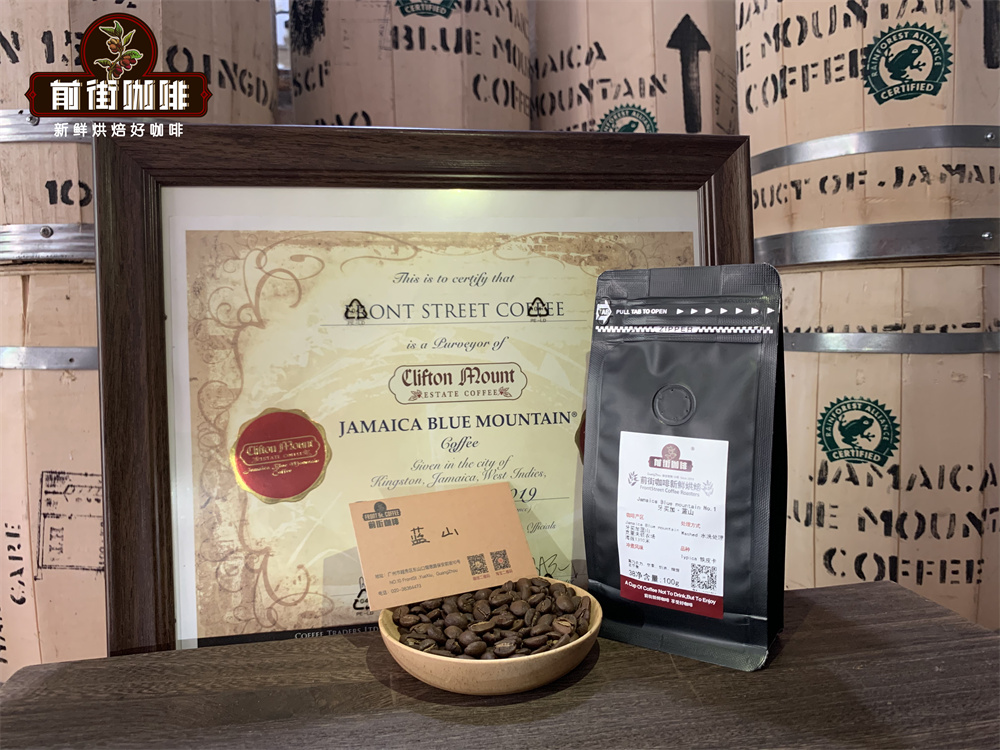
Certificates come in three types:
(1) Quality certificate issued by the Jamaican Coffee Board
(2) Authorization certificate issued by Blue Mountain manufacturers (Blue Mountain coffee is processed by 4 Jamaican government-licensed processors and exported by 16 licensed exporters)
(3) Certificate of origin for Jamaica Blue Mountain coffee
Quality certificates record time and quantity. The Board randomly inspects a package from submitted Blue Mountain coffee and issues a certificate only if it meets the standards.
FrontStreet Coffee Roasting Analysis
FrontStreet's roaster used a medium roast for the Jamaica Blue Mountain No. 1 to highlight its balanced, rich flavor. Taking 500g of green beans in a Yangjia 600N semi-direct-heat roaster as an example:
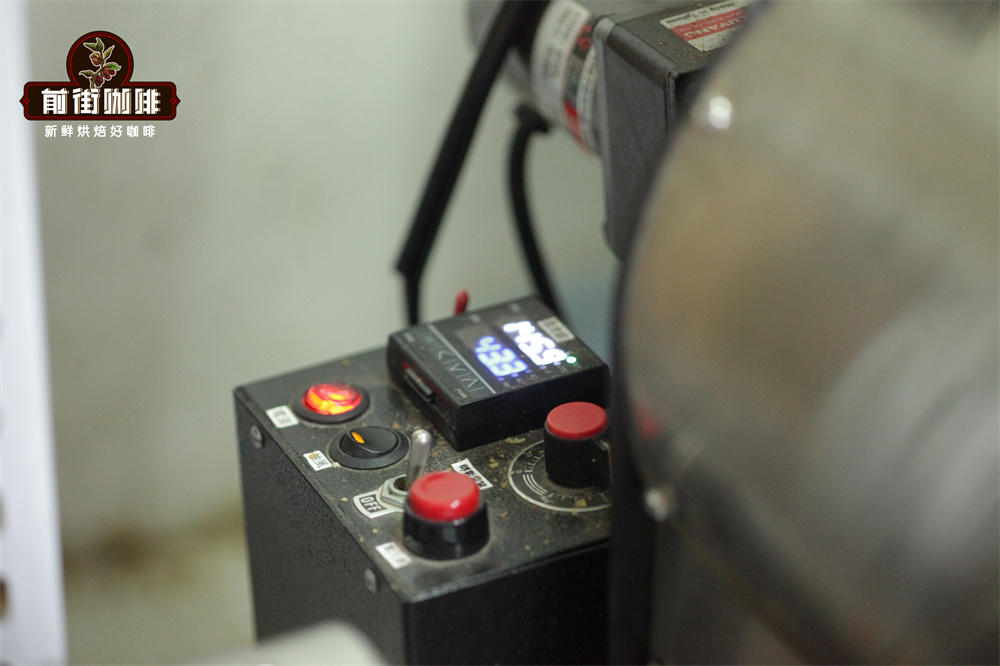
Charge the drum at 165°C with heat at 130 and the air damper at 3. Turning point at 1'32", drum temperature 95.8°C, heat unchanged. At 3 minutes, open the damper to 4. At 4 minutes, raise heat to 140. At a drum temperature of 153.3°C the beans turn yellow, the grassy smell disappears entirely, and the drying stage gives way. At 8'36", wrinkles and dark mottling appear on the bean surface and the toast aroma clearly shifts to coffee aroma—the prelude to first crack. Listen carefully from here. First crack begins at 10'06"; develop 3 minutes after first crack and drop at 198.5°C.
Flavor Profile of FrontStreet Coffee's Jamaica Blue Mountain No. 1
FrontStreet's Jamaica Blue Mountain tastes remarkably clean, and it's one of the sweetest coffees in the world. As Jim Reynolds of Peet's Coffee and Tea described it: the best examples of Jamaica's Blue Mountain coffee have aromatic, smooth, and rich qualities that give me a gem-like feeling. It's as precious as a gem. It's complex but very mild, sweet, with very strong body. You must taste it to know what I'm talking about.
Unique growing conditions and meticulous care at every stage made Blue Mountain famous. The flavor is rich and mellow, with a perfect balance of sweetness, acidity, and bitterness—no harsh bitterness at all, just moderate, well-judged acidity and a lasting fruity finish.

FrontStreet Coffee: How to Spot Real vs. Fake Blue Mountain
1. Appearance: Genuine green beans are blue-green, very uniform, medium to small, with slightly upturned ends. They expand noticeably after roasting and become very full.
2. Grinding: Authentic beans grown at high altitude have a looser cellular structure. When ground by hand they feel crisp, smooth, and continuous, with no resistance at all.
3. Aroma: Real Jamaica Blue Mountain has a rich, dense aroma. Blended "Blue Mountain" coffees don't.
4. Taste: Authentic Blue Mountain is balanced and rich, with nothing overdone or missing—something no other bean can imitate, and the most crucial test. Blue Mountain peaberry has a subtler aroma but a comparatively stronger taste.
FrontStreet Coffee's Brewing Suggestions for Jamaica Blue Mountain No. 1
FrontStreet recommends freshly roasted beans to get the full flavor experience. Beans shipped by FrontStreet are roasted within 5 days—freshness dramatically affects flavor. FrontStreet's philosophy is "Freshly Roasted Good Coffee": with a resting period of about 4-7 days, the coffee arrives right at peak flavor.
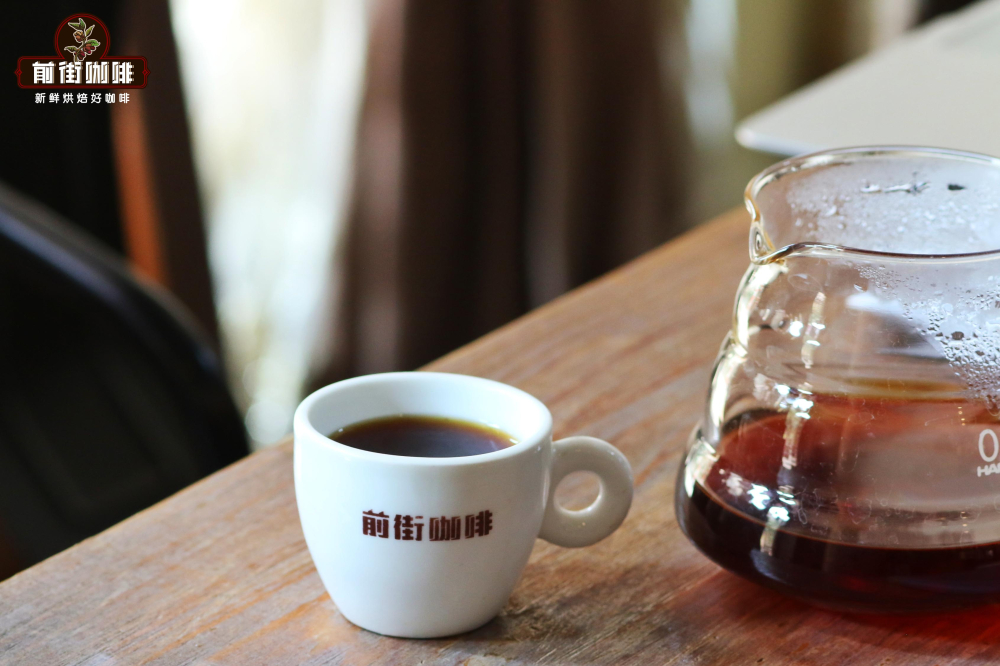
15g of coffee, water at 86°C, coffee-to-water ratio 1:15, medium grind (75% pass-through on the China standard #20 sieve)
For drippers, FrontStreet works with the V60, Kalita wave, and Kono, and demonstrates primarily with the Kono. The reason: this Blue Mountain is a darker roast, and high water temperatures easily over-extract—hence 86°C water. At that temperature a fast-flowing dripper like the V60 would under-extract. The Kono has fewer, shorter ribs, which creates a gap between filter paper and dripper wall, slows the water down, and adds an immersion element. After testing every parameter, the Kono won.
The Kono isn't just for Blue Mountain No. 1, by the way—it also suits FrontStreet's Brazil Queen Estate, PWN Golden Mandheling, and other medium-dark roasted beans.
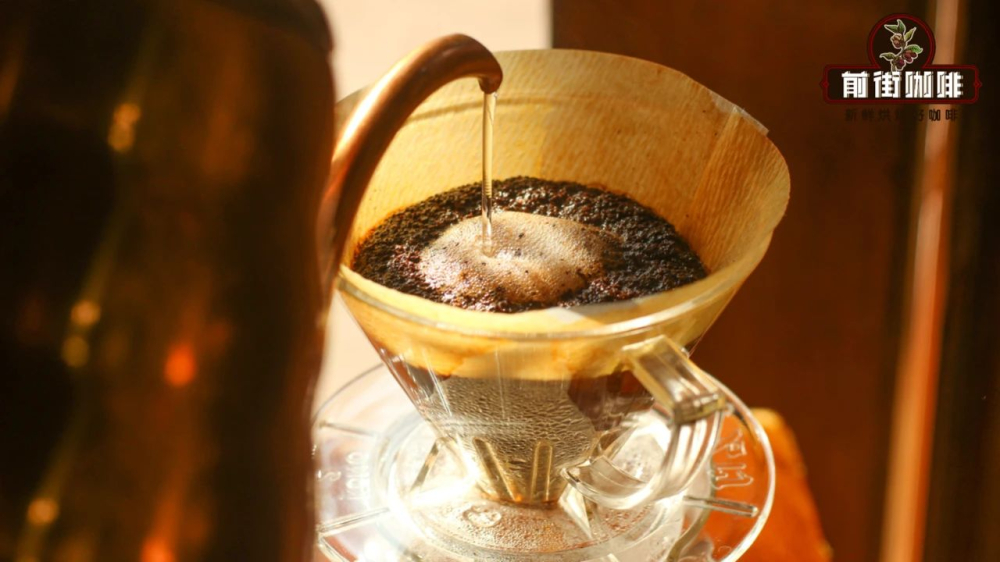
For technique, FrontStreet uses segmented extraction—the three-pour method. Bloom with 30g of water for 30 seconds. First pour: small circular flow up to 125g, then stop. When the liquid level nearly exposes the coffee bed, pour the second time up to 225g and let it finish. Total extraction time (including bloom) is 2'00".
One final note from FrontStreet: the market is full of "Blue Mountain flavored" blends that have nothing to do with Blue Mountain. This arose because Blue Mountain was always rare and expensive, so sellers mixed other beans and roasted them dark to imitate the flavor. Conscientious merchants, domestic and international, will clearly label these as Blue Mountain blend, Blue Mountain flavored, or Blue Mountain style—not genuine Jamaica Blue Mountain.
Authentic Blue Mountain and Blue Mountain flavor are two different things. "Blue Mountain blend" beans usually show obvious differences in bean shape and size, making them relatively easy to spot. And don't believe in "premium Blue Mountain" at a few dozen yuan per jin, or "Blue Mountain coffee" at ten-odd yuan a cup. Not everything labeled Blue Mountain is Blue Mountain!
FrontStreet Coffee Recommendation
For many coffee lovers, Blue Mountain is a name you simply can't avoid. In the era before specialty coffee spread, "treating someone to Blue Mountain" was shorthand for the finest coffee money could buy. Strictly speaking, only coffee grown in the designated Blue Mountain zone of eastern Jamaica—whose highest peak reaches 2,256 meters, wrapped in year-round mist—and certified by the Jamaican authorities may be called Jamaica Blue Mountain Coffee. Annual output is under 2,500 tons, a sliver of global production, and Japan historically bought over 70% of it, which keeps genuine Blue Mountain scarce and expensive.
What makes Blue Mountain special is balance. It lacks the aggressive fruit acidity of many African coffees and the heavy bitterness of dark roasts, landing instead on a near-perfect harmony of acidity, sweetness, bitterness, and aroma: cream, caramel, chocolate, nuts, honey, and a light fruitiness, with a soft round entry, a richly sweet middle, and a clean, lingering finish. It's often called the specialty coffee that almost everyone can love. FrontStreet's Jamaica Blue Mountain No. 1 comes from the historic Clifton Farm—growing coffee since around 1750 at an average of 4,300 feet (1,310.64 meters)—with full certification documents and the original wooden shipping barrels (15, 45, or 70 kg) that are themselves a hallmark of genuine Blue Mountain.
To brew it, FrontStreet recommends 15g of coffee rested 4-7 days from the roast date, ground slightly coarser than light-roast beans—about white-sugar texture—at 87-88°C water and a 1:15 ratio. Use a Kono dripper to build body, with a three-stage pour: 30g bloom for 30 seconds, second pour to 120g, third pour to 225g. Beyond pour-over, Blue Mountain's balance also shines in a moka pot (slightly finer grind, hot water in the chamber, medium-low heat) or as espresso with milk, where its chocolate, caramel, and nut character carries through beautifully.
Important Notice :
FrontStreet Coffee is a long-established specialty coffee roaster in Guangzhou China, selling freshly roasted beans from its own farm in Yunnan as well as dozens of carefully selected single-origin beans from around the world for both pour-over and espresso. The products deliver consistently excellent quality and great value, with shipping within 24 hours. Guangzhou's FrontStreet Coffee shop is recommended by many coffee lovers, and the beans are now available online at the Tmall 。
FrontStreet Coffee has moved to a new address:
FrontStreet Coffee Address: 315,Donghua East Road,GuangZhou
Tel:020 38364473
 Scan and follow the En Gafei WeChat official account. Please indicate that the reprint comes from "En Gafei".