Costa Rica Tarrazu Baha Raisin Honey Process Coffee Beans - Flavor Characteristics

Costa Rican Coffee
Coffee from Costa Rica is always captivating: sweet yet full of strength, it makes you want to explore everything it has to offer after a single taste. Honey processing is Costa Rica's most famous method, because it lets the country's coffee show its high sweetness to the fullest, leaving a lasting impression after every cup.
Costa Rican Coffee History
Costa Rican coffee comes from the Republic of Costa Rica in southern Central America, and its flavor is often compared to Colombian coffee. Coffee is a vital economic pillar for the country: introduced in 1808 from Cuba, it now has over two hundred years of history, and roughly one-third of Costa Rica's population takes part in coffee cultivation. Although Costa Rica ranks third from last in area among Central American nations, its economy outperforms more than half the countries in the region.

Costa Rica has a population of 3.5 million but as many as 400 million coffee trees, and coffee exports account for twenty-five percent of the country's total exports. The volcanic soil is fertile and well-drained, particularly in the central highlands, where the ground contains several layers of volcanic ash and dust.
The Tarrazú Growing Region
Tarrazú lies south of the capital, San José, and is Costa Rica's main coffee-producing area as well as one of the world's major coffee regions. Its growing soil is extremely fertile and well-drained. Although coffee production here is small, the crop has been owned by the McAlpine family of the UK for the last three generations. Tarrazú has the highest average altitude in the country, together with excellent climate and soil conditions, making it the most famous - and generally recognized as the best - of Costa Rica's major coffee regions.

Tarrazú is also the most intensive fruit-growing area in Costa Rica. The estates there mainly cultivate passion fruit, so coffee production is quite small. What coffee they do grow, however, is mostly processed by red honey, black honey, and yellow honey methods. The sweetness and berry aroma will absolutely surprise you: excellent sweetness, consistency, and thickness, with flavors reminiscent of dried banana.
Canet Estate
Canet Estate is a small 5-hectare farm in the town of San Marcos in Tarrazú, owned by the Robles brothers - Leo, Elian, and Melvin. They have worked together in cultivation and production for over 10 years and also share a small wet mill (beneficio).

Canet sits in the highest-altitude coffee-growing area of the Tarrazú region. Because this zone is Costa Rica's most intensive fruit-growing region, the estate's owners devote most of their land to passion fruit, and coffee production is scarce. Only a specific plot is dedicated to coffee, receiving special care and harvested exclusively from fully mature red cherries.
Varieties: Bourbon Varietal Caturra
Caturra is a single-gene variant of Bourbon, discovered in Brazil in 1937. Its yield and disease resistance both surpass Bourbon, and its shorter plants make harvesting convenient. Unfortunately, it shares Bourbon's tendency to bear heavily one year and rest the next. Its flavor is comparable to, or slightly below, Bourbon. More importantly, it adapts extremely well, needing no shade trees and thriving directly under intense sun - hence the nickname "Sun Coffee." It tolerates high-density planting but requires heavier fertilization, which raises costs; that is why acceptance among farmers was initially lukewarm.
Caturra suits altitudes from 700 meters up to 1,700 meters, and the higher the altitude, the better the flavor, though production falls accordingly. Yellow Caturra variants also exist in Central and South America, but their reputation doesn't match that of Yellow Bourbon.

Costa Rican Altitude Classification
Costa Rica classifies its coffee by altitude grades:
SHB: Strictly Hard Bean, grown at 1,500 meters altitude
GHB: Good Hard Bean, grown at 1,100-1,200 meters
HB: Hard Bean, grown at 1,000 meters
High-quality Costa Rican coffee is called "Strictly Hard Bean," grown above 1,500 meters. Generally, the higher the altitude, the better the beans - not only because altitude increases acidity and enhances flavor, but also because cooler nights at elevation slow tree growth, concentrating the flavors in the beans.

The Raisin Honey Processing Method
Raisin honey processing retains 100% of the mucilage and uses zero water.
That raises the difficulty of honey processing considerably, demanding strict control of timing. On harvest day, the freshly picked cherries are poured into large water tanks: mature, full fruits sink to the bottom, while underdeveloped or overripe fruits float and must be removed. The selected cherries are then laid on raised beds to pre-dry for at least three days before the skins are removed; the mucilage is kept intact and drying continues. At this stage, climate is the key factor in successful honey processing.
During drying, the cherries must be turned constantly for even drying, yet the turning frequency must be carefully judged: slow enough to ferment properly, but not so slow as to over-ferment.

Yellow Catuai (Catuai Amarillo) comes from a cross between Mundo Novo and Caturra, first cultivated in 1949 by Brazil's Instituto Agronomico de Campinas. Like Red Catuai (Catuai Rojo), Yellow Catuai has extremely high disease resistance and suits cultivation at high altitudes and in windy areas.
Both Catuai varieties have very delicate, clean acidity. Through adjustments at the mill they yield red honey, yellow honey, and black honey coffees (depending on the degree of mucilage retained). Canet sits in the highest-altitude coffee-growing area of Tarrazú, the most intensive fruit-growing region in Costa Rica. The owners mainly cultivate passion fruit, so coffee is scarce: only one dedicated plot is farmed, with special care and a harvest of only fully mature red cherries.
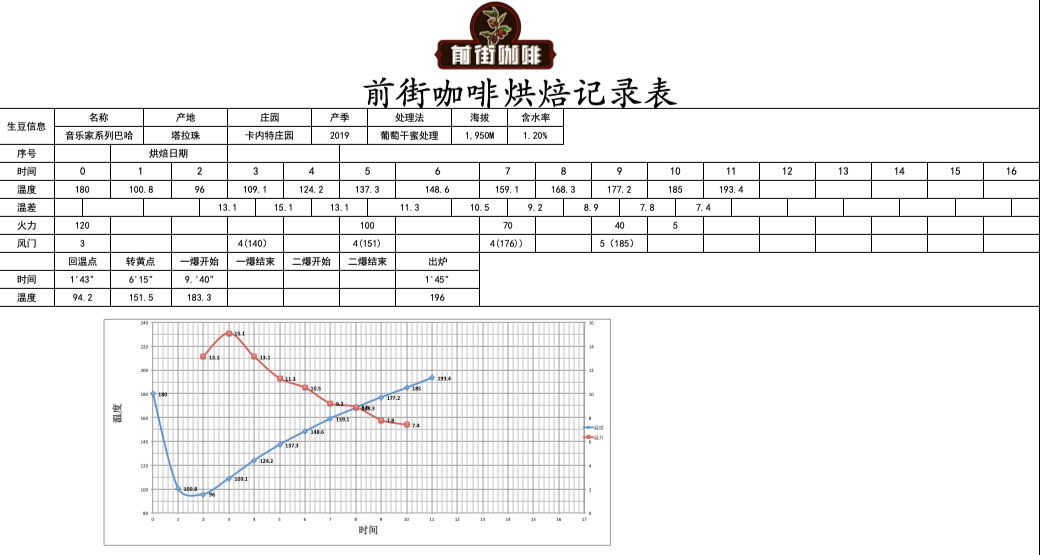
Roasting Profile
The roaster is a Yangjia Pegasus 800N from Taiwan, a semi-direct-fire type, with maximum airflow of 5 and a 300-gram charge.
Charge temperature: 180°C. Turning point: 1'43", at 94.2°C. Yellowing point: 6'15", at 151.5°C. First crack: 9'40", at 183.3°C. Development time after first crack: 1'45". Drop temperature: 196°C.
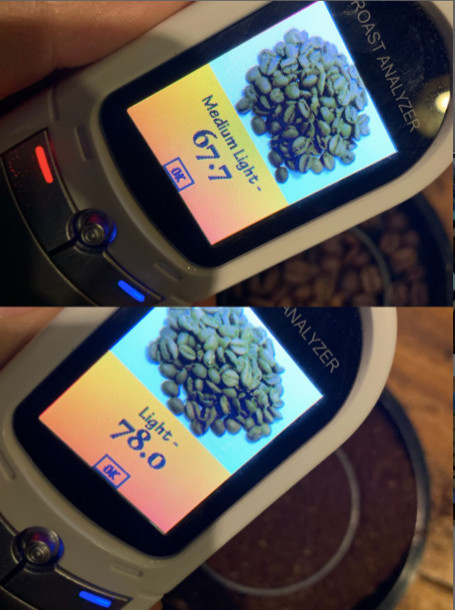
Agtron bean color value: 67.7 (image above). Agtron ground color value: 78 (image below). Roast delta value: 10.3.
Roasting Approach
This FrontStreet Coffee Costa Rica Bahia coffee bean consists of the two most common varieties of Central and South America, Caturra and Catuai. The green beans carry a fermented fruit aroma. Visually they are dark green, grown at around 1,950 meters with a relatively hard bean texture. From the 2019 harvest, the beans have a relatively high moisture content. The roasting approach therefore uses gradually reduced heat and an extended drying phase along this curve. Since this "FrontStreet Coffee Costa Rica Musician Bahia" undergoes double-fermented raisin honey processing, the roast was designed as a medium roast, mainly to highlight the bean's fermented aroma and fruit flavors while preserving the balanced, full-bodied texture typical of honey-processed coffee.
Taking FrontStreet Coffee Costa Rica Bahia Coffee Beans as an Example

FrontStreet Coffee Costa Rica Bahia Coffee Bean Cupping Notes
It smells of fermented rice-wine aroma, with mature tropical fruit flavors, berry sweetness and acidity, nutty and creamy notes, a caramel aftertaste, and a subtle floral finish.

FrontStreet Coffee Costa Rica Bahia Coffee Bean Brewing Method
Brewing equipment: Hario V60
Water temperature: 90°C
Coffee-to-water ratio: 1:15
Grind size: medium-fine

Brewing method: poured in stages. Start with 30g of water for a 30-second bloom. With small circular pours, continue to 125g, then pause. When the water level drops and is about to expose the coffee bed, pour on to 225g and stop. When the level drops again and the bed is about to show through, remove the dripper (timing starts from the bloom). Extraction time: 1'56".
FrontStreet Coffee Recommendation
If the raisin honey process intrigues you, FrontStreet Coffee offers several companions in the same style. The FrontStreet Strawberry Sugar Geisha blend pairs Panama Geisha with Costa Rican raisin-honey coffee (100% mucilage retained, zero water), yielding a floral, tea-like base with grape and dried blueberry aromatics, gentle fruit acidity, an almond finish, and obvious sweetness. The FrontStreet Costa Rica Mozart pushes raisin honey processing even further, with osmanthus, pineapple, and raisin notes whether brewed as pour-over, cold brew, or moka pot.
For a classic washed counterpart, the FrontStreet Colombia Huila is a benchmark single origin: medium-dark roasted with dark chocolate and nutty sweetness, a moderate body, and enough versatility for pour-over, French press, moka pot, or espresso. For adventurous palates, the FrontStreet Colombia Sidra from Divide Line Estate undergoes anaerobic natural processing that transforms the cup into passion fruit, grape, apricot, and dried-fruit aromas.
Brew any of these honey or anaerobic lots on a V60 at 90°C with a 1:15 ratio and a staged pour - bloom 30g for 30 seconds, build to 125g, then finish at 225g - to keep the fermented fruit sweetness clean and layered.
Important Notice :
FrontStreet Coffee is a long-established specialty coffee roaster in Guangzhou China, selling freshly roasted beans from its own farm in Yunnan as well as dozens of carefully selected single-origin beans from around the world for both pour-over and espresso. The products deliver consistently excellent quality and great value, with shipping within 24 hours. Guangzhou's FrontStreet Coffee shop is recommended by many coffee lovers, and the beans are now available online at the Tmall 。
FrontStreet Coffee has moved to a new address:
FrontStreet Coffee Address: 315,Donghua East Road,GuangZhou
Tel:020 38364473
 Scan and follow the En Gafei WeChat official account. Please indicate that the reprint comes from "En Gafei".