Flavor Characteristics of Costa Rica Mirasu Estate Geisha Coffee Beans and the Origin Story of Geisha Coffee
Costa Rican Coffee: The Sweet Essence of Central America
Costa Rican coffee is widely regarded as one of the finest coffees in Central and South America. Its growing regions enjoy high altitudes, pleasant temperatures and fertile soil, and the result is high-quality Costa Rican beans. That reputation has even carried Costa Rican coffee into Starbucks' Reserve collection.
Arabica plants are delicate and need specific conditions to thrive, above all high altitude and moderate temperatures. In this beguiling Latin American country, the mountainous terrain and warm growing areas provide exactly the environment needed for the finest Arabica.
Costa Rica has distinct dry and rainy seasons, with temperatures between 17°C and 28°C through the year and an annual temperature swing of only about 10°C. More than 80% of the coffee-growing land sits between 800 and 1,600 meters above sea level, with average rainfall of 2,000-3,000 millimeters.
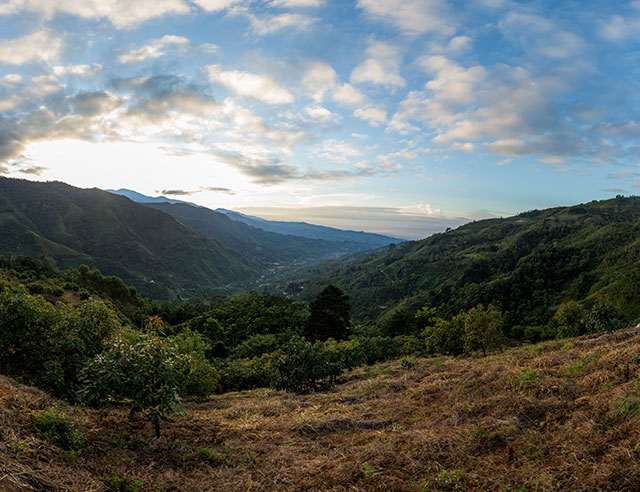
Heavy rainfall and high altitude create ideal growing conditions and striking mountain scenery. More than 70% of the coffee grows in these lush forests, where altitude varies sharply. All of this shapes the aroma, body, flavor and acidity of Costa Rican coffee from region to region. Volcanic ash enriches the soil, feeding oxygen to the beans and giving them more complex flavors. This mix of diversity and a beautiful natural climate makes Costa Rica a perfect place to live, to visit and to grow coffee.
The Eight Coffee-Growing Regions
Costa Rica has eight distinct coffee-growing regions, each producing coffee with its own flavor profile. Within the country, different areas offer a range of climates, microclimates and high humidity, which is a great advantage for growing different varieties.
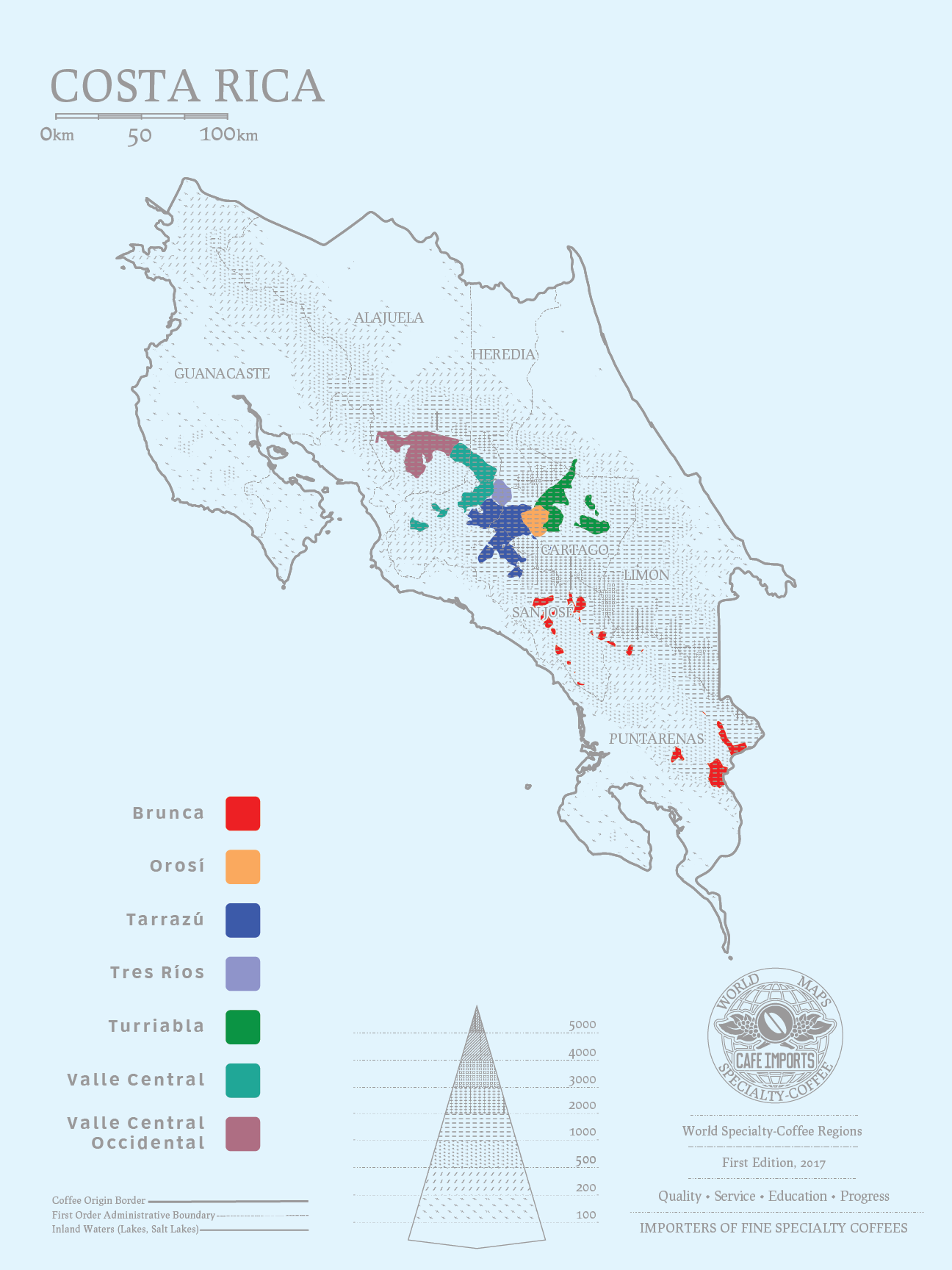
Costa Rica's coffee regions include Brunca, Orosi, Tarrazú, Tres Ríos, Turrialba, Valle Occidental and Valle Central.
Among them, Tarrazú stands out as one of the country's most famous growing areas, known for bright acidity and rich aroma. Brunca offers a moderate body, while Valle Occidental is renowned for subtle peach and apricot notes. The diversity of climate and humidity gives each region a distinct profile, so Costa Rican coffee can be enjoyed eight different ways, each with its own character.

FrontStreet Coffee's Tarrazú Recommendation
Known for being "sweet as honey," Costa Rican coffee has won over many drinkers. FrontStreet Coffee would like to recommend a Costa Rican Tarrazú bean for anyone who wants to experience that sweetness. On FrontStreet Coffee's bean list is a coffee from the Mirazu Estate.
Tarrazú Region Characteristics
Tarrazú is one of the highest-altitude growing areas in Costa Rica. Its soil is acidic, and most coffee plants there grow under shade from other plants. Tarrazú beans have a beautiful blue-green appearance. Because of the high altitude, tree diseases are strongly suppressed, letting the trees put more energy into fruit development. Nearly 95% of the beans produced here are graded Strictly Hard Bean (SHB). Tarrazú flavors lean toward citrus acidity, preserved-fruit sweetness and chocolate notes.

FrontStreet Coffee Costa Rican Strawberry Candy
Region: Costa Rica Tarrazú
Estate: Mirazu Estate
Altitude: 1,700 meters
Varieties: Geisha, ET47, SL28, Maico
Processing: Raisin Honey Processing
Mirazu Estate's owner, Esteban Sanches, was originally a staff member at La Candelilla estate, where he built deep expertise in coffee machinery and post-harvest processing. Later, driven by his own views on coffee, he left La Candelilla and founded his own estate, naming it Mirazu. In the local language, Mirazu means "overlooking Tarrazú." Esteban Sanches believes that coffee quality begins with the tree itself.
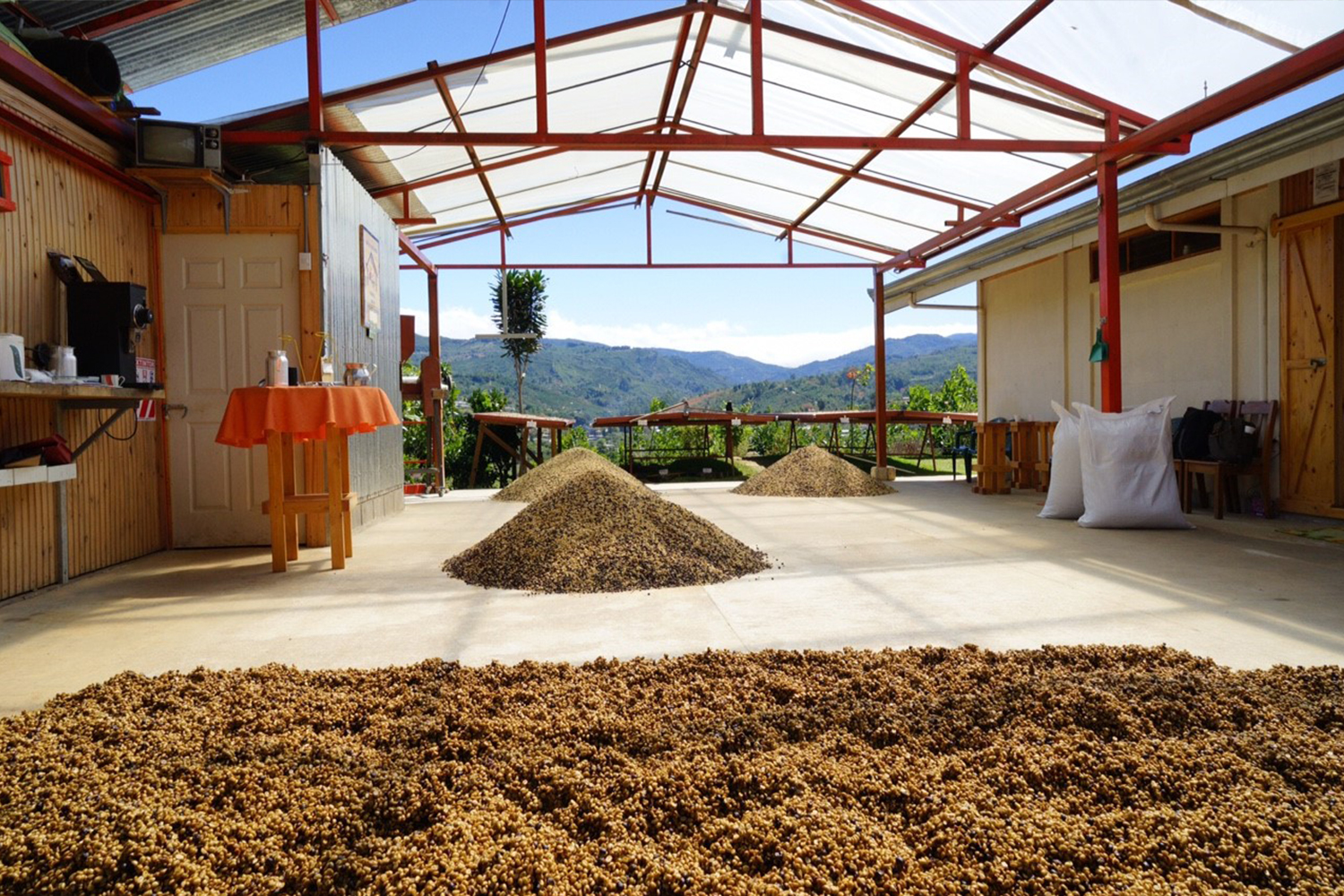
FrontStreet Coffee's Mirazu beans use raisin honey processing: ripe cherries are dried until shriveled, then the skin and pulp are removed while the entire mucilage layer is retained, followed by further drying. FrontStreet Coffee has found that coffee processed this way has a richer, more viscous body than regular honey-processed coffee, with a more persistent aroma and more intense sweetness.
When FrontStreet Coffee's baristas received these green beans, they wanted to highlight the intense fruity and floral aromas of the raisin honey process along with its strong sweetness. The roasters therefore chose a medium roast. After the roasted beans arrived, the baristas, keeping the lighter roast in mind, decided to brew with a higher water temperature (93°C) and a finer grind (80% pass-through rate on China standard #20 sieve).

Readers of FrontStreet Coffee's articles know that FrontStreet has two signature pour-over drippers: the Hario V60 and the Kono. When brewing at a higher water temperature, to avoid over-extraction from prolonged contact between hot water and grounds, the faster-flowing Hario V60 is used. A three-stage pour also helps build richer layers of flavor.
Filter: Hario V60
Water Temperature: 93°C
Coffee Dose: 15 grams
Ratio: 1:15
Grind Size: 80% pass-through rate on China standard #20 sieve
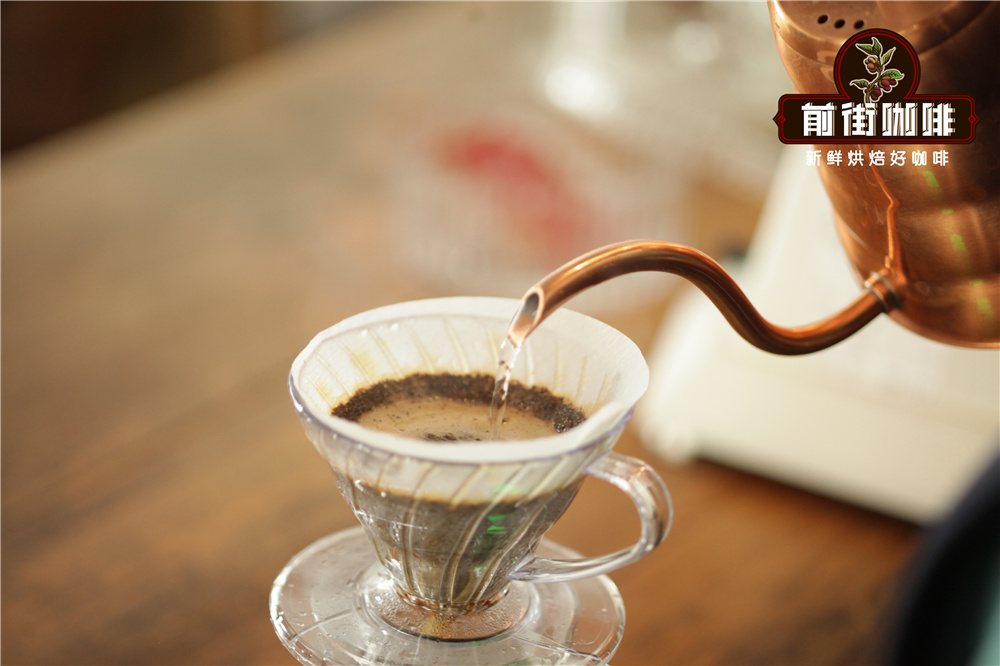
Start with 30 grams of water for a 30-second bloom, then pour slowly in a small circular motion to reach 125 grams for the second stage. When the water level drops to just above the coffee bed, pour again in gentle circles to reach 225 grams for the third stage. Remove the dripper once all the water has drained into the server. Total extraction time is about 2 minutes.
FrontStreet Coffee Recommendation
This coffee is FrontStreet Coffee's take on the Gesha family. The Mirazu Estate lot blends Geisha with ET47, SL28 and Maico and is processed as a raisin honey, so it delivers delicate floral notes alongside sweet fruit. Because it is roasted to a medium level, FrontStreet brews it hotter and finer than a typical dark roast: a Hario V60 at 93°C with 15 g of coffee, a 1:15 ratio and a grind that passes 80% through a China standard #20 sieve, poured in three stages to about 2 minutes total.
FrontStreet also offers the Costa Rican Strawberry Candy as an approachable alternative to a full-blown Panama Gesha. It combines Costa Rican honey processing with Panama Geisha material, giving the cup both fine florals and sweet fruit, and it is flexible enough for pour-over, a moka pot or an espresso machine. For a cold brew, FrontStreet grinds 30 g to the texture of fine sugar (EK43s setting 9, or C40 setting 24), adds 360 g of room-temperature water at a 1:12 ratio, stirs, seals and refrigerates for 8 hours, then filters out all the grounds and ages the liquid in the fridge for another 3 hours. The result drinks with notes of grape juice, rose, sweet orange and fruit wine.
For comparison, FrontStreet's Panama Esmeralda Red Label Gesha, grown at 1,600-1,800 meters and cupping at over 90 points, and its Ethiopian Gesha Village Gold and Red Label lots both sit at the pinnacle of the Gesha range; the Costa Rican Strawberry Candy lets you enjoy that floral, fruit-forward character at a friendlier price.
Important Notice :
FrontStreet Coffee is a long-established specialty coffee roaster in Guangzhou China, selling freshly roasted beans from its own farm in Yunnan as well as dozens of carefully selected single-origin beans from around the world for both pour-over and espresso. The products deliver consistently excellent quality and great value, with shipping within 24 hours. Guangzhou's FrontStreet Coffee shop is recommended by many coffee lovers, and the beans are now available online at the Tmall 。
FrontStreet Coffee has moved to a new address:
FrontStreet Coffee Address: 315,Donghua East Road,GuangZhou
Tel:020 38364473
 Scan and follow the En Gafei WeChat official account. Please indicate that the reprint comes from "En Gafei".