What are the characteristics of Jamaica Blue Mountain Coffee? No.1, No.2, No.3 Grade Classification and Identification

Introduction to Jamaica Blue Mountain Coffee
When it comes to Jamaica, eyes light up at once — this is the home of the world's finest "Jamaica Blue Mountain Coffee." FrontStreet Coffee firmly believes Jamaica Blue Mountain is the ultimate coffee: its acidity, sweetness, richness, and bitterness are perfectly balanced, with a fragrant aroma and an exceptionally smooth taste.
The earliest "Jamaica Blue Mountain" referred to coffee produced by the Wallenford Estate and Silver Hill Estate, with the former considered the best. Today, Jamaica Blue Mountain means beans grown in the Blue Mountain region east of the capital Kingston, at elevations exceeding 1,000 meters. Mavis Bank is currently the largest estate, its wooden barrels marked M.B.C.F. Quality control is extremely strict, with certification conducted by the government's Coffee Industry Board (CIB).

Beans grown at lower elevations and in other regions can only be called Jamaica High Mountain beans or Jamaica Prime beans, and their flavor profiles differ vastly from true Blue Mountain. Yet the cultivation area for these coffees is twice that of the true Blue Mountain region, accounting for 75% of the country's production — so even buying beans locally in Jamaica does not guarantee genuine Blue Mountain coffee.
Jamaica's Coffee Growing Regions
Today the St. Andrew growing region remains one of the three major Blue Mountain regions, alongside Portland and St. Thomas.
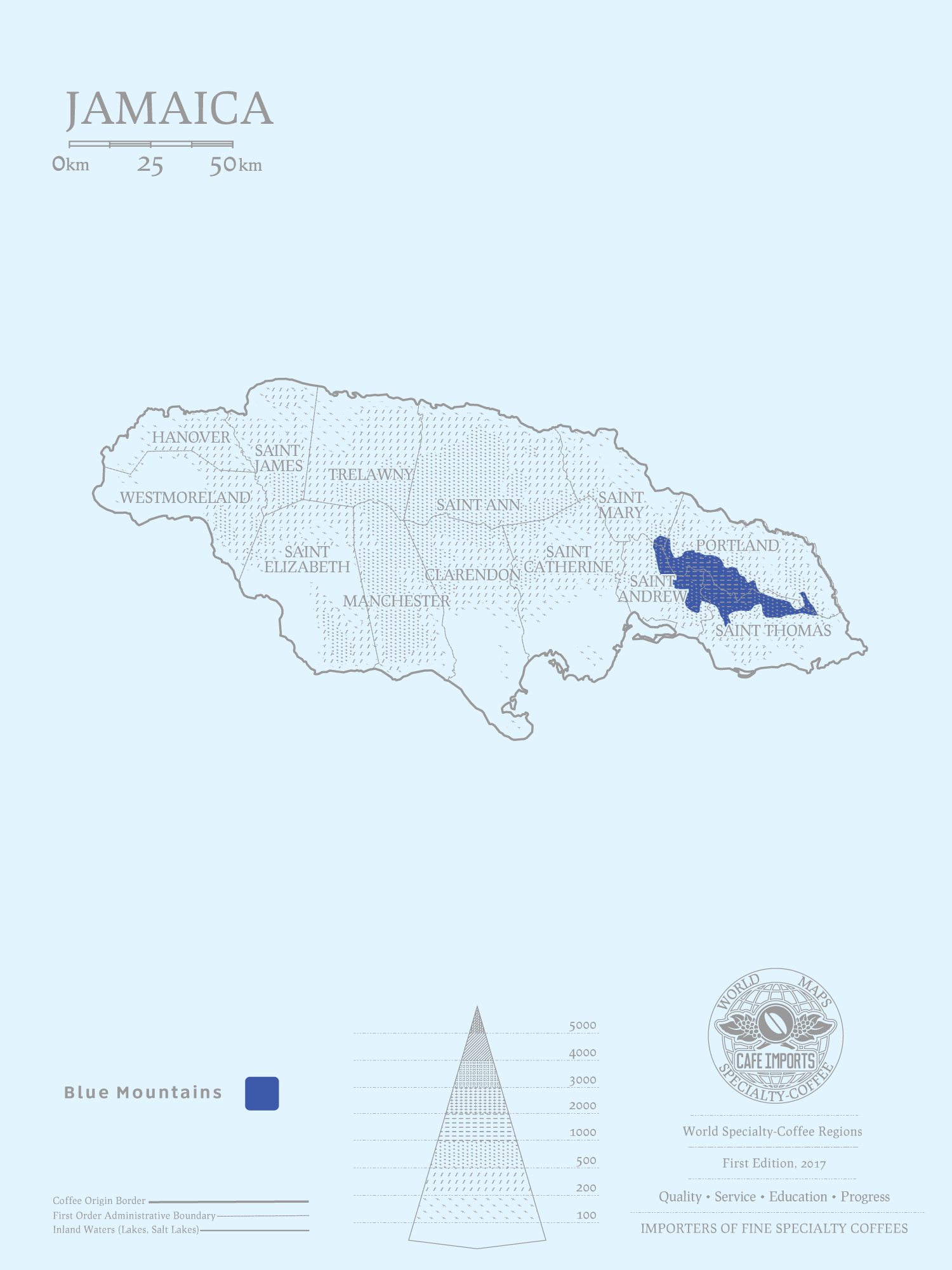
The recognized Blue Mountain region is small — just 6,000 hectares of planting area — so not all coffee labeled "Blue Mountain" can possibly come from there. Another 12,000 hectares grow the two other types of Jamaican coffee: High Mountain Supreme and Prime Washed Jamaican.
Ideal Growing Conditions
True Blue Mountain is among the world's most superbly situated coffees. Jamaica's weather, geology, and topography provide an exceptionally ideal setting. The mountain range running through the island extends to the east, where the Blue Mountains rise beyond 2,100 meters. The cool, foggy, frequently rainy weather creates perfectly balanced moisture on this fertile land. Coffee is grown in mixed cultivation, planted on terraces alongside banana and avocado trees.

Jamaica Blue Mountain Coffee Classification
Jamaica Blue Mountain Coffee is divided into several grades: Blue Mountain coffee and High Mountain coffee are each subdivided into four grades, ranked from highest to lowest as No.1, No.2, No.3, and PB. No.1 is what we call Blue Mountain No.1, No.2 the grade below, and PB refers to peaberries. Under CIB standards, only coffee grown above 910 meters may be called Jamaica Blue Mountain Coffee.

Jamaica High Mountain Supreme Coffee Beans come from the Blue Mountain region below 666 meters. They are the second-highest quality after Blue Mountain — known in the trade as Blue Mountain's sibling. Given Blue Mountain's extremely limited production, High Mountain coffee is the best way to taste a Jamaican-style cup.
Jamaica Prime Coffee Beans are grown outside the Blue Mountain region. A common misconception held that only coffee grown above 1,800 meters in the Blue Mountains could be called Blue Mountain coffee. In fact, there is only one estate above 1,800 meters — Amber — owned by someone of Chinese descent surnamed Lyn (Lin), whose ancestors came from Guangdong, China. It has only 30 hectares and very limited production. Blue Mountain coffee is mainly distributed across five mountainous areas: John Crow, St. John's Peak, Mossman's Peak, High Peak, and Blue Mountain Peak.

Blue Mountain coffee is coffee grown in Jamaica's Blue Mountains, further divided by grade into Jamaica Blue Mountain Coffee and Jamaica High Mountain Coffee.
The Excellence of Blue Mountain Coffee
Blue Mountain coffee is the world's most superior coffee, and its limited production makes it precious for its rarity. The Blue Mountains lie in eastern Jamaica. Surrounded by the Caribbean Sea, on clear days when sunlight strikes the azure sea the peaks reflect the water's brilliant blue light — hence the name. The range's highest peak reaches 2,256 meters, the tallest in the Caribbean and a famous tourist destination.
The area sits within the coffee belt, with fertile volcanic soil, clean unpolluted air, and a humid climate of year-round fog and rain (average precipitation of 1,980mm and temperatures around 27°C). These conditions created the world-famous Jamaica Blue Mountain Coffee — for years the world's second most expensive coffee. It has every hallmark of a fine coffee: rich and aromatic, with sweetness, acidity, and bitterness so perfectly balanced that it shows no bitterness at all, only moderate and perfect acidity. It is typically enjoyed as a single origin, but because production is tiny and prices exorbitant, most "Blue Mountain" sold on the market is blended with similar-tasting coffees.

Cultivation and Processing
The trees grow on rugged mountain slopes, making harvesting extremely difficult; only skilled local pickers can manage it. Selecting perfectly ripe beans is crucial — under- or over-ripe beans compromise quality. After harvesting, the beans must be hulled the same day, then fermented for 12-18 hours, then washed and sorted. Drying must be done on concrete floors or thick blankets until moisture drops to 12%-14%, after which the beans are stored in special warehouses. When needed, they are taken out, roasted, and ground. Every step must be strictly controlled, or quality suffers.
Market and Distribution
Since Japan has consistently invested in Jamaica's coffee industry, most Blue Mountain coffee is controlled by the Japanese, who hold priority purchasing rights. In 1992, Jamaica sold 688 tons of Blue Mountain coffee to Japan, 75 tons to the United States, and 59 tons to the United Kingdom. 90% of Blue Mountain coffee is purchased by Japan; the rest of the world can obtain only 10% of production, so Blue Mountain is perpetually in short supply regardless of price.

Jamaica Coffee Market
Blue Mountain is a coffee that reputable retailers must stock regardless of circumstances. One major British retailer has said that regardless of price he will continue selling Blue Mountain year-round, because he has many customers who recognize only "Blue Mountain."
Currently 90% of the harvest is purchased by Japan, leaving the rest of the world only 10% — hence the perpetual shortage. In the UK, Langford Brothers was for many years the sole supplier; later, the Edmonds Group also obtained supply from Jamaica's Salda Foods.

What sets Blue Mountain apart in shipping is that it travels in 70kg wooden barrels, replicas of the Bonifieur barrels once produced on Guadeloupe Island. These barrels were originally used to ship flour from England to Jamaica and usually carry trademark names and manufacturer information. The Coffee Industry Board issues certificates for all genuine Jamaican coffee, stamped with approval before export.
The Jamaican government once insisted that all Blue Mountain be roasted in Jamaica to ensure consistent quality. In reality, roasting is a delicate art requiring experience, training, and expensive equipment — and from the consumer's perspective, beans should be consumed immediately after roasting, which roasting in Jamaica cannot deliver. Raw Jamaican beans can now be exported. Jamaica has three coffee varieties:

Few "Blue Mountain style" coffees on the market contain even a single genuine Blue Mountain bean. There is a "Jamaica Blend Blue Mountain" made from 30% Blue Mountain and 70% of the finest Jamaica High Mountain coffee. Both style and blend attempt to imitate Blue Mountain, but neither achieves perfection.
Identifying Genuine vs. Fake Blue Mountain Coffee Beans
1. Appearance
Raw Blue Mountain beans are blue-green in color, very uniform, medium to small in size, with slightly upturned ends. After roasting they expand significantly and become very plump.

2. Grinding
Genuine Blue Mountain grows at high altitude, giving it a relatively loose cellular structure. When ground, the beans feel crisp, smooth, and continuous, with no resistance.

3. Aroma
The aroma is very intense and dense. Blended "Blue Mountain" coffees do not have this characteristic aroma.

4. Taste
Genuine Blue Mountain is defined by a balanced, rich taste in which no single flavor dominates or is missing — something no other bean achieves, and the most crucial identification point. Blue Mountain peaberries have a more reserved aroma but a relatively stronger taste.
5. Sensation
As the world's finest coffee, Blue Mountain's classic balance inevitably creates a subtle, hard-to-describe sense of satisfaction when you drink it.
In addition, authenticity can be verified through certificates.
Currently, the Jamaica Coffee Board can issue certificates for all exported Blue Mountain coffee.

Certificate Types
1) Quality Certificate issued by the Jamaica Coffee Board
2) Authorized Sales Certificate issued by Blue Mountain producers
(Blue Mountain coffee is distributed by 4 Jamaican government-licensed processing producers and exported by 16 licensed exporters.)
FrontStreet Coffee's certificate is precisely the certification issued by Clifton Farm.

3) Jamaica Blue Mountain Coffee Certificate of Origin
Quality certificates indicate time and quantity. The Jamaica Coffee Board randomly selects a package of submitted Blue Mountain coffee for inspection; if it meets Blue Mountain standards, a certificate is issued.
How to Brew Blue Mountain Coffee
KONO dripper. Parameters: 15g of coffee, water temperature 88°C, grind size with a 75% pass-through rate on the China standard #20 sieve, water-to-coffee ratio close to 1:15, extraction time around 1:45.

Bloom with 30g of water for 30 seconds; first pour to 120g and stop, with a vertical water flow and small, slow circles; second pour to 225g with a slightly faster flow and circle speed to keep fines from clogging the dripper.
Blue Mountain Flavor Profile
The taste is very clean, complex, and mild, with chocolate sweetness and very strong body. Rich and aromatic, with sweetness, acidity, and bitterness in perfect balance — no bitterness at all, only moderate and perfect acidity, and a persistent fruity finish.
FrontStreet Coffee Recommendation
For the definitive experience, FrontStreet Coffee's Jamaica Blue Mountain No. 1 comes from the historic Clifton Estate, growing coffee since around 1750 at an average elevation of 4,300 feet (about 1,310 meters), where cool mists, shade, sunshine, and mineral-rich soil extend cherry ripening. FrontStreet holds the complete origin certificates and the traditional wooden shipping barrels (15kg, 45kg, and 70kg) stamped with lot details — the hallmarks of genuine Blue Mountain. Roasted medium-dark, it unfolds in layers of nut, black chocolate, and creamy caramel sweetness, with the gentle, perfectly balanced acidity Blue Mountain is famous for.
FrontStreet recommends a KONO dripper with 15g of coffee rested 4-7 days from the roast date, a grind slightly coarser than for light roasts (about white-sugar texture), 87-88°C water, and a 1:15 ratio: bloom with 30g for 30 seconds, pour to 120g, pause, then finish at 225g. The result is a clean, complex, remarkably gentle cup with strong body — no bitterness, just a long, fruity finish.
Important Notice :
FrontStreet Coffee is a long-established specialty coffee roaster in Guangzhou China, selling freshly roasted beans from its own farm in Yunnan as well as dozens of carefully selected single-origin beans from around the world for both pour-over and espresso. The products deliver consistently excellent quality and great value, with shipping within 24 hours. Guangzhou's FrontStreet Coffee shop is recommended by many coffee lovers, and the beans are now available online at the Tmall 。
FrontStreet Coffee has moved to a new address:
FrontStreet Coffee Address: 315,Donghua East Road,GuangZhou
Tel:020 38364473
 Scan and follow the En Gafei WeChat official account. Please indicate that the reprint comes from "En Gafei".