An Introduction to the Wide Variety of Brazilian Specialty Coffee Beans: Grind Size, Roast Degree, and Processing Methods
FrontStreet Coffee: Brazilian Premium Coffee Beans - An Introduction to Grind, Roast Level, and Processing Methods
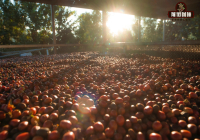
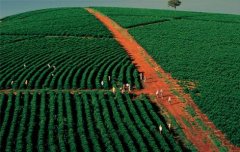
Brazil is vividly described as the "giant" and "monarch" of the coffee world. There are roughly 39.7 billion coffee trees there, and small farmers now grow coffee that accounts for 75% of Brazil's total national production. The number of people engaged in coffee production in Brazil is 2 to 3 times that of Colombia, the world's second-largest coffee-producing country.
Brazil also has many large farms running vast coffee plantations. They rely on mechanical harvesting and machine drying with a high degree of automation, treating coffee as ordinary agricultural material while paying little attention to flavor. As a result, many specialty coffee companies simply refuse to sell Brazilian beans, to avoid devaluing their reputation. In specialty coffee shops, Brazilian "Santos" coffee occasionally appears, but it is always "Bourbon Santos" rather than the low-priced "Flat Bean Santos." Santos is a descendant of the Bourbon variety, named after the port from which it was exported.
The Baú Estate sees an annual precipitation of 1,800mm and sits at an altitude of 1,100m on a plateau. The farm covers approximately 700 hectares and uses the latest equipment with thorough quality management to produce specialty coffee exclusively. Most of Baú Estate's coffee is supplied to quality-focused clients such as Tully's and Key Coffee. Because of its specialty character, the quantity is very limited, so only a small amount circulates on the market. The cultivation area sits at about 1,100 meters, with annual precipitation reaching 1,800-2,000 millimeters — an ideal environment for coffee within Brazil. Its Yellow Bourbon is processed using the Pulped Natural method. Although that method removes the fruit pulp right after harvest, it keeps the mucilage surrounding the parchment of the raw beans during drying. The coffee therefore retains a clean aftertaste, a smooth texture, and sweet acidity. Bourbon is a branch of the Arabica species, and the name "Bourbon" comes from a place name.
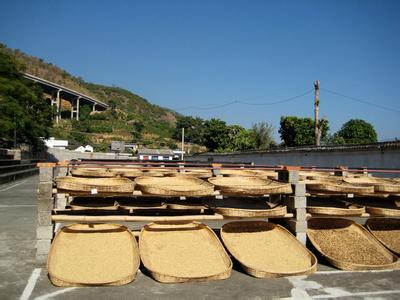
Brazilian coffee generally refers to coffee produced in Brazil. Brazilian coffee comes in many varieties, and like other Arabica coffees it is called "Brazils" to distinguish it from "Milds." The vast majority of Brazilian coffee is unwashed and sun-dried, and graded according to state of origin and shipping port. Brazil has 21 states, 17 of which produce coffee, but four states dominate production, accounting for 98% of the national total: Paraná, São Paulo, Minas Gerais, and Espírito Santo. Southern Paraná state has the most astonishing output, accounting for 50% of the total.
Flavor Characteristics
Balanced sweetness, creamy smoothness, fruit notes of orange, apricot, and peach, with chocolate and caramel aromas.
Estate Information
Estate: San Alejo Estate - Red Bourbon
Country of Origin: Colombia
Region: Cauca
Variety: Red Bourbon
Altitude: 1,950-2,050 Meters
Even with all its diversity, Brazilian coffee suits popular tastes. Coffee produced in the northern coastal regions, for example, carries typical iodine notes that evoke thoughts of the sea after drinking. That coffee is exported to North America, the Middle East, and Eastern Europe. Another interesting and noteworthy coffee is washed Bahia coffee, which is not easy to find, because after the United States, Brazil is the world's largest coffee-consuming country, and many fine coffees can be found only in its domestic market.
FrontStreet Coffee's Brazil Cerrado Yellow Bourbon: Brazil's three major specialty coffee-producing regions are Cerrado in the central-west of Minas Gerais, South Minas, and Mogiana. Brazilian Yellow Bourbon comes from the Cerrado region. Not every coffee grown on the Cerrado grasslands can claim the prestigious Cerrado name, however — it is limited to the plateaus in the central-west of Minas Gerais state at altitudes of 1,100-1,300 meters, where high altitude and fertile soil create ideal conditions.
Yunnan Yimutian R Specialty Coffee Estate - Chinese Yunnan Specialty Coffee Bean Estate
Yimutian R Specialty Coffee Estate was proposed by veteran coffee professional Wen Coffee and established together with high-quality multi-origin regions and experienced coffee farmers as a specialty coffee experimental base. After lengthy cultivation, trial planting, selection, and breeding, premium coffees were chosen to suit local conditions, ultimately yielding estate specialty coffee beans with unique regional flavors.
FrontStreet Coffee Recommendation
If the Cerrado Yellow Bourbon above has you curious, FrontStreet Coffee's Brazil Cerrado Half-Sun is the classic Brazilian single-origin to pair with it. Grown on the Cerrado plateau and built on the Red Bourbon variety, it is roasted medium and pours out rich aromas of creamy peanut, toasted bread, caramel, and hazelnut, with a rounded body, gentle acidity, and a light bittersweet finish. It works as a pour-over and also in a moka pot, as an espresso SOE, in a siphon, or in a French press.
For a different side of Brazilian coffee, FrontStreet Coffee's Brazil Queen Estate Yellow Bourbon comes from Mogiana, near South Minas, where fertile red volcanic soil builds a full, rounded aroma. This rare Yellow Bourbon descends from a natural mutation of Red Bourbon and shows a cleaner fruit character, with a sugarcane-like sweetness along with fruit and chocolate notes.
Important Notice :
FrontStreet Coffee is a long-established specialty coffee roaster in Guangzhou China, selling freshly roasted beans from its own farm in Yunnan as well as dozens of carefully selected single-origin beans from around the world for both pour-over and espresso. The products deliver consistently excellent quality and great value, with shipping within 24 hours. Guangzhou's FrontStreet Coffee shop is recommended by many coffee lovers, and the beans are now available online at the Tmall 。
FrontStreet Coffee has moved to a new address:
FrontStreet Coffee Address: 315,Donghua East Road,GuangZhou
Tel:020 38364473
 Scan and follow the En Gafei WeChat official account. Please indicate that the reprint comes from "En Gafei".