Panama Natural Coffee Beans: Flavor Profile, Processing Methods, Grinding Settings, Varieties and Brewing Guide
Speak from the heart and it is all true love. FrontStreet Coffee understands why Panamanian coffee is so desirable, and no variety illustrates that better than Geisha, a bean the coffee world pursues like a goddess. Panama is home to estates whose reputations circle the globe, and their high-quality Geisha lots command extraordinary prices, yet the passion of coffee lovers is undimmed and records keep falling. Today FrontStreet Coffee shares the story of an estate named after animals: Panama's Donkey Farm Estate.
Where Panama Coffee Grows
Panama is the southernmost country in Central America. The Caribbean Sea lies to its east, the Pacific Ocean to its west, Costa Rica to the north and Colombia to the south, making it an important isthmus between North and South America. Those geographic influences give Panama complex, varied microclimates, and those microclimates shape the distinctive flavors of Panamanian coffee.
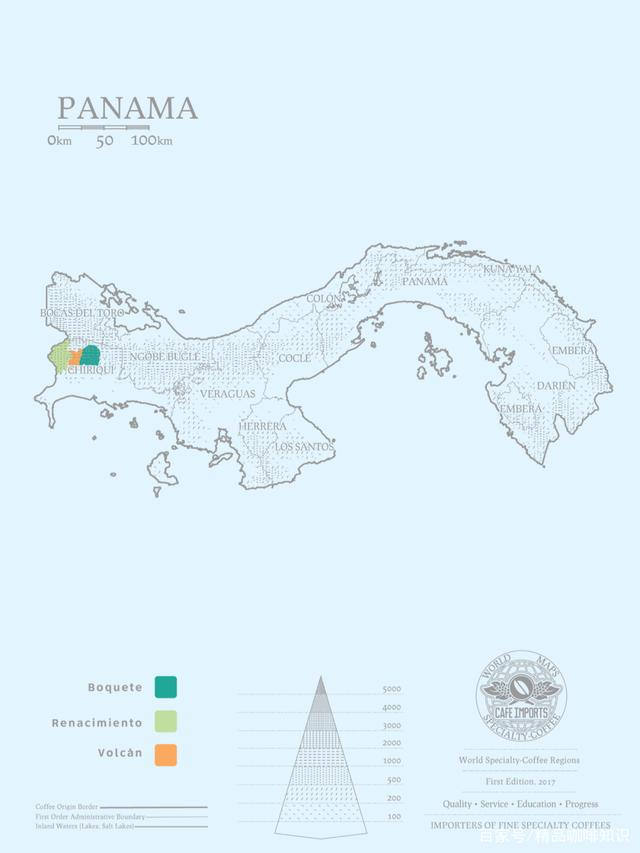
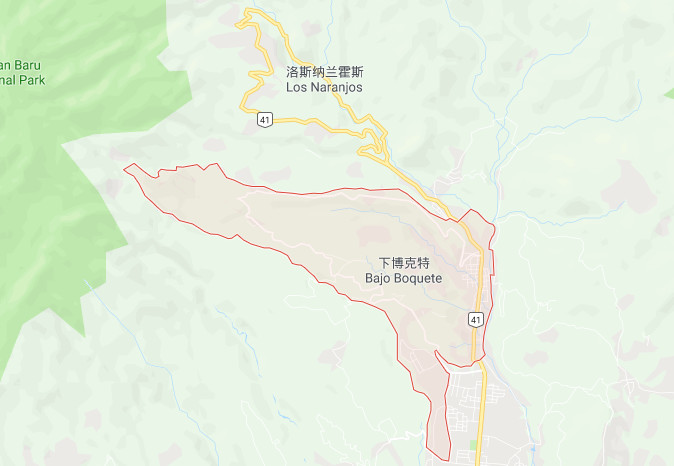
Panama's premium coffee grows in the west of the country, near Costa Rica and the Pacific Ocean. The most famous comes from the Boquete district of Chiriquí province, while Volcán and Santa Clara are also well known.
Other areas include the David, Renacimiento, Bugaba and Tolé districts. Only coffee grown between 1,300 and 1,500 meters is considered specialty coffee.
The Boquete Growing Region
Boquete is a town in Chiriquí province, close to the border between Panama and Costa Rica and near the famous Barú Volcano. The scenery is beautiful, the soil is fertile and rich, and the climate is ideal for producing high-quality coffee.
The microclimate of the Boquete highlands is a unique resource for the region's specialty coffee. Panama's east-to-west orientation funnels cold air currents through the central mountain range, where they converge above 6,500 feet and create a patchwork of microclimates around Boquete. Temperature and rainfall suit plant growth perfectly, so coffee trees planted here thrive.
The Story Behind Donkey Farm Estate
Donkey Farm Estate has a history of one hundred years. The land was previously used for raising livestock, so when the owner began planting coffee he named the estate after the donkeys. Its sister estate is the renowned Elida Estate.
Donkey Farm Estate sits in the Boquete region of Chiriquí province, Panama. It covers approximately 50 hectares: 20 hectares planted with Geisha and Catuaí, 10 hectares held as a reserved planting area, and the remainder protected forest inside Barú Volcano National Park. The altitude is about 1,700-1,800 meters. The terrain is steep, and numerous native tree species provide shade. Clouds and mist settle over the land for much of the year, effectively lengthening the coffee growth cycle. The soil is volcanic, high in potassium and phosphorus and rich in organic matter.
Perched on the southern slopes of Barú Volcano, Donkey Farm Estate draws on fertile, organic-rich soil, high elevation, steep terrain and year-round cloud cover to create the distinctive terroir of its coffee.
The estate's name may be humble, but its coffee is outstanding. In recent years Donkey Farm Estate has performed remarkably well at the Best of Panama (BOP) competition, raising its profile considerably.
In 2016, a barista from Maruyama Coffee won the Japan Barista Championship using Donkey Farm Estate's washed Geisha.

The Natural Process
Harvested coffee cherries go into large water tanks, where the ripe, full cherries sink to the bottom and floaters are skimmed off. The whole cherries, pulp, skin and parchment included, are then spread on drying patios and dried naturally to about 12% moisture content, which takes roughly two to four weeks. Finally a hulling machine removes the dry hard husk, pulp and parchment layer to reveal the green beans.
The Geisha Variety
The Geisha variety was discovered in the Geisha forest of Ethiopia in 1931 and later sent to the Coffee Research Institute in Kenya.
In 1936 it was introduced to Uganda and Tanzania.
In 1953 Costa Rica brought it in.
In 1960 Pachi Serracin, then owner of Panama's Torgi Estate, brought Geisha from Costa Rica to Panama. Later, Panama's Hacienda La Esmeralda separated it from other varieties and won the national coffee championship.
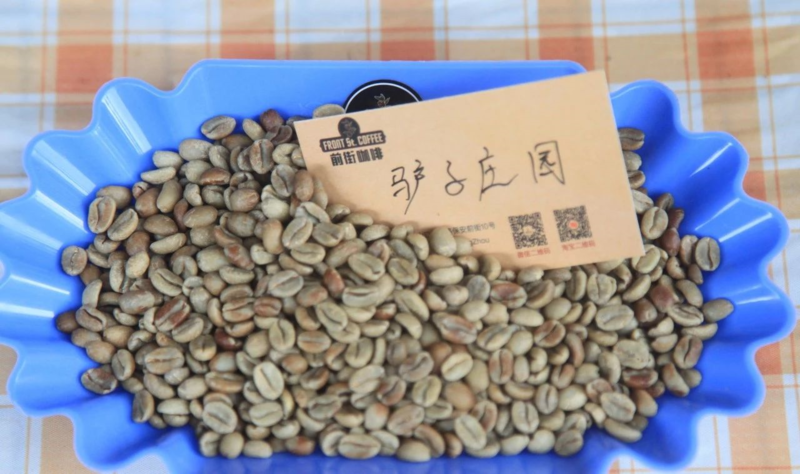
FrontStreet Coffee Panama Donkey Farm Natural
Country: Panama
Estate: Donkey Farm Estate
Region: Boquete
Variety: Geisha
Altitude: 1700-2000m
Processing: Natural Process
FrontStreet Coffee Roaster's Recommendations
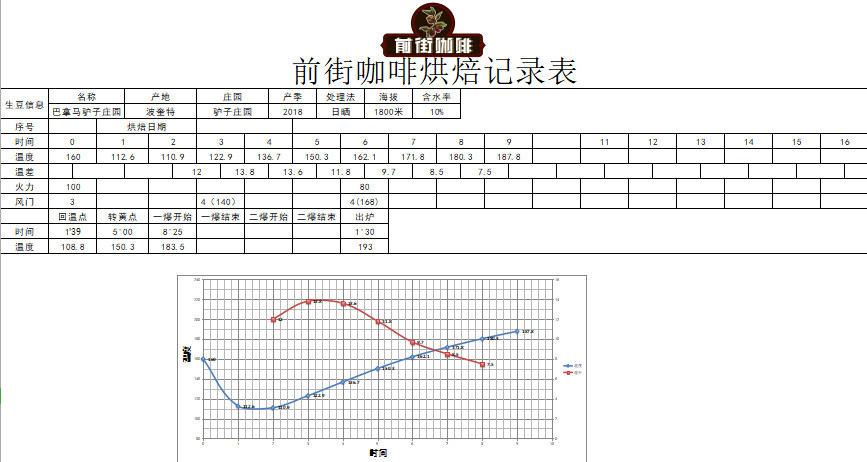
Roaster: Yangjia 800N
Charge at a roaster temperature of 160°C with the damper open to 3 and heat at 130. The temperature returns at 1'40"; when the roaster reaches 140°C, hold the heat and open the damper to 4. By this point the bean surface has turned yellow and the grassy smell has disappeared completely, marking the dehydration stage. When the roaster reaches 168°C, lower the heat to 80 and leave the damper unchanged.
At 7'50", ugly wrinkles and dark spots appear on the bean surface and the toast smell shifts clearly into coffee aroma, which can be read as the prelude to first crack. Listen carefully for the sound of first crack. At 8'25" first crack begins; reduce the heat to 50 and set the damper to 5, adjusting the heat very carefully so that it does not drop so low the crack sounds stop. Develop for 1'30" after first crack and discharge at 193°C.
FrontStreet Coffee Pour-over Recommendations
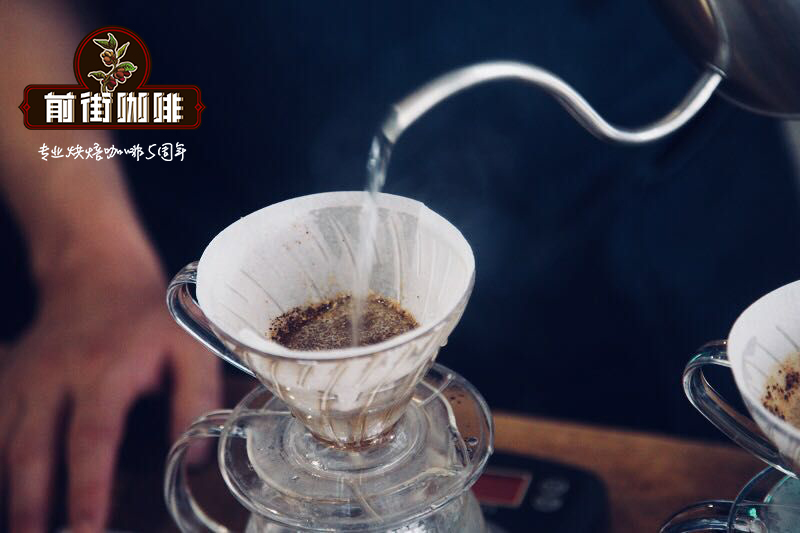
Filter: V60
Water Temperature: 91°C
Coffee-to-Water Ratio: 1:15
Grind Size: BG#6L

FrontStreet Coffee Brewing Technique
Brew with 30g of water for a 30-second bloom, then pour in stages up to 125g. When the water level drops and is about to expose the coffee bed, continue pouring to 225g and stop. When the level again drops to the point of exposing the bed, remove the filter cup. (Timing starts from the bloom.) Total extraction time is about two minutes.
Flavor Description
Ginger flower on the nose, with citrus, honey and berries on entry alongside a fermented wine aroma. As the cup cools, a pineapple-like sweetness gradually emerges, and the finish carries the sweet-and-sour character of sweet orange.
FrontStreet Coffee Recommendation
If this natural-processed Panamanian Geisha has you curious about the country's most celebrated variety, FrontStreet Coffee keeps a small range of Panamanian Geishas that make the style easy to explore. Newcomers are usually pointed to the FrontStreet Boquete Geisha first: an entry-level Geisha that lets you taste the orange-blossom honey sweetness and oolong-tea mouthfeel of a classic high-quality Panamanian Geisha, with delicate fruit acidity and clearly layered flavors at an approachable price.
From there, the Hacienda La Esmeralda line is the natural next step. The Red Label "Esmeralda Special" is drawn from single plots grown at 1,600-1,800 meters, with each lot cupping above 90 points; the Green Label "Private Collection" instead blends several plots into a more affordable expression of the estate's signature high-altitude Geisha character. Between them you can decide how far you want to travel into the top of the Panamanian Geisha pyramid.
Geisha is a medium-light, floral-and-fruit style with a dense bean that tends to sink and clog the drain hole, so FrontStreet Coffee suggests grinding to about 78% pass-through on a Chinese standard No. 20 sieve, roughly the size of fine granulated sugar, and brewing at 91°C. A 15g dose in a small Hario V60 at a 1:16 brew ratio works well. Use a three-stage pour: start the timer and add 30g of water for a 30-second bloom, then pour slowly in circles to 125g, wait for the bed to drain about halfway, and pour carefully in circles again to 225g. Once the bed has fully drained, total extraction lands at around 2:10 to 2:20.
Important Notice :
FrontStreet Coffee is a long-established specialty coffee roaster in Guangzhou China, selling freshly roasted beans from its own farm in Yunnan as well as dozens of carefully selected single-origin beans from around the world for both pour-over and espresso. The products deliver consistently excellent quality and great value, with shipping within 24 hours. Guangzhou's FrontStreet Coffee shop is recommended by many coffee lovers, and the beans are now available online at the Tmall 。
FrontStreet Coffee has moved to a new address:
FrontStreet Coffee Address: 315,Donghua East Road,GuangZhou
Tel:020 38364473
 Scan and follow the En Gafei WeChat official account. Please indicate that the reprint comes from "En Gafei".