What is the Best Grinding Setting for Dark Roast Espresso Coffee Beans - How to Brew Dark Roast Espresso Beans
What Is the Ideal Grind Setting for Dark Roast Espresso Coffee Beans?
For professional coffee knowledge exchange and more coffee bean information, please follow Coffee Workshop (WeChat public account: cafe_style).
Most espresso grinders have a mid-point that acts as a relative reference, and you can fine-tune from there to suit your needs. You should be able to find it easily on the adjustment dial.
For espresso, a single basket typically holds 8–10g of ground coffee, while a double basket generally takes 14–16g. No other brewing method calls for an espresso grinder. Manual grinders usually carry no markings, whereas electric grinders such as the widely used Small Eagle, Small Pegasus, and Zhengxing are far more common. As rough reference points, a siphon pot usually sits at setting 3, pour-over at 4–5 (the exact coarseness shifts with the dose), a French press at 5, and a moka pot at 2. These are relative values, so adjust them to your own taste and the condition of your grinder.
FrontStreet Coffee works with a Pegasus 800N espresso grinder. In practice, FrontStreet Coffee pulls espresso at a grind setting of around 2, but that number needs fine-tuning every day. Because so many variables are in play — how much the beans have degassed, the humidity, fluctuations in machine pressure — the grind setting is never fixed.
Why Adjust the Grinder's Grind Setting?
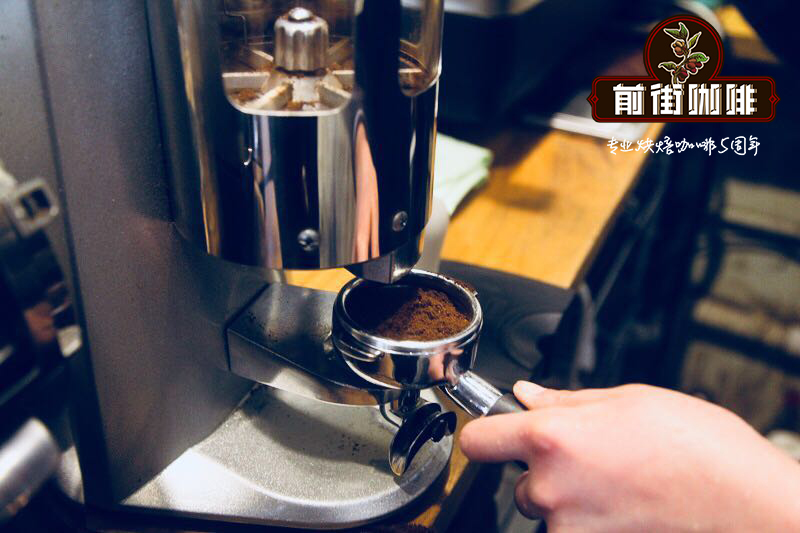
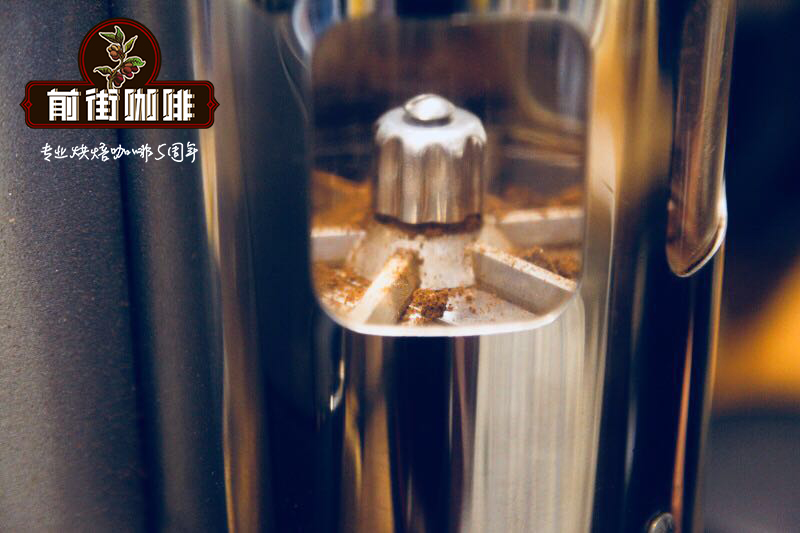
When beans enter the grinder, the burrs crush them into powder. The narrower the gap between the burrs, the finer the particles. Finer grounds pack together more tightly, making it harder for water to push through and therefore stretching the extraction time considerably. Widen the gap, on the other hand, and the particles grow coarser, so water flows through more freely and extraction speeds up. A simple way to picture it: water races through a bed of rocks far faster than through fine sand, because there is far more open space between rocks. Correct grinding matters enormously, because particle size has a direct effect on extraction quality.
In FrontStreet Coffee's view, espresso extraction is handled mainly by the machine. Pressure, water temperature, and other machine parameters are fixed. What a person can control is the grind setting, the dose, the distribution and leveling of the grounds, the tamp, and — of course — the extraction time.
FrontStreet Coffee's Approach to Adjusting the Grinder
Taking FrontStreet Coffee's "Premium Blend" as an example, FrontStreet Coffee doses 13–14g in a single basket and 20–21g in a double basket (the exact amount should be set by your basket's capacity). The coffee-to-water ratio runs 1:1.5 for a single shot and 1:2 for a double, with extraction time held between 25 and 30 seconds.
On dosing, a siphon typically uses 10–12g per serving, pour-over uses 12–15g per serving plus an extra 8–10g for each additional cup, a moka pot should be filled to 80–90% of capacity, and a French press generally uses 10g per serving. Water temperature, grind coarseness, brewing time, dose, and roast level can all be treated as variables within a certain range. Each parameter leaves room to adjust, but change one and you must adjust the others to match. So if you truly want to master brewing, you can only lean on accumulated experience — no formula turns you into a barista overnight.
Pour-over kettles, French presses, and American drip coffee makers generally call for medium-coarse particles (settings 7–6). Siphon pots and Belgian royal pots typically want a medium grind (settings 6–4). Aeropress and moka pots generally take medium-fine particles (settings 4–3). Espresso machines and cold drip towers usually require a fine grind (settings 3–2). Turkish coffee pots generally call for an extra-fine grind (setting 1). As a visual guide: medium-coarse and coarse particles resemble sugar granules; medium and medium-fine particles look like sea salt; medium-fine and fine particles have the texture of flour but feel sandy; and extra-fine particles are like flour with no noticeable grit.
FrontStreet Coffee Recommendation
If you're dialing in a dark roast for espresso, FrontStreet's Classic Blend is a natural place to start. Built on the traditional Mamba recipe and designed for both espresso machines and moka pots, it pulls a thick, velvety crema even on a modest home setup — the same rich body that makes lattes, cappuccinos, and Dirty drinks possible. Because it stays full and mellow across a range of settings, it gives you room to fine-tune without losing the shot.
For a single-origin option with the same dark-roast character, try FrontStreet's PWN Indonesian Golden Mandheling. Deep-roasted for very low acidity, it delivers a full, lingering body layered with herbal and dark chocolate notes and a faint earthy undertone — a forgiving bean for anyone who prefers a heavier cup to a bright one.
Important Notice :
FrontStreet Coffee is a long-established specialty coffee roaster in Guangzhou China, selling freshly roasted beans from its own farm in Yunnan as well as dozens of carefully selected single-origin beans from around the world for both pour-over and espresso. The products deliver consistently excellent quality and great value, with shipping within 24 hours. Guangzhou's FrontStreet Coffee shop is recommended by many coffee lovers, and the beans are now available online at the Tmall 。
FrontStreet Coffee has moved to a new address:
FrontStreet Coffee Address: 315,Donghua East Road,GuangZhou
Tel:020 38364473
 Scan and follow the En Gafei WeChat official account. Please indicate that the reprint comes from "En Gafei".