How Many Years for Yunnan Coffee Trees from Planting to Fruiting - Annual Yield of One Coffee Tree
Coffee, as an agricultural crop, follows its own annual fruiting cycle. How many years does it take from planting a coffee bean to harvesting fruit? And how much coffee can a single tree produce in a year? FrontStreet Coffee answers both questions from our experience growing Typica in Baoshan, Yunnan.
How Long Do Yunnan Coffee Trees Take to Bloom and Bear Fruit?
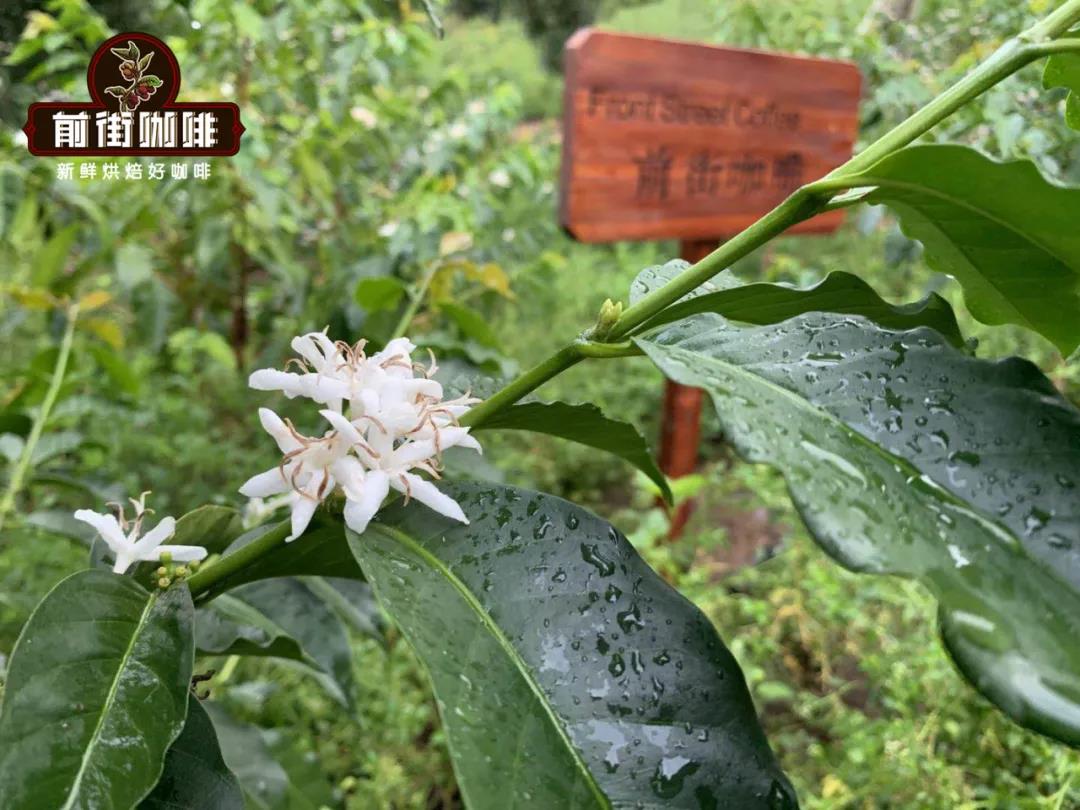
Based on FrontStreet Coffee's observations, coffee trees typically flower for the first time at around three years of age. The white, five-petaled tubular flowers carry a faint jasmine fragrance, their dense inflorescences arranged in clusters. The petals wither within two to three days, and several months later fruit forms. The fruit is a drupe about 1.5 centimeters in diameter — green at first, gradually turning yellow, and finally red when ripe, much like a cherry. Hence the name "coffee cherry"; it can be harvested as soon as it ripens.
Coffee beans are actually the two seeds inside the fruit. They stand upright, joined face-to-face along their flat sides. Each bean is wrapped in a thin membrane called silver skin, covered by a yellow outer layer called parchment. Around all of that sits a mucilaginous pulp — the soft, sweet coffee flesh — with the husk as the outermost layer.
How Much Coffee Can One Tree Produce in a Year?
Annual yield depends mainly on variety and growing conditions. In FrontStreet Coffee's growing region in Yunnan, coffee trees fruit just once a year. Catimor, which tolerates dense planting, can be grown at about 330 trees per mu (approximately 667 square meters), and one mu generally produces about 300kg of coffee beans — meaning a single Catimor tree yields roughly 0.9kg of beans per year.
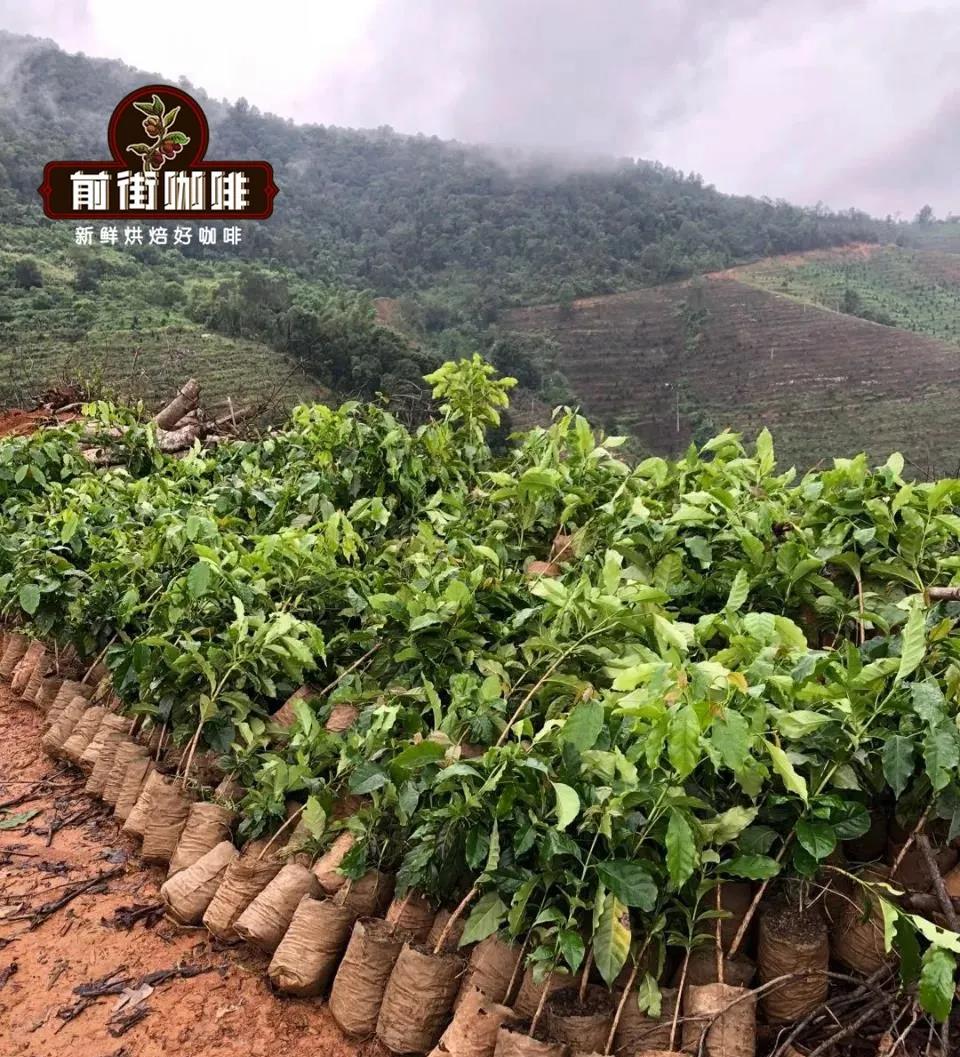
Typica is a different story. Its main vertical trunk can reach 5 meters, which means the spacing between branches — and between nodes on the same branch — is longer than in other varieties. Only about 100 trees fit per mu, with an approximate yield of 100kg per mu. A single Typica tree therefore produces only about 1kg of coffee beans per year.
The most widely planted single-origin coffee in Yunnan is Catimor — what the market usually sells as Yunnan small-bean single-origin coffee. The variety yields heavily and is easy to grow, but its flavor cannot match Typica. That is why FrontStreet Coffee grows primarily Typica in Baoshan, Yunnan, to bring you the best-tasting Yunnan beans.
Typica is also the oldest original Arabica variety in the coffee market, and nearly every Arabica variety traces back to it. Typica's flavor is elegant; its weakness is a fragile constitution, low disease resistance, and susceptibility to leaf rust.
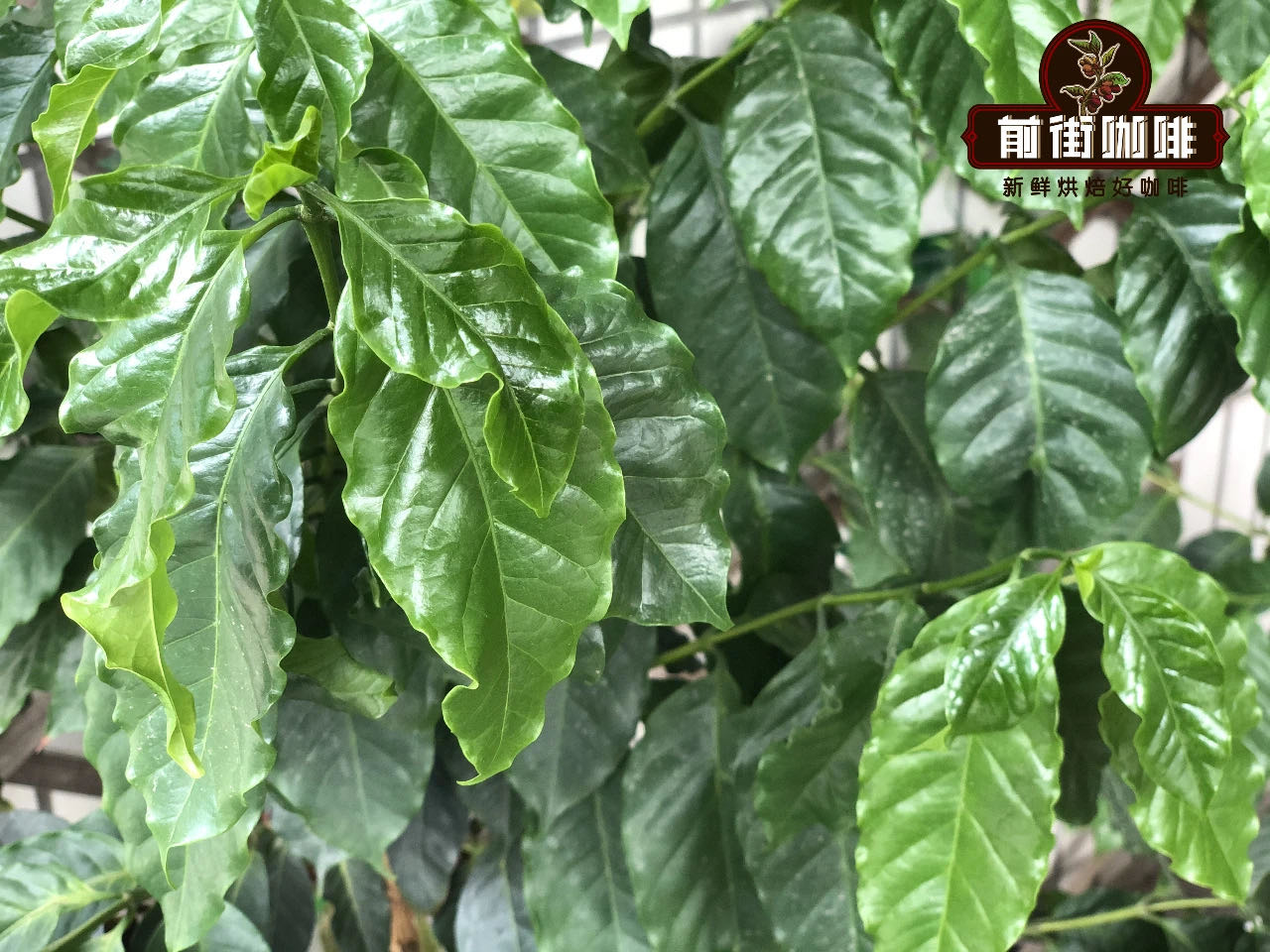
Because of those low yields, Typica struggles to pay for itself. In recent years it has gradually been replaced by Caturra and Catuai in Central and South America — one reason Typica is becoming ever rarer. Despite its elegant flavor, it is not as popular as Bourbon.
The earliest variety planted in Yunnan's coffee regions was also Typica.
That history goes back to the early 20th century, when foreign missionaries planted coffee in Yunnan for their own consumption. Large-scale production began in the 1950s, aimed at export to the Soviet Union. Weighing Yunnan's growing environment and quality goals, coffee agronomists of the time designated Typica as the main planting variety.
But as noted above, Typica yields little, falls ill easily, and demands strict altitude conditions — so per-tree output was very low. Worse, Yunnan's farmers of that era lacked the specialty-coffee awareness to pick only fully ripe cherries, so harvest quality was inconsistent. Farmers consequently turned to Catimor: easy to plant, high survival rates, high yields.
Catimor is a hybrid of Arabica and Robusta. Robusta resists leaf rust well, carries rich oils, yields heavily, and is easy to cultivate. After hybridizing with Typica (an Arabica), Catimor acquired 25% Robusta genes — improving its rust resistance, retaining the rich oil content, and keeping some of Typica's original flavor richness.
That is one reason Catimor is still widely planted across Yunnan. Even so, FrontStreet Coffee chooses to grow primarily Typica on its estates, because changing Yunnan coffee's flavor profile has to start at the root. Right now, Yunnan coffee leans heavily on specialty processing methods to quickly patch over undesirable flavors, which has fixed in consumers' minds the idea that "only specially processed Yunnan coffee is drinkable." As we said, Typica offers a uniquely subtle, clean flavor with balanced character and high clarity — something processing tricks cannot conjure. After all, whether a bean tastes good ultimately comes down to the variety; specialty processing is not a long-term solution.
Yunnan Coffee Growing Region: Baoshan
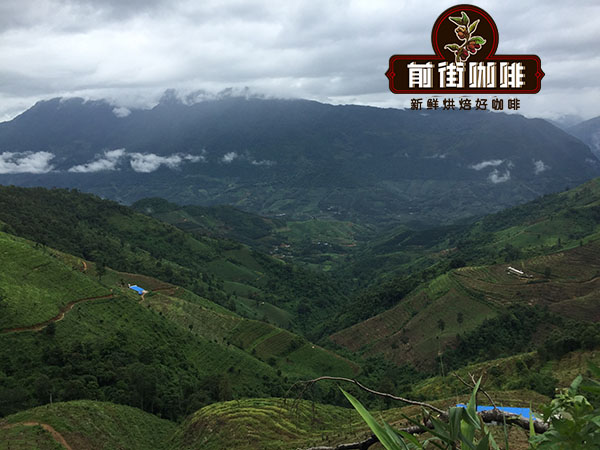
FrontStreet Coffee's decision to plant Typica in Baoshan was no accident. Baoshan's coffee history stretches back to the mid-1950s, when the first seedling was brought from Southeast Asia by the late patriotic overseas Chinese Mr. Liang Jinshan.
In recent years, as international trade expanded, Lujiangba's small-bean coffee has become renowned. Merchants from Europe, America, and the Arab world — especially Britain, the United States, Egypt, Hong Kong, and Macao — regard it as premium coffee, with demand outstripping supply. In December 2010, after review by China's General Administration of Quality Supervision, Inspection and Quarantine, "Baoshan Small-Bean Coffee" received national geographical indication product protection.
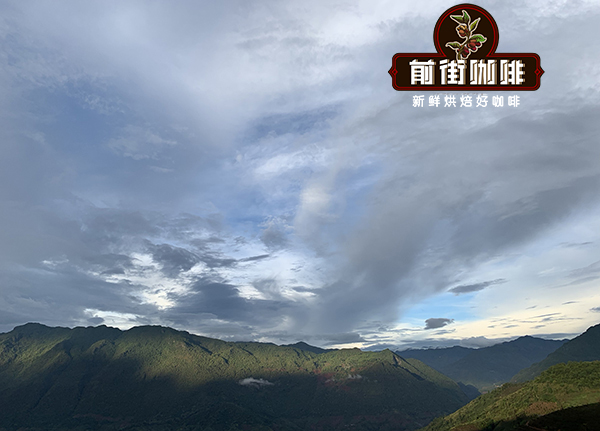
FrontStreet Coffee plants its coffee at the border of Yunnan's Baoshan and Myanmar because Baoshan's average temperature is 21.5°C (with a maximum of 40.4°C) and it is essentially frost-free year-round — a recognized optimal region for small-bean coffee. The coffee grown here is famous at home and abroad for being strong but not bitter, fragrant but not intense, with small, uniform beans, a rich mellow aroma, and fruity notes.
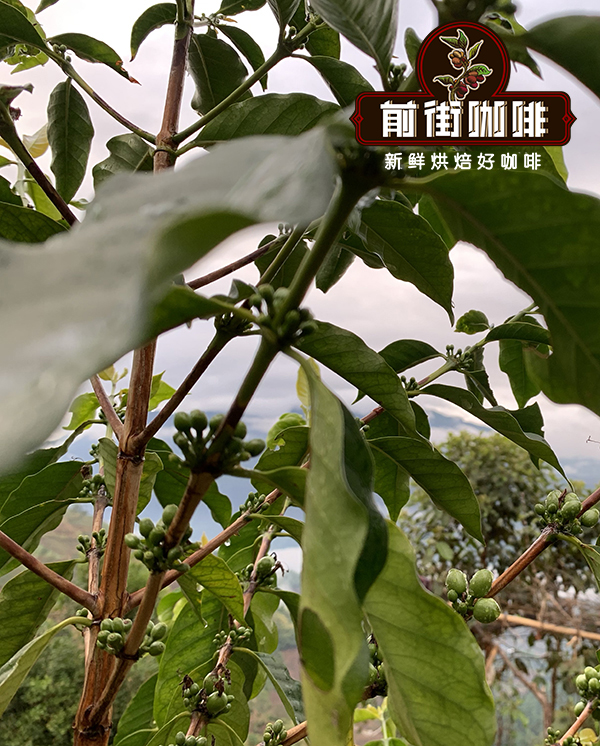
Which means that even the easy-to-grow Catimor shows excellent flavor here — let alone the higher-quality Typica.
That covers how many years Yunnan coffee trees take from planting to fruiting and how much one tree yields annually. Next, FrontStreet Coffee shares the flavor differences between Yunnan Catimor and Typica single-origin beans.
FrontStreet Coffee Yunnan Flower-Fruit Mountain Coffee Beans
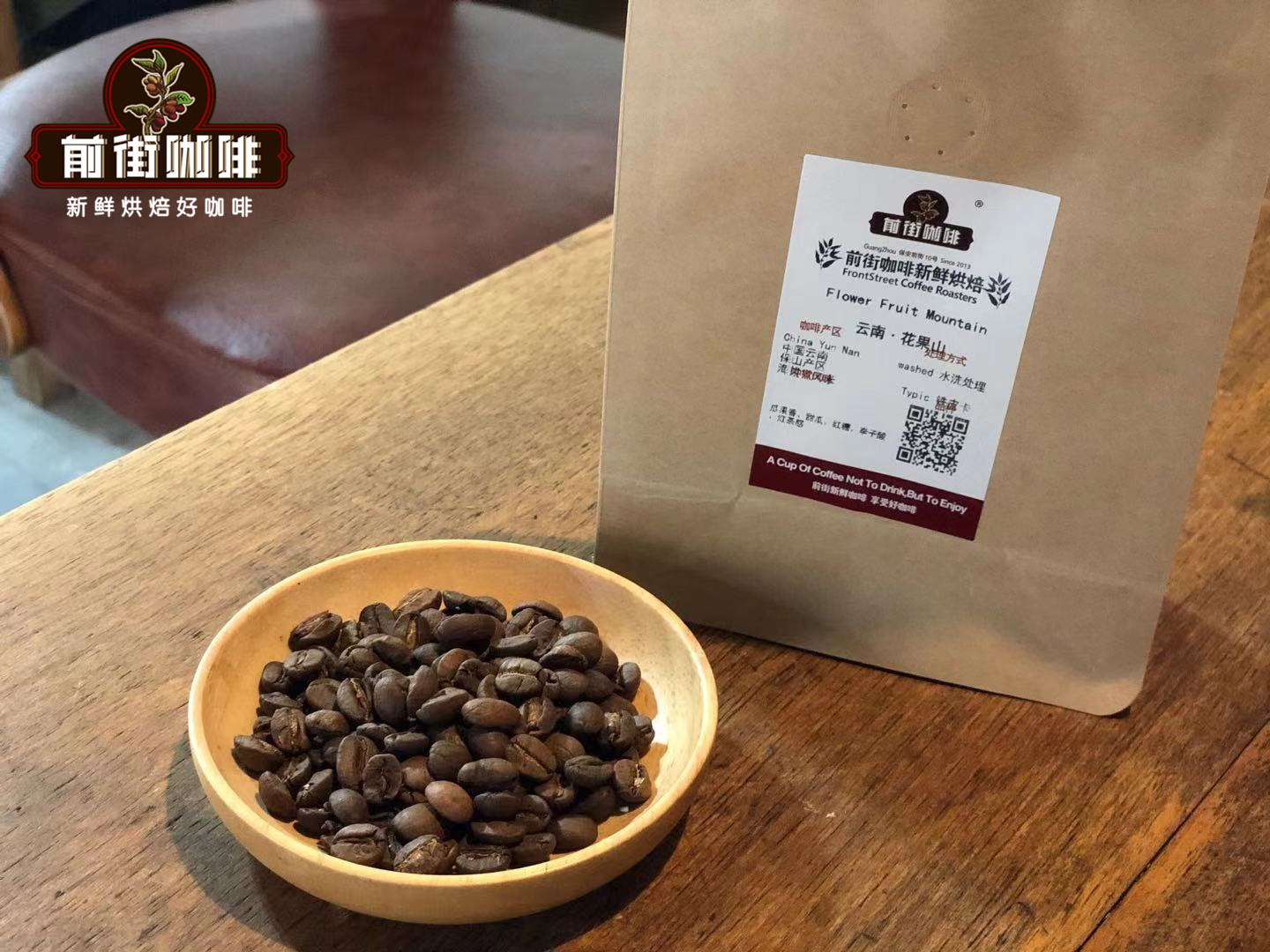
Country: China
Region: Baoshan, Yunnan
Altitude: 1450-1550m
Variety: Typica
Processing: Washed
Flavor: Citrus, nuts, plum, melon fragrance, brown sugar, black tea sensation
The difference between FrontStreet Coffee's Yunnan Flower-Fruit Mountain beans and Yunnan small-bean coffee is the variety: Flower-Fruit Mountain is Typica, while Yunnan small-bean is Catimor. Both can technically be called small-bean coffee, but because Typica's floral and fruity acidity is mellower and richer, we gave it its own name to distinguish the two.
FrontStreet Coffee Yunnan Small-Bean Coffee (Daily Coffee)
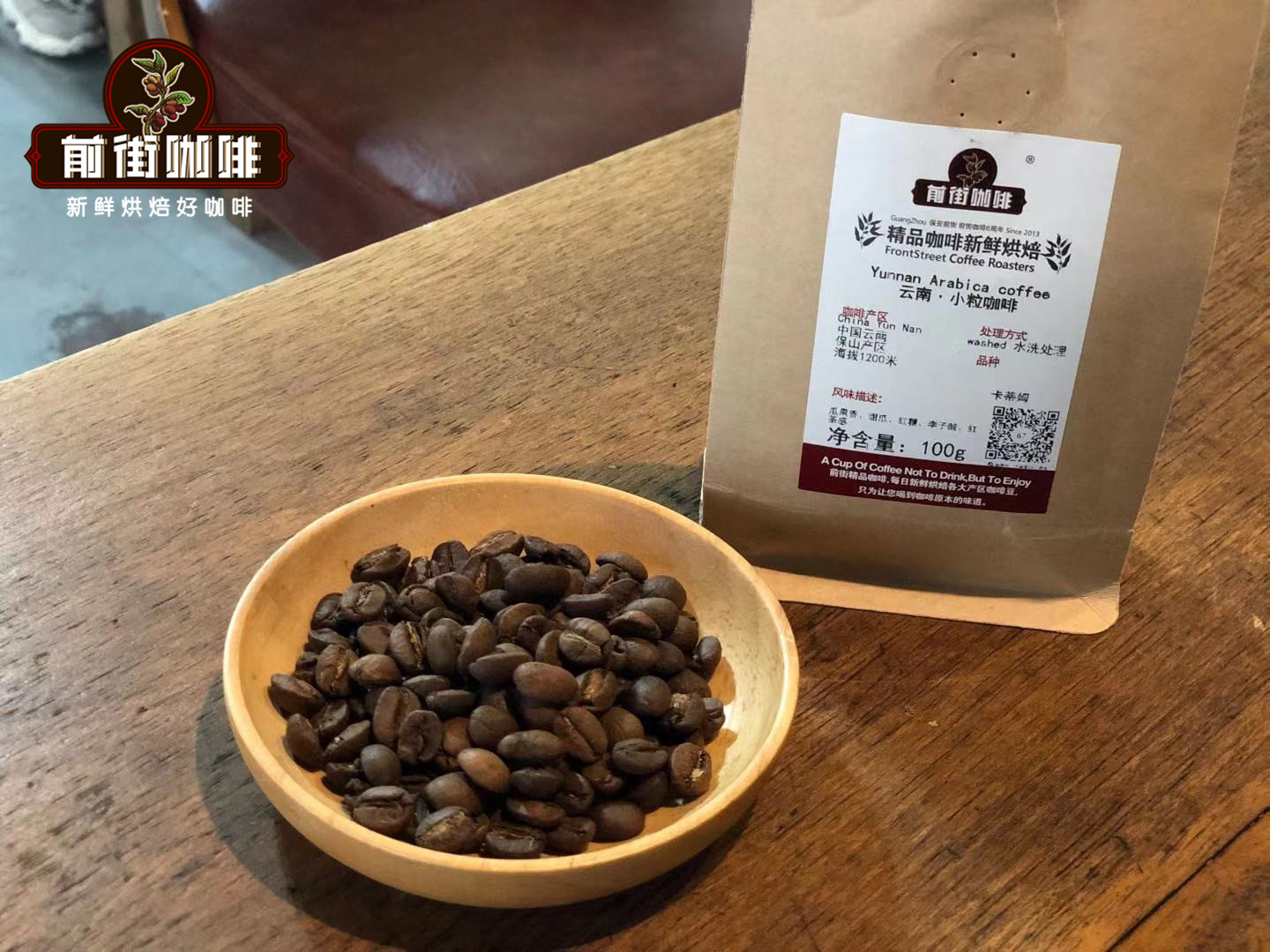
Country: China
Region: Baoshan, Yunnan
Altitude: 1200m
Variety: Catimor
Processing: Washed
Flavor: Herbal, nutty aroma, chocolate, caramel
Yunnan small-bean coffee refers to small-bean coffee cultivated in the Yunnan region. Coffee is an evergreen small tree of the Rubiaceae family, native to Africa; the main coffee plants grown as beverage crops today are small-bean (Arabica) and medium-bean (Robusta) coffee. The small-bean coffee traditionally cultivated in China's Yunnan specifically refers to a mixed population of Bourbon and Typica variants.
FrontStreet Coffee Yunnan Coffee Bean Pour-Over Recommendations
Since both beans come from Yunnan and are medium-roasted, FrontStreet Coffee recommends a V60 conical dripper. The V60's large opening and unique spiral rib design let air escape easily, improving extraction quality. The body may not be the richest, but the high concentration brings out Yunnan coffee's fruity acidity and distinct aromatics — its defining trait.
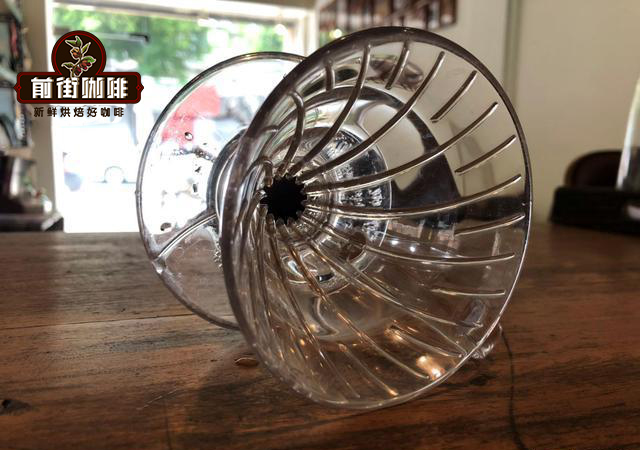
Dripper: V60
Water temperature: 90-92°C
Ratio: 1:15
Grind size: medium-fine, similar to granulated sugar (VARIO 5O: 57% pass rate on the China standard #20 sieve)
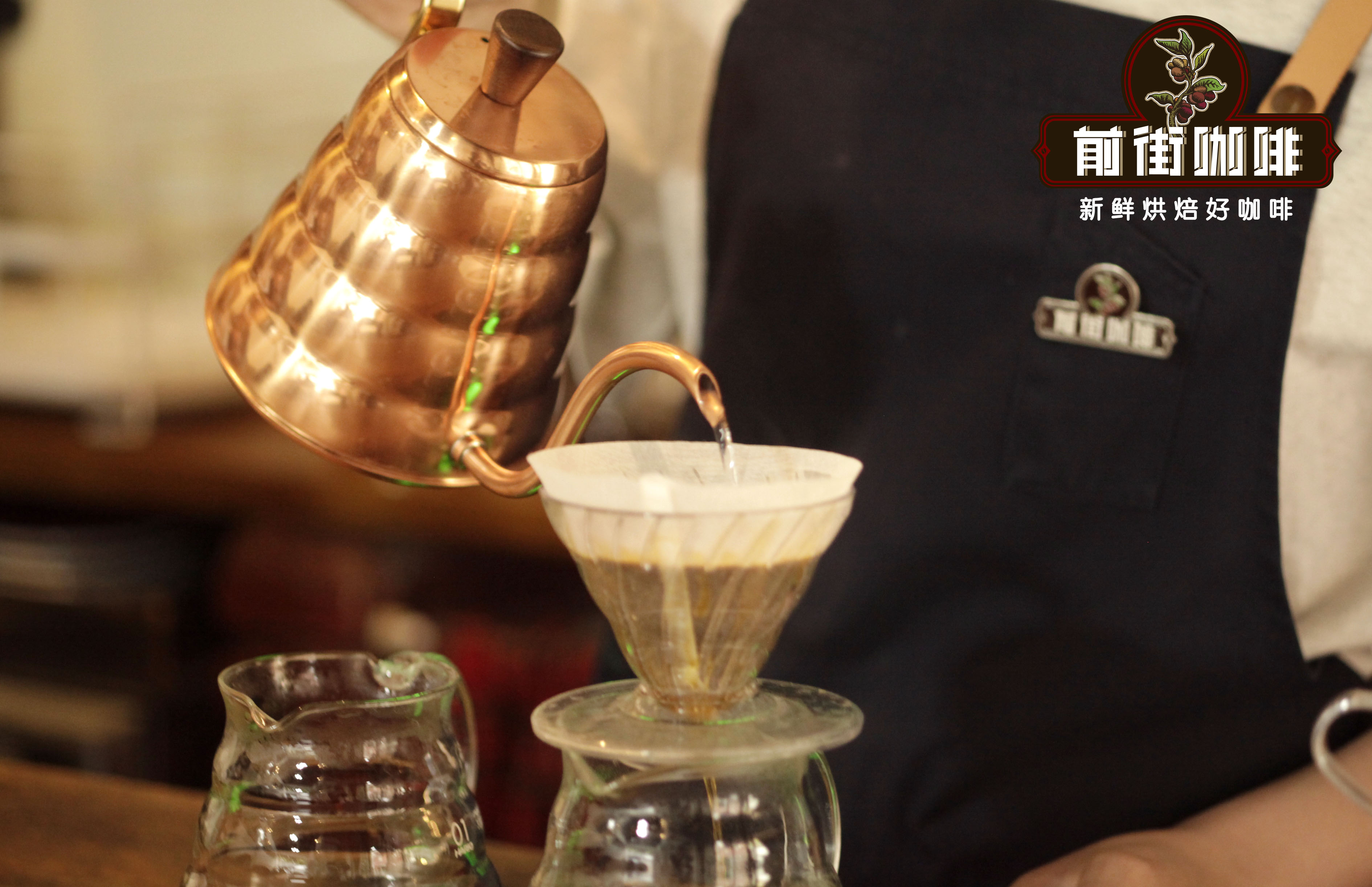
Brewing method: segmented extraction.
Pour 30g of water for a 30-second bloom, then pour in small circles up to 124g before pausing. When the water level drops and the coffee bed is about to be exposed, pour up to 227g and stop. When the bed is about to break the surface again, remove the dripper. Extraction time is 2 minutes (timed from the start of blooming).
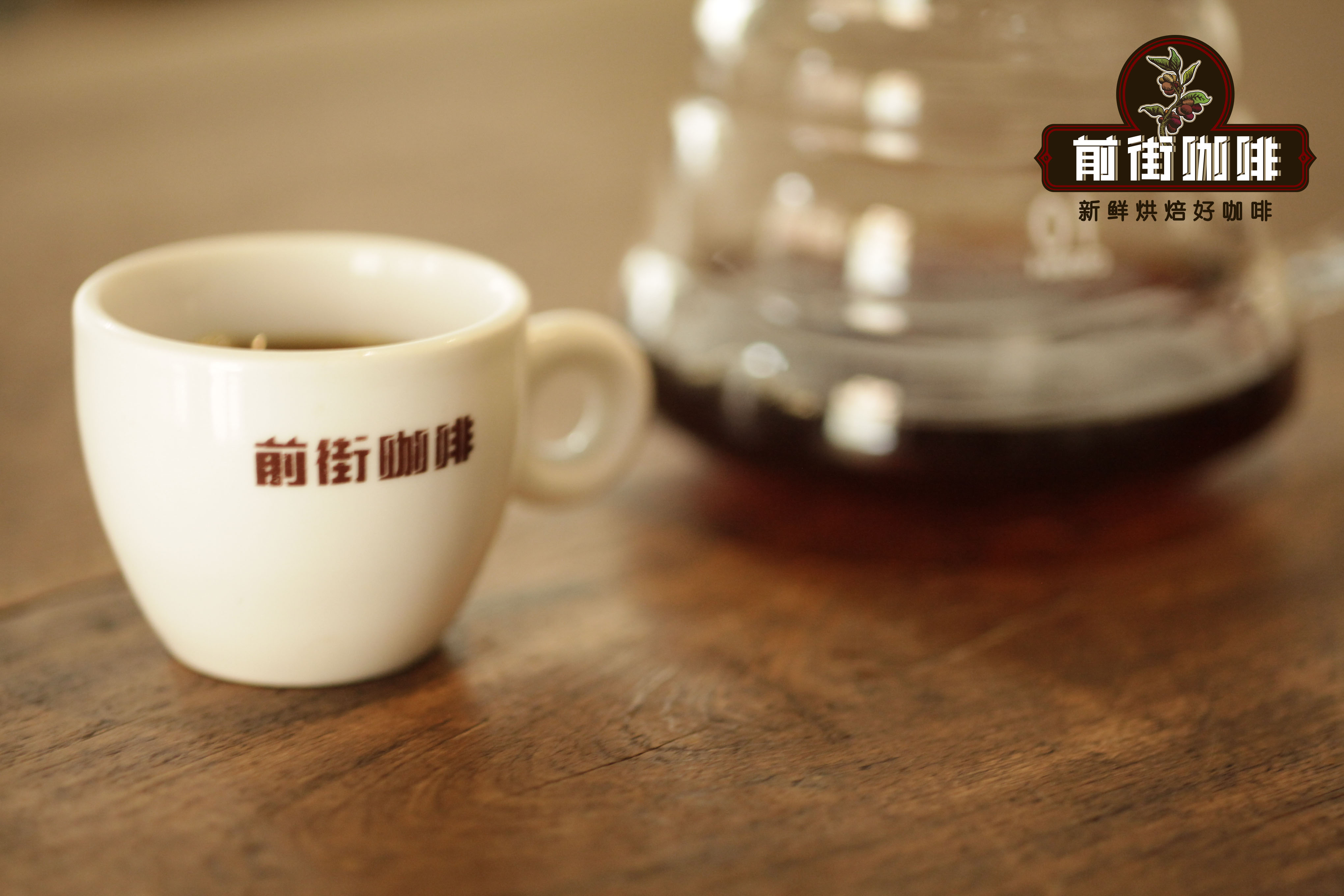
Flower-Fruit Mountain brewed: strong but not bitter, fragrant but not intense, with floral notes, cantaloupe sweetness through the mid-palate, and a black-tea finish.
Yunnan small-bean brewed: a smooth entry with an Asian herbal aroma, lively bright acidity that makes both cheeks water, soft acidity balanced against good body, rich layers, and distinct dark chocolate, honey, and cane sugar in the aftertaste — turning to brown sugar as the cup cools completely.
FrontStreet Coffee Recommendation
Both of the beans featured here come from Baoshan, a region whose coffee heritage reaches back to the mid-1950s and Mr. Liang Jinshan's first seedlings, and whose Lujiangba small-bean coffee earned national geographical indication protection in December 2010. If you want the affordable everyday option, the FrontStreet Yunnan Small-Bean (Catimor, washed, grown at 1200m) delivers herbal, nutty aromatics with chocolate and caramel — smooth, layered, and remarkably balanced in the cup.
If you want to taste what Yunnan can really do, choose the Flower-Fruit Mountain Typica, grown at 1450-1550m and washed: its mellower floral-fruity acidity unfolds as citrus, plum, and melon fragrance over brown sugar sweetness, finishing on a long black-tea note. Brew either one on a V60 at a 1:15 ratio with 90-92°C water and a granulated-sugar grind: bloom with 30g for 30 seconds, pour to 124g, then finish to 227g, with total extraction around 2 minutes — and see for yourself how far a Yunnan bean has come.
Important Notice :
FrontStreet Coffee is a long-established specialty coffee roaster in Guangzhou China, selling freshly roasted beans from its own farm in Yunnan as well as dozens of carefully selected single-origin beans from around the world for both pour-over and espresso. The products deliver consistently excellent quality and great value, with shipping within 24 hours. Guangzhou's FrontStreet Coffee shop is recommended by many coffee lovers, and the beans are now available online at the Tmall 。
FrontStreet Coffee has moved to a new address:
FrontStreet Coffee Address: 315,Donghua East Road,GuangZhou
Tel:020 38364473
 Scan and follow the En Gafei WeChat official account. Please indicate that the reprint comes from "En Gafei".