Flavor Description and Variety Introduction of Panama Hartmann Estate Red Wine Natural Process Long-tailed Cuckoo Coffee Beans
Panama Hartmann Estate Red Wine Natural Process Long-Tailed Cuckoo Coffee Bean Flavor Description and Variety Introduction
In Boquete's exceptional growing environment, there is naturally more than just the king of coffees like Emerald's Geisha, with its impressive flavor, quality, and value. Still, drinking Geisha every day would be extravagant, and even if you could afford it, treating it like shark fin and bear paw daily wouldn't be right. Coffee is the same — exploring broadly is what makes tasting truly enjoyable. There are many washed methods, but they generally follow the same steps: after harvesting, floating beans are removed, the pulp is taken off, and the beans are soaked in fermentation tanks. Enzymes in the water soften the mucilage clinging to the parchment while natural yeast breaks down the sugars in the mucilage — that is fermentation. Once it finishes, the beans move to drying patios, where constant turning ensures even drying. Finally they are stored in parchment until green bean buyers order, at which point they're hulled and bagged. Coffee processed this way yields a clean cup with bright, lively fruit acidity and clear fruit and floral notes.
01 | Growing Region Overview
One of the most important reasons for Panama's unique coffee quality is its microclimate. Panama borders Costa Rica and Colombia, and its east-west layout lets cold air flow through the central mountains and converge above 6,500 feet, creating a very distinctive microclimate in the Boquete and Volcán Candela areas, Panama's main coffee-producing region. The surrounding land is nutrient-rich, and these fertile soils provide ideal growing conditions, shaping many distinctive, high-quality coffees.
Hartmann Estate
The founder of Hartmann Estate, Mr. Alois St. Hartmann, was born in Czechoslovakia in 1891. Because of war, he later emigrated to the United States for his education. At age 20 he traveled to Panama and was deeply drawn to the place, finally settling in Chiriquí and establishing what became Hartmann Estate.
Today the estate is run by the family's third generation. Mr. Ratibor Hartmann and his four siblings each take on different roles; they live together on the estate and make their living from growing coffee.
The Hartmann family also manages and processes coffee for many Panamanian estates, such as the consistent Best of Panama winner Finca La Mula and other 90+ estates in Panama, all under Hartmann family management. Although the estate keeps a low profile and rarely appears in Best of Panama competitions, its coffee ranks among Panama's finest. The family's contribution to Panama's coffee reputation today cannot be overstated.
Panama Hartmann Red Wine
2016 Panama Hartmann Estate Refined Red Wine Style Honey Process Coffee
- Origin: Boquete, Panama
- Variety: Catuai
- Processor: Hartmann
- Altitude: 1450-2000 meters
- Processing Method: Wine Process
- Flavor: Ripe berries, red wine fermentation aroma, honey sweetness
02 | Processing Method
In 2015, WBC competitor Sasa introduced a Colombian coffee processed in a way similar to red wine fermentation. Beyond the novel taste of the beans, the "Red Wine Processing" method used to treat them sparked curiosity among editors and coffee lovers alike. What exactly is this so-called "Red Wine Processing"?
Coffee Bean Red Wine Processing
Also known as wine-style processing, this method draws on red wine fermentation techniques. So far, only eight estates in Colombia have successfully brought coffee processed this way to market. Based on information from those eight estates, red wine processing can be broadly grouped into acetic fermentation (aerobic), lactic fermentation (anaerobic), and mixed fermentation (aerobic + anaerobic).
Traditional methods struggle to control the variable degree of fermentation in coffee. Red wine processing, by contrast, can safeguard quality by controlling pH — even temperature and humidity — while sealed fermentation keeps aromatic compounds from volatilizing easily.
Now the specific fermentation process. First, farmers carefully harvest and meticulously select red coffee fruit, ensuring that among the cherries selected for processing, unripe cherries are under 2%, defective beans under 3%, and floating beans under 5%.
The selected cherries are placed in specific containers fitted with devices like red wine fermentation locks or one-way exhaust valves. This lets carbon dioxide escape through the device, controlling the air concentration in the container. At this point the cherries undergo acetic fermentation, and the resulting beans have relatively bright, clean flavors with lemon acidity.
According to Sasa's competition description, processors inject carbon dioxide into the container to prevent oxidation from forming volatile acids. This is lactic fermentation, which produces malic and tartaric acid. Since tartaric acid is relatively stable, beans from lactic fermentation have mellower acidity with cheese, nut, and cream flavors.
03 | Green Bean Analysis
The Resilient Catuai
Hartmann Estate grows a wide range of coffee types: Typica, Caturra, Catuai, Bourbon, Pacamara, Maragogipe, and Geisha. The variety we're introducing today is the resilient Catuai.
Catuai is a variety artificially hybridized from Caturra and Mundo Novo. It resists natural disasters — especially wind and rain — well. Catuai trees grow relatively low. Compared with other coffee trees, Catuai fruit holds on more firmly and is not easy to harvest. The fruit comes in red and yellow forms. To date, no superior taste has been found in yellow fruit over red; in fact, some cuppers have found that while coffee from some yellow fruit has good acidity, its clean cup quality is inferior to that from red fruit.
04 | Roasting Analysis
This coffee is best roasted with a medium-slow method to highlight its round, smooth character while preserving rich red wine fruit aromas.
Roaster: Yangjia 600g Semi-Hot Air
Preheat the roaster to 200°C and set the damper to 3.5. After 1 minute, reduce heat to 170°C, damper unchanged. Temperature recovery point at 1'39''. When the drum temperature reaches 145°C, adjust the heat once; at this point the bean surface turns yellow and the grassy aroma disappears completely, marking the end of dehydration. Set the heat to 130°C, damper unchanged.
At 7'50'', ugly wrinkles and dark spots appear on the bean surface, and the toast aroma clearly turns to coffee aroma — the prelude to first crack. Adjust the heat to 80°C. Now listen carefully for the sound of first crack. First crack begins at 8'43''; reduce heat to 60°C and open the damper fully to 5 (heat adjustments must be made very carefully — not so low that cracking stops). 1'43'' after first crack, discharge at 195.5°C.
Cupping:
- Dry Aroma: Ripe orange, jasmine hints
- Wet Aroma: Winey, honey-like
- Flavor: Smooth entry, lively and bright acidity, soft and richly layered, with a red wine aftertaste and evident honey and sucrose flavors. After the cup cools fully, brown sugar flavors emerge.
05 | Brewing Analysis
Recommended Brewing Methods: Siphon, Pour-over
- Grind Size: 3.5 (Japanese Fuji R440)
- Water Temperature: 90°C
V60 dripper, 15g of coffee, 90°C water, grind size 4, water-to-coffee ratio close to 1:15
30g of water for the bloom, bloom time 30s
Stages: pour to 110ml, pause, then slowly pour to 225ml
That is: 30-80-105
Other Drip Extraction Recommendations:
- French Press: Recommend grind size 3.5-4, water temperature 90°C
- Aeropress: Recommend grind size 2.5, water temperature 88°C
- Pour-over: Grind size 3.5, water temperature 89°C
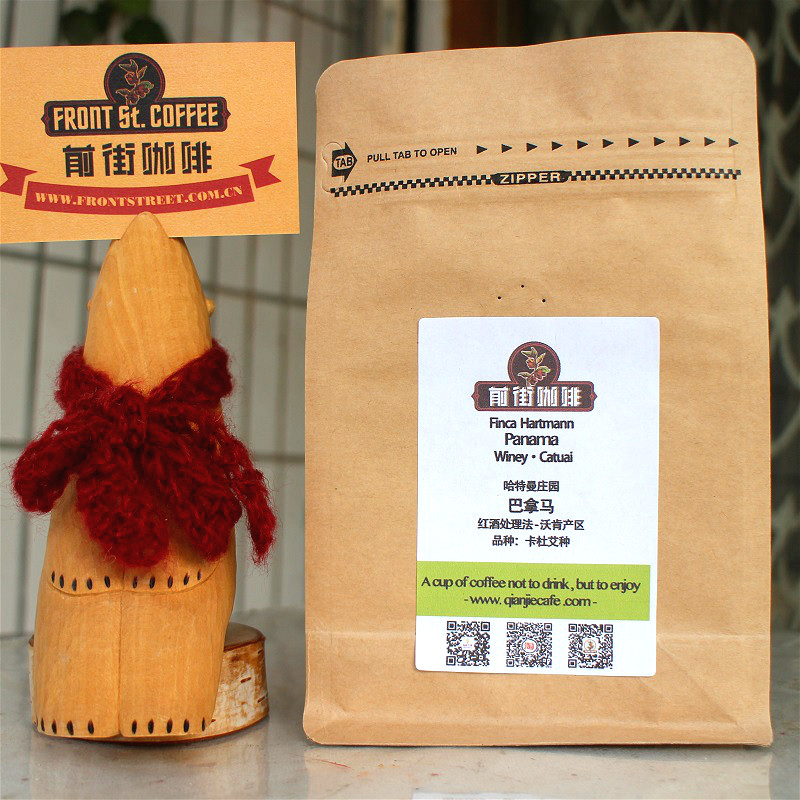
FrontStreet Coffee's roasted Hartmann Estate Red Wine Process beans offer full assurance in both brand and quality. More importantly, they offer exceptional value — each 227-gram package costs only 85 yuan. At 15g of beans per cup, one package makes 15 cups, so each cup costs only about 6 yuan. Compared with café prices that often run to tens of yuan per cup, this is a genuinely conscientious recommendation.

FrontStreet Coffee Recommendation
If Hartmann's wine-processed Panama character has you exploring Boquete further, FrontStreet's Panama Geisha lineup is the next step. For newcomers, FrontStreet's entry-level Panama Boquete Geisha delivers the classic Panamanian profile — citrus-honey sweetness, an oolong-tea sensation, delicate fruit acidity, and clearly defined layers — at a friendly price.
At the top of the range, FrontStreet's Hacienda La Esmeralda Red Label Geisha ("Esmeralda Special") grows between 1,600-1,800 meters, with every lot cupped above 90 points, individually numbered, and drawn from a single plot — FrontStreet's Red Label comes from the Cañas Verdes plot and shows citrus, complex fruit, rose tea, and honey. The Green Label ("Private Collection") blends several plots at the same altitude for the same floral, fruity, sweet-and-sour character at a friendlier price, while FrontStreet's Elida Estate Geisha, from an estate with a century of history founded in 1918, is anaerobically fermented and slow natural-processed at 1,900 meters for fermentation aroma, rose, citrus, green tea, cream, and nut notes. Geisha is dense and medium-light roasted, so FrontStreet suggests brewing 15g in a Hario V60 at a 1:16 ratio with 91°C water and a grind around 78% pass-through a China-standard #20 sieve (about fine table sugar), poured in three stages: 30g for a 30-second bloom, a slow circular pour to 125g, a pause until the bed drops halfway, then a gentle circular pour to 225g, finishing in about 2:10-2:20.
Important Notice :
FrontStreet Coffee is a long-established specialty coffee roaster in Guangzhou China, selling freshly roasted beans from its own farm in Yunnan as well as dozens of carefully selected single-origin beans from around the world for both pour-over and espresso. The products deliver consistently excellent quality and great value, with shipping within 24 hours. Guangzhou's FrontStreet Coffee shop is recommended by many coffee lovers, and the beans are now available online at the Tmall 。
FrontStreet Coffee has moved to a new address:
FrontStreet Coffee Address: 315,Donghua East Road,GuangZhou
Tel:020 38364473
 Scan and follow the En Gafei WeChat official account. Please indicate that the reprint comes from "En Gafei".