African Coffee Bean Regions and Characteristics - Starbucks Coffee Bean Stories from Three Major Growing Regions
African Coffee Growing Regions
In the world of specialty coffee, Africa's growing regions occupy a prominent place thanks to their captivating citrus and floral fruit notes. Beans from Ethiopia and Kenya are surely familiar to every coffee lover. Yirgacheffe has won over wave after wave of newcomers with its unique citrus-floral fragrance, while the cherry-tomato acidity of Kenya's Assalia beans is just as memorable, earning praise from countless drinkers. The aim of this FrontStreet Coffee article is to introduce the flavor characteristics of Africa's coffee regions.
As coffee's birthplace, Africa holds a pivotal position in the entire industry. FrontStreet Coffee believes African coffees generally show rich aromas and captivating fruit acidity, with a bright, lively tartness that is invigorating. They often have a somewhat lighter body and less prominent sweetness, however. FrontStreet Coffee therefore suggests African coffees for those who enjoy acidity; if you prefer a fuller body, you might consider Asian beans instead.
Ethiopia
FrontStreet Coffee finds that when enthusiasts mention Africa, Ethiopia is the first country that comes to mind. As coffee's birthplace, Ethiopia's seeds were spread around the world, giving rise to countless varieties.
Coffee has been woven into Ethiopia's social fabric and cultural economy for hundreds of years. It is the cultural core of the Ethiopian people and an important source of income for most of them. Ethiopian coffee appears on café menus worldwide, and FrontStreet Coffee is no exception.
Ethiopian coffee cultivation is categorized by scale and pattern:
Forest Coffee (8-10%): trees coexist with other crops in primary forest, with no artificial management at all. Farmers harvest the cherries regularly.
Semi-Forest Coffee (30-35%): trees are planted in the zone between forest and the farmers' living areas. The trees are natural varieties like those in forest coffee, and farmers manage the plots while growing other cash crops.
Garden Coffee (50-55%): trees are planted around the farmers' living areas and mostly tended by the farmers themselves.
Plantation Coffee (5-6%): large private growers with more processing facilities and production capacity.
Ethiopian Coffee Growing Regions
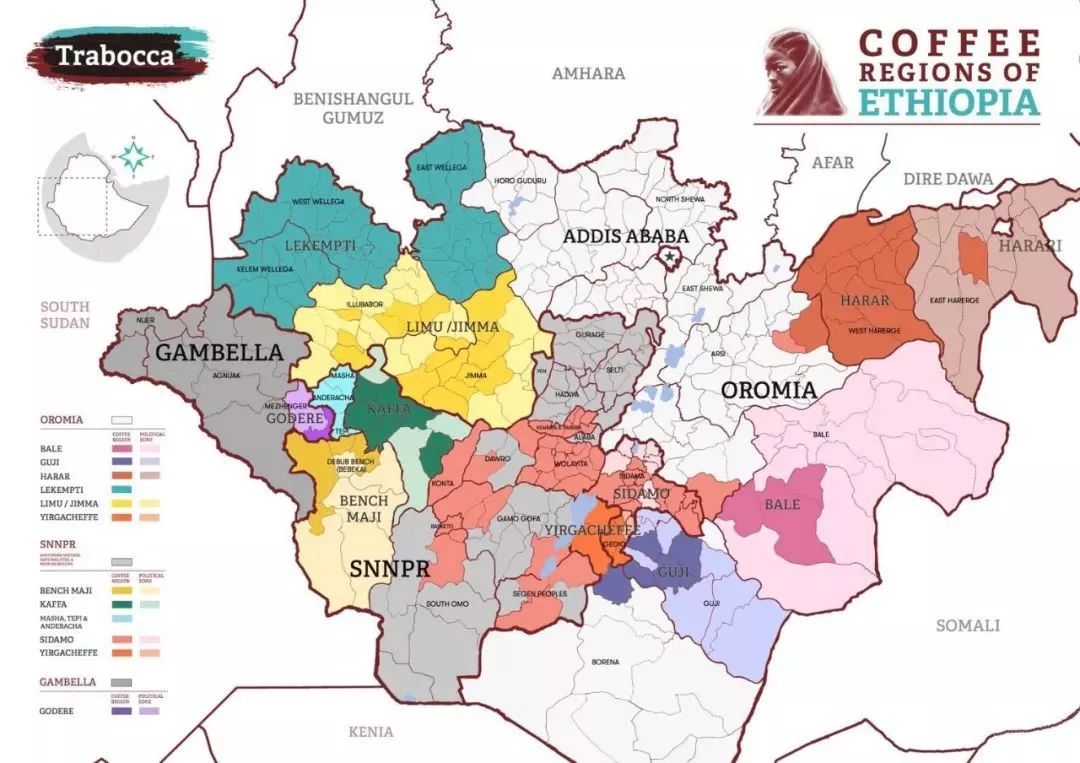
According to FrontStreet Coffee, Ethiopia's coffee is spread across a set of major growing areas: Yirgacheffe, Sidamo, Limu, Harar, Jimma, Illubabor, Keffa, Tepi, Bebeka, Lake Tana, Wenago, and Gelena/Abaya. Among them, Yirgacheffe is arguably the most famous. FrontStreet Coffee briefly introduces each below.
1. Yirgacheffe (Specialty Region): Altitude 1,800-2,000 meters (Garden Coffee System)
Yirgacheffe is administratively part of the Sidamo region but was separated because of its unique flavor profile. Besides the town of Yirgacheffe, it takes in three sub-regions: Wenago, Kochere, and Gelena/Abaya. In the new Yirgacheffe grading system, Yirgacheffe A, Wenago A, Kochere A, and Gelena/Abaya A therefore command higher prices than their B-grade counterparts.
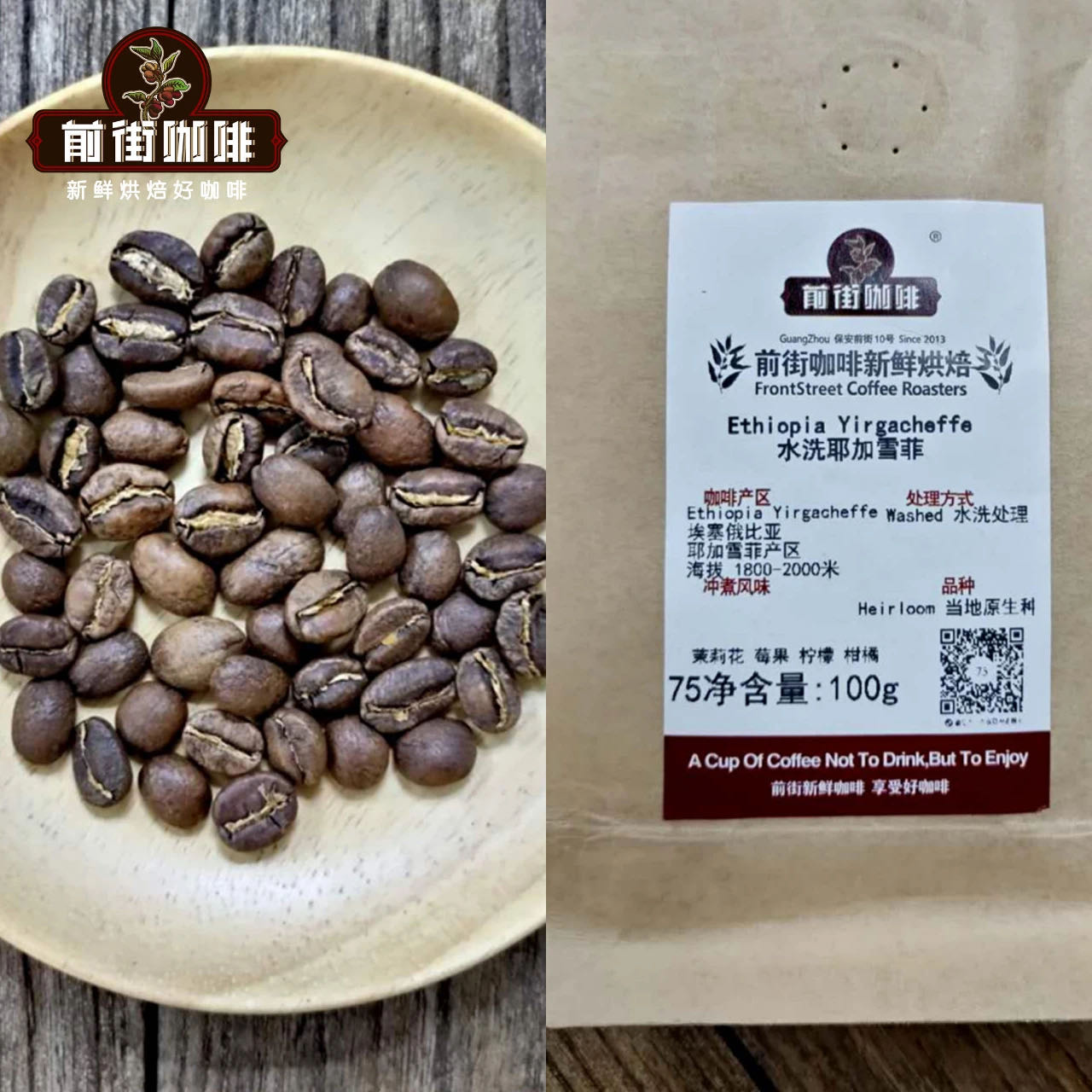
So-called Yirgacheffe flavor means rich jasmine fragrance, lemon aroma, peach and almond sweetness, and tea notes. FrontStreet Coffee thinks "a hundred flowers blooming" is the most fitting description. Traditionally, Yirgacheffe used the oldest natural processing, but in 1972 Ethiopia introduced Central and South American washing techniques to improve quality, making Yirgacheffe's jasmine and citrus notes cleaner and brighter. FrontStreet Coffee believes the essential difference between washed and natural processing is that washing reveals coffee's most fundamental flavors, directly reflecting the region's unique character, while natural processing adds sweetness and fermentation notes on top of those basics.
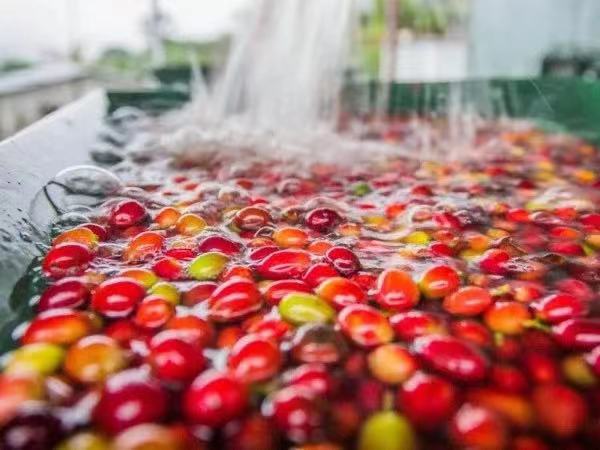
Thanks to the introduction of washing, Yirgacheffe became a standard-bearer for world specialty coffee. After the 1970s the region concentrated on washed processing, becoming Ethiopia's most prosperous washed-coffee area. In the 21st century, however, natural processing gradually improved and began producing impressive natural coffees. Credit goes to Yirgacheffe coffee trader Bagersh, who, nostalgic for traditional natural flavors and unwilling to see natural processing replaced by washing, improved natural methods, enhanced flavor, cut defect rates, and launched three extremely famous Yirgacheffe naturals: Idido Misty Valley, Beloya, and Aricha.
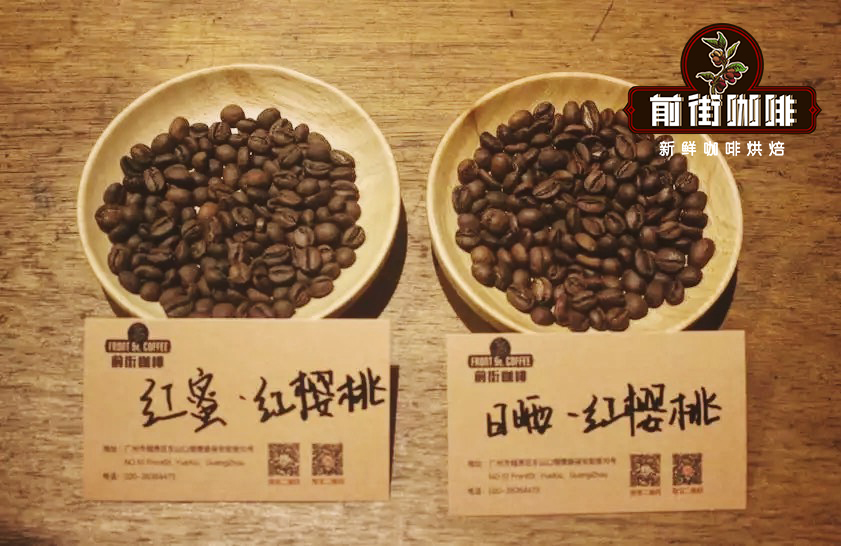
Beyond washed and natural, there are other methods such as red honey and anaerobic. FrontStreet Coffee once cupped a red honey Yirgacheffe that kept the original basic flavors while adding complexity; its mouthfeel was lighter than a natural Yirgacheffe but fuller than a washed one.
FrontStreet Coffee Ethiopia Gedeb Cooperative Coffee Beans

Country: Ethiopia
Region: Yirgacheffe
Altitude: 1900-2300m
Variety: Local heirloom varieties
Processing: Washed
Flavor: Tropical fruits, cream, honey, berries, citrus
The name Gedeb comes from the fact that these cherries are produced by the Gedeb Cooperative. According to FrontStreet Coffee, the cooperative was originally part of the Woka Cooperative under the Yirgacheffe Union YCFCU and became independent as the Gedeb Cooperative in 2012. It currently has more than 300 smallholder members.
Gedeb village was among the first village areas to be separated out. Many smallholders were also members of the original Woka Cooperative, so their production skills are beyond question. The Gedeb Cooperative is known as the last pure land of Yirgacheffe, and it accordingly uses very traditional methods (washed and natural).
FrontStreet Coffee Ethiopia Yirgacheffe Red Honey Red Cherry Coffee Beans
Country: Ethiopia
Region: Yirgacheffe
Altitude: 2000-2200m
Variety: Local heirloom varieties
Processing: Red Honey
Flavor: Jasmine, citrus, honey, berries, almond, fermented red wine
Honey processing means drying the beans with their mucilage intact. After the outer pulp is removed, a sticky, gelatinous layer remains. Traditional washing rinses it away with clean water, but where water is scarce at high altitude, direct drying was born instead.
The pectin mucilage is the highest-sugar part of the coffee fruit and a key component of fermentation — it can be said to supply 80% of the nutrients during processing. Yellow honey retains 60% of the pectin, red honey 75%, and black honey removes almost none.
FrontStreet Coffee Ethiopia Yirgacheffe Natural Red Cherry Coffee Beans
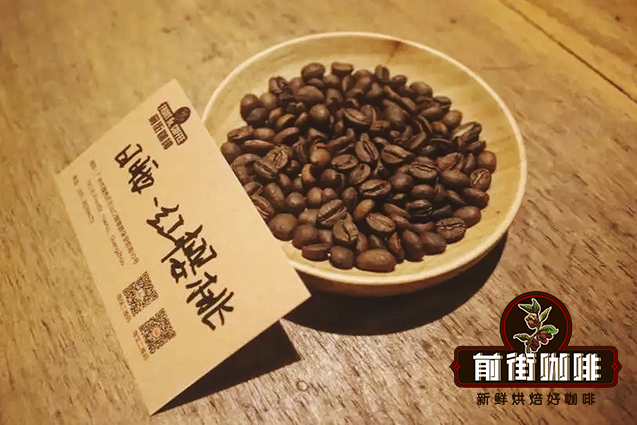
Country: Ethiopia
Region: Yirgacheffe
Altitude: 2300m
Variety: Local heirloom varieties
Processing: Natural
Flavor: Berries, lemon, strawberry, fermented wine aroma
Natural processing is the oldest and most primitive method. FrontStreet Coffee's natural red cherry process spreads whole cherries, pulp and skin intact, on raised beds for natural drying, isolating them from the ground and preventing earthy off-flavors from direct sun exposure. After more than two weeks of drying, the dark-brown fruit is stored to allow complete flavor maturation, and the beans are removed from the cherries only before shipping. This yields lower acidity, noticeable sweetness, and body, though the cleanliness is not as high as washing.
FrontStreet Coffee's Red Cherry beans also involve Ethiopia's Red Cherry Project. What is the Red Cherry Project?
Red Cherry Project:
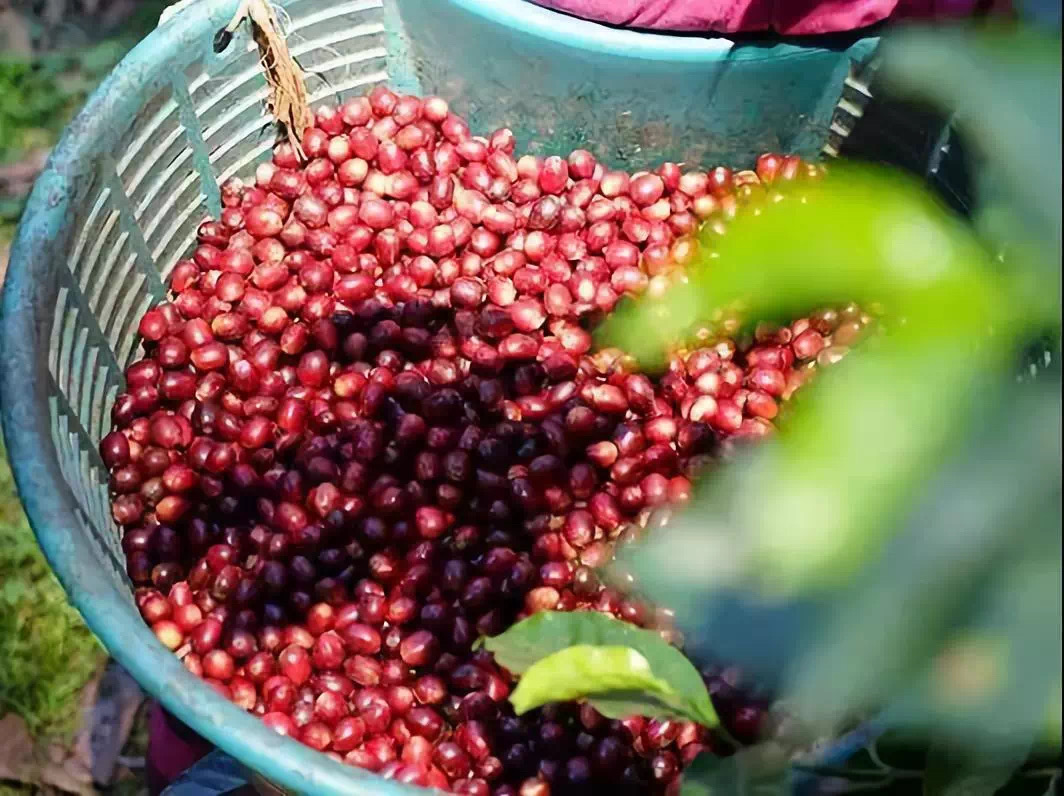
The Red Cherry Project was initiated jointly by the Dutch trader Trabocca and local Ethiopian farmers to improve the quality of small farms. Harvesting requires picking only fully ripe red fruit, entirely by hand, but that is only the most basic requirement; there are corresponding requirements for processing as well.
The project is also a reinforcement approach that pushes farms to invest more effort in sorting and selecting beans, and these coffees command relatively higher prices. Its main implementing regions include Yirgacheffe, Sidamo, Bonga Forest, Lekempti, Kembata, Illubabor, Harar, and Limu. All of these have unique flavors that fully showcase Ethiopian coffee. FrontStreet Coffee believes, however, that specialty coffee today in fact operates along Red Cherry Project lines, and yet the distinctive term "Red Cherry Coffee" still belongs exclusively to Ethiopia. Red Cherry coffees are printed with Trabocca on their burlap bags.
2. Sidamo (Specialty Region): Altitude 1,400-2,200 meters (Garden Coffee System)
Finely washed or natural Sidamo coffees typically show noticeable sweetness, with strawberry and berry flavors loved by many enthusiasts, and enjoy status no lower than Yirgacheffe's. Sidamo and Yirgacheffe share similar varieties, with medium-sized beans but also dwarf small-grain types that farmers often sell separately. The most watched Sidamo bean today is undoubtedly "Hua Guai" (Flower Champion). Since debuting at Ethiopia's TOH (Taste Of Harvest) competition in 2017, it made a stunning impact, breaking Geisha's monopoly in brewing competitions and becoming the only coffee able to rival it. Hua Guai comes from the Hambela sub-region under Guji. Like Yirgacheffe, Guji was originally part of Sidamo but became independent for its outstanding regional flavor; even so, when people mention Guji today it is still generally treated as part of Sidamo.
FrontStreet Coffee Ethiopia Sidamo Hua Guai Coffee Beans
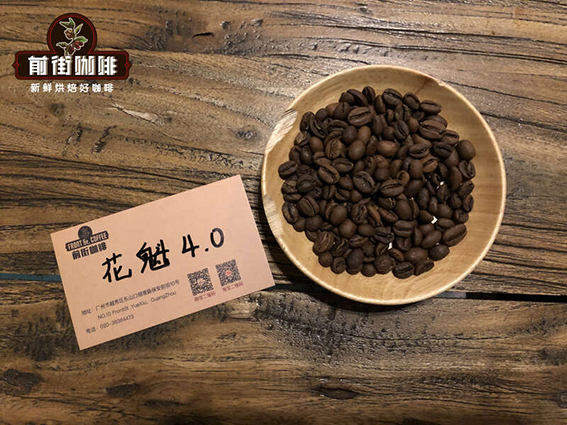
Country: Ethiopia
Region: Sidamo
Altitude: 2250-2350m
Variety: Local heirloom varieties
Processing: Natural
Flavor: Berries, floral tea, honey, lemon, black tea
Hua Guai (Flower Champion) got its name because in 2017 Ethiopia's DW green-bean company submitted its beans to the TOH (Taste Of Harvest) competition hosted by the African Coffee Association, where the natural lot won the Ethiopia championship. This batch was named "Hua Guai" in honor of that title.
3. Limu (Specialty Region): Altitude 1,200-2,000 meters (Garden, Forest, Semi-Forest, and Plantation Systems)
Production is relatively low and mainly exported to European and American markets, so it is not easy to find in Taiwan, but it is very popular in Europe and America. It has three processing methods: washed, natural, and semi-washed. Limu has noticeably lower viscosity, and its floral and citrus expressions are inferior to Yirgacheffe and Sidamo, but it has a unique grassy fragrance and brown-sugar aroma with bright fruit acidity.
4. Harar (Specialty Region): Altitude 1,500-2,400 meters (Garden Coffee System)
Harar focuses exclusively on natural processing. It is an ancient eastern city, though the urban area does not grow coffee; "Harar coffee" refers to coffee produced in the Hararghe Highlands of the greater Harar region. With annual rainfall of only 1,000 millimeters, all coffee uses natural processing. In flavor, Harar is famous for its special "mixed aromas," typical of ancient early flavors. If its defective beans are sorted cleanly, it is easy to detect berry aroma with a pleasant fermented mixed fragrance. Owing to various factors, however, Harar quality has been unstable in recent years and its grading system is unreliable, so cup testing or trial drinking is essential when buying.
5. Jimma (Commercial Coffee Bean Region): Altitude 1,350-1,850 meters (Forest/Semi-Forest System)
Jimma is the capital of the Kaffa Forest, or Kaffa Province, with chaotic English spelling — mostly "Jimma" on maps, but "Djimmah" on coffee burlap. It is Ethiopia's largest coffee-producing region, accounting for 1/3 of exports, and serves as the distribution center for the Kaffa region. Farmers are accustomed to transporting forest-harvested coffee to Jimma, where hundreds of varieties are mixed and sold as commercial beans, masking the flavors of many delicious varieties.
Washed specialty Jimma lacks Yirgacheffe's citrus aroma and floral charm, but has a quite clean, transparent profile similar to Central American specialty coffees. Commercial-grade specialty Jimma is common in Taiwan. With luck you can buy high-quality, reasonably priced Jimma that reveals lemon-peel freshness, no less impressive than Sidamo. Overall, Jimma offers better flavor than Brazil's commercial Santos, making it an excellent mid-range formula bean.
6. Illubabor (Commercial Coffee Bean Region): Altitude 1,350-1,850 meters (Forest/Semi-Forest System)
This region lies in western Ethiopia, bordering Sudan, and is the westernmost coffee region. Its genetic diversity is second only to the Kaffa Forest. The beans are noticeably larger than Yirgacheffe's and Sidamo's, with lower fruit acidity, good viscosity, and balanced flavors. Most coffee from here is transported to Jimma for blending and rarely sold independently.
7. Keffa, Lekempti (Commercial Coffee Bean Region): Altitude 1,500-1,800 meters (Forest/Semi-Forest System)
This region has both natural and washed coffees, with long-shaped beans similar to Harar's. There are also small quantities of specialty-grade coffees popular in Europe and America. Most are hailed as "poor man's Harar," with fruit acidity and fruit flavors inferior to Illubabor but bright overall.
8. Tepi, Bebeka (Commercial Coffee Bean Region): Altitude 500-1,900 meters (Garden/Forest/Semi-Forest System)
The two areas are very close, with Tepi north of Bebeka. They have enterprise-managed plantations. In recent years they have promoted garden systems to raise farmers' incomes, with annual production of about 3,000 tons. Both have wild coffee with low production but flavors completely different from Harar and Yirgacheffe; low fruit acidity is their biggest trait, making them suitable for formula beans. Both natural and washed processing are available.
9. Lake Tana (Alternative Region): Altitude 1,840 meters (Forest System)
Monastery coffee, with very low annual production of surrounding forest coffee — less than 10 tons — so it can hardly be called a region. The area's many Eastern Orthodox monasteries, churches, religious murals, and myths create the world's most "divine" coffee.
European monks established the local coffee industry, later managed by coffee communities or cooperatives in villages around the town. There are no dedicated plantations here — coffee trees scatter naturally through forests and gardens. During harvest, Ethiopian trading companies come to town to buy the beans farmers have collected.
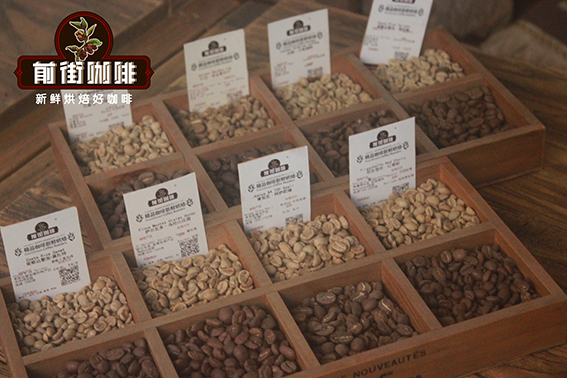
Ethiopian Coffee Varieties
According to FrontStreet Coffee, Ethiopia's coffee cherry varieties are also extremely rich, with nearly 2,000 recorded (1,927 native varieties and 128 introduced). In bean shape, Ethiopian varieties are a "garden of wonders" — long, short, thin, plump, you find them all. Long-shaped beans exist throughout Ethiopia's growing regions; from observed proportions, western Jimma, including Limu and Kaffa, has more long-shaped varieties, while Sidamo and Yirgacheffe have fewer.
Small-grain varieties are relatively round and very small, mostly between 14-15 screen size. This type should be the most familiar, as it appears often in Sidamo and Yirgacheffe. FrontStreet Coffee has also seen it in a Harar sample and in green coffee sold locally in Jimma. Compared with other regions, Sidamo, Yirgacheffe, and the surrounding Arsi and Guji areas have more of these small-grain native varieties.
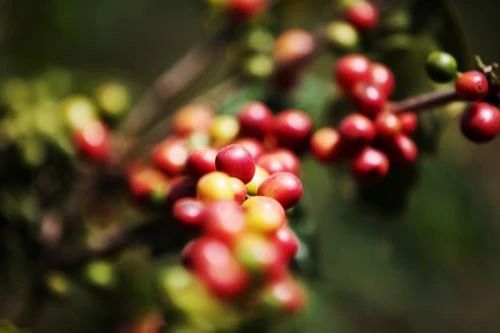
Ethiopian Coffee Bean Grading
ECX (the Ethiopian Commodity Exchange) defines grading by defect rate: G1 and G2. G1 means no more than 3 defective beans per 300g of green coffee, while G2 means 4-12 defective beans per 300g.
There are also grading definitions based on flavor evaluation, using SCA (Specialty Coffee Association) cupping methods to assess G1 and G2 coffees. Scoring 85 points or above is graded Q1, while 80-84.75 points is graded Q2.
Kenya
Most Kenyan coffee grows at altitudes between 1,500-2,100 meters, with two harvests a year. As FrontStreet Coffee mentioned above, its main characteristic is a distinct fruit aroma, commonly cherry tomato. Kenyan coffee has multi-layered flavors and juice-like acidity, with perfect grapefruit and wine notes and moderate body, making it a favorite single origin among many industry professionals. Kenyan coffee gained further fame through the Hollywood film "Out of Africa."
According to FrontStreet Coffee, cutting down or destroying coffee trees is illegal in Kenya. Kenyan coffee buyers are all world-class premium purchasers, and no country can continuously plant, produce, and sell coffee the way Kenya does.
All Kenyan beans are first purchased by the Coffee Board of Kenya (CBK), where they are inspected and graded, then sold at weekly auctions without further grade separation.
Kenyan Coffee Growing Regions
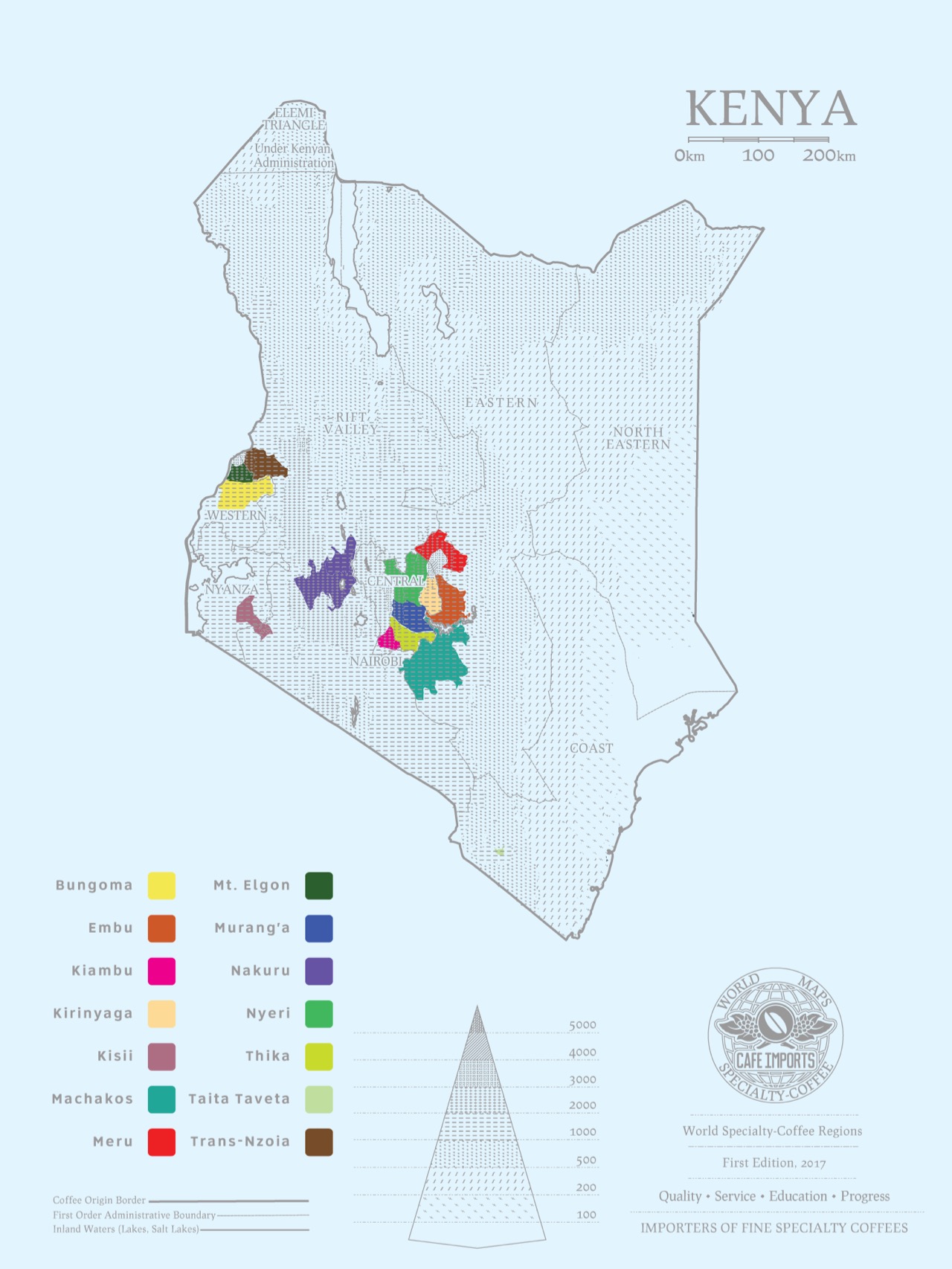
According to FrontStreet Coffee, Kenya's growing regions comprise six main areas: Thika, Kirinyaga, Mt. Kenya West, Nyeri, Kiambu, and Muranga. Their harvest periods all run October-December (main season) and June-August (secondary season).
Thika
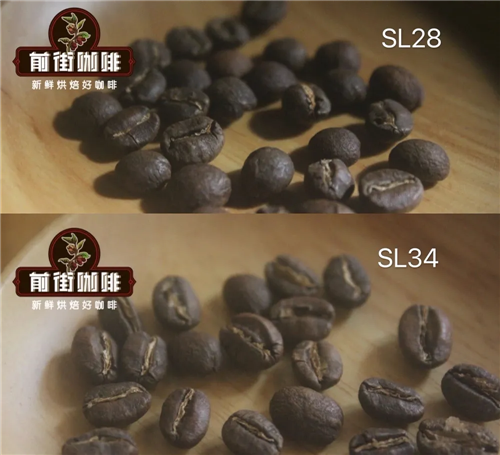
Thika is a small town near Kenya's capital, Nairobi. There are many coffee fields around Nairobi, and although Thika is an industrial town, it is surrounded by agriculture and waterfalls. The Thika region has about 2,000 farmers. Kenyan Thika cultivation dates to the late 19th century, with varieties introduced from neighboring Ethiopia to the north. Through local improvement, common varieties now include Bourbon, Kents (SL34, SL28), Typica, and Ruiru 11. Currently about 90% of planted varieties are SL34 and SL28. The new variety Batian, released in 2007, has not yet been widely planted. The region's flavor features bright fruit acidity, rich berry juice, and honey-like sweetness.
Altitude: 1,550-1,750 meters
Varieties: SL-28, SL-34
Kirinyaga
Kirinyaga lies on the slopes of Mount Kenya, near Nyeri, and is world-renowned for coffee with intense, complex flavors and a solid mouthfeel. Together with Nyeri it is recognized as one of Kenya's two finest regions. Most producers here are smallholders who join cooperatives; the cooperatives coordinate and provide washing stations where farmers deliver their cherries for processing. The region's flavor features bright fruit acidity with moderate oiliness and delicate sweetness.
Altitude: 1,300-1,900 meters
Varieties: SL-28, SL-34, Ruiru 11, Batian
Mt. Kenya West
Mt. Kenya West includes Kisii and Bungoma in the Elgon region. Kisii lies in southwestern Kenya, not far from Lake Victoria, and is a relatively small producing area where most beans come from cooperatives of small producers. The flavor here differs markedly from the central regions, featuring roasted nuts and mild fruit acidity — popular among buyers who dislike bright acidity.
Altitude: 1,450-1,800 meters
Varieties: SL-28, SL-34, K7
Nyeri
Located in central Kenya, Nyeri is home to the extinct volcanic Mount Kenya. The region's red soil nurtures Kenya's best coffee. Agriculture is extremely important here, with coffee the main crop, and cooperatives of smallholders are more common than large estates. There are two harvest seasons, but main-season coffee is usually higher quality. The region features bright berry juice with citrus and subtle floral notes; the beans grown here have made Kenyan coffee world-renowned.
Altitude: 1,200-2,300 meters
Varieties: SL-28, SL-34, Ruiru 11, Batian
Kiambu
This central Kenyan region has the highest-altitude coffee areas. Some high-altitude trees, however, suffer from dieback disease and stop growing. The region is named after Nakuru town. Cultivation here includes both estates and smallholders, though production is relatively small.
Altitude: 1,850-2,200 meters
Varieties: SL-28, SL-34, Ruiru 11, Batian
Muranga
Muranga belongs to Central Province and has about 100,000 coffee farmers. This inland region was one of the first settlement choices for missionaries, because the Portuguese barred them from living in coastal areas. Another region blessed with volcanic soil, it has more smallholders than estates. The coffee features bright acidity and a rich, juicy texture.
Altitude: 1,350-1,950 meters
Varieties: SL-28, SL-34, Ruiru 11, Batian
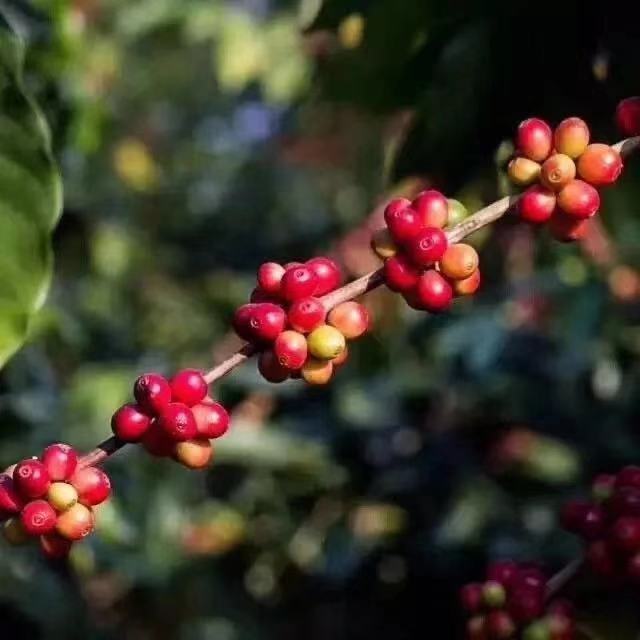
Kenyan Coffee Bean Grading System (by size)
AA Plus (AA+): AA-grade beans with particularly excellent cup quality (flavor and mouthfeel).
AA: Screen size 17-18.
AB: Screen size 15-16, accounting for the majority of production.
C: Smaller than AB.
TT: Lighter beans blown out by air classifiers from AA and AB beans.
T: Lighter beans blown out by air classifiers from C beans.
E (Elephant Bean): Large variant beans where two beans merge, also called elephant ear.
PB (Peaberry): Classified by shape, unrelated to flavor or weight.
For AA and AB green beans, special grading based on cupping results has been added (not officially recognized by the Kenyan government; established by exporters), ranked from high to low as TOP, PLUS (+), and FAQ. The flavor grade of FrontStreet Coffee's Kenyan Assalia reaches TOP grade. As noted, however, this is not an officially recognized system, and not all of FrontStreet Coffee's Kenyan regional beans carry flavor grades, so there is no need to worry about it. Reaching AA or AB grade already implies very high quality.
Below are all of FrontStreet Coffee's current Kenyan coffees:
FrontStreet Coffee Kenya Thithi PB Coffee Beans
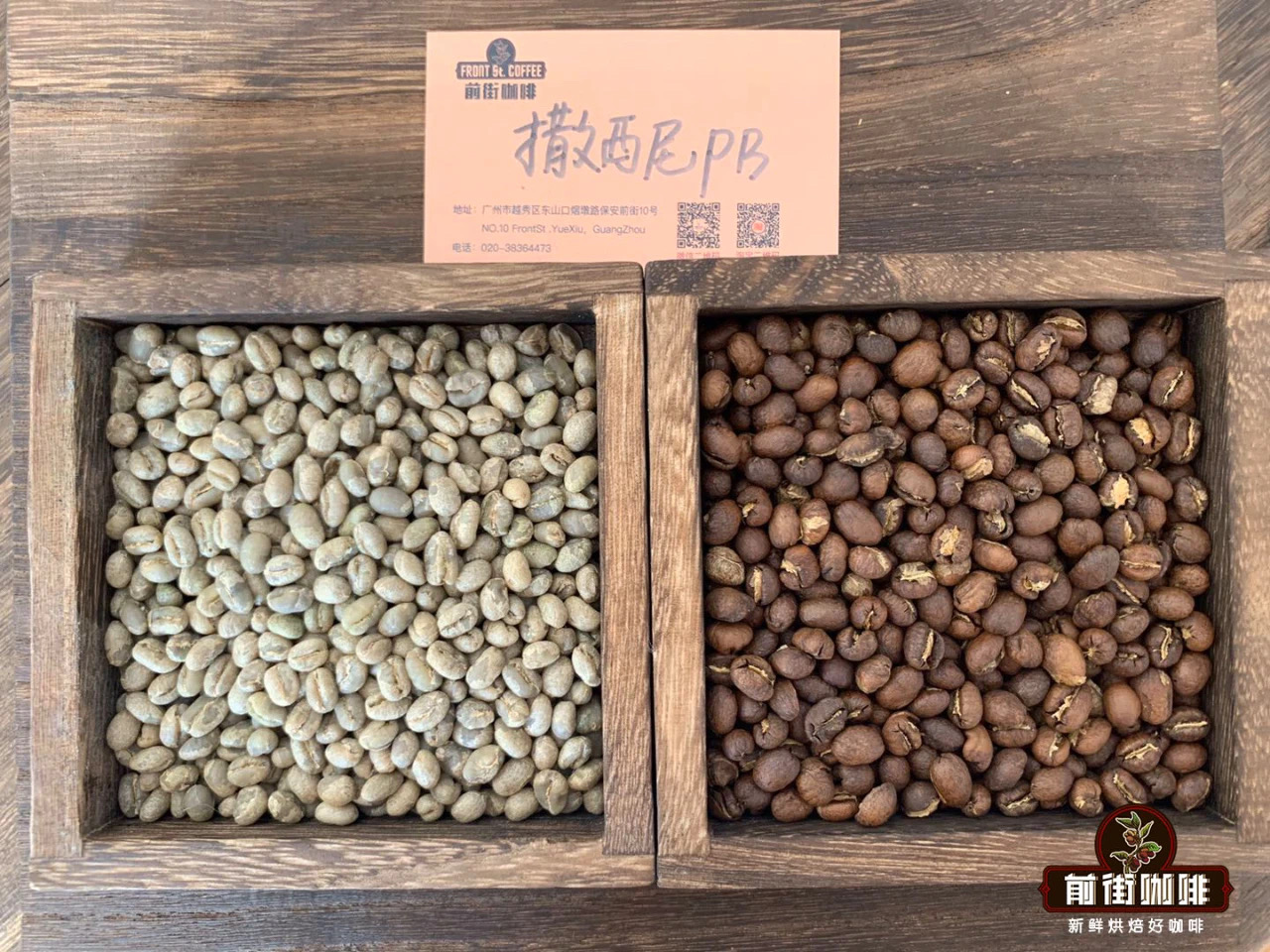
Country: Kenya
Region: Thithi
Altitude: 1,900m
Varieties: SL28, SL24, Ruiru
Processing: Washed
Flavor: Tomato, fruits, berries
Thithi Estate lies in the KIAMBU region around Mount Kenya, at about 1,800 meters altitude. The area has beautiful scenery, a pleasant climate, ample sunshine, and superior soil — fertile acidic red soil that is loose, deep, and well drained, with pH between 5.5-6.5.
Thithi Limited was originally established in 1952 and was among the first coffee and tea companies founded after Kenya's independence. It has earned multiple certifications, including UTZ, Rainforest Alliance, and the Kenya Bureau of Standards Diamond mark.
FrontStreet Coffee believes high-quality Kenyan coffee has bright fruit acidity and an intoxicating fruity sweetness. The sweet-sour contrast is significant, with a refreshing sweet aftertaste and hints of black currant.
FrontStreet Coffee Kenya Assalia Coffee Beans
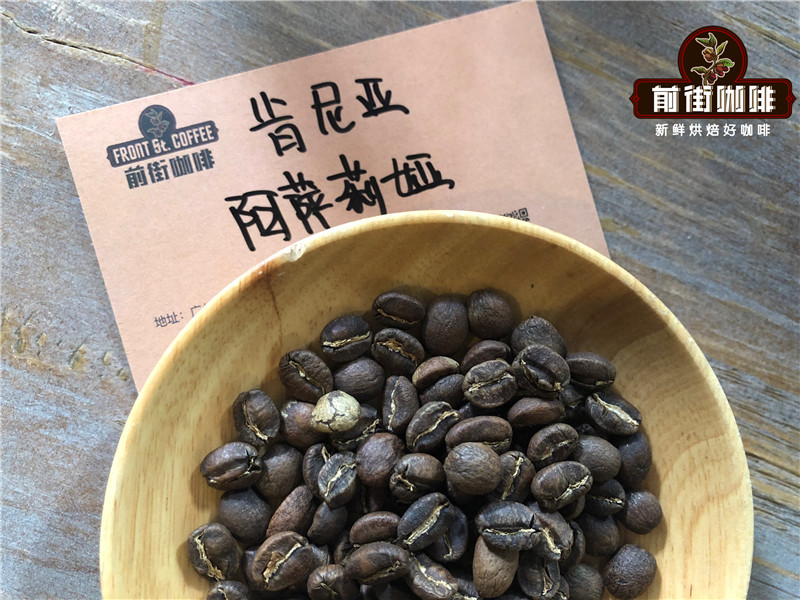
Country: Kenya
Region: Asali (Honey Processing Station)
Altitude: 1,550-1,750m
Varieties: SL28, SL34
Processing: Washed
Flavor: Pear, dried plum, brown sugar, cherry tomato, plum
According to FrontStreet Coffee, SL-28 and SL-34 are two of 40 experimental varieties from a research program led by Guy Gibson of Scott Laboratories. The Bourbon variants SL-28 and SL-34 have consistently been champions at expert cuppings and Nairobi auctions.
Burundi
Burundi Coffee Bean History
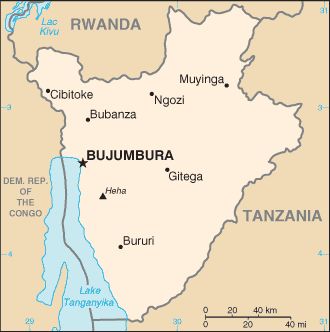
Burundi, known as the heart of Africa, is a landlocked country on the steep terrain of the East African Rift Valley. With complex topography, it is the crossroads of Central and East Africa and the watershed between Africa's two great river systems, the Nile and the Congo. It has long been called the "Heart of Africa."
Burundi began coffee cultivation in 1930, introduced by the colonial power Belgium. Locals originally had no habit of drinking coffee, and many farmers resisted planting in the early years. Under colonial exploitation, coffee quality in those years was, understandably, not good. Burundi's long-standing ethnic issues and producers' distrust of buyers also seriously hindered quality improvements.
Beginning in 1993, project guidance from the World Bank and the International Monetary Fund brought a turning point. In October of that year, however, the first Hutu president was assassinated, social unrest erupted, and the industry's development was shelved again. It was not until September 2006, when the ruling Tutsi party signed a ceasefire with anti-government organizations, that the situation gradually stabilized and coffee development entered a new phase.
The World Bank-guided project pursued two main strategies: expanding coffee washing stations and comprehensively increasing cultivation. Before 2007, all washing stations were state-controlled, with poor efficiency and inconsistent green-bean quality. That year the government allowed private washing stations, the true turning point for Burundi's coffee industry. In 2011, the Alliance for Coffee Excellence held coffee evaluations in Burundi for the first time, drawing international attention, and farmers realized that coffee cultivation had returns.
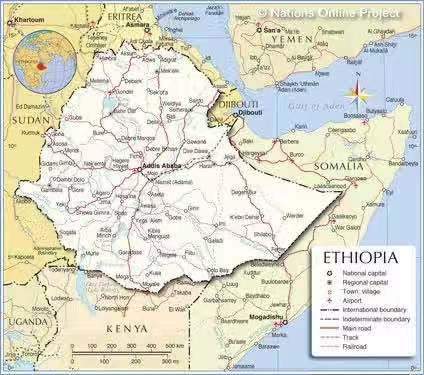
Burundi Coffee Bean Growing Regions
Burundi's main growing regions include five areas: Kayanza, Ngozi, Muyinga, Kirundo, and Kirimiro.
Kayanza, Ngozi
Both Kayanza and Ngozi belong to Buyenzi, at altitudes between 1,700-2,000m. The main rainy season begins in March-April, followed by a dry season in July after harvest. The average annual temperature is 18-19°C, with cool nights continuing until morning — the main reason for the tight bean body and rich aroma of these two regions.
In the 2015 Cup of Excellence (COE) competition, coffee from Kayanza scored a high 91.09. Ngozi produces less than Kayanza but has also shown impressive potential in recent years; in the 2015 COE, its best batch scored 88.92, with other batches from the region also scoring above 85.
Kirundo
This region is quite close to the Rwandan border, with relatively low production at altitudes between 1,400-1,700m. Influenced by Kayanza, it has gradually moved toward specialty batches, and its washed coffee has already achieved excellent COE results.
Muyinga
Located in northeastern Burundi, bordering Tanzania, with an average altitude of 1,800 meters. The flavor is slightly simpler than Kayanza's, lacking the latter's mouthfeel richness.
Kirimiro
Located in Burundi's central highlands, with an average temperature of 12-18°C and annual rainfall of about 1,100mm, lower than other regions. Besides COE-winning coffees, it also has a professional coffee laboratory focused on monitoring export quality.
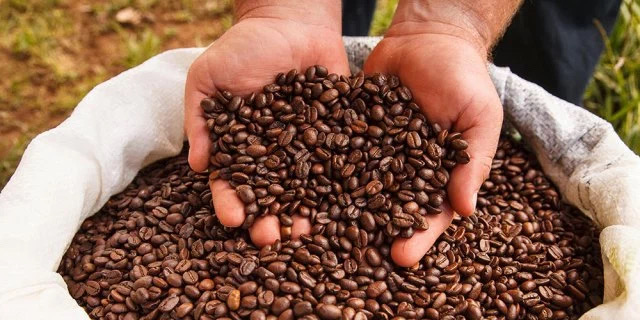
Burundi Coffee Varieties
Generally, Burundi coffee is mainly Bourbon, with some other variants (such as Jackson and Blue Mountain). According to FrontStreet Coffee, cultivation ranges from 700-2,700 meters altitude. High altitudes produce brighter acidity and lemon notes, along with passion fruit, pineapple, floral, and honey flavors, with quality reaching SCA 86 points or above. Lower-altitude coffee has a slightly lighter body with more chocolate and hazelnut flavors.
Burundi Coffee Bean Processing Methods
Burundi's varieties, like neighboring Rwanda's, are mostly Bourbon. Today, over 800,000 Burundian families depend on coffee for their livelihood. These are mostly small coffee gardens, intercropped with other crops and manually cultivated without mechanized equipment. Processing is mainly washed, with small amounts of natural in recent years.
Burundi has two washing methods. One is where farmers wash and process manually before delivering to washing stations, called hand-washed and marked "washed." The other is delivering cherries directly to washing stations, marked "fully washed."
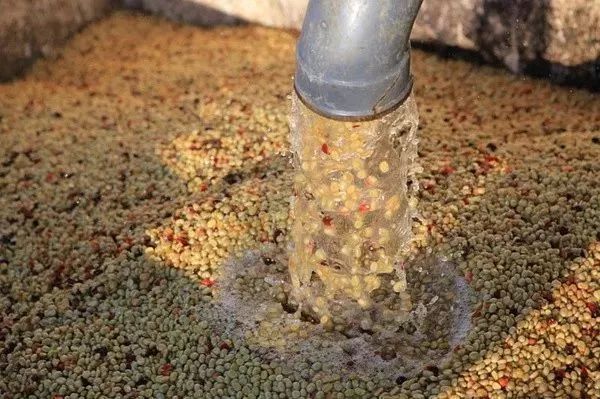
Hand washing involves completely manual removal of skin, pulp, and mucilage. As FrontStreet Coffee mentioned, producers' distrust of buyers included distrust of processing stations: farmers felt station prices were unfair and that direct cherry trading prices were too low, preferring to process coffee themselves to negotiate better prices. The problem is that farmers mostly rely on manual processing without proper tools, often working on dusty roadsides, which inevitably affects quality. Since the liberalization of private washing stations, however, the government has encouraged delivering cherries to professional stations after harvest.
Burundi has also developed a washing method similar to Kenya's — double fermentation. First, harvested cherries go into large water tanks for flotation to select dense fruit. Machines then remove skin and pulp, and the beans enter fermentation tanks for about 18 hours. The next day the fermented fruit is poured into clean water to ferment another 18 hours, totaling about 36-48 hours. Afterward the fruit is thoroughly washed to remove the softened mucilage, then dried. The first drying stage requires shade to avoid intense direct sunlight, reducing moisture below 40%, then moving to raised beds for natural drying until moisture reaches 11%.
Below are all of FrontStreet Coffee's current Burundi coffees:
FrontStreet Coffee Burundi Heart of Africa Coffee Beans
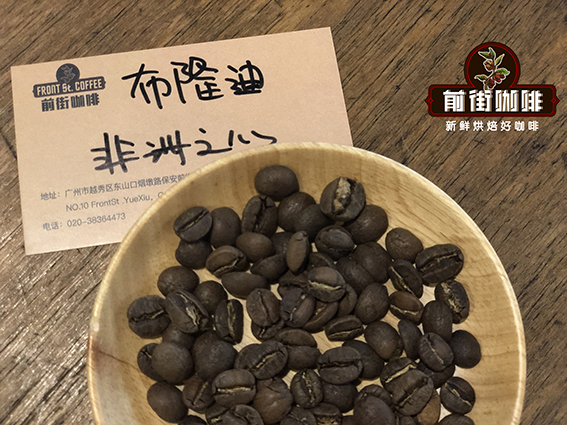
Country: Burundi
Region: Bubanza
Altitude: 1,400-1,700m
Varieties: Bourbon
Processing: Washed
Flavor: Kumquat, lemon, dried fruit, caramel, light acidity
Rwanda
Rwandan Coffee
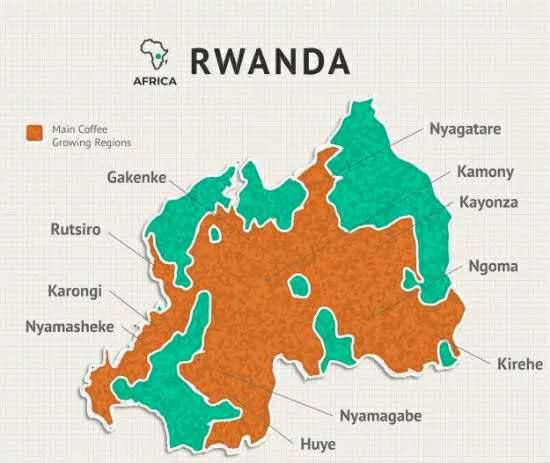
Rwanda lies in central Africa and is a standard landlocked country, with all its neighbors being major coffee producers. In the early 20th century Rwanda successively became a colony of Germany and Belgium, with coffee first introduced by German missionaries. During colonial times production rose significantly, but exploited labor, suppressed crop prices, and high export taxes meant bean quality was not ideal — typical of commercial coffee development at the time. FrontStreet Coffee notes that Brazil, which also experienced colonial rule, once prioritized quantity over quality, earning a reputation for poor coffee for a period.
Only after Rwanda's independence and the founding of its first official coffee organization, OCIR, did attention gradually turn to bean production. Rwandan production grew continuously from the 1960s-80s, peaking unprecedentedly in 1986. It was not until political instability began in the early 1990s (the Rwandan genocide) that the industry stagnated. FrontStreet Coffee has recently bought several batches of Rwandan beans from different regions — partly because Rwanda's coffee industry is developing rapidly with assured quality, and partly because Rwanda is gradually forming distinct regional flavors that differ from Ethiopia and Kenya.
Rwandan Coffee Growing Conditions
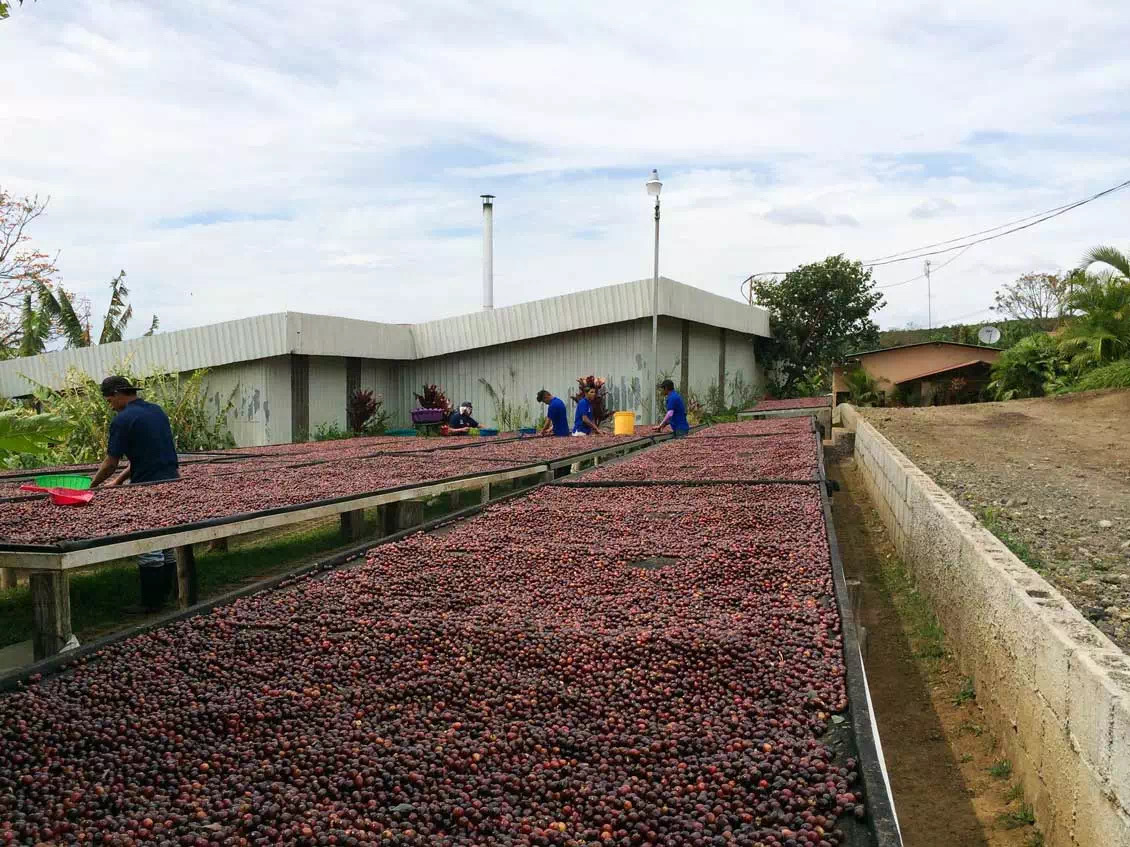
Rwanda has a temperate tropical highland climate, with average temperatures between 24.6-27°C. Its climate is cooler than typical equatorial countries, and coffee is grown in the mountainous west, where temperatures are even lower than the eastern lowlands and the temperature range is greater. Lake Kivu in the north, for example, sits at an average altitude of 1,463 meters with an average daily temperature of 22°C. Combined with fertile volcanic soil, this is very suitable for coffee.
Rwanda Coffee Processing Methods
According to FrontStreet Coffee, Rwandan coffee mainly uses washed processing today. The method floats the harvested cherries to remove insufficiently dense fruit, then removes skin and pulp. The mucilage-covered beans go into water pools to ferment. After fermentation, clean water washes away the mucilage. Finally, the beans are dried until moisture reaches 11-13%. FrontStreet Coffee believes washed coffee has higher acidity, good cleanliness, and stable overall performance.
Rwanda Coffee Growing Regions
Rwanda's specialty regions are mainly in the south and west. The southern Huye highlands and Nyamagabe region, at higher altitude, produce beans with floral and citrus notes. The western Nyamasheke region along Lake Kivu produces rich, aromatic, juicy coffees. Although regional differences are not dramatic, careful tasting reveals distinctions. People often ask FrontStreet Coffee how to tell them apart. FrontStreet Coffee believes flavor perception can seem mysterious, but through extensive recognition training one can distinguish coffees from different regions — it takes time, effort, and persistence.
Rwanda Coffee Cultivation Varieties
Over 90% of Rwandan varieties are early-introduced Bourbon and Bourbon-family mixed varieties, which resist natural disasters. Bourbon was originally cultivated on Réunion Island, introduced to Brazil in 1860, and rapidly expanded northward throughout Latin America. FrontStreet Coffee currently offers several Latin American Bourbons, including Brazilian Red Bourbon, Brazilian Yellow Bourbon, and Colombian Pink Bourbon.
FrontStreet Coffee Rwanda Gisakura Coffee Beans
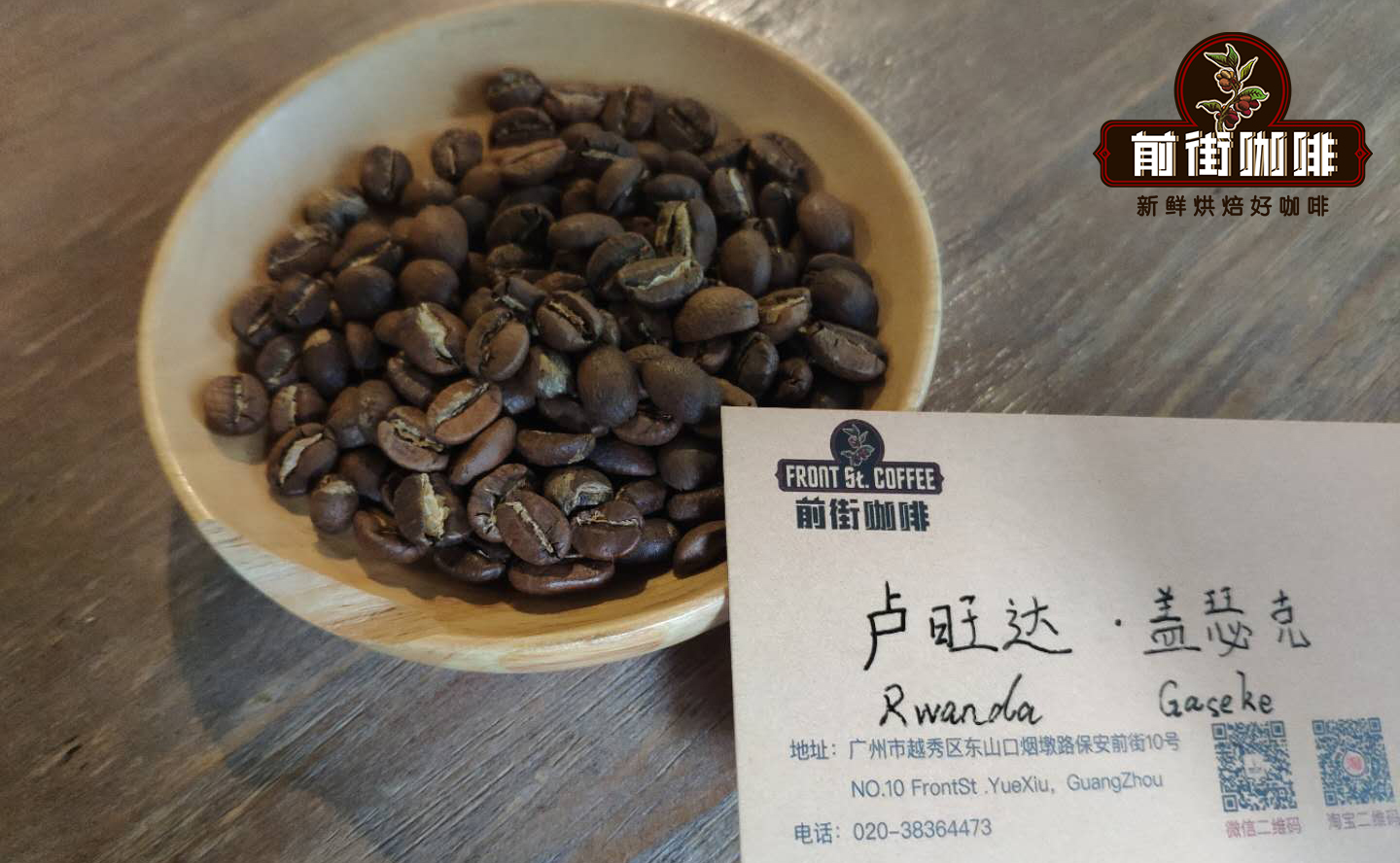
Country: Rwanda
Region: Nyamasheke
Altitude: 1,500m
Varieties: Caturra, Catuai, Bourbon
Processing: Washed
Flavor: Citrus, berries, plums, nuts, honey, tea notes
Tanzania
Tanzania Coffee History
Tanzania, with Africa's highest peak, Mt. Kilimanjaro, standing in its northeast, was a trusteeship after World War I and was colonially ruled by Britain until independence in 1964.
What makes Tanzanian coffee unique is its composition from three different plantations in the north. One plantation lies on the slopes of Mount Kilimanjaro — Africa's highest mountain and the Earth's largest free-standing mountain range. Coffee grows between 1,150-1,500 meters there.
In 1898, Bourbon coffee was introduced to Tanzania's Kilimanjaro region by Catholic missionaries, followed by the Kent variety in 1920. To this day, Tanzanian beans are mainly Bourbon and Kent. Bourbon cherries are small and round, with high pulp and seed density, and typically high sweetness and bright acidity. Bourbon yields 20-30% more than Typica but is still considered low-yield and equally susceptible to leaf rust. Kent: a Typica hybrid discovered in India, with high yield and strong disease resistance.
Tanzania Growing Regions
According to FrontStreet Coffee, Tanzania's main regions include three areas: Kilimanjaro, Ruvuma, and Mbeya.
Kilimanjaro
This is Tanzania's oldest Arabica-growing region, so it has had the longest time to build an international reputation. Due to its long history, infrastructure here is relatively good, though many trees are quite old, resulting in lower production; in recent years other crops have gradually replaced coffee. Altitude: 1,050-2,500 meters. Harvest period: July-December.
Ruvuma
This region lies in southern Tanzania and is named after the Ruvuma River. Cultivation is mainly in the Mbinga area and is considered a potential region for high-quality coffee. Altitude: 1,200-1,800 meters. Harvest period: June-October.
Mbeya
Located around Mbeya city in southern Tanzania, this region is an important producer of high-value export crops such as coffee, tea, cocoa, and spices. In recent years it has drawn attention from certification groups and NGOs aiming to improve the region's poorly rated coffee quality. Altitude: 1,200-2,000 meters. Harvest period: June-October.
Tanzania Coffee Grading System
Tanzania's grading system is the same as Kenya's, grading by bean size. During screening, green beans pass through screens with fixed-size holes; larger screen numbers mean larger beans.
FrontStreet Coffee Tanzania Kilimanjaro Coffee Beans
Country: Tanzania
Region: Mount Kilimanjaro
Altitude: 1,300-2,000m
Varieties: Bourbon
Processing: Washed
Flavor: Citrus, berries, honey, tea notes
According to FrontStreet Coffee, Kilimanjaro coffee is produced on Mount Kilimanjaro, Africa's highest mountain range in northeastern Tanzania. Its quality is excellent, with rich aroma and prominent acidity, suitable for blending comprehensive coffees.
Kilimanjaro coffee is an important economic lifeline for Tanzania, with about 17% of foreign exchange created by coffee. Production is concentrated around Mount Kilimanjaro near northeastern Arusha — the Kilimanjaro volcano, Africa's highest peak with perennial snow. Kilimanjaro is one of Tanzania's top AA representatives, nurtured by volcanic ash — a naturally achieved variety with a unique cocoa-fruit aroma and a strong, mellow character. It is precisely because of its excellent flavor that FrontStreet Coffee introduced this bean.
Bolivia
Bolivia Coffee History
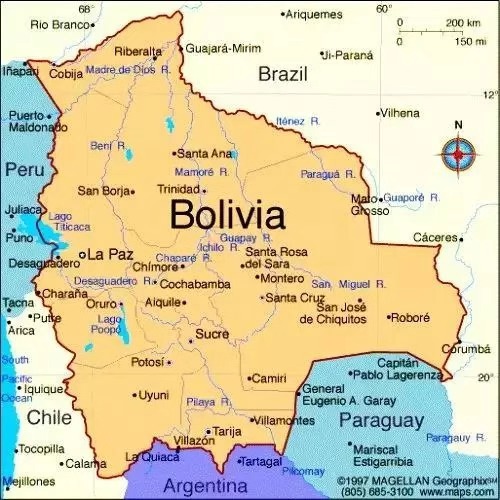
Bolivia is a landlocked country in South America, bordering Brazil and Colombia. Its capital, La Paz, sits above 3,600 meters, making it the world's highest capital city.
According to FrontStreet Coffee, Bolivia is also the world's poorest coffee-producing country, even poorer than Ethiopia. Beyond lacking a port, high-level government corruption is another reason for its extreme poverty.
Bolivia's coffee origins trace to 1880, when all production was basically tied to the owners of some large farms north of La Paz. In 1991 the government promoted a plan for indigenous people to take up Bolivian coffee cultivation, but without emphasizing quality.
For Bolivian farmers, the biggest problem has always been earning enough to sustain long-term coffee cultivation. To supplement coffee income they must grow other crops, mainly coca leaves, which can be used to produce cocaine. Coca cultivation is legal in Bolivia. With government encouragement, coca profits are four times those of coffee and it is much easier to grow, causing many farmers to abandon coffee or even give up their farms entirely.
Growing coca, however, requires large amounts of chemical pesticides and fertilizers, causing extreme soil damage. In other words, after several years of coca the soil becomes barren and cannot grow any crop. In the early 2000s the United States strongly supported Bolivian agriculture, but later Bolivian government support for coca cultivation strained relations with the US, and coffee farmers suffered most. Later, under Bolivia's limited resumption of anti-drug efforts, many programs to assist coffee farmers restarted, such as COE (Cup of Excellence), held with USAID support.
As if these blows were not enough, in 2013 leaf rust arrived (a mold that attacks coffee leaves and prevents photosynthesis). In that single year, Bolivia lost 50% of its coffee production. Combined with the government's coca policy and leaf rust, Bolivia's production has fallen 70% over the past decade, reducing it to a minor coffee-producing country.
Bolivia Coffee Growing Regions
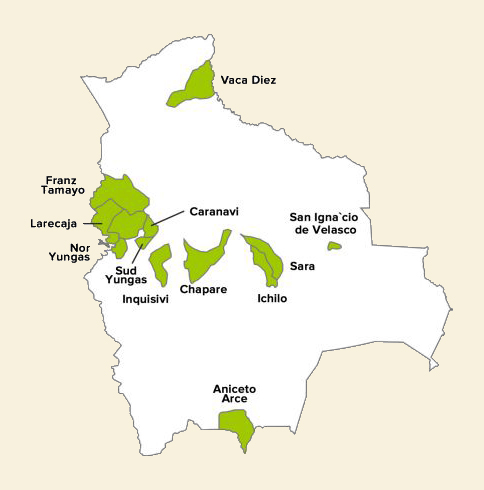
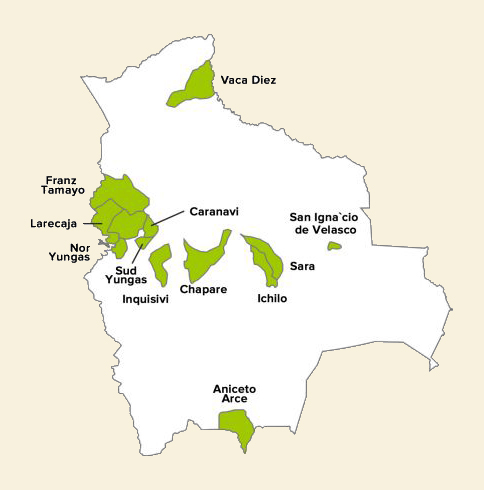
Bolivia's most famous region is La Paz, including the Caranavi, Yungas, and Inquisivi areas.
Among these, Yungas lies in Caranavi province, northeast of La Paz city. Bolivia produces 95% of its coffee here, along the vast forests extending from the eastern slopes of the Andes. This is fertile land with a rainy, humid, warm climate favorable for coffee. Altitude here is 800-1,800 meters. The area is famous for one of the world's most dangerous roads, nicknamed Yungas Road — also known as "the world's most dangerous road."
Bolivia Coffee Cultivation
Bolivia's coffee production is mainly based on small farms, with 23,000 small farms of 2-9 hectares nationwide. What is particularly special is that about 40% of Bolivia's coffee is consumed domestically. Moreover, Bolivian cultivation is almost entirely organic.
Bolivia Coffee Cultivation Varieties
Bolivia mainly cultivates Arabica-derived varieties: Typica, Caturra, Catuai, and Catimor. The harvest season runs from July to November.
Below are all of FrontStreet Coffee's current Bolivian coffees:
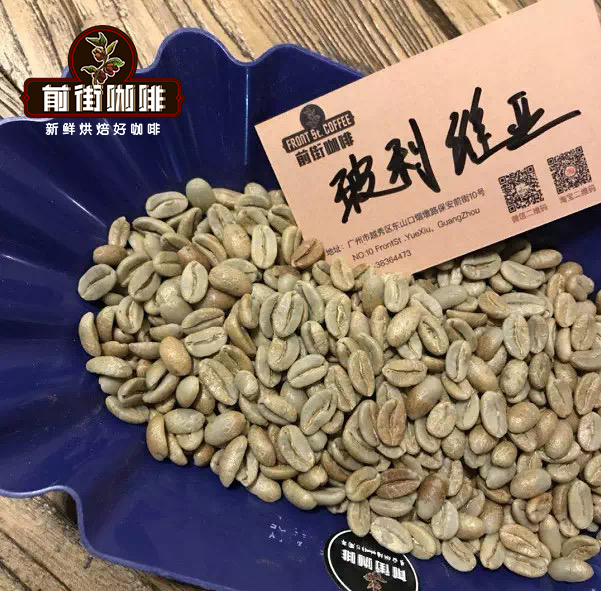
FrontStreet Coffee Bolivia Java Coffee Beans
Country: Bolivia
Region: La Paz
Altitude: 1,600m
Varieties: Java
Processing: Cocoa Natural
Flavor: Fermentation notes, grapes, nuts, subtle floral notes, honey, cream
FrontStreet Coffee's Bolivian Valiki Estate bean is the Java variety. In Bolivia it is called the long-bean variety, named for its elongated appearance; its formal name is Java. Java is a fascinating variety — its name reveals a strong connection to Indonesia, yet it actually originated from coffee trees in Ethiopia's original forests, collected by local peoples, then transmitted through Yemen to Indonesia, where it was named Java. People once assumed Java was a Typica variant, but genetic comparison revealed it actually descends from the Ethiopian variety Abysinia.
Java's fruit and seeds are both long, with bronze-colored young shoots. The plant is quite tall but low-yielding. Because its outstanding flavor rivals Geisha's, and it resists leaf rust and coffee berry disease more strongly, it is also very suitable for smallholders to cultivate.
The above is FrontStreet Coffee's summary of the cherry flavors and characteristics of Africa's coffee regions. FrontStreet Coffee believes that after reading this article, enthusiasts will have some understanding of African coffee and will find it easier to choose flavors in the future.
FrontStreet Coffee Recommendation
If Africa's bright, aromatic coffees have won you over, FrontStreet Coffee's most direct introduction is the washed Yirgacheffe daily bean. It is the classic first step into the region's flavors — white jasmine, bright citrus and lemon acidity, and a clean, tea-like body — and its friendly price has made it the very first specialty coffee for many drinkers. Yirgacheffe lies in Ethiopia's south, at roughly 1700-2100 m, with the trees planted above 1800 m, putting it among the highest coffee regions in the world and explaining the intensity of its white florals and lemon-citrus acidity. Its fame grew so great that in 2010 the Ethiopian Commodity Exchange separated it from Sidamo, creating today's Yirgacheffe name.
For a single cooperative expression, try the washed Godinding lot from the Worka area at the southeastern edge of Yirgacheffe. Originally part of the Worka cooperative under the YCFCU alliance, Godinding was later established as its own single origin as buyers pursued traceability, and it is often called the last clean spring of Yirgacheffe. Its traditional washed methods, stripping the fruit before drying, let the inherent aroma read clearly: fresh, bright citrus and lemon with jasmine fragrance and none of the traditional bitterness. Those who like a sweeter, juicier cup should look to the natural-processed Red Cherry, made from fully ripe cherries dried whole on raised beds. The cherries are turned every 2-3 hours in the first days to prevent uneven fermentation, and after three to five weeks the dried fruit is hulled away. Because the fruit dries on the bean, the coffee keeps its classic Yirgacheffe character while gaining tropical-fruit aroma, with citrus acidity, berry-juice body, honeyed sweetness, and a creamy smoothness.
To brew Yirgacheffe at home, FrontStreet Coffee suggests a V60 at 90-91°C, 15g of coffee at a 1:15 ratio, and a fine-sugar grind (EK43s setting 10, about 80% through a #20 sieve). Pour 30g of water to bloom for 30 seconds, then a further 95g (the scale reading about 125g), finishing near the one-minute mark; once the water falls to about two-thirds of the bed, add the remaining 100g (the scale reading about 225g) by about 1 minute 35 seconds. Total drawdown finishes at 2:00-2:10, and the cup is ready.
Important Notice :
FrontStreet Coffee is a long-established specialty coffee roaster in Guangzhou China, selling freshly roasted beans from its own farm in Yunnan as well as dozens of carefully selected single-origin beans from around the world for both pour-over and espresso. The products deliver consistently excellent quality and great value, with shipping within 24 hours. Guangzhou's FrontStreet Coffee shop is recommended by many coffee lovers, and the beans are now available online at the Tmall 。
FrontStreet Coffee has moved to a new address:
FrontStreet Coffee Address: 315,Donghua East Road,GuangZhou
Tel:020 38364473
 Scan and follow the En Gafei WeChat official account. Please indicate that the reprint comes from "En Gafei".