Exquisite Smooth Jamaican Blue Mountain Coffee Flavor Description - Altitude, Grind Size, Taste Profile, Characteristics, and Price Guide
Blue Mountain Coffee - Featured Coffee: FrontStreet Coffee's Blue Mountain Coffee
In Cuba, coffee cultivation is managed by the state, and the country's finest growing region sits in the central mountain range. Because this area yields precious minerals such as quartz and crystals alongside coffee, it is also known as Crystal Mountain. Crystal Mountain lies geographically close to Jamaica's Blue Mountain range and enjoys similar climate conditions, producing a taste profile comparable to Blue Mountain coffee that can hold its own against the Jamaican original. Cuban Crystal Mountain has therefore become a natural point of comparison with Jamaican Blue Mountain, and Crystal Mountain is known as the "Blue Mountain of Cuba."
The representative coffee of Cuban Crystal Mountain is Cubita, a name whose Chinese rendering means "Noble Coffee." Cubita holds an equally high reputation in the coffee industry. Cuban Crystal Mountain coffee ranks among the best in the world, and Cubita adheres to a principle of perfect coffee, focusing only on single-origin and specialty lots. The beans are harvested entirely by hand, and washed processing is used to protect quality. Cubita is like an elegant princess: noble, gentle and graceful. Its balance is excellent, with bitterness and acidity well coordinated, offering a delicate, smooth, refreshing and elegant sensation. Today Crystal Mountain Cubita has become synonymous with top-tier Cuban coffee.
The "Secret" to Why Blue Mountain Coffee Tastes So Pure
All the coffee trees grow on rugged mountain slopes, which makes harvesting extremely difficult; only skilled local women can manage the task. Selecting perfectly ripe cherries during harvest is crucial, since under-ripe or overripe beans will drag down quality. The harvested beans must be hulled the same day, then fermented for 12-18 hours, after which they are washed and sorted. Drying comes next and must be done on concrete floors or thick blankets until the beans' moisture content drops to 12%-14%. They are then stored in special warehouses, and taken out for roasting and grinding as needed. Every one of these steps has to be tightly controlled, or the quality of the coffee will suffer.
In 1717, King Louis XV of France ordered coffee to be cultivated in Jamaica. To supplement the labor force, Spain began trafficking enslaved Africans to Jamaica from 1517 onward, and Black people gradually became the island's main ethnic group. In 1538, the Spanish established Spanish Town as Jamaica's capital.
From the late 16th century onward, Jamaica suffered repeated pirate attacks from countries including France, England and the Netherlands. In May 1655, a British fleet jointly commanded by William Penn and Robert Venables occupied Jamaica. They immediately invited pirates to Port Royal on the island to help defend against a possible Spanish counterattack. Between 1657 and 1658, the Spanish launched counterattacks from Cuba, all of which ended in failure.

FrontStreet Coffee Recommendation
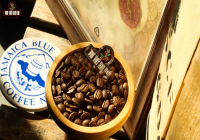
Blue Mountain's reputation rests on that balance, and at FrontStreet Coffee the top expression of it is Blue Mountain No. 1 from Clifton Estate, a farm that has been growing and processing coffee since roughly 1750 on land sitting at an average elevation of 4,300 feet (1,310.64 meters). It ships in the traditional wooden barrels, each stamped with the lot details, and is roasted at a medium-dark level and shipped within 5 days of roasting so the beans reach you at full flavor. Brewed as a pour-over it is clean, complex and exceptionally gentle: chocolate sweetness, a very strong body, acidity and bitterness in perfect proportion, no bitterness at all to speak of, and a long fruity finish. It works equally well in a moka pot or an espresso machine, where the chocolate, caramel and nut notes grow richer and fuller while the signature balance stays intact.
For a pour-over, FrontStreet suggests a Kono dripper with 15g of coffee rested 4-7 days from the roast date, a grind coarser than you would use for a light roast (roughly the texture of granulated sugar), 87-88°C water and a 1:15 ratio. Pour in three stages: 30g for a 30-second bloom, water up to 120g with a slow, tight spiral, then up to 225g with a slightly faster flow to keep the bed from clogging. Water temperature is where most burnt, bitter brews go wrong, and water that is too cool leaves the cup flat and lifeless instead.
Important Notice :
FrontStreet Coffee is a long-established specialty coffee roaster in Guangzhou China, selling freshly roasted beans from its own farm in Yunnan as well as dozens of carefully selected single-origin beans from around the world for both pour-over and espresso. The products deliver consistently excellent quality and great value, with shipping within 24 hours. Guangzhou's FrontStreet Coffee shop is recommended by many coffee lovers, and the beans are now available online at the Tmall 。
FrontStreet Coffee has moved to a new address:
FrontStreet Coffee Address: 315,Donghua East Road,GuangZhou
Tel:020 38364473
 Scan and follow the En Gafei WeChat official account. Please indicate that the reprint comes from "En Gafei".