Colombia Cauca La Esperanza Estate Geisha Coffee Bean Flavor Profile Characteristics and Brewing Methods

Panamanian Geisha coffee is indeed one of the world's finest specialty coffees, but if FrontStreet Coffee recognized Geisha from only one estate, we would miss out on many other Geisha coffees from different producing regions. They may not be better or worse in quality than Panamanian Geisha, but those with real regional character are exactly what FrontStreet Coffee wants to explore. Today's FrontStreet Coffee La Esperanza Geisha comes from Colombia, and we are introducing it because it has enough distinctive character to catch our attention. It shows prominent citrus sweetness and acidity, delicate floral aromas, pleasant tea-like notes, and a finish that turns into creamy, honey-like sweetness. It delivers Geisha flavors, but with a different kind of layered complexity.

Colombia La Esperanza
La Esperanza is located in the Cauca region, which features high-altitude mountain terrain reaching up to 2,100 meters. The suitable rainfall, significant day-night temperature differences, and volcanic soil here are all ideal for coffee trees. These pronounced day-night temperature differences, formed at high altitude, are the biggest distinction from other Colombian producing regions. Coffee beans mature more slowly and fully absorb nutrients, which creates the pleasant sweet-and-sour profile of Cauca coffee.

The estate is not a personal or family-owned coffee farm, but a collective of several coffee farmers who sell under the unified name La Esperanza. La Esperanza's plots are spread through forests at altitudes of 1,400-1,650 meters, where the cherries are hand-harvested when fully ripe. The farmers insist on maintaining excellent growing environments and diligently control the quality of their green coffee. La Esperanza was the champion estate in the 2007 Colombia Coffee Competition and also took 9th, 12th, and 14th places in 2008 (with different coffee growers). In November 2008, American coffee master Kenneth Davids (author of Coffee Review and Home Coffee Roasting) gave it a high score of 93 points, making it a top-tier Colombian estate.
According to FrontStreet Coffee's research, La Esperanza actually owns four estates (Esperanza, Las Margaritas, Cerro Azul, and Potosi). It has won Best of Panama champion (2008) and runner-up (2009). In 2012, it secured three spots in the top ten of the SCAA Coffee of the Year, ranking 2nd, 3rd, and 7th. At the GFA (Good Food Award), La Esperanza also became the only award-winning estate outside the Ethiopia, Kenya, and Panama regions.

Washed and Honey Processing
FrontStreet Coffee has acquired two La Esperanza Geisha coffees from Colombia, processed using the washed and honey methods respectively, so the green beans present different flavor profiles.
Washed Process Steps:
Place screened coffee cherries into a depulper to remove the skin and pulp; put the beans with residual pulp and mucilage into water for about 24 hours of fermentation; after fermentation, place the parchment coffee beans in flowing water channels to wash away the pulp and mucilage; after washing, dry the beans either by sun-drying or with drying machines until the moisture content reaches about 12%. Finally, remove the parchment from the green coffee beans.

Honey Process Steps:
With honey processing, the farmers first pour fresh cherries into water tanks for flotation selection, removing underripe and defective beans as well as impurities such as stones. After removing the outermost skin with specialized equipment, the beans, with some pulp still attached, undergo a period of "dry fermentation" and then enter the drying process. The term "honey" refers to the sticky, sugar-rich state of the mucilage after fermentation, which resembles honey, hence "honey processing."

Because of the higher growing altitude, FrontStreet Coffee deliberately extended the roasting rhythm so the beans could fully release their flavors without underbaking. At the same time, to bring out Geisha's floral and fruity character, FrontStreet Coffee chose a medium-light roast level, letting the coffee express its own aromas more fully.
FrontStreet Coffee Green Bean Analysis
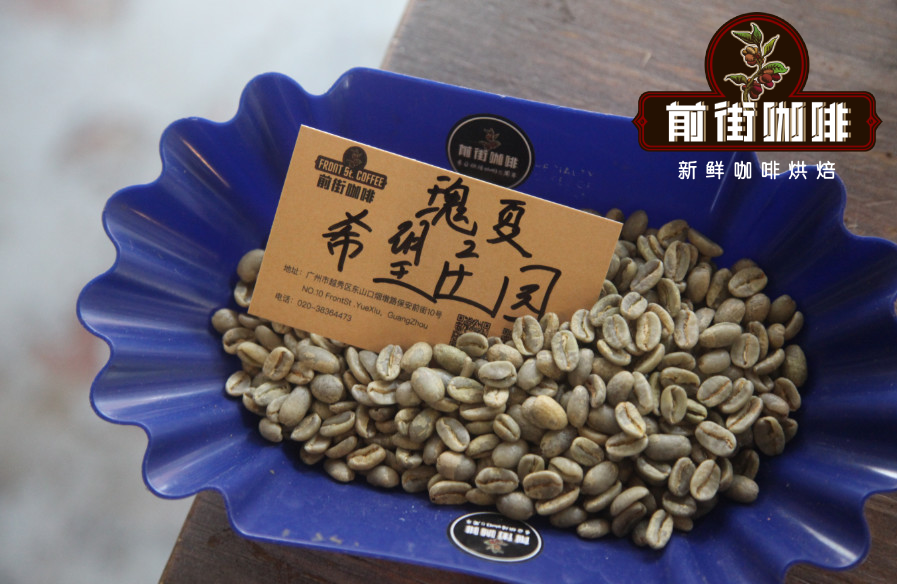
The variety of this FrontStreet Coffee La Esperanza bean is Geisha. Geisha is an original variety within the Arabica species, particularly picky about growing conditions: it needs high altitude, cloud and shade cover, fertile soil, and sufficient accumulated temperature. The Geisha variety was discovered in 1931 in the Geisha forest of Ethiopia and later sent to the Coffee Research Institute in Kenya. It was introduced to Uganda and Tanzania in 1936, and Costa Rica introduced it in 1953. The green beans have a beautiful blue-green color and smell of distinctly fermented fruit and orange aromas.
FrontStreet Coffee Roasting Analysis
Roaster: Yangjia 800N (300g batch size)

Set drum temperature to 160°C at charging, air damper at 3. After 30 seconds, adjust heat to 140, air damper unchanged. Return temperature at 1'42". When drum temperature reaches 140°C, adjust heat to 120, air damper to 4. At this point the bean surface turns yellow, the grassy aroma disappears completely, and the batch enters the dehydration stage. When drum temperature reaches 166°C, adjust heat to 110, air damper unchanged. At 7'50", ugly wrinkles and black spots appear on the bean surface and the toast aroma clearly shifts to coffee aroma, which can be defined as the prelude to first crack. Watch closely for the sound of first crack. First crack starts at 8'15"; adjust heat to 50, air damper to 5 (adjust heat very carefully, not so low that cracking stops). Development after first crack runs 1'28", discharging at 190°C.
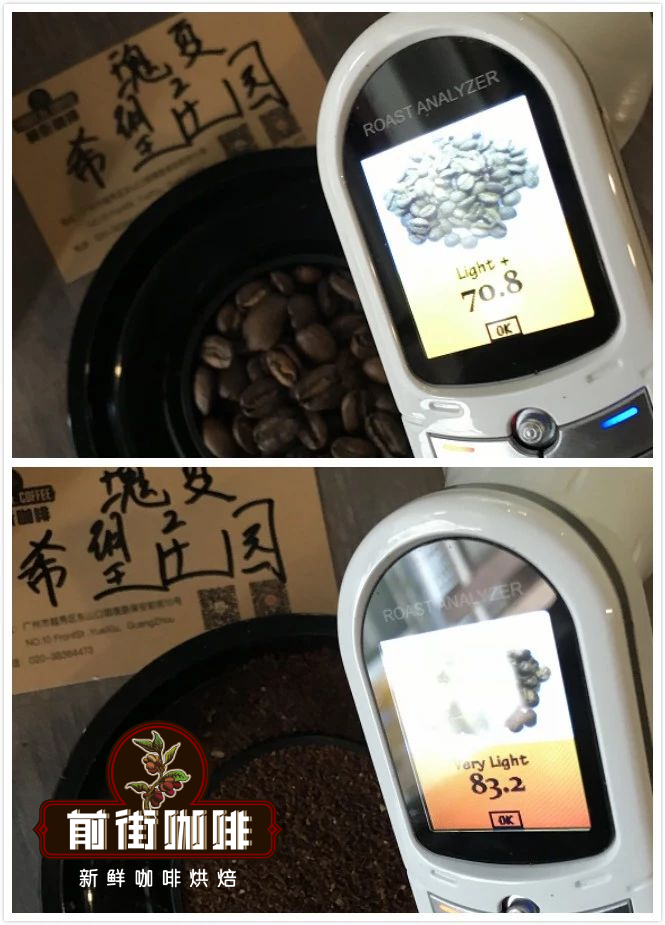
Agtron bean color value 70.8 (image above), Agtron ground color value 83.2 (image below), and a Roast Delta value of 12.4.

Eight hours after roasting finished, FrontStreet Coffee immediately cupped the coffee. From the dry aroma, FrontStreet Coffee picked up sweet-and-sour notes of grapes and berries. On the palate, FrontStreet Coffee clearly sensed full blackcurrant juice, followed by rich aromas of orange, smoked plum, and blueberry. As the temperature dropped, the juice-like sensation became more pronounced, and after swallowing one could clearly perceive a red wine finish, which was very comfortable.

Colombia La Esperanza Geisha
FrontStreet Coffee: Colombia · La Esperanza Geisha Coffee Beans
Country: Colombia
Region: Cauca
Altitude: 1,650M
Processing: Honey Process
Grade: SUPREMO
Variety: Geisha
FrontStreet Coffee Brewing Analysis
Dripper: Hario V60
Water Temperature: 90-92°C
Coffee-to-Water Ratio: 1:15-1:16
Grind Size: Fine sugar (80% pass-through rate on a China standard #20 sieve)

Brewing Method:
30g water for bloom, 30 seconds. Pour water in stages to 125g. When the water level drops and is about to expose the coffee bed, continue pouring to 225g and stop. When the water level drops and is about to expose the coffee bed again, remove the dripper (timing starts from the bloom). Extraction time is about two minutes.

Brewed with higher water temperature, this FrontStreet Coffee Colombia La Esperanza Geisha shows more prominent sweetness and tea-like notes, with citrus, plum, and bergamot acidity, mid-palate flavors of cinnamon and caramel, and a distinct oolong tea finish. Brewed with lower water temperature, the bean shows clear flavor layering: delicate floral aromas and citrus, orange, and lemon with slight berry acidity up front, then creamy, honey sweetness at mid-palate, and a finish with subtle oolong tea aroma and a sugarcane aftertaste.
FrontStreet Coffee Recommendation
Colombia's La Esperanza shows how far Geisha can travel beyond Panama, and FrontStreet Coffee carries several Geisha coffees that let you compare origins side by side. From Panama's Hacienda La Esmeralda, the Red Label Esmeralda Special is natural processed from the Jaramillo Mario plot at 1,600-1,800 meters, while the Green Label Private Collection is washed and shows lemon, berry, pomelo, and Tieguanyin tea notes.
From Ethiopia, the Geisha Village Gold Label is a natural-processed Gesha 1931 and the Geisha Village Red Label is a Gori Gesha scoring 88 points or above on the SCA scale. All of them are roasted light to medium and brewed best by pour-over with a V60 at 90-92°C, with a 1:16 ratio, to keep the floral aromatics and layered fruit acidity intact.
Important Notice :
FrontStreet Coffee is a long-established specialty coffee roaster in Guangzhou China, selling freshly roasted beans from its own farm in Yunnan as well as dozens of carefully selected single-origin beans from around the world for both pour-over and espresso. The products deliver consistently excellent quality and great value, with shipping within 24 hours. Guangzhou's FrontStreet Coffee shop is recommended by many coffee lovers, and the beans are now available online at the Tmall 。
FrontStreet Coffee has moved to a new address:
FrontStreet Coffee Address: 315,Donghua East Road,GuangZhou
Tel:020 38364473
 Scan and follow the En Gafei WeChat official account. Please indicate that the reprint comes from "En Gafei".