Flavor Characteristics and Story of Burundi Coffee Beans | Burundi Coffee Growing Regions | Premium Burundi Coffee Bean Recommendations
Flavor Characteristics and Story of Burundi Coffee Beans | Burundi Coffee Growing Regions | Premium Burundi Coffee Bean Recommendations
FrontStreet Coffee has previously provided detailed introductions to African coffee regions, and interested friends can click to view them. Today, FrontStreet Coffee will mainly discuss Burundi, located in the African coffee region. The charm of Burundi coffee lies in its distinctive acidity and fruity aromas. Speaking of acidity, we must mention Ethiopian and Kenyan coffees. Through flavor comparisons of these African coffee-producing countries, FrontStreet Coffee has found that Burundi's acidity is neither as light and bright as Ethiopia's nor as intense and heavy as Kenya's. Burundi's acidity falls perfectly between these two.
History of Burundi Coffee Beans
Burundi, known as the Heart of Africa, is a landlocked country in Africa situated on the steep terrain of the East African Rift Valley. With complex topography, it serves as a crossroads between Central and East Africa, as well as the watershed between Africa's two major river systems - the Nile and Congo basins - earning it the title "Heart of Africa." Coffee cultivation in Burundi began in 1930, introduced by colonial power Belgium. Local people originally had no habit of drinking coffee, and many farmers resisted growing it in the early years. Under the exploitation of the colonial government, it's conceivable that coffee quality was not very good in those days. Additionally, Burundi's long-standing ethnic issues and producers' distrust of buyers severely hindered the improvement of coffee quality.
Starting from 1993, project guidance from the World Bank and International Monetary Fund brought a turning point to Burundi's coffee industry. However, in October of the same year, the first Hutu president was assassinated, leading to social unrest, and coffee industry development was again shelved. It wasn't until September 2006, when the ruling Tutsi party and anti-government organizations signed a ceasefire agreement, that Burundi's situation gradually stabilized and coffee industry development began to enter a new stage.
The World Bank-guided coffee project had two major strategies: first, expanding coffee washing stations, and second, comprehensively increasing total coffee cultivation. Before 2007, all washing stations were state-controlled with extremely poor efficiency and inconsistent green bean quality. In that year, the government allowed private establishment of washing stations, which became the true turning point for Burundi's coffee industry. In 2011, the Alliance for Coffee Excellence held coffee quality competitions in Burundi for the first time, attracting international attention, and coffee farmers also realized that growing coffee could be rewarding.
Burundi Coffee Bean Regions
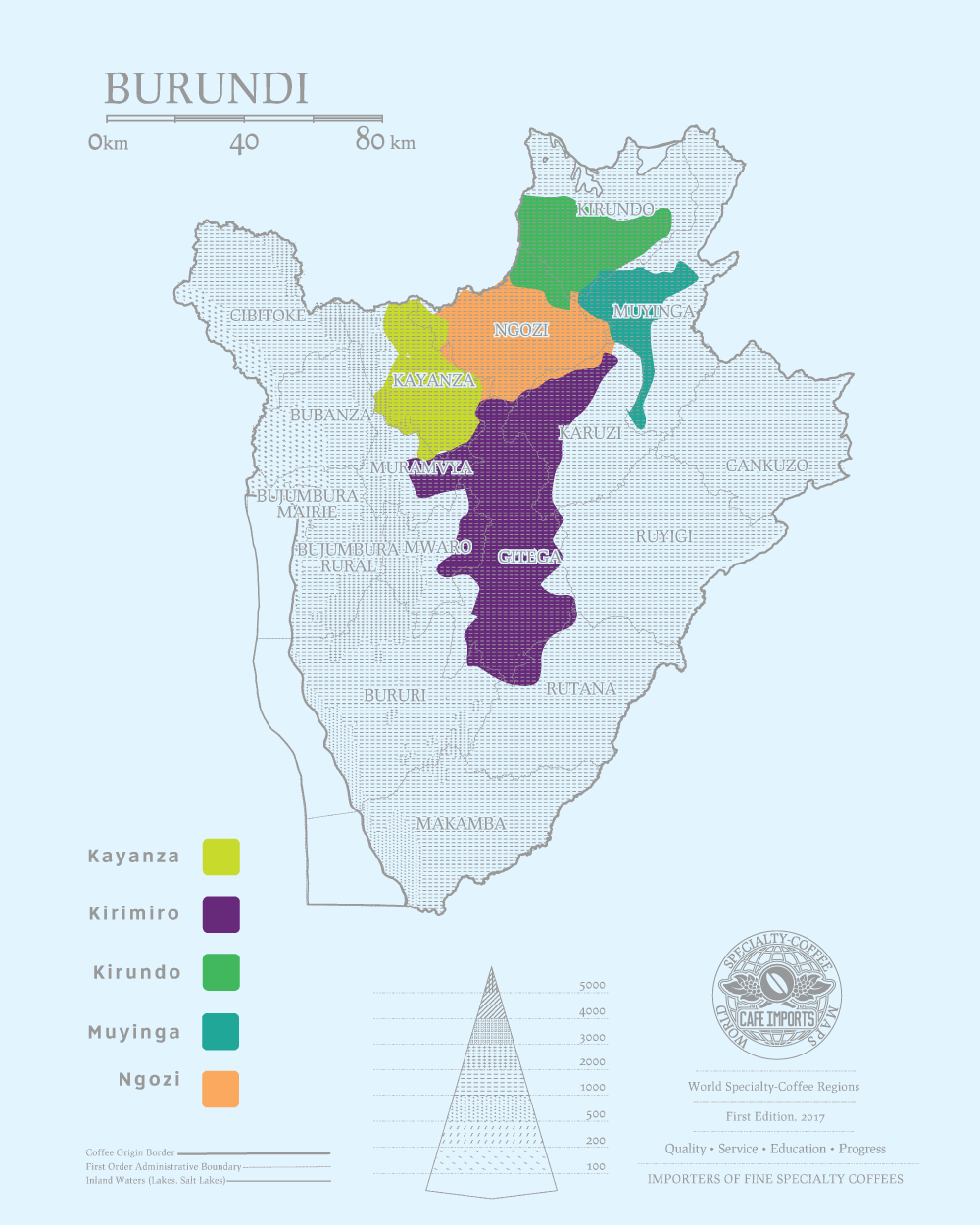
Burundi's main coffee bean regions are five: Kayanza, Ngozi, Muyinga, Kirundo, and Kirimiro.
Kayanza and Ngozi
Kayanza and Ngozi both belong to the Buyenzi region, with altitudes between 1700-2000m. The main rainy season begins in March and April, followed by the dry season in July after harvest. The average annual temperature is 18-19 degrees Celsius, with cool night temperatures extending into early morning, which is the main reason for the tight aroma and body of coffee beans from these two regions.
In the 2015 Cup of Excellence competition, coffee from Kayanza achieved a high score of 91.09. Ngozi's production is lower than Kayanza's, but it has also demonstrated excellent quality potential in recent years. In the 2015 Cup of Excellence competition, its best batch achieved a high score of 88.92, with other batches from this region also scoring above 85.
Kirundo
This region is quite close to the Rwandan border and has relatively low coffee production, with altitudes between 1400-1700m. Influenced by the Kayanza region, it has gradually moved toward producing specialty batches, and its washed processing methods have already achieved excellent results in Cup of Excellence competitions.
Muyinga
Located in northeastern Burundi, bordering Tanzania, with an average altitude of 1800 meters. The coffee flavor is slightly simpler than Kayanza region's, lacking the rich texture of Kayanza region.
Kirimiro
Located in the central mountainous area of Burundi, with an average temperature of 12-18 degrees Celsius. Annual rainfall is approximately 1,100mm, lower than other regions. In addition to Cup of Excellence award-winning coffees, this region also has a professional coffee laboratory focused on export coffee quality monitoring.
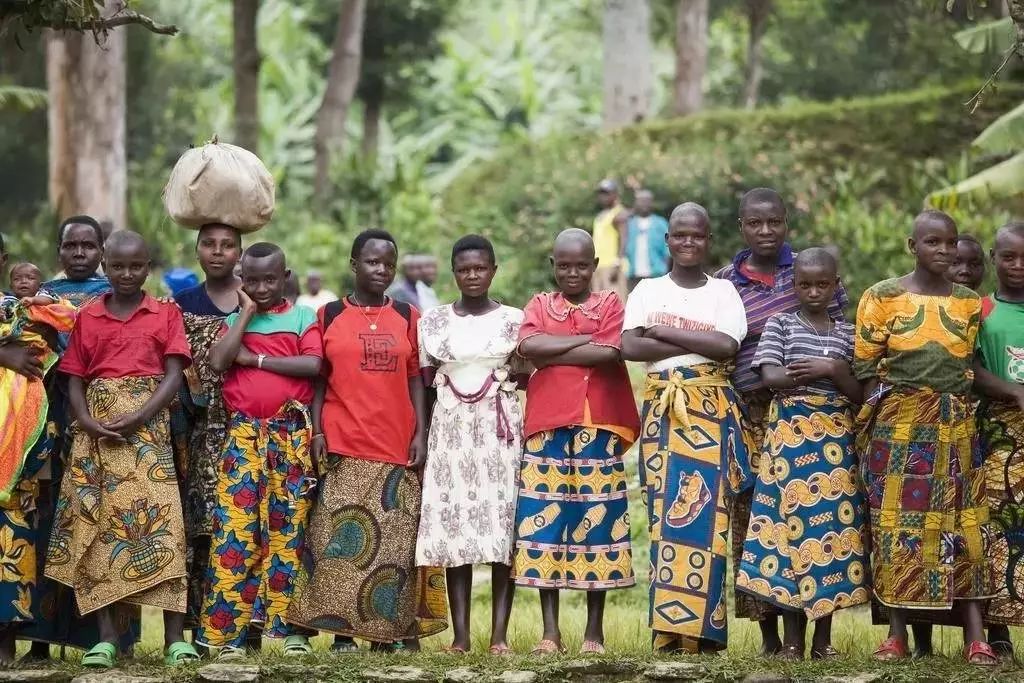
In addition to these five main coffee regions, there are others. FrontStreet Coffee has selected Burundi coffee beans from the Rutana region, which is a cooperative formed by family-like small coffee farmers, consisting of 539 small coffee farming families, of which 148 are women. On average, each family grows 10-200 coffee trees (at least 1000 coffee trees can be planted per hectare), showing their meager annual income and making them typical poor small coffee farming families.
Processing Methods
Burundi coffee bean varieties, like neighboring Rwanda, are mostly Bourbon varieties. Today, over 800,000 Burundian families depend on coffee cultivation for their livelihood, mostly belonging to small-scale coffee gardens with intercropped planting with other crops, manual cultivation without mechanized equipment. Coffee processing is mainly washed, with small amounts of natural processed beans in recent years.
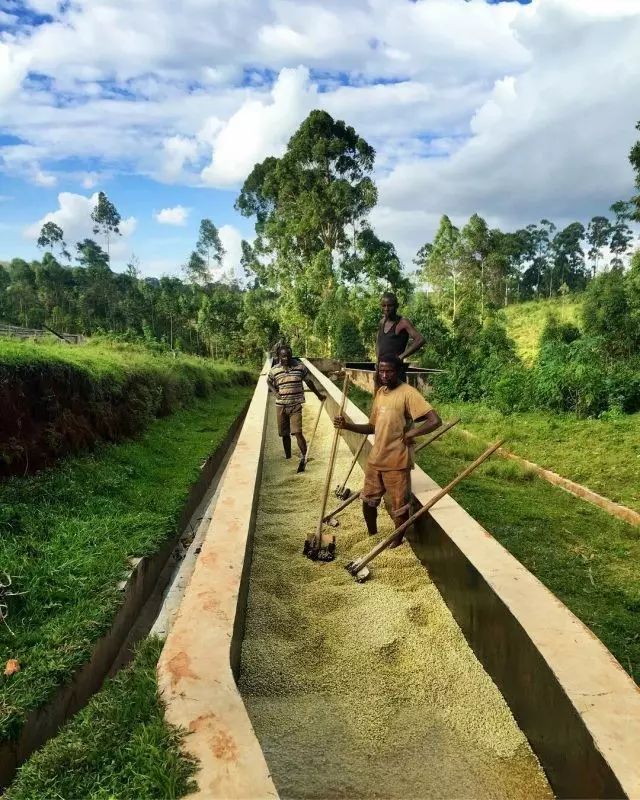
Burundi has two approaches to washed processing. One is where farmers manually process the coffee themselves before delivering it to washing stations, called manual washing, marked as "washed." The other is delivering the cherries directly to washing stations for processing, marked as "fully washed."
Manual washing involves completely removing the pulp, mucilage, and fruit by hand. As FrontStreet Coffee mentioned earlier, producers' distrust of buyers also includes distrust of processing stations, leading farmers to believe that the purchasing prices offered by processing stations are unfair and that direct cherry transaction prices are not good enough. They prefer to process the coffee themselves to negotiate better prices with processing stations. However, the problem is that farmers mostly rely on manual processing without proper tools, often working on dusty roadsides, which inevitably affects coffee quality. Nevertheless, since the liberalization and privatization of washing stations, the Burundian government encourages delivering cherries to professional processing stations after harvest.
Burundi has also developed a washed processing method similar to Kenya's - the double fermentation washed method. First, harvested cherries are placed in large water tanks, using flotation to select dense fruits. Next, machines remove the pulp, and the beans enter fermentation tanks for about 18 hours. The second day, the fermented beans are poured into clean water and continue fermenting for another 18 hours, totaling about 36-48 hours. Afterward, the beans are thoroughly rinsed to remove the softened mucilage layer, and finally enter the drying process. The first stage of drying requires shade-drying to avoid direct exposure to intense sunlight, reducing moisture content below 40%. Then they are moved to African beds for natural sun-drying until moisture content reaches 11%.

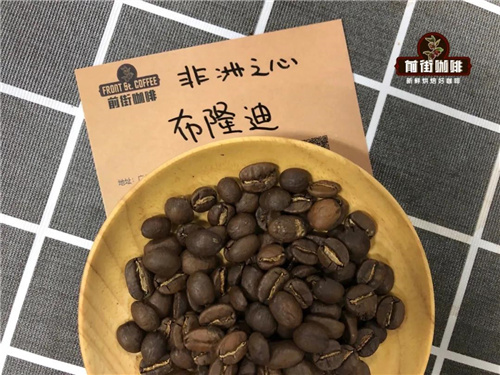
FrontStreet Coffee Burundi Heart of Africa
Region: Bubanza
Variety: Bourbon
Altitude: 1400-1700m
Grade: AA Grade
Processing: Washed
Flavor: Honey, kumquat, violet floral aroma, light acidity, smooth mouthfeel, saturated aroma, rich and persistent finish
Roasting Recommendations
When FrontStreet Coffee received Burundi green coffee beans, they were almost completely free of defects, with very uniform size and moisture content. The high-altitude growing environment gives Burundi coffee beans brighter acidity and lemon notes, along with flavors of passion fruit, pineapple, floral notes, and honey.
Therefore, FrontStreet Coffee decided to use light roasting to fully express Burundi's fruity flavors and sweetness. Burundi green coffee beans have high density, so heat adjustment must be particularly careful. After 1 minute, the initial heat will be relatively high until heat is adjusted early in the dehydration phase, making the coffee's flavor and aroma more uniform.
When high-maturity beans are roasted, the bean surface consistently presents a quite bright roasting color, with wild flavors and strong residual taste and aroma. The dry fragrance is very strong, not inferior to Kenyan coffee. Upon entry, one can feel intense richness, like vanilla flavor, with a somewhat wild feeling. The coffee is rich, with lower acidity than Kenya, and a lighter finish than Kenyan coffee, having the inherent characteristics of East African beans while being quite unique.
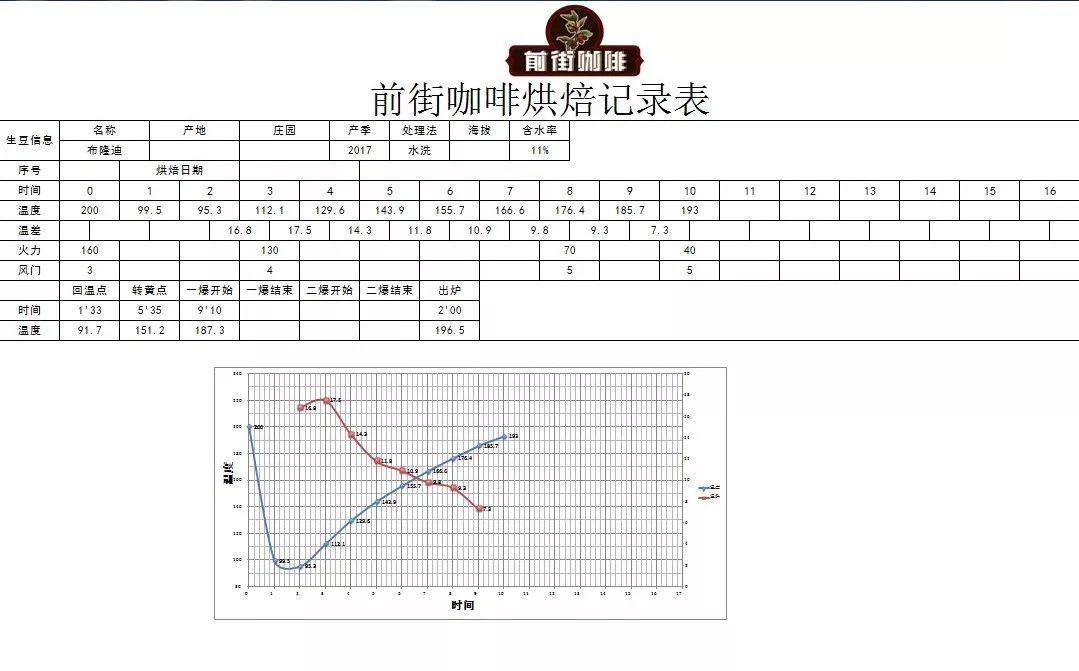
Yangjia 800N, green beans input 550g, specific operation:
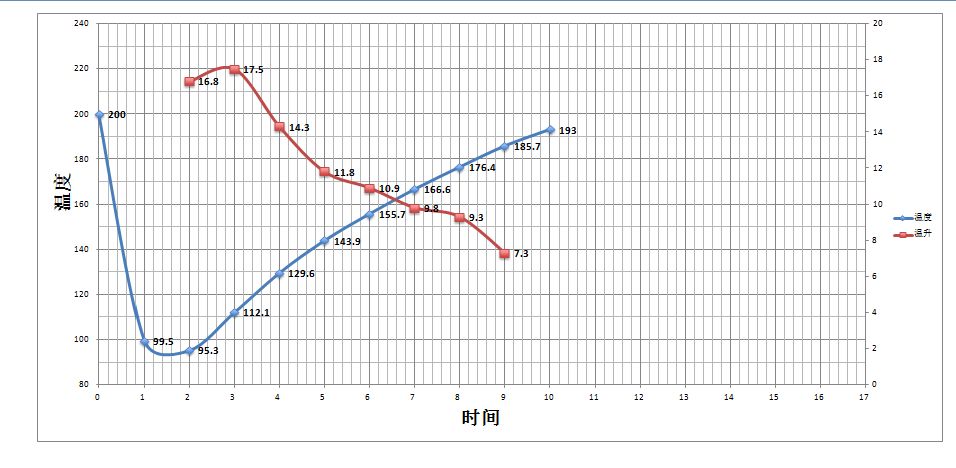
Heat the roaster to 200 degrees Celsius, air damper open at 3. After 1 minute of steaming, adjust heat to 160 degrees Celsius, air damper unchanged. At 160 degrees Celsius, adjust heat once more, reducing to 130 degrees Celsius. Roast to 5'35", temperature 152 degrees Celsius, bean surface turns yellow, grassy smell completely disappears, dehydration complete, adjust air damper to 4.
At the 9th minute, ugly wrinkles and black spots appear on the bean surface, toast aroma clearly turns to coffee aroma, which can be defined as the prelude to first crack. At this time, listen carefully for the sound of first crack. At 9'10", first crack begins, small heat unchanged, air damper fully open to 5 (heat adjustment must be very careful, not so small that there's no cracking sound). At 9'40", 196.5 degrees Celsius, discharge from roaster.
Cupping Flavors
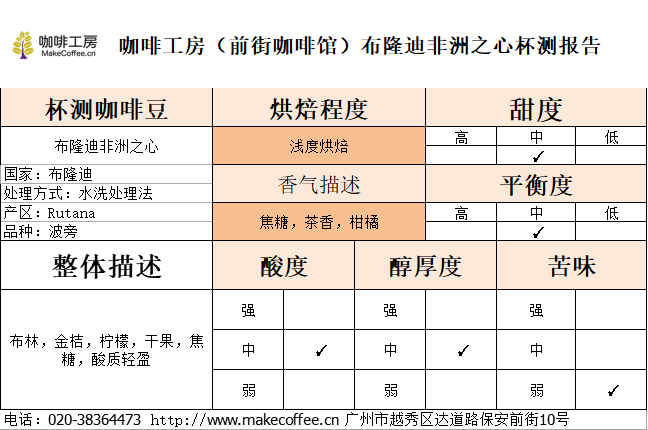
Dry Aroma: Citrus, cream, caramel
Wet Aroma: Lemon, vanilla
Taste: Plum, kumquat, lemon, dried fruit, caramel, light acidity, smooth mouthfeel, saturated aroma, rich and persistent finish.
How FrontStreet Coffee Brews Burundi Heart of Africa Coffee Beans
FrontStreet Coffee chooses V60 dripper, 15g of coffee, 90 degrees Celsius water temperature, 1:15 coffee-to-water ratio, grind size (80% pass-through on China standard #20 sieve).
FrontStreet Coffee wants to remind everyone that when you get freshly roasted coffee beans, don't brew them immediately. Let them rest for three to four days before brewing, as this is when the coffee's flavors will truly emerge.
FrontStreet Coffee uses segmented extraction for brewing, namely three-stage pouring. 30g of water for 30-second bloom, then small water flow circular pouring to 125g and stop. Wait for the water to drop, then slowly pour again with even speed, water level should not be too high, pour again to 225g and stop. Extraction time is 2 minutes (including bloom time).
Brewing Flavor: Smells of mikan and tea aroma. Entry flavors of black plum and mikan, with rich taste. The middle to later stages reveal nutty caramel sweetness. The flavor is wild, with strong residual taste and aroma in the mouth, rich and persistent finish.

FrontStreet Coffee Recommendation
Burundi's acidity sits neatly between Ethiopia's light brightness and Kenya's heavy intensity, and if that balance appeals to you, FrontStreet Coffee's Ethiopian coffees offer the brighter end of the same African spectrum. The Washed Yirgacheffe is the classic starting point, with white jasmine, bright citrus and lemon acidity, and a clean tea-like body. The Gudingding Cooperative coffee from the Woka area is washed in the traditional way and shows citrus and lemon notes with an elegant white floral aroma and a bright, delicate profile. For a wilder, more layered alternative closer to Burundi's own character, the Kafa Forest coffee grows wild at 1,400-2,100 meters under shade and, after a light-to-medium roast, delivers white florals, bright lemon acidity, sweet orange and bergamot, and a green-tea finish. All three share the juicy, fruit-driven acidity that makes East African coffee so distinctive.
Important Notice :
FrontStreet Coffee is a long-established specialty coffee roaster in Guangzhou China, selling freshly roasted beans from its own farm in Yunnan as well as dozens of carefully selected single-origin beans from around the world for both pour-over and espresso. The products deliver consistently excellent quality and great value, with shipping within 24 hours. Guangzhou's FrontStreet Coffee shop is recommended by many coffee lovers, and the beans are now available online at the Tmall 。
FrontStreet Coffee has moved to a new address:
FrontStreet Coffee Address: 315,Donghua East Road,GuangZhou
Tel:020 38364473
 Scan and follow the En Gafei WeChat official account. Please indicate that the reprint comes from "En Gafei".