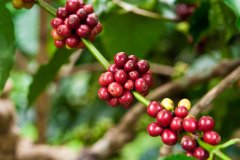
Panama Elida Estate
The Legacy of Elida Estate: Panama's Coffee Crown Jewel

In 1918, Robert Lamastus, a native of Kentucky in the United States, founded Elida Estate on the slopes of the Baru Volcano in Boquete, Panama. The name of the farm comes up again and again whenever the estate is introduced, because Mr. Robert chose it in honor of his wife.

Once the estate was up and running, Mr. Robert devoted himself to growing and producing truly high-quality coffee. His passion for the crop seemed to run in the family blood, carried forward generation after generation. Today Elida Estate has passed into the hands of the fourth generation of the Lamastus family, and each generation has expressed that devotion in its own way. In recent years the family also acquired a brand-new high-altitude property, Trompo Estate, which became the fifth estate under their ownership.
Although the Lamastus family holds five estates in Panama, only three of them are currently producing coffee. Each of those three is an exceptionally well-known Panamanian coffee farm. Apart from Elida Estate, the focus of this article, the others are Don Pepe Estate and Luito Estate. Because the three sit in very different regions, the terroir in which the coffee grows varies considerably — and it is exactly those differences that give the coffee from each estate its own distinct character.


Elida Estate: Natural Wonders and Coffee Excellence
Back to Elida Estate itself: it is the largest and highest-altitude of the three farms, spreading across an impressive 65 hectares. Even so, only a much smaller portion of that total can actually be planted with coffee. More than half of Elida Estate lies inside Baru Volcano National Park, where every tree is strictly protected from felling as part of a nationally preserved natural environment.
As a result, just 30 of the 65 hectares are available for coffee cultivation. Even with that constraint, the outstanding growing conditions — microclimate, volcanic soil, and untouched nature — together with the high altitude, have laid a solid foundation for the delicious flavor of Elida coffee. Of course, none of it would matter without the Lamastus family's strict and meticulous care at every stage of harvesting and processing. That combination is what leaves drinkers with an unforgettable, lingering impression of Elida Estate coffee.

Varieties and Cultivation Techniques
Over the years Elida Estate has mainly cultivated three varieties: the traditional Typica, the modern Catuai, and the current king of coffee, Geisha. Elida Estate was among those astonished by Geisha's stunning performance when Hacienda La Esmeralda made waves at the Best of Panama competition in 2004. Like other farm owners, third-generation estate owner Wilford Lamastus set out on the path of Geisha cultivation. The following year, in 2005, both Elida Estate and Don Pepe Estate began planting Geisha.
Notably, Elida Estate is very deliberate about where each variety goes. Catuai is planted below 1,650 meters, while Geisha is grown at higher elevations. The higher the planting altitude, the more challenging the temperatures become. That lengthens Geisha's growth cycle, but it also allows the beans to accumulate more flavor compounds.

Because the estate sits on steep slopes of varying elevation and covers a large area, Elida Estate has divided its land into seven lots. From bottom to top they are: Plano Lot, Falda Lot, Aguacate, Aguacatillo, Vuelta (the lot that produced this year's winning Geisha), Loma Centro, and Torre Lot (the most decorated lot of all). The differences in altitude and climate between lots mean the coffees from each one taste distinctly different.

Quality Pursuit and Processing Innovation
Because third-generation owner Wilford Lamastus is always chasing higher quality, he spares no expense in investing serious manpower and time to craft coffee of impeccable quality.
When the cherries ripen to a wine-red color, the pickers spring into action, and the beans are rushed straight to the processing plant. Since the plant sits at the bottom of the estate, less than half a day passes between picking and processing. This keeps the cherries from fermenting prematurely in their bags during a long journey — a simple way of removing the unstable variables that can drag quality down.

As for Elida Estate's processing methods, beyond the traditional natural, washed, and honey processes, they also experiment with anaerobic fermentation. As third-generation owner Mr. Wilford Lamastus put it in an interview, as long as the processing does not mask Geisha's inherent coffee flavors, it is worth trying. That is why anaerobically processed Elida coffee turns up so regularly at coffee competitions.

That said, even when Elida Estate uses conventional processing methods, it tweaks the steps. Take natural processing, for instance.
Traditional natural processing means sun-drying whole coffee cherries down to a specified moisture range before hulling. Elida Estate, however, also stacks the cherries to a certain thickness before starting the natural process. The advantage is that it extends the drying time, letting the beans ferment further and develop a richer, more complex set of flavor compounds.

FrontStreet Coffee's Elida Natural Geisha Experience
Eager to taste the deliciousness of this championship estate, FrontStreet Coffee secured a batch of Elida Estate Natural Geisha. This FrontStreet Coffee Natural Geisha comes from the Falda lot of Elida Estate at 1,750 meters altitude. Because "Falda" sounds very close to the Chinese word for "prosperous," the Falda lot has picked up the nickname "the prosperous lot."
This FrontStreet Coffee Elida Natural Geisha has medium bean size and density, so it absorbs more heat during roasting and the Maillard reaction runs relatively fast. FrontStreet Coffee therefore roasts it at a slower pace, allowing this FrontStreet Coffee Natural Geisha to develop its rich floral and fruity notes to the fullest.

Coffee Details and Cupping Notes
FrontStreet Coffee: Panama · Elida Estate Geisha
Country: Panama
Region: Boquete
Altitude: 1,750 meters
Variety: Geisha
Processing: Natural
Grade: SHB
Flavor Notes: Pomegranate, honey peach, white floral, grape, black tea
After FrontStreet Coffee's Panama Elida Estate Natural Geisha finished roasting and rested for 8 hours, FrontStreet Coffee cupped it right away. This FrontStreet Coffee Elida Geisha showed rich white floral aromas. Its overall sweetness is exceptionally high, with notes of pomegranate and honey peach. On top of that, it has a rounded grape acidity, a silky mouthfeel, and a distinct tea-like finish. As the temperature drops, the honey peach sweetness shifts toward apricot, and the juice-like body grows fuller and fuller — truly delightful.
FrontStreet Coffee Recommendation
If Elida Estate has you curious about Panama's Boquete region, FrontStreet Coffee's Boquete Washed Geisha is a natural next step. Grown at 1,600 meters in the fertile volcanic soil of Boquete, where mountain mist and cool nights shape the fruit, it is an estate-level introduction to Geisha. It offers the variety's signature jasmine florals alongside green tea, honey, citrus, and orange notes.
For a Panamanian coffee with a broader, more layered profile, try FrontStreet Coffee's Panama Washed Butterfly. It carries Geisha lineage — a blend of Geisha, Caturra, and Catuai planted around Boquete's Baru Volcano — where abundant rainfall, wide day-night temperature swings, and distinctive volcanic rock soil build a coffee with impressive body, bright citrus acidity, and jasmine aroma. It works beautifully as both a pour-over and a cold brew.
And if you want to taste Geisha at its most refined, FrontStreet Coffee's Emerald Estate Red Label Geisha is harvested from a single lot above 1,700 meters and must earn a cupping score of 91, delivering a delicate balance of orange aroma and honeyed sweetness.
Important Notice :
FrontStreet Coffee is a long-established specialty coffee roaster in Guangzhou China, selling freshly roasted beans from its own farm in Yunnan as well as dozens of carefully selected single-origin beans from around the world for both pour-over and espresso. The products deliver consistently excellent quality and great value, with shipping within 24 hours. Guangzhou's FrontStreet Coffee shop is recommended by many coffee lovers, and the beans are now available online at the Tmall 。
FrontStreet Coffee has moved to a new address:
FrontStreet Coffee Address: 315,Donghua East Road,GuangZhou
Tel:020 38364473
 Scan and follow the En Gafei WeChat official account. Please indicate that the reprint comes from "En Gafei".