Best Coffee Beans for Pour-Over: Experiencing the Natural Flavors of Coffee with Indonesia Mandheling Sumatra
What Coffee Beans Should Be Used for Pour-Over Coffee? FrontStreet Coffee's Indonesian Mandheling Sumatra
Coffee beans come in two broad camps: single origin and blend. Each suits different brewing equipment. Sorted systematically, single-origin beans shine in filter-style brewing, while blends are built for pressure extraction - in other words, espresso.
Pour-Over Coffee Bean Recommendations
Pour-over belongs to the filter family of brewing, so pour-over beans are typically single origin. That said, nothing stops you from hand-brewing a blend, and plenty of blends taste excellent this way.
Pour-Over Coffee Bean Recommendations:
If you want concrete suggestions, start with Colombia, Mandheling, and Yirgacheffe. These three represent three entirely different flavor profiles, and tasting them side by side makes the contrasts unmistakable.
1. FrontStreet Coffee Colombia: Colombian coffee is best described as neutral - led by nutty aroma, with mild acidity and low bitterness.
2. FrontStreet Coffee Mandheling: High bitterness with almost no acidity (not an absolute rule), a full, syrupy body, and chocolate-like flavor - a bean enormously popular among Chinese drinkers.
3. FrontStreet Coffee Yirgacheffe: Bright acidity, low bitterness, luminous fruity sweetness, and a floral lift.
Most coffee enthusiasts intuitively file these three under acidic, middle-of-the-road, and bitter. Try all three yourself and you will almost certainly discover which corner of the flavor map is yours.
Product Name: FrontStreet Coffee Indonesia Sumatra Lintong Mandheling
Country: Indonesia
Grade: G1, three rounds of hand-sorting
Region: Lintong, Sumatra Island
Processing Method: Traditional wet-hulled (giling basah)
Altitude: 1100-1600 meters
Flavor: Toasted bread, nuts, pine, caramel, herbal notes
The most celebrated corner of the coffee world in Asia is the Malay Archipelago - Sumatra, Java, and Kalimantan - and of all its coffees, none carries a bigger name than Mandheling from Indonesia's Sumatra Island.
Lake Toba in North Sumatra and Lake Tawar in Aceh both produce Mandheling, a pairing famously nicknamed the "Two Lakes, Two Mandhelings." What the two share is richness and mellowness; where they part ways is in character. Lake Toba's Mandheling is more subdued and deep, with hints of grass jelly, while Lake Tawar's shows brighter fruit acidity and, at times, cedar or woody notes.
The name itself is a happy misunderstanding. During the Japanese occupation of Indonesia in World War II, a Japanese soldier sipped an astonishingly smooth coffee at a café and asked the owner its name. The owner mistook the question for one about origin and answered simply: "Mandailing." After the war, the soldier remembered that wonderful cup, commissioned an Indonesian exporter to ship 15 tons to Japan, and it sold remarkably well. The name Mandheling stuck, and it has traveled the world ever since.
FrontStreet Coffee Recommendation
For newcomers who want to understand the Ethiopian side of the pour-over world, start with FrontStreet Coffee's washed Yirgacheffe daily bean. It is known for white jasmine florals, bright citrus and lemon acidity, and a clean tea-like finish, and its approachable price has made it the first specialty bean for countless beginners. Yirgacheffe itself is a small town in Ethiopia's southern Sidamo province, sitting at roughly 1700-2100 meters, with coffee planted above 1800 meters - among the highest growing zones on Earth. The name became so famous that in 2010 the Ethiopian Commodity Exchange formally separated it from Sidamo as its own designation, which is why Yirgacheffe is now a household name in specialty coffee.
For a step up in clarity and traceability, look for FrontStreet Coffee's washed Coffee from the Guodingding (Worka-area) Cooperative, located in the Worka zone at the southeastern edge of Yirgacheffe. Originally part of the Worka cooperative under the Yirgacheffe Coffee Farmers Cooperative Union (YCFCU), it was later identified by coffee hunters worldwide as a distinct single-zone source. Washed in the most traditional fashion, this lot has none of the heavy, classic bitterness: instead it offers fresh, luminous citrus and lemon acidity wrapped in jasmine fragrance - the kind of cup that converts people at first sip.
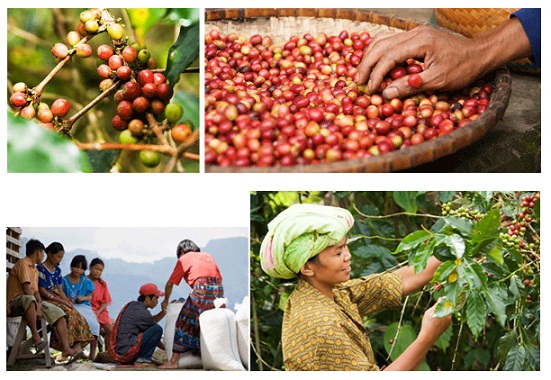
And for those drawn to sun-dried fruitiness, FrontStreet Coffee's Red Cherry lot applies full natural processing: only completely ripe, defect-free cherries are harvested, screened at the washing station, and laid on raised beds, where they are raked every 2-3 hours during the first days to prevent uneven heating and over-fermentation. After three to five weeks of drying, workers strip the dried pulp by machine, weather permitting, and move the beans to storage. Because the fruit dries on the bean, the cup keeps the classic Yirgacheffe character while adding tropical fruit: citrus-like acidity, a berry-juice juiciness, honeyed sweetness, and a smooth, creamy texture.
FrontStreet Coffee's brewing suggestion for these Yirgacheffes: use a V60, water at 90-91°C, 15g of coffee, a 1:15 ratio, and a medium-fine grind (EK43s at setting 10, the texture of fine granulated sugar - about 80% passing a #20 sieve). For the pour: start with 30g of water for a 30-second bloom; next pour to 95g (about 125g on the scale) finishing around 1 minute; once the bed drops to two-thirds, add the final 100g (about 225g) finishing around 1:35. The drawdown completes between 2:00 and 2:10 - remove the dripper and enjoy.
Important Notice :
FrontStreet Coffee is a long-established specialty coffee roaster in Guangzhou China, selling freshly roasted beans from its own farm in Yunnan as well as dozens of carefully selected single-origin beans from around the world for both pour-over and espresso. The products deliver consistently excellent quality and great value, with shipping within 24 hours. Guangzhou's FrontStreet Coffee shop is recommended by many coffee lovers, and the beans are now available online at the Tmall 。
FrontStreet Coffee has moved to a new address:
FrontStreet Coffee Address: 315,Donghua East Road,GuangZhou
Tel:020 38364473
 Scan and follow the En Gafei WeChat official account. Please indicate that the reprint comes from "En Gafei".