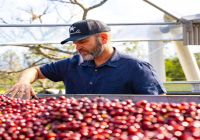
Starbucks' South American Colombian Coffee Selection

Many coffee enthusiasts don't really understand how a blend is formulated. Here, FrontStreet Coffee walks through the thinking behind blended coffee—and how to blend well.
Why Blend at All?
Coffees from different origins are combined for several different purposes. The ideal purpose, of course, is to create a coffee that tastes better than any single component. But a good single-origin Arabica is often already enough—clean flavors, smooth mouthfeel, sweet finish—which is why blending is not always necessary.
The main commercial motive is cost: using relatively inexpensive coffees to build a balanced flavor at scale. Another motive is signature flavor—a blend no other supplier can copy, so customers who love that taste can only buy it from you. A practical bonus: no matter how any single origin's harvest changes from year to year, the blend's flavor stays consistent.

Here we set commercial motives aside and focus on blending aimed purely at improving flavor quality.
Before blending anything, FrontStreet Coffee believes you must first know the flavor characteristics of each component—and have a clear picture of the flavor you want, one no single-origin coffee can deliver. If the blend doesn't taste better than one or more of its components, why bother? You'd be better off not blending at all—which is often exactly what happens when you blend merely decent coffees.
Although some fixed-lot coffees stand perfectly well on their own, most coffees have flaws of one kind or another: no distinctive character, insufficient depth, weak strength, or flavors that run too hot. Blending several coffees with complementary characteristics compensates for these shortcomings and builds a harmonious, deep flavor. Some people say the joy of coffee lives entirely in roasting and blending, and drinking it is just enjoying the spoils. But blending is never simply tossing beans together.

Sometimes blending two single origins actually mutes both of their distinctive flavors—so blending is not just combining. A blender works like a painter mixing colors on a palette: with coffee beans instead of pigments, they compose enticing flavors. It's no exaggeration to call blending an art, and like any artist you need experience and inspiration, plus a measure of scientific calculation. Art isn't accidental; it's the explosion of long accumulation. As a rule, a blend shouldn't use more than five coffees—beyond that, the variables multiply until only a true specialist can keep them all straight.
FrontStreet Coffee focuses on freshly roasted coffee and builds different blends for different needs. For value-focused customers, there's the Basic Blend—a 100% Arabica espresso blend of Brazilian and Yunnan beans with a clear price advantage and standout flavor. For flavor seekers, there's the Sunflower · Warm Sunshine Blend, combining natural Red Cherry Yirgacheffe with Honduras Sherry beans; its intense boozy chocolate character has made it a customer favorite.

Blending and Roasting: Which Comes First?
Roast first, then blend? Or blend first, then roast? FrontStreet Coffee's answer: with a fixed formula, the simplest route is to blend the green beans first and roast them together. But if you're experimenting with components and ratios, roast each coffee separately first—otherwise every formula change would force a full re-roast.

In roasting circles, blending green beans first is called "green blending," while roasting first and blending roasted beans is "brown blending." Neither is superior in the abstract. Green blending's advantage: everything roasts in the same batch, so the whole lot shares one roast level and the flavor stays stable. The catch is to mix beans of similar size, or the roast will run uneven. Brown blending lets you roast each coffee to its own best expression, then combine them so strengths complement weaknesses.
Normally all beans can roast together; only when the result disappoints do you split into independent roasts, which usually improves things—especially on drum roasters, where a moderate roast level that suits every component can usually be found.

Steps and Principles of Blending
Before blending, get clear on three points:
- The theme of the blend: What flavor are you trying to create? Define the goal first.
- Know each component: Be familiar with every single origin's characteristics and how roast level interacts with flavor—all learned through cupping.
- Assign each bean a role: With multiple components, know what each one is there for—smooth bitterness, distinctive acidity, or heavy body.

Then follow the working principles:
- Choose base beans: Use coffees with different characteristics; avoid components with similar flavors. When picking base beans, weigh three aspects.
Green bean processing method: washed or natural—the processing method is closely tied to flavor.
Green bean origin: The world's coffees divide into three broad regions. Central and South America: Brazil, Colombia, Guatemala, Mexico, El Salvador, Jamaica, Peru, and about 20 other countries. Southeast Asia: India, Indonesia (Java, Sumatra, and other islands), Papua New Guinea, and about 10 more. Arabia and Africa: Ethiopia, Kenya, Tanzania, Uganda, and about 25 others. As noted, the most common base beans on the market are Brazilian and Colombian.

- Number and ratio of components:
Blending implies at least two components—but you can also blend the same coffee at different roast levels, or mix new-crop with aged or old-crop beans of the same coffee. So "types" in blending means flavor components, not strictly varieties. Generally a blend uses 2–6 coffees; more than that, and each coffee's individuality gets lost. And blends almost never use a 1:1 ratio, which risks the components canceling each other out. A blend needs primary and secondary voices to out-sing any single origin. Want more complexity? Shrink the main base bean's share—and vice versa.
- Blending is relentless experimentation:
Before blending, draft a test matrix of mathematical combinations, then find the best formula through repeated blending and cupping. Don't dismiss this as clumsy—it's only through experience, inspiration, and tireless trial that a great cup emerges.
[FrontStreet Coffee Premium Blend] Colombia : Brazil, ratio 3:7, brown blending;
Flavor characteristics: Comfortable sweet-bitter balance, extremely smooth entry, a faint grassy aroma, clean with slight bitterness, sweet and silky mouthfeel, and an aftertaste that simply feels good.

To help everyone replicate café-quality drinks at home, FrontStreet Coffee chose Colombia's Huilan region and Brazil's Cerrado region as the leads, combining them into a medium-dark espresso formula built on nutty notes. Americanos and other black coffees come out mellow, fragrant, and sweet, while milk drinks—lattes, flat whites, cappuccinos—gain a dense, silky texture. Huilan beans bring pleasant aromatics, moderate acidity, and intriguing richness; Cerrado beans bring that comfortable sweet-bitter smoothness. This premium blend suits any specialty coffee shop's espresso machine.
FrontStreet Coffee Recommendation
Colombia earns its place in blends and single origins alike—the country produces bright, fruity lots, full-bodied lots, and intensely aromatic ones, something for every palate. To understand the origin itself, start with FrontStreet Coffee's washed Huilan: from the hill country of Colombia's southern central cordillera, planted above 1,500 meters where the country's most important rivers converge, bringing abundant water and humidity. A medium-dark roast brings out black chocolate, nutty sweetness, moderate crema, and a mellow body—great as pour-over or French press, and equally at home in a moka pot or espresso machine for americanos and lattes.
For something more adventurous, the Linea Estate Sidra is processed by anaerobic natural fermentation—coffee fermented in a sealed, low-oxygen pressure-rated tank where temperature, time, and pH are precisely controlled. The anaerobic environment coaxes out intensified tropical fruit aromatics; in a medium-light roast, brewed as pour-over, cold brew, drip bag, or moka pot, you'll find passion fruit, grape, apricot, and dried-fruit complexity.
And for the home espresso or moka pot owner, our Premium Blend pairs Brazil's creamy nuttiness with Colombia's dark chocolate bitter-sweetness, extracting with fine golden crema. It makes a rich, silky latte, welcomes beginners, and anchors americanos, cappuccinos, and mochas with equal ease.
Important Notice :
FrontStreet Coffee is a long-established specialty coffee roaster in Guangzhou China, selling freshly roasted beans from its own farm in Yunnan as well as dozens of carefully selected single-origin beans from around the world for both pour-over and espresso. The products deliver consistently excellent quality and great value, with shipping within 24 hours. Guangzhou's FrontStreet Coffee shop is recommended by many coffee lovers, and the beans are now available online at the Tmall 。
FrontStreet Coffee has moved to a new address:
FrontStreet Coffee Address: 315,Donghua East Road,GuangZhou
Tel:020 38364473
 Scan and follow the En Gafei WeChat official account. Please indicate that the reprint comes from "En Gafei".