The Premium Coffee Powerhouse of Southern Central America - Costa Rica
Coffee Introduction
It has been a while since we introduced a coffee-producing country, so today let's explore how coffee is grown in Costa Rica.
A Personal Note
The first time Costa Rica caught my attention was during a World Cup year, when its team played with a spirit that was impossible to ignore.
Coffee Cultivation Overview
Coffee cultivation in Costa Rica began in 1779, when it was introduced from Cuba, and it was not until 1820 that coffee was first exported. There are currently around 32,000 coffee farmers, each cultivating an average area of less than one hectare (10,000 square meters). Costa Rica has a population of 4.1 million (as of 2006), with coffee cultivation covering 82,500 hectares. Annual production is 1.7 million bags (60kg per bag), with domestic annual consumption of 380,000 bags. Average annual consumption per person is 5.5kg — higher than Japan's 4kg and far above Taiwan's current average of just over 1kg.
Geographic and Climatic Advantages
Costa Rica was the first country in Central America to introduce coffee cultivation, and it boasts a long history and a complete system from production to sales. Located on the Central American Isthmus, the country is dotted with volcanoes and has the natural advantages of sunshine and fertile land. The climate is moderated by Pacific and Atlantic ocean currents and sea breezes, producing coffee with the distinctive character of local microclimates and terroir. In both quality and quantity, Costa Rican coffee has consistently received worldwide recognition and is rated among the world's high-quality coffees. Many towering volcanoes reach altitudes of 2,000 meters, allowing coffee cherries to mature slowly in fertile volcanic ash soil and a high-altitude cool environment, which cultivates beans with complete and rich flavors.
Coffee Growing Regions
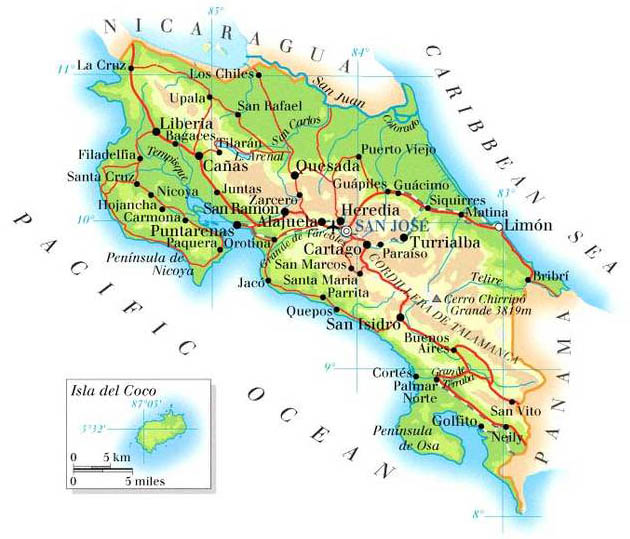
Coffee cultivation in Costa Rica began two hundred years ago, with the earliest growing areas on the slopes of the Poas and Barva volcanoes — what is known today as the Central Valley region. After years of development, Costa Rica now has eight main growing regions: Guanacastes, West Valley, Central Valley, Turrialba, Orosi, Tres Rios, Tarrazu and Brunca.
Production Statistics
According to ICO statistics, Costa Rica produces approximately 1.6 million bags of Arabica coffee each year. Although that is lower than Central American countries such as Guatemala and Honduras, the quality and price are significantly higher.
Seasonal Patterns and Processing
Costa Rica has two seasons through the year. The dry season runs from December to April each year and is also the coffee harvest time, while the rainy season runs from May to November. In recent years, micro-mills have been established one after another. Because their water consumption is only 5% of that of traditional washed processing plants and they do not need large water tanks or drying fields, the required investment is far smaller. The "honey-processed coffee" with low acidity, increased complexity and rich sweet aroma has become a sought-after commodity in the coffee industry in recent years, and standout producers have shone in major competitions, greatly enhancing the international reputation of their estates.
Sumava Estate
Sumava Estate in Costa Rica is a very young estate. Originally in the coffee trade business, Francisco Mena purchased the land and preserved most of the original forest, developing only a small portion as coffee cultivation area to maintain the estate's natural ecological balance.
Sumava Estate sits at approximately 1,670-1,790 meters, in another renowned Costa Rican growing region — the West Valley. The high temperature difference combined with fertile soil makes it very suitable for coffee cultivation.
Francisco Mena introduced the high-quality Villa Sarchi variety, which reached the top 13 in the Cup of Excellence. Villa Sarchi is a rare variety bred by crossing with Red Bourbon trees. It is resistant to strong winds, prefers high-altitude environments and possesses excellent acidity with various complex fruit aromas. It has high sweetness, a bright and delicate citrus acidity, and deeper raisin and nut aromas, showing considerable complexity and excellent balance.
Most of the estate is left as forest to maintain the natural environment, and great care goes into estate management. For broken wood, rotten wood and weeds, traditional burning methods are not used. Instead the wood is shredded into fragments and mixed with organic fertilizer to be used on the farm.
FrontStreet Coffee Recommendation
Costa Rica built its name on honey processing, and FrontStreet Coffee carries that style in a few distinct directions. FrontStreet Coffee's Costa Rica Blackberry is the black honey expression: almost none of the mucilage is removed, drying takes at least 2 weeks under cover, and the beds are turned at intervals so the sugars convert evenly, which is why black honey takes more care than any other honey style. Roasted light-medium, it releases a deep floral fragrance when ground and drinks with grape, berry and ripe blackberry.
FrontStreet Coffee's Mozart takes the idea further with a raisin honey process, a departure from the classical yellow, red and black honey styles. The fruit is dried before the honey steps continue, and the method retains the mucilage almost completely, which makes it harder to control than black honey. In the cup the two share a family resemblance: both the Blackberry and the Mozart bring the sweetness of raisin and blueberry together with osmanthus and rose. FrontStreet Coffee's Tarrazú completes the set, coming from Costa Rica's best-known growing region and showing the same clean, sweet character that made the country's honey processing famous.
Because these coffees are sweet rather than bitter, keep the brew gentle. FrontStreet Coffee's Costa Rican honey coffees suit pour-over, cold brew, americano and latte alike, and their sweetness still comes through clearly once milk is added. Brewed as a black pour-over, a light-medium roast with a moderately fine grind brings the fruit forward; if you want the dried-fruit and floral notes to lead, cold brew will push the sweetness higher still.
Important Notice :
FrontStreet Coffee is a long-established specialty coffee roaster in Guangzhou China, selling freshly roasted beans from its own farm in Yunnan as well as dozens of carefully selected single-origin beans from around the world for both pour-over and espresso. The products deliver consistently excellent quality and great value, with shipping within 24 hours. Guangzhou's FrontStreet Coffee shop is recommended by many coffee lovers, and the beans are now available online at the Tmall 。
FrontStreet Coffee has moved to a new address:
FrontStreet Coffee Address: 315,Donghua East Road,GuangZhou
Tel:020 38364473
 Scan and follow the En Gafei WeChat official account. Please indicate that the reprint comes from "En Gafei".