The Impact of Blooming and Its Duration on Coffee Brewing (Part 1)
We have run many experiments sporadically in our shop but had never systematically organized the results. As time passed, many of the theories and findings gradually faded from memory. FrontStreet Coffee's team therefore decided to carry out a rigorous experiment with minimal deviation and to organize and share the data and results, which reinforces our own understanding while inviting collective discussion.
Introduction to Blooming in Pour-Over Coffee
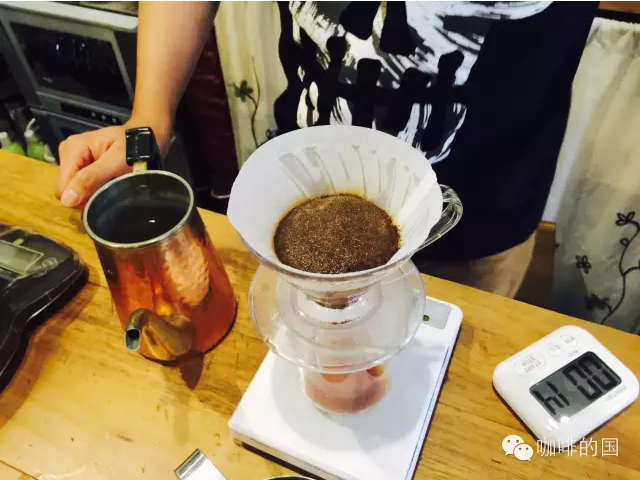
We decided to begin with blooming in pour-over extraction, the crucial opening of the pour-over process. How much does blooming actually affect brewing? What happens if we do not bloom? How do short and long bloom times reveal different flavor profiles? Beyond the sensory side, how do they affect extraction rates? This experiment addresses two main questions: first, the difference between blooming and not blooming; second, the differences between 20-second, 40-second and 60-second bloom times. We organize the results in a table below for clearer, more intuitive comparison.
Experimental Methodology
To minimize human factors, we first ran a preliminary experiment using the Clever Dripper, primarily to obtain basic data. We designated this as the first group of experiments.
Preparation for the First Experiment:
Before conducting formal pour-over experiments, we used the more consistent Clever Dripper for preliminary preparation to obtain reference data and make more accurate predictions for the formal results.
Experimental Procedure:
1. Weigh 12g of coffee beans and grind using a Fuji ghost-tooth grinder at setting 2.5#.
2. Prepare sufficient 92°C hot water.
3. We divided the experiment into four subgroups, A, B, C and D, using the same amount of water but different bloom times.
Group A: Add 12g of coffee grounds to the Clever Dripper, pour 216g of hot water all at once, cover with the lid and let stand, total brewing time 4min;
Group B: Add 12g of coffee grounds to the Clever Dripper, first pour 40g of hot water for a 20-second bloom, then continue pouring to 216g, cover with the lid and let stand, total brewing time 4min;
Group C: Add 12g of coffee grounds to the Clever Dripper, first pour 40g of hot water for a 40-second bloom, then continue pouring to 216g, cover with the lid and let stand, total brewing time 4min;
Group D: Add 12g of coffee grounds to the Clever Dripper, first pour 40g of hot water for a 60-second bloom, then continue pouring to 216g, cover with the lid and let stand, total brewing time 4min;
Experimental Results:
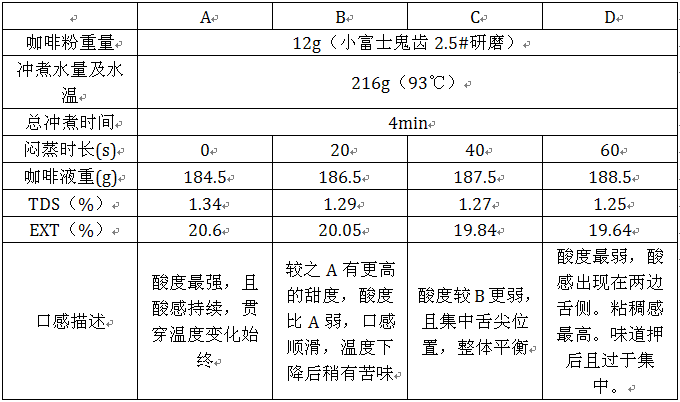
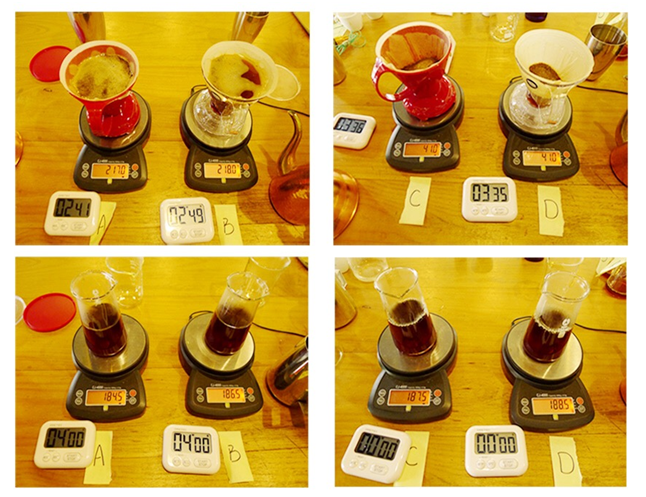
Results Analysis:
Based on the comprehensive results above, as bloom time increases:
● Coffee concentration and extraction rates decrease accordingly. The reasons:
1. When total brewing time is fixed at 4min, the actual extraction phase shortens as bloom time increases;
2. During blooming, the grounds in the dripper inevitably lose heat. The longer the bloom, the greater the temperature drop, and when water is added again the water temperature in the kettle also falls somewhat. Across the whole brew, the extraction temperatures in Groups A, B, C and D therefore decrease in sequence.
● As bloom time increases, acidity decreases while sweetness and viscosity increase. Overall flavor gradually shifts toward later notes and becomes more complex.
Conclusion and Future Plans
In this first experiment we used the Clever Dripper to practice our pre-designed theme and obtained some basic data on blooming. Everyone knows, however, that while the Clever Dripper reduces human factors and provides relatively objective data, it more closely resembles immersion brewing. In the next installment we will run pour-over experiments using a HARIO V60 dripper and organize, compare and review the data and sensory records exactly as we did here.
While we conduct experiments and derive theories, we will not offer any final conclusion or say which method is best, because different brewing methods showcase different flavor profiles. We hope everyone understands the data and uses it as a reference when brewing. Different beans, different techniques; different techniques, different flavors. Nothing in the coffee world is absolutely fixed, and that is where the joy lies.
If anyone has questions about the experiments during this period, we welcome the discussion, and we will edit and publish the next installment's data and text as soon as possible.
About FrontStreet Coffee
FrontStreet Coffee
Experiment conducted by: Xiao Hei
Data compiled by: Lao Lin
Text edited by: Jingjing
FrontStreet Coffee Recommendation
The results above show that bloom time mostly trades acidity for sweetness and body, which makes bean choice and dripper choice matter as much as technique. For a light, floral, high-acid coffee that rewards a bright bloom, FrontStreet Coffee's Yirgacheffe Gedingding is a classic starting point, with bright citrus, berry and floral notes and a green-tea-like sweetness, and its bright acidity tastes more like the natural sweet-sour balance of fruit than a sharp sourness. FrontStreet Coffee's Ethiopia Huakui is another light-roast favorite, with tropical aromas of strawberry, passion fruit, jackfruit and lychee, obvious sweetness and almost no bitterness.
If your taste runs to a balanced, low-acid cup, FrontStreet Coffee's medium-dark range including Lindong Mandheling and PWN Golden Mandheling responds well to a shorter bloom and slightly cooler water, preserving the thick body, caramel sweetness and chocolate and nut notes. For the pour-over experiment in the next installment, FrontStreet Coffee suggests a V60 dripper: its conical shape and 60-degree angle force water toward the center before it drips through, extending contact with the coffee bed and extracting aroma and flavor fully, and its single large hole keeps the flow rate under your own control.
For light roast coffees FrontStreet Coffee generally brews at 90-91°C with a medium grind at about 80% through a No. 20 standard sieve, 15g of coffee and a 1:15 ratio, wetting the bed with twice the coffee's weight in water and blooming for 30 seconds before continuing to 125g and then 225g. Adjust the bloom and temperature within those parameters to shift the cup the way this experiment describes.
Important Notice :
FrontStreet Coffee is a long-established specialty coffee roaster in Guangzhou China, selling freshly roasted beans from its own farm in Yunnan as well as dozens of carefully selected single-origin beans from around the world for both pour-over and espresso. The products deliver consistently excellent quality and great value, with shipping within 24 hours. Guangzhou's FrontStreet Coffee shop is recommended by many coffee lovers, and the beans are now available online at the Tmall 。
FrontStreet Coffee has moved to a new address:
FrontStreet Coffee Address: 315,Donghua East Road,GuangZhou
Tel:020 38364473
 Scan and follow the En Gafei WeChat official account. Please indicate that the reprint comes from "En Gafei".