Why is Mandheling Coffee Always Deep Roasted? What are the Characteristics of Mandheling, One of the World's Top Ten Famous Coffees?
Mandheling is one of the world's ten most famous coffees (whoever crowned it), and FrontStreet Coffee suspects that even if you've never actually tasted it, you've certainly heard of it — it's everywhere.
Have you noticed, though, that nearly every café that serves Mandheling serves it deep roasted? That puzzles a lot of people: in an era dominated by light roasts, why do some beans stubbornly stay dark? Lately our shop has been fielding the same question again and again: "Why is Mandheling always deep roasted? Is it because light-roasted Mandheling doesn't taste good?"

We're not exaggerating — lately roughly one customer in twenty has asked us something along these lines. But before answering, let's clear up the misconceptions hidden in the question. First: not all café Mandheling is deep roasted. Second: light-roasted Mandheling is not unpleasant. In fact, since so many customers have been asking, FrontStreet Coffee has roasted a special batch of light-roast Mandheling to share in the store.

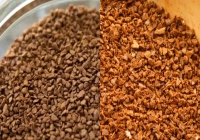
Traditional Mandheling is typically taken past second crack — that's the "charred" version on the right of the photo. Our light-roast batch was dropped one minute after first crack — the version on the left. Beyond the obvious color difference, note the size difference too: that's what different roast levels do to the same beans. Enough talk — let's brew a pot of the light roast and taste it. The parameters: 20g of coffee, 1:15 ratio, 92°C water, grind set to 10 on the Ek43, three-pour method on a V60.

Skipping the play-by-play, the total brew time was 2 minutes. The verdict: light-roasted Mandheling actually performs quite well — plum and kumquat sweet-tart notes with an oolong tea finish. The famously "muted" aroma of traditional Mandheling was nearly absent; neither impressive nor flawed. It lacks a standout character, but it's comfortably drinkable. Which brings us back to the question: if light-roasted Mandheling isn't bad, why do coffee shops insist on deep roasting?
Why Most Mandheling is Deep-Roasted?
Mandheling's bond with dark roasting is the product of decades of "cultivation" — history, regional character, and market demand all pushing the same direction. Dark roasting was the mainstream before the new millennium, and under very dark roast conditions, defect flavors are erased — but so is the coffee's own character. Florals and fruit get buried under roast smoke, regional distinctiveness fades, and coffees from different origins start tasting alike (the difference still exists, just faintly).

Mandheling is the exception. As FrontStreet Coffee has stressed in every introduction to it, Mandheling carries a unique "muted aroma" that sets it apart from ordinary dark-roasted coffee — and that's precisely what made it Japan's most popular coffee in the era before Blue Mountain ascended the throne.

The root of that aroma lies in Indonesia's climate. Where Mandheling grows, the air is extremely humid and daylight hours are short, so traditional natural or washed drying is a mold-risk gamble. Out of that constraint, locals developed their own "secret technique": wet hulling (giling basah). We've explained the full process in FrontStreet Coffee's article on Mandheling's muted aroma; here, we'll focus on what wet hulling does to the beans. It dries coffee fast — at the cost of a much higher chance of contamination.

Because the beans are stripped of every protective layer early — hulled from their parchment while still half-wet, then left fully "exposed" to sun and humid air — they get far more contact with dust and microorganisms. And since the hulling itself is rough, raw beans are easily cracked or wounded in the process, inviting more contamination. That's why Mandheling needs several rounds of hand sorting before export: there are simply too many defective beans to remove otherwise. (Which may also be why wet hulling never caught on elsewhere.)


But it's precisely this rough processing that creates Mandheling's signature flavor. Academic research suggests it's the early exposure to air during wet hulling — that controlled "contamination" — that produces the wild aroma of wood, herbs, and soil. And that aroma only truly opens up under deep roasting. (It's why we could barely detect it in our light-roast batch — though growing environment and variety play their parts too.) The deeper the roast, the more pronounced it becomes, giving Mandheling an expression no other coffee offers. Combine that with the heavy body a dark roast brings, and you get a profile tailor-made for Japanese tastes — hence its wild popularity in Japan before Blue Mountain took over.

After years of refinement in the Japanese market, deep-roasted Mandheling went global on the strength of that "intense" image. In a real sense, the image made the coffee famous — and without deep roasting, the image wouldn't exist. That's what welded Mandheling to dark roasting. Light-roasted Mandheling can be delicious, but it loses the signature and becomes just another origin, hard to pick out of a lineup. So even in today's light-roast era, most cafés keep their Mandheling dark, because customers have learned to expect the roast bitterness and the muted aroma that only a dark roast draws out. Put differently: without that cultural signature, would it still be Mandheling?
- END -
FrontStreet Coffee Recommendation
If this article has you craving a proper dark, wild cup, here are the Mandhelings we'd point you to:
FrontStreet PWN Golden Mandheling (Sumatra, wet-hulled, medium-dark roast) — The flagship of Indonesia's PWN company, built from beans of 18 mesh and larger, graded G1 with fewer than 3 defects per 300g sample and triple hand-sorting for exceptional cleanliness and sweetness. Expect roasted aromatics, a clean cup, and full, heavy body with herbal and dark chocolate depth — the natural choice for anyone who dislikes sour coffee.
FrontStreet Lintong Mandheling (Sumatra, medium-dark roast) — From the traditional Lintong region around Lake Toba: bold, spicy, and intense, with clove and woody aromatics, low acidity, and a strong, lasting, earthy sweetness. For drinkers who want the full, untamed Mandheling experience.
FrontStreet Classic Blend (Brazil + Mandheling) — Creamy nuttiness from Brazil topped up with medium-dark Mandheling for butter, roasted chestnut, and caramel notes, plus sandalwood, herbal, and spice complexity — with a touch of Robusta added for richer crema. Effortless for latte art and Dirty layering alike.
Important Notice :
FrontStreet Coffee is a long-established specialty coffee roaster in Guangzhou China, selling freshly roasted beans from its own farm in Yunnan as well as dozens of carefully selected single-origin beans from around the world for both pour-over and espresso. The products deliver consistently excellent quality and great value, with shipping within 24 hours. Guangzhou's FrontStreet Coffee shop is recommended by many coffee lovers, and the beans are now available online at the Tmall 。
FrontStreet Coffee has moved to a new address:
FrontStreet Coffee Address: 315,Donghua East Road,GuangZhou
Tel:020 38364473
 Scan and follow the En Gafei WeChat official account. Please indicate that the reprint comes from "En Gafei".

What's the Difference Between Iced Pour-Over, Cold Drip, and Cold Brew Coffee? How Long Can Cold Drip Coffee Last? How Long Does Cold Drip Coffee Take to Make?