What's the Difference Between Iced Pour-Over, Cold Drip, and Cold Brew Coffee? How Long Can Cold Drip Coffee Last? How Long Does Cold Drip Coffee Take to Make?
It's only early March, but FrontStreet Coffee can already feel the heat radiating off bicycle seats. No wonder the refreshing, thirst-quenching summer staple — iced coffee — is already a bestseller in our store. But "iced coffee" covers a lot of ground. Beyond iced Americanos and iced lattes (the espresso-based crowd), there are iced pour-over, iced drip, and cold brew.

With that many options, beginners often freeze up because they can't quite tell the three apart. So today, FrontStreet Coffee will walk through what each one is, what it does well, and how they differ.
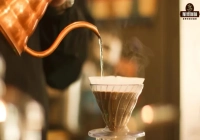
Iced Pour-Over Coffee
Most people already know this one, but for those who don't: think of it as hot pour-over, cooled with ice.
The trick is preventing melting ice from watering the coffee down. So we grind finer than usual and cut the water ratio, brewing a concentrate hotter and stronger than a normal pour-over. Then the ice does double duty — cooling the coffee and diluting the concentrate back to a balanced strength.

FrontStreet Coffee's own numbers: we normally brew pour-over with 15g of coffee. Hot, a light roast goes at an 80% pass-through rate on a #20 sieve with a 1:15 ratio; iced, we grind to 85% pass-through and use a coffee-to-water-to-ice ratio of 1:10:6. Everything else stays the same — 92°C water, a 2-minute extraction, three-stage pouring. Once brewed, the coffee gets shaken or stirred with the ice several times so it cools fast and the dilution lands exactly where we want it.

Compared with the other two, iced pour-over's great strength is variety. Because hot water does the heavy lifting of dissolving flavor and ice simply cools it, there's no 1–2 day lead time — it's made to order, and customers can pick whichever beans suit their mood that day.
Flavor-wise, since its concentration is lower than iced drip or cold brew, it drinks light and crisp — clean, expressive flavors with no heaviness.
Iced Drip Coffee
Iced drip is also a percolation method, like pour-over — but it drips ice water instead of hot water. Ice water extracts extremely slowly, and combined with the slow drip rhythm, a full batch takes several hours.

And you still can't drink it when the dripping stops: iced drip needs several hours of refrigeration to ferment. That fermentation develops richer aromas and a lovely texture — which is exactly why iced drip has to be made 1–2 days ahead.

FrontStreet Coffee's iced drip recipe: 60g of coffee, a 1:10 coffee-to-liquid ratio, and the same grind as our pour-over — 80% pass-through on a #20 sieve for light roasts. The ice-water reservoir is mixed 1:1, the throttle valve set to one drop every 2 seconds, and the whole extraction runs roughly 6–8 hours. Afterward the coffee goes into a sealed bottle and refrigerates for 12 hours before serving.

Of the three, iced drip delivers the most striking coffee flavors — fermented aromas, higher sweetness, a clean texture, and rich layering. Its downsides: the winey character can feel too strong for some palates, and you can't improvise a batch on the spot.
Cold Brew Coffee
Cold brew, like iced drip, extracts with cold water — but it's an immersion method, which makes it far simpler. Steep the grounds in water under refrigeration for a long time, then filter through filter paper for a clean, ready-to-drink coffee (owners of dedicated cold brew bottles can skip the filtering — at the cost of a fussier cleanup).

FrontStreet Coffee's cold brew: 50g of grounds, a 1:12 coffee-to-water ratio, and 8–12 hours of immersion. The method: combine the grounds and room-temperature water in a sealed bottle, stir, seal, refrigerate. The next day — 8 to 12 hours later — pull it out, filter, and the cold brew is ready.

Compared to the other two, cold brew has less dramatic layering but a thicker texture. Filtering can't remove every fine particle and every drop of oil, and what remains gives cold brew its fuller mouthfeel. And because immersion extracts so evenly, its sweetness stands out more than either of the others.
- END -
FrontStreet Coffee Recommendation
Each method flatters different beans. From our lineup, here are three that shine when the weather heats up:
FrontStreet Natural Hambela (Ethiopia, natural process) — Cold brewing amplifies florals and fruit while muting woody and roast notes, and this natural-process Yirgacheffe delivers magnolia, creamy strawberry, dried mango, guava, and black tea in abundance. A gorgeous cold brew or iced pour-over.
FrontStreet Kenya Cherry Tomato (Sithka, Kenya; SL28 & SL34, K72 double-washed, light roast) — Cherry tomato, pear, black plum, and dried dark plum acidity that low-temperature extraction shows off to the fullest: low bitterness, full juiciness, and wonderfully refreshing over ice, with a long fragrant finish.
FrontStreet Strawberry Candy Geisha Blend (Panama Geisha + Costa Rica honey process) — Rose and orange from the Geisha side meet grape, blueberry, and strawberry-gummy sweetness from the honey-processed side. As cold brew it's sweet-tart and lively — and with a little fermentation, it takes on a fruit-wine character that rivals the best iced drip.
Important Notice :
FrontStreet Coffee is a long-established specialty coffee roaster in Guangzhou China, selling freshly roasted beans from its own farm in Yunnan as well as dozens of carefully selected single-origin beans from around the world for both pour-over and espresso. The products deliver consistently excellent quality and great value, with shipping within 24 hours. Guangzhou's FrontStreet Coffee shop is recommended by many coffee lovers, and the beans are now available online at the Tmall 。
FrontStreet Coffee has moved to a new address:
FrontStreet Coffee Address: 315,Donghua East Road,GuangZhou
Tel:020 38364473
 Scan and follow the En Gafei WeChat official account. Please indicate that the reprint comes from "En Gafei".